10 Knowledge Management Best Practices for 2025
Imagine a workday where you never have to search for information again. No more digging through old documents, pinging colleagues for answers you know exist somewhere, or switching between five different apps to find a single piece of data. Instead, you just ask a question in Slack and get an instant, accurate answer. This isn't a future-state fantasy; it's the result of implementing effective knowledge management best practices.
This article moves beyond abstract theory to focus on the tangible transformation you'll see in your business: less friction, fewer interruptions, and more time for focused, high-impact work. The goal is to shift your team from a culture of constant searching to one of instant access, turning scattered conversations and siloed documents into a reliable, centralized source of truth that lives where your team already works. When knowledge flows freely, productivity isn't just improved; it's fundamentally changed. Your team can make smarter decisions faster, onboard new hires more efficiently, and solve customer problems with unprecedented speed.
We will explore 10 high-impact practices designed for immediate implementation. Each section provides concrete how-to steps, common pitfalls to avoid, and specific examples, including how to automate knowledge capture and retrieval directly within Slack using tools like an AI assistant. You'll learn not just what to do but exactly how to do it, empowering you to stop managing information and start using it to drive your business forward. This guide provides a clear roadmap to building a system where answers find you, creating a more efficient and less stressful work environment for everyone.
1. Document Management and Version Control
Effective document management is the bedrock of any successful knowledge management strategy. It’s a systematic approach to how your organization creates, organizes, stores, and maintains documents, ensuring everyone has access to the most current and accurate information. This practice eliminates the chaos of multiple file versions, lost data, and outdated instructions that slow teams down.
Proper version control is a critical component, tracking all revisions made to a document over its lifecycle. This creates a clear audit trail, allowing you to see who made changes, when, and why. The primary benefit is building a single source of truth; your team no longer wastes time hunting for the right version of a Q4 marketing plan or the latest engineering specs.
How to Implement This Practice
- Establish Clear Naming Conventions: Create a standardized, logical system for naming files and folders (e.g.,
ProjectName_DocumentType_YYYY-MM-DD_v1.0). Consistency is key. - Define a Centralized Folder Structure: Design a universal folder hierarchy that is intuitive for all teams. Platforms like Google Workspace or Microsoft SharePoint excel at creating these shared, accessible environments.
- Automate Version Control: Use tools that automatically save new versions instead of overwriting old ones. Confluence is excellent for technical documentation, while Box.com offers robust enterprise-level controls.
- Use Metadata and Tags: Implement a tagging system to make documents searchable by topic, project, or department, vastly improving discoverability.
- Set Access Permissions: Define clear roles and permissions to control who can view, edit, and approve documents, protecting sensitive information.
Key Insight: A strong document management system directly translates to less time spent searching and more time spent doing. When your team trusts that the information they find is the correct and most recent version, decision-making accelerates and costly errors are avoided. This is a foundational step in building a reliable knowledge base that empowers your entire organization.
2. Implement a Centralized Knowledge Management System (KMS)
A Knowledge Management System (KMS) is a dedicated software platform that serves as a single, centralized hub for capturing, organizing, storing, and distributing your organization's collective intelligence. It's the engine that powers your knowledge sharing culture, transforming scattered information from documents, emails, and conversations into a structured, searchable, and instantly accessible resource. This moves beyond simple document storage to create an active ecosystem for institutional learning and expertise.
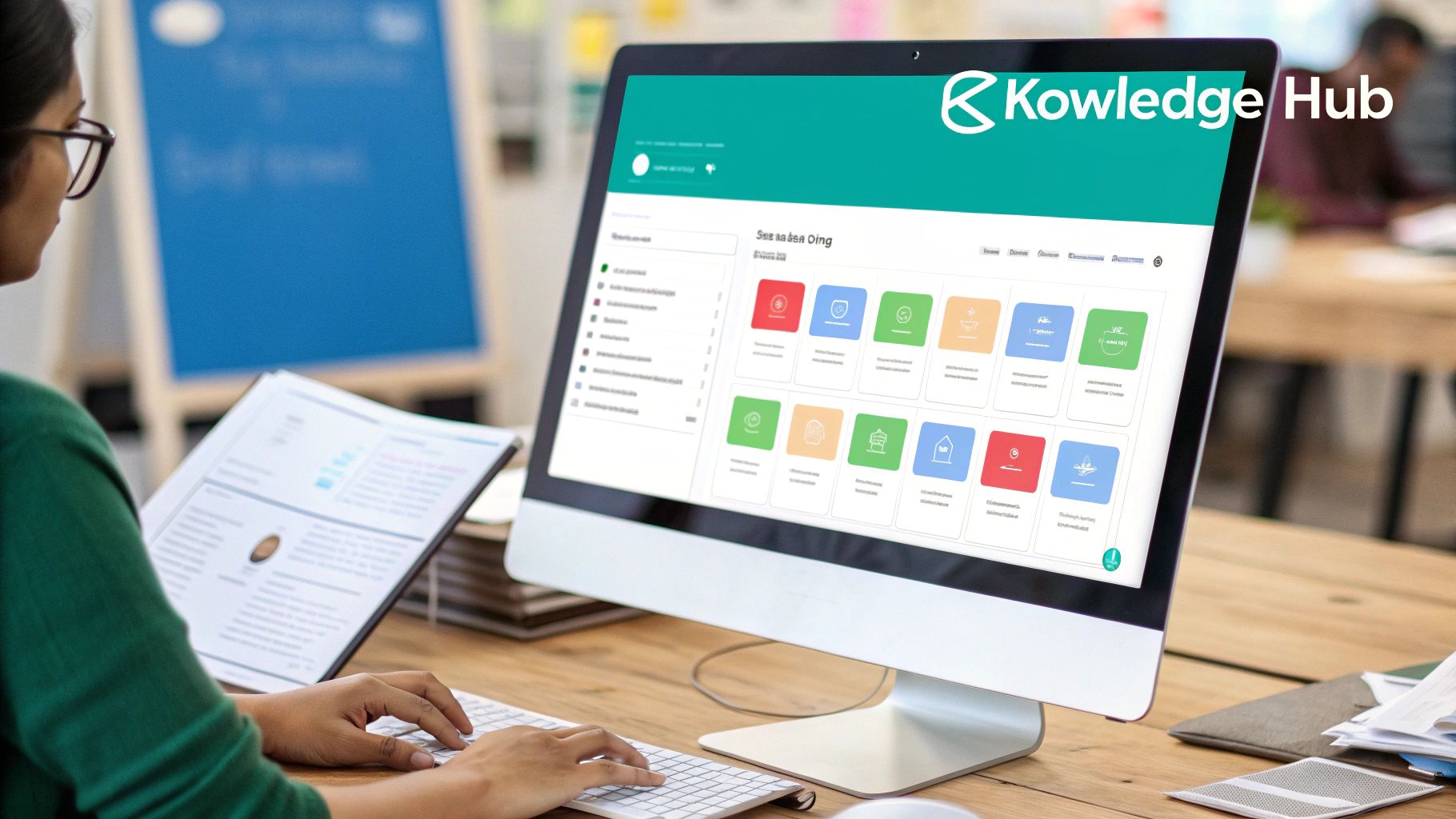
The primary goal of a KMS is to ensure that valuable knowledge doesn't leave with employees and that teams don't waste time reinventing the wheel. Instead of hunting through multiple drives or asking the same questions repeatedly, imagine your team getting instant answers directly within their workflow. This is a core component of modern knowledge management best practices, streamlining everything from employee onboarding to customer support.
How to Implement This Practice
- Start with a Pilot Program: Before a full-scale rollout, test the KMS with a single department or project team. Use their feedback to refine your strategy and demonstrate value.
- Secure Executive Sponsorship: Gain buy-in from leadership to champion the initiative. Their support is crucial for driving adoption and securing necessary resources.
- Integrate with Existing Workflows: Choose a system that integrates seamlessly with the tools your team already uses, like Slack. Platforms such as Guru or Notion are excellent starting points, but for teams living in Slack, tools like SAI can automate knowledge capture and retrieval without anyone having to switch context. Learn more about SAI's automated knowledge solutions.
- Establish Content Governance: Create a dedicated team or assign
knowledge champions
responsible for creating, curating, and updating content to ensure it remains accurate and relevant. - Measure Usage and Impact: Track key metrics like search query success rates, content creation, and ticket deflection. Use this data to measure ROI and identify areas for improvement.
Key Insight: The right KMS transforms knowledge from a passive asset stored in folders into an active, on-demand service. When your team can instantly access verified answers and best practices without leaving their primary communication tools, you eliminate information silos, boost productivity, and empower everyone to make smarter, faster decisions. It shifts the focus from
Where can I find this?toWhat can I achieve with this information?
3. Foster Communities of Practice (CoPs)
Beyond formal documentation, knowledge thrives in the informal connections between people. Communities of Practice (CoPs) formalize this process by creating dedicated groups for employees who share a common profession, passion, or set of challenges. These communities act as living networks where members can solve problems, share best practices, and incubate new ideas through peer-to-peer collaboration and shared experience.
This approach transforms tacit knowledge, the know-how
that lives inside experts' heads, into collective wisdom. Instead of one engineer solving a complex bug alone, a CoP allows them to tap into the collective experience of dozens of peers, dramatically accelerating innovation and problem-solving. Companies like IBM and the World Bank have used CoPs for decades to connect global experts and drive a culture of continuous learning.

How to Implement This Practice
- Appoint Experienced Facilitators: Designate a respected community sponsor or facilitator to guide conversations, schedule events, and keep the group focused on its shared goals.
- Establish a Regular Cadence: Create a consistent rhythm for meetings, workshops, or
ask me anything
sessions. This builds momentum and keeps members engaged. - Use Collaborative Platforms: Leverage tools like dedicated Slack channels or Microsoft Teams spaces to bridge geographic divides and provide a central hub for discussions and resource sharing.
- Recognize and Reward Contributors: Publicly acknowledge members who actively share their expertise, answer questions, and help others. This encourages a culture of participation.
- Link CoPs to Business Goals: Ensure the community’s work aligns with broader organizational objectives, demonstrating its value and securing ongoing support from leadership. Discover how to enhance these groups by improving team connections within your digital workspace.
Key Insight: Communities of Practice are essential for scaling expertise and fostering innovation organically. They create a powerful support system where employees feel empowered to ask questions, share learnings, and grow professionally. By investing in these communities, you are not just organizing information; you are nurturing the human connections that are fundamental to effective knowledge management best practices and building a resilient, knowledgeable workforce.
4. Mentorship and Knowledge Transfer Programs
Not all organizational knowledge lives in a document or database; much of it is tacit, existing only in the minds and experiences of your most seasoned employees. Mentorship and knowledge transfer programs are a strategic way to capture and pass on this invaluable wisdom, pairing experienced staff with junior members to facilitate direct skill development, institutional learning, and professional growth. This practice systematically transfers expertise that might otherwise be lost when an employee leaves or retires.
These programs formalize the process of sharing practical insights, from navigating complex client relationships to troubleshooting legacy systems. By creating structured relationships, organizations like Google, Deloitte, and GE ensure that critical knowledge is not only retained but also enriched with new perspectives. This is one of the most effective knowledge management best practices for cultivating a culture of continuous learning and preventing knowledge silos from forming around key individuals.
How to Implement This Practice
- Match Mentors and Mentees Strategically: Go beyond department lines. Pair individuals based on specific skills, career goals, and even personality traits to foster a strong, productive relationship.
- Create Clear Expectations and Timelines: Define the program’s purpose, duration, and expected commitment from both parties. Provide a structured framework with milestones to guide discussions and track progress.
- Provide Mentor Training: Equip your mentors with essential coaching and feedback skills. Effective mentoring is a skill in itself, and training ensures a positive experience for everyone involved.
- Guide Discussions with a Curriculum: Offer conversation starters, topic suggestions, and skill-building exercises to prevent meetings from becoming unstructured chats.
- Track Progress and Gather Feedback: Use regular check-ins and surveys to assess the program's effectiveness and make adjustments. Publicly recognizing successful mentorships can also encourage broader participation.
Key Insight: Mentorship programs are a powerful tool for transferring the “unwritten rules” of your organization-the nuanced, experience-based knowledge that is impossible to document. This direct human connection not only preserves critical expertise but also boosts employee engagement, accelerates career development, and builds a more resilient, interconnected workforce.
5. After-Action Reviews (AARs) and Retrospectives
One of the most powerful knowledge management best practices is converting direct experience into institutional wisdom. After-Action Reviews (AARs) and retrospectives are structured processes for teams to systematically deconstruct a completed project, event, or sprint. This practice moves beyond simple project wrap-ups by focusing on capturing lessons learned, both positive and negative, to drive future improvement.
Originally popularized by the U.S. Army and widely adopted in Agile methodologies, this approach encourages an open, blame-free discussion about what happened, why it happened, and how to improve. The goal is to create a cycle of continuous learning, ensuring that mistakes are not repeated and successes are replicated across the organization. This turns project outcomes into tangible, actionable knowledge that benefits everyone.
How to Implement This Practice
- Standardize with Templates: Create a consistent AAR or retrospective template that guides the conversation. Key questions should include: What was the intended outcome? What actually happened? What went well and why? What could be improved?
- Facilitate Neutral Discussions: Appoint a neutral facilitator who can guide the discussion, ensure all voices are heard, and maintain a focus on process, not people. This fosters psychological safety.
- Hold Sessions Promptly: Conduct the review as soon as possible after the project or event concludes, while memories are still fresh and details are sharp.
- Document and Centralize Learnings: Capture the key findings, insights, and action items in a centralized, searchable knowledge base like Confluence or a dedicated Slack channel. Tag the notes with relevant project names or keywords.
- Assign Actionable Follow-Ups: Every identified improvement should be assigned a clear owner and a deadline. This critical step ensures that insights translate into concrete changes.
Key Insight: AARs and retrospectives close the learning loop. They prevent valuable
tribal knowledgefrom walking out the door when a project ends or an employee leaves. By systematically capturing these insights, you build a resilient, self-improving organization that learns from every experience, accelerating growth and preventing the recurrence of costly errors.
6. Wikis and Collaborative Platforms
Wikis and collaborative platforms are dynamic, web-based systems that empower employees to collectively create, edit, and manage knowledge. These tools transform static documentation into a living, breathing knowledge base where information is continuously refined and updated by the people who use it every day. This approach democratizes knowledge creation, breaking down information silos and ensuring that critical insights aren't locked away with a single expert.
Instead of hunting through outdated shared drives for the latest project brief or sales process, teams can turn to a central, user-maintained hub. Platforms like Confluence and Notion have become essential tools for this practice, creating an interactive network of interconnected information that grows with your organization. This is a core component of modern knowledge management best practices.

How to Implement This Practice
- Establish Clear Governance: Create style guides and templates to ensure consistency across all entries. Define who can create, edit, and approve pages to maintain quality.
- Designate Wiki Champions: Appoint subject matter experts or enthusiastic team members to own specific sections, encourage contributions, and keep content fresh.
- Create Interlinked Knowledge Networks: Actively link related pages, articles, and documents. This creates an intuitive web of information that helps users discover relevant content contextually.
- Prioritize Searchability: Use clear titles, relevant keywords, and tags on every page. This makes it easy for team members to find exactly what they need without assistance.
- Conduct Regular Audits: Schedule periodic reviews to archive outdated pages, merge duplicate content, and update information that is no longer accurate.
Key Insight: A well-maintained wiki becomes the organization's collective brain. It shifts the burden of knowledge from individuals to the entire team, ensuring that valuable information is preserved and accessible even as roles change. By fostering a culture of collaborative documentation, you build a resilient and self-sustaining knowledge ecosystem that accelerates onboarding and simplifies daily work.
7. Expert Directories and Skill Mapping
Expert directories are internal systems that catalog employee expertise, skills, and project experience, making it simple to find the right person for a specific question. Instead of broadcasting a query in a public channel and hoping the right expert sees it, skill mapping creates a searchable, dynamic Yellow Pages
of your organization's talent. This practice transforms knowledge discovery from a game of chance into a precise, efficient process.
The core function is to connect question-havers with answer-havers instantly. When a complex sales question arises, a junior developer is stuck on a coding problem, or a marketer needs a legal review, an expert directory immediately points them to the right colleague. This dramatically reduces resolution time and prevents the same questions from being asked repeatedly, fostering one of the most effective knowledge management best practices: leveraging human expertise directly.
How to Implement This Practice
- Automate Profile Creation: Integrate with HRIS platforms (like Workday or BambooHR) and project management tools (like Jira) to automatically pull data on roles, completed projects, and certifications.
- Encourage Self-Reporting: Allow employees to update their own profiles with specific skills, language proficiencies, and areas of interest. Platforms like Microsoft Viva Topics can even suggest expertise based on an individual's work in Microsoft 365.
- Include Project History: Don't just list skills; showcase them. Link profiles to specific projects or documents they authored to provide concrete evidence of their expertise.
- Integrate with Communication Tools: Connect the directory to your primary collaboration hub. For instance, a Slack integration could allow a user to type
/who-knows pythonand get a list of relevant experts they can message directly. - Define Proficiency Levels: Use a standardized scale (e.g., Novice, Intermediate, Expert) to help people find the appropriate level of support for their needs.
- Protect Expert Time: Implement a system to manage how often experts are contacted to prevent burnout and ensure their primary responsibilities don't suffer.
Key Insight: Your most valuable knowledge isn't always in a document; it's often in the minds of your people. An expert directory bridges the gap between tacit and explicit knowledge, ensuring that critical, unwritten expertise is accessible across the entire organization. It democratizes access to knowledge and fosters a culture of collaborative problem-solving.
8. Content Curation and Information Architecture
Simply having a lot of information isn't useful; making that information findable is what creates value. This is where content curation and information architecture (IA) become essential knowledge management best practices. IA is the science of organizing, structuring, and labeling content effectively, while curation is the process of selecting and maintaining the most relevant and high-quality information within that structure.
This strategic approach transforms a chaotic data dump
into a logical, intuitive library where employees can quickly find what they need. A well-designed IA ensures that knowledge is accessible and understandable, preventing the frustration of searching through endless folders or outdated pages. It’s the difference between a cluttered attic and a well-organized library, where every piece of information has a designated, logical place.
How to Implement This Practice
- Start with User Research: Understand how your team members search for information. Use techniques like interviews and card sorting exercises to map their mental models and build a structure that feels natural to them.
- Create Clear Labeling Conventions: Develop a consistent and predictable vocabulary for categories, tags, and navigation menus. Avoid jargon and use terms your employees actually use.
- Establish a Taxonomy and Metadata Strategy: A formal taxonomy provides a hierarchical classification system, while metadata (tags like
ProjectName,Team, orStatus) makes content highly discoverable through filters and search. - Design for Scalability: Build your information architecture with future growth in mind. Anticipate new types of content and departments to ensure the structure remains logical and doesn't collapse under its own weight.
- Document and Maintain the Rationale: Keep a record of why specific architectural decisions were made. This documentation is invaluable for onboarding new team members and for making future adjustments. Learn more about how a well-structured information architecture powers modern knowledge management and enables instant answers.
Key Insight: Excellent information architecture is invisible to the user. When done right, finding information feels effortless and intuitive. This practice directly reduces
search frictionand cognitive load, empowering your team to spend less time looking for answers and more time applying knowledge to solve real business problems, driving efficiency and innovation.
9. Learning Management Systems (LMS) and Training Integration
A passive knowledge base is only half the solution; proactive learning and development are essential for turning information into applied skill. Integrating a Learning Management System (LMS) formalizes the knowledge transfer process, creating structured pathways for employee training, onboarding, and continuous upskilling. This practice transforms documented knowledge into trackable, measurable learning experiences that directly contribute to employee growth and organizational capability.
An LMS serves as the central hub for all training materials, from compliance modules to advanced skill courses. By connecting it to your broader knowledge management ecosystem, you ensure that formal training is always based on the most current, single-source-of-truth information. For instance, updates to a product’s technical specifications in your knowledge base can automatically trigger a microlearning module in the LMS for the sales team, ensuring they are always equipped with the latest data.
How to Implement This Practice
- Create Personalized Learning Paths: Use the LMS to design role-specific learning journeys. A new marketing hire might have a path that includes brand guidelines, SEO best practices, and campaign management protocols, all pulled from your central knowledge repository.
- Embrace Microlearning: Break down complex topics into short, digestible video or text-based modules. This approach, easily managed in platforms like Docebo or Udemy for Business, respects employees' time and boosts knowledge retention.
- Balance Asynchronous and Synchronous Learning: Offer a mix of self-paced courses (asynchronous) and live, instructor-led webinars or workshops (synchronous) to cater to different learning styles and needs.
- Integrate with Your Workflow: Connect your LMS to your primary communication tools. For example, a Slack integration can send notifications about new courses or reminders for pending modules, keeping learning top-of-mind.
- Measure Impact on Business Outcomes: Go beyond completion rates. Track how training impacts performance metrics, such as a decrease in support tickets after a product training module or an increase in sales close rates post-negotiation training.
Key Insight: Integrating an LMS with your knowledge base creates a powerful feedback loop. It ensures that training is built on validated, current information while simultaneously identifying knowledge gaps through course performance and feedback. This synergy between static knowledge and active learning is a cornerstone of a mature knowledge management best practices strategy, turning your organization into a true learning ecosystem.
10. Knowledge Capture and Storytelling
Facts and figures are essential, but true understanding and retention often come from context and connection. Knowledge capture through storytelling transforms dry data into memorable, impactful narratives. This practice involves systematically documenting and sharing organizational knowledge through case studies, success stories, and expert interviews, recognizing that humans are wired to learn from stories, not just raw information.
This approach is powerful for transferring tacit knowledge, the unspoken expertise that experienced employees hold. By framing lessons learned, project successes, and even failures within a narrative structure, you make complex ideas more accessible and relatable. Think of Southwest Airlines' famous culture stories or Apple's innovation narratives; they communicate core values and strategic principles far more effectively than any policy manual could.
How to Implement This Practice
- Interview Subject Matter Experts: Conduct structured interviews, especially with retiring or departing employees, to capture their invaluable institutional knowledge. Use video to preserve the nuance, tone, and emotion of their experiences.
- Create Storytelling Templates: Develop standardized templates for case studies or project post-mortems. These templates can guide team members to consistently capture key elements: the challenge, the actions taken, the outcome, and the lessons learned.
- Link Stories to Business Outcomes: Ensure every story is tied to a tangible business result or key performance indicator. This demonstrates the practical value of the knowledge being shared and reinforces strategic priorities.
- Make Stories Discoverable: Use a robust tagging system to categorize stories by department, project, skill, or business challenge. This makes your story archive a searchable, living resource rather than a static library.
- Share Through Multiple Channels: Distribute stories through internal newsletters, team meetings, and dedicated Slack channels. This ensures the knowledge reaches a wide audience and becomes part of the daily conversation.
Key Insight: Storytelling is a high-impact knowledge management best practice because it embeds critical knowledge in a format that is emotionally resonant and easy to recall. It moves beyond simply documenting what happened to explaining why it matters. By building a culture of storytelling, you create a powerful mechanism for transferring wisdom, reinforcing company values, and inspiring future innovation.
Top 10 Knowledge Management Practices Comparison
| Item | Implementation Complexity 🔄 | Resource Requirements ⚡ | Expected Outcomes 📊 | Ideal Use Cases 💡 | Key Advantages ⭐ |
|---|---|---|---|---|---|
| Document Management and Version Control | Medium — setup, governance required | Low–Medium — storage, admin, training | Improved accuracy; audit trails | Regulated orgs; document-heavy teams | Version history, access control, compliance |
| Knowledge Management Systems (KMS) | High — integration & change management | High — licenses, curation teams | Faster decisions; reduced search time | Large enterprises; cross-functional scaling | Centralized search, analytics, scalability |
| Communities of Practice (CoPs) | Low–Medium — facilitation and coordination | Low — time, basic platforms, facilitators | Increased informal learning; innovation | Skill development; peer knowledge sharing | Low cost, engagement, peer-to-peer learning |
| Mentorship and Knowledge Transfer Programs | Medium — program design and matching | Medium — mentor time, coordination | Faster onboarding; leadership development | Succession planning; onboarding ramps | Transfers tacit knowledge; improves retention |
| After-Action Reviews (AARs) and Retrospectives | Low–Medium — facilitation skills needed | Low — meeting time, documentation | Rapid lessons learned; process improvements | Projects, incidents, agile sprints | Low cost, continuous improvement, practical insights |
| Wikis and Collaborative Platforms | Low–Medium — governance for structure | Low — platform hosting, editors, training | Broad participation; living documentation | Remote teams; evolving knowledge bases | Easy editing, transparent history, cost-effective |
| Expert Directories and Skill Mapping | Medium — data collection and tagging | Medium — integrations, maintenance | Faster expert discovery; better staffing | Project staffing; internal consulting | Reveals skill gaps; enables quick connections |
| Content Curation and Information Architecture | High — taxonomy and UX design | Medium–High — IA experts, analytics | Improved discoverability; lower cognitive load | Large content repositories; search-driven orgs | Scalable structure, better UX, governance |
| Learning Management Systems (LMS) and Training Integration | High — content dev & system integration | High — platform costs, instructional design | Consistent training; compliance tracking | Mandatory training; large-scale upskilling | Scalable learning, measurable outcomes, certifications |
| Knowledge Capture and Storytelling | Medium — interviews and multimedia editing | Medium — interviewers, recording tools | Better retention; context-rich knowledge | Preserving tacit knowledge; culture transfer | Engaging narratives, preserves nuance and context |
Make Your Knowledge Work for You, Not the Other Way Around
You've just explored ten foundational knowledge management best practices, from establishing robust document version control to creating dynamic expert directories. We’ve covered everything from After-Action Reviews to Communities of Practice, each one a powerful lever for transforming how your organization captures, shares, and leverages its collective intelligence. Implementing even a few of these strategies will mark a significant step forward, reducing redundant work and empowering your teams.
However, the true goal isn't just to implement a system; it's to create a new reality for your team. Imagine a workday where no one has to say, Let me find that for you,
or spend twenty minutes digging through old documents and shared drives. Picture a world where new hires get up to speed in days, not weeks, because the answers to their questions are instantly available. This isn't about adding another tool to your stack; it's about fundamentally changing the flow of work.
From Information Chaos to Instant Clarity
The common thread across all these best practices is the reduction of friction. Each one aims to close the gap between having a question and finding a verified answer. The challenge, as many teams discover, is the immense manual effort required to maintain these systems. Wikis become outdated, documents get lost, and institutional knowledge remains locked in private conversations.
This is where the paradigm shifts. The future of effective knowledge management isn't about meticulously curating a knowledge base by hand. It's about automating the capture of knowledge at its source: the daily conversations where problems are solved and decisions are made.
The ultimate goal is to make accessing knowledge as natural and effortless as asking a question. Your team shouldn't have to break their workflow to consult a separate system. The answers should come to them, right where they're already working.
Your Actionable Path Forward
Moving from theory to practice can feel daunting, but the journey starts with a single step. Don't try to boil the ocean. Instead, focus on the highest-impact, lowest-effort changes you can make today.
- Start with One Channel: Identify a high-traffic Slack channel where repetitive questions are common, like
#dev-help,#support-escalations, or#it-requests. This is your pilot area. - Automate Capture: The most significant bottleneck in any knowledge management strategy is the manual process of documenting information. By using a tool that learns from conversations, you bypass this entirely. Every question answered in that channel becomes a permanent, searchable asset without anyone lifting a finger.
- Measure the Impact: Track the reduction in repeat questions and the time saved. When your team sees that they can get instant answers without interrupting a senior team member, the value becomes undeniable.
Embracing these modern knowledge management best practices is about giving your team its most valuable resource back: time. It’s about empowering them to focus on innovation, problem-solving, and driving the business forward, rather than on the repetitive, frustrating hunt for information. You can create an environment where collective knowledge truly works for everyone, not the other way around.
Ready to stop the endless search and transform your Slack channels into a single source of truth? SAI learns from your team's conversations to build a self-maintaining knowledge base, giving everyone instant answers right where they work. Add SAI to a Slack channel for free today and see the transformation firsthand.
Article created using Outrank