What Is a Knowledge Management System?
Let's be honest. Every company has a brain
—a messy, scattered collection of expertise, processes, and past decisions. A knowledge management system (KMS) is simply a way to organize that brain. Think of it less like a dusty old library and more like an intelligent assistant that captures your team's collective wisdom and serves it up the moment it's needed.
It's the cure for information chaos, turning frantic searching into a smooth, effortless flow of answers.
Imagine a Workday With Zero Searching
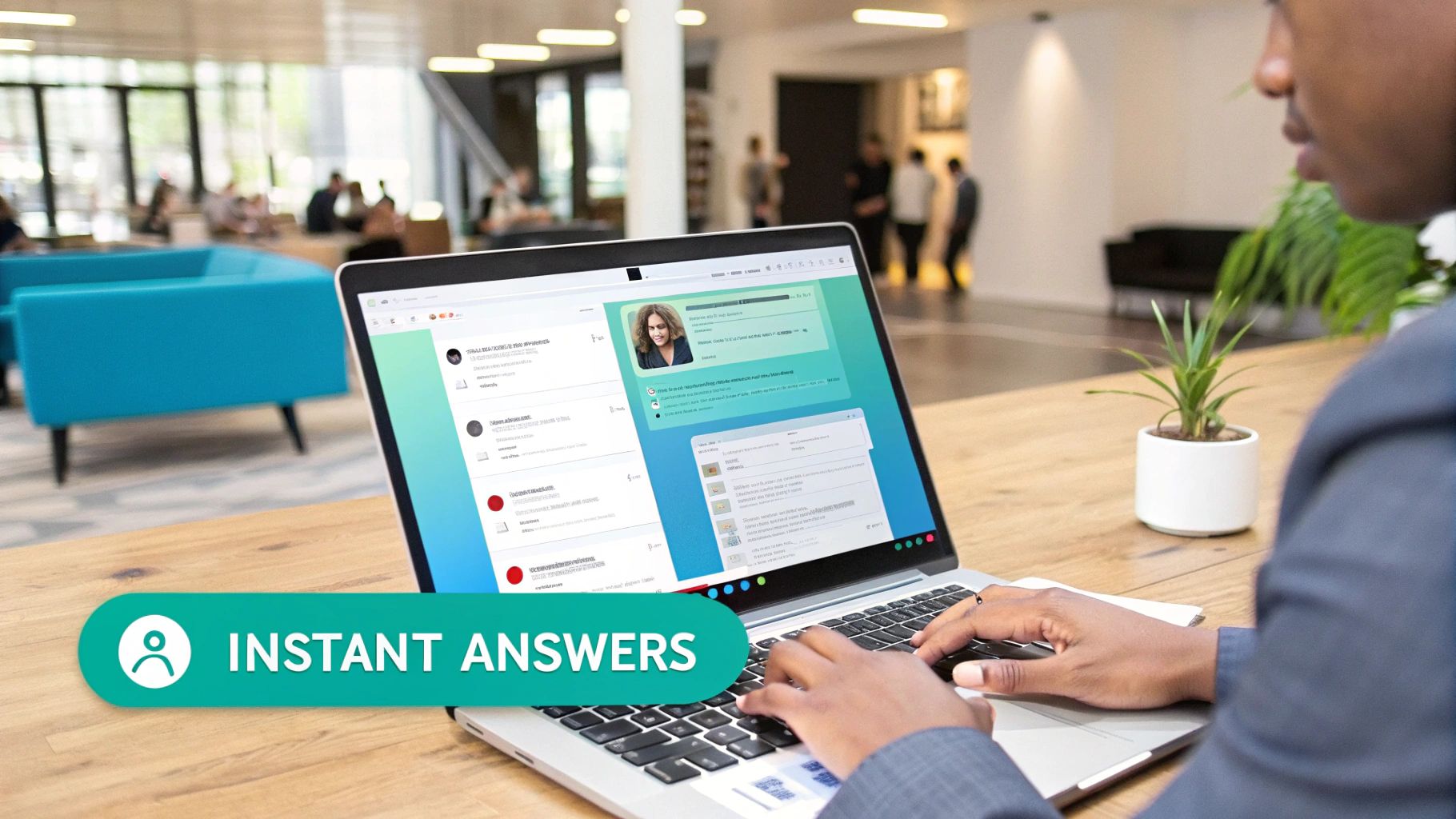
Take a second and picture your team’s typical day. How many hours evaporate while people hunt for that one specific file in a shared drive, scroll endlessly through old Slack channels, or try to decipher an outdated wiki page? The cost is staggering. Professionals often waste up to five hours every day just looking for the information they need to do their jobs. It’s a silent killer of productivity.
Now, what if all that friction just disappeared?
Imagine a day where your team never has to open another resource. No more digging through drives, no more searching in multiple places. Instead, you just ask a question right in Slack and get an instant, correct response. No more shoulder-tapping colleagues, no more waiting for someone in another time zone to log on, and definitely no more juggling a dozen browser tabs. This isn't a far-off dream; it's what a modern Knowledge Management System (KMS) makes possible.
The Shift from Hunting to Asking
At its heart, a KMS fundamentally transforms how your team gets information. It’s a deliberate move away from frustrating, manual searches and toward a simple, conversational experience. This is about more than just saving a few minutes here and there; it’s about giving your team back their most valuable assets: time and focus.
With an AI assistant like SAI integrated into Slack, your team can:
- Get Instant Answers: Forget searching. Just ask. Questions like,
What’s our Q4 marketing budget?
orWhere’s the latest project proposal?
get answered on the spot. - Stop Answering the Same Questions: The system learns from every question, so common queries are handled automatically. This frees up your subject matter experts for work that actually moves the needle.
- Tap into the Company Brain: Every documented process, old project detail, and key decision becomes part of a living, breathing knowledge base that anyone can access, right from Slack.
Ultimately, a knowledge management system provides a single source of truth that works where your team already does. It turns scattered, disorganized data into a reliable, intelligent resource that helps everyone make smarter decisions, faster.
Let’s be honest, the constant search for information isn't just a minor annoyance—it's a silent killer of productivity. It’s the drag chute on your entire business.
Every minute someone on your team spends digging through old Slack threads, hunting in a labyrinth of shared drives, or tapping a colleague on the shoulder for a link is a minute they aren’t doing their actual job. We're not just talking about lost time here. We're talking about lost momentum, mounting frustration, and a slow drain on your company's energy.
Picture a typical day for someone on your team—we’ll call her Sarah. Her morning kicks off with a customer asking about a new feature. She dives into Slack, spending the next 20 minutes searching for the latest talking points from the product team, only to find three conflicting versions. Later, she needs a specific logo for a presentation and has to message three different people before someone finally points her to the right folder. Each hunt is a hard context switch, shattering her focus.
The Ripple Effect of Wasted Time
This daily scramble adds up, and its downstream effects can stall growth and sink your bottom line. It's not just the hours lost to searching—which studies suggest can eat up as much as 25% of an employee's workday—but the ripple effects that cascade from there.
Without a single source of truth, teams unknowingly do work that’s already been done. They give inconsistent answers to customers. They struggle to make informed decisions quickly. The entire organization just moves slower, held back by this invisible friction.
This disorganization is especially brutal for new hires. Think about it: a slow, frustrating onboarding process where newcomers feel like they have to constantly ask for basic information leaves them feeling unsupported. It massively extends their time-to-productivity, and they can’t start adding real value if the foundational knowledge they need is scattered to the winds.
Spotting the Symptoms in Your Own Team
If Sarah's day sounds painfully familiar, you're almost certainly paying the price for disorganized knowledge. The symptoms are glaringly obvious once you know what to look for:
- Deja Vu Work: Teams rebuild processes or create content that already exists somewhere else, all because they couldn't find the original. Sound familiar?
- Inconsistent Customer Support: Customers get different answers to the same question depending on who they talk to, which slowly chips away at their trust.
- Painfully Slow Onboarding: New employees take weeks—sometimes months—to get up to speed, constantly interrupting senior staff for information that should be at their fingertips.
- Decision Paralysis: Critical projects get delayed while everyone waits for someone to track down the data needed to move forward.
These hidden costs pile up, creating a workplace that feels defined by inefficiency and roadblocks. When you see it this way, the need for a central, easy-to-access knowledge hub isn't just a nice-to-have; it's an undeniable business imperative.
How a Modern KMS Actually Works
Forget about those dusty digital libraries or clunky software that no one on the team ever bothers to use. A modern knowledge management system isn't just another tool to learn; it's an intelligent engine humming quietly in the background. Its entire job is to turn your team's scattered, chaotic information into instant, reliable answers.
The goal is wonderfully simple: make finding information as easy as asking a colleague a question. This isn’t about manual filing or coming up with a perfect tagging system. Instead, the focus is on a continuous cycle of capturing your team's collective wisdom, organizing it intelligently, and delivering it right when it's needed most—directly in Slack.
From Chaos to Captured Knowledge
The first, crucial step is Knowledge Capture. This is all about getting information into the system. In the past, this was a massive headache. It meant someone had to manually upload documents or spend hours writing wiki entries—a chore that, let's be honest, almost never got done consistently.
Today, a modern KMS—especially one that lives inside Slack—does this work for you. It learns from the conversations your team is already having every day. Every question asked and answered in a channel, every document shared, and every project decision becomes a breadcrumb of knowledge the system automatically picks up, without anyone lifting a finger.
Making Information Effortlessly Findable
Next up is Organization. This is where the magic happens, turning a messy pile of data into a searchable goldmine. Instead of forcing you to create rigid folder structures or guess the exact keywords someone used, AI-driven systems analyze the content to understand its actual meaning and context.
It's like having a super-smart librarian who has read every single document and conversation, then neatly organized it all based on topics and concepts. So when you ask, What are our refund policies for enterprise clients?
the system understands the intent behind your question and finds the answer, even if the original doc used slightly different wording. It completely eliminates the frustrating guesswork.
The infographic below paints a clear picture of what happens without this level of organization: a cascade of wasted time, duplicated work, and painfully slow onboarding.
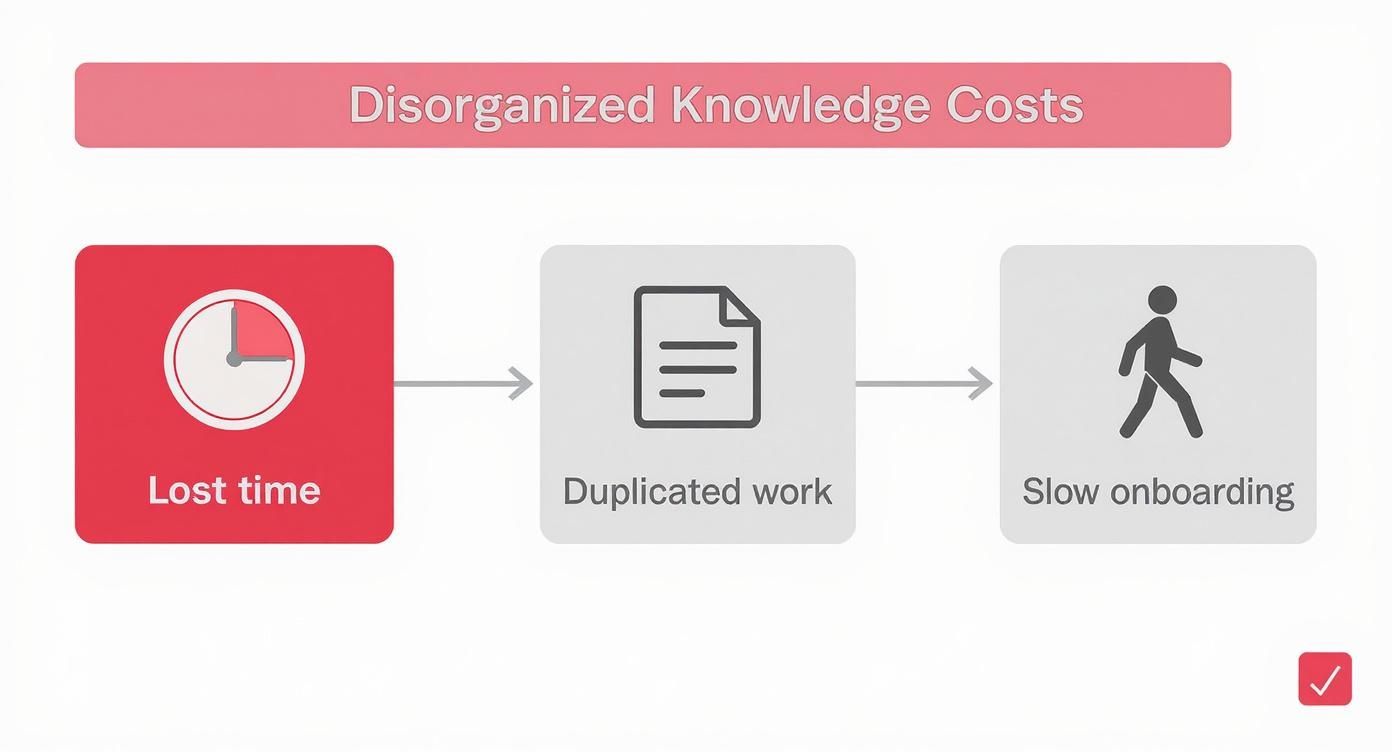
As you can see, a simple failure to organize knowledge creates a domino effect of inefficiency that ripples through the entire company.
Instant Answers, Right Where You Work
Finally, we get to Retrieval, and this is where you'll feel the difference immediately. All that perfectly captured and organized knowledge is useless if it’s locked away somewhere. A modern KMS brings the answers directly to you, right inside the tools you already live in, like Slack.
You never have to leave your workflow. You just ask your question, and the AI assistant delivers a precise, sourced answer in seconds. It’s a seamless experience that makes your company’s entire collective brain available on demand.
The massive business value here is undeniable. The global knowledge management market was valued at around USD 773.6 billion in 2024 and is projected to skyrocket to USD 2.1 trillion by 2030. This isn't just hype; it's a clear signal that companies see this as absolutely critical to their operations. You can dig deeper into knowledge management trends to see just how heavily businesses are investing in getting this right.
Bring Your Team’s Knowledge to Life, Right Inside Slack

This is where the idea of a knowledge management system
stops being a buzzword and starts changing how your team actually works. It's the point where theory becomes the reason your day feels less like a scavenger hunt and more like a smooth, productive workflow. To really get it, let's paint a picture of a typical workday before a modern KMS versus the effortless rhythm that comes after.
The before
state is probably a little too familiar. It’s a day full of frustrating little roadblocks. Your star sales rep is about to hop on a demo but can't find that one perfect case study. They burn 10 minutes digging through shared drives, then ping the marketing channel in Slack, pulling five other people out of their flow. They finally get a link just as the meeting starts, leaving them feeling rushed and unprepared.
At the same time, a support agent is wrestling with a tricky customer problem. They know the answer is out there somewhere—but is it buried in an ancient Confluence page or a random Slack thread from six months ago? After a dead-end search, they’re forced to escalate the ticket and make the customer wait. Each of these moments feels like a small hiccup, but they add up, draining time, energy, and morale.
From Hunting and Pecking to Instant Answers
Now, let's flip the script. Imagine the after.
That same sales rep is prepping for their call. Instead of opening any other app, they just ask in Slack: @SAI, find our latest case study for the finance industry.
In seconds, the AI assistant serves up the exact document. No frantic searching, no interrupting colleagues, no last-minute stress.
Our support agent, facing that same technical glitch, asks the AI: @SAI, what are the steps to fix error code 502?
An instant, step-by-step guide appears, pulled directly from the team's most trusted documentation. The customer gets their answer on the first try, and the agent is already on to the next ticket.
The real magic is this shift from hunting for information to simply asking for it. A modern KMS that lives in Slack doesn't just store information; it makes the whole act of searching obsolete.
Real Wins for Every Single Department
This isn't just a nice-to-have. It’s about creating tangible, measurable improvements across your entire company. The true value of a knowledge management system shines when you see it solve the everyday headaches that grind your teams to a halt.
Think about these common scenarios:
- Sales Teams: A rep needs to know,
What's our current discount policy for enterprise clients?
They get an immediate answer, empowering them to close the deal confidently without pausing the conversation. - Customer Support: An agent asks,
How do we process a refund for a European customer under GDPR?
They receive the correct, compliant procedure right away, ensuring a great customer experience. - New Hires: A team member on day three wonders,
How do I request PTO?
Instead of tapping their busy manager on the shoulder, they ask the AI and get the info they need. As we cover in our guide to fostering strong team connections, removing these small barriers is crucial for building an efficient and supportive culture.
By putting this power directly into Slack, you're meeting your team where the work already happens. There's no need to switch apps, remember another login, or learn a new, clunky interface. Knowledge simply becomes part of the conversation, making everyone on your team smarter, faster, and more autonomous.
Choosing the Right Knowledge Management Approach
Let’s be honest: not all knowledge management systems are built the same. The best one isn't the one with the longest feature list—it's the one your team will actually use. I've seen too many companies invest a small fortune in massive, standalone platforms that promise the world but end up becoming digital ghost towns.
These old-school systems require a ton of setup, force everyone to learn a brand-new interface, and just add another login to an already long list of tools. This approach completely misses the point. The goal isn’t to build another complex library; it’s to make finding answers completely effortless.
From Clunky Platforms to Conversational AI
Instead of a separate, cumbersome system, picture a lightweight, intelligent assistant that lives right inside Slack. This is the modern approach, and it’s built for speed and adoption. There’s no complex implementation or a rollout that drags on for months. You just connect the data sources you already use—like Google Drive, Confluence, or even past Slack conversations—and the AI immediately starts learning.
This simple shift turns the chore of finding information into a quick conversation. Instead of leaving Slack, opening a new tab, and guessing the right keywords, your team just asks a question. They stay in their workflow, get an instant answer, and get back to work.
The most critical factor for success is meeting your team where they already work. When the KMS is a natural part of their daily conversation in Slack, adoption isn't a challenge; it's automatic.
This move toward integrated, AI-powered assistants explains why the market is heading so decisively in this direction. As of 2025, cloud-based solutions now dominate, holding about 62.66% of the market share for knowledge management software. It’s a clear signal that companies want flexible, AI-ready platforms that fit into their existing toolset. You can dive into the full market trends for knowledge management software to see how this is changing the way we all work.
What to Prioritize for Immediate Value
When you're trying to figure out what kind of KMS is right for you, focus on the real-world impact it will have on your business. Don't get lost in the technical weeds. The real value comes from a solution that's easy to set up, feels natural to use, and taps into the knowledge you've already created.
An AI assistant like SAI, for example, is designed to deliver that value from day one. By putting a conversational interface and seamless Slack integration first, it gets rid of the friction that causes so many traditional systems to fail. You can see how this low-friction approach translates into predictable value by exploring SAI's straightforward pricing model.
Your First Steps to Effortless Knowledge Access
Rolling out a new system can feel like a monumental task, but getting started with a modern knowledge management system is surprisingly straightforward. Forget about those painful, months-long, company-wide rollouts. The real goal here is to get a quick win and build momentum.
The best way to do that? Start small, prove the concept, and let the results do the talking.
Think about the biggest source of friction for your team right now. What are the top three to five questions that pop up constantly in Slack? Those repeat questions are your golden ticket—your perfect starting point.
Instead of trying to boil the ocean by connecting every single data source on day one, just focus on the one or two places where the answers live. That might be a specific folder in Google Drive, a certain space in Confluence, or even just the history of a single, noisy Slack channel.
From Pilot Program to Effortless Workflow
A full-scale launch is daunting. That’s why we always recommend a pilot program with a single, high-impact team. Pick a group that’s always scrambling for information to do their job, like your customer support or sales team. Getting an AI assistant like SAI up and running for them can be done in a matter of hours, not months.
This quick, focused test does two crucial things:
- It delivers immediate value. When the pilot team suddenly gets instant answers instead of digging through folders, the benefit is crystal clear.
- It creates internal champions. That team becomes your best advocate, telling everyone else how much easier their jobs have become.
The objective isn't to solve every problem at once. It's to show how quickly you can fix a real, tangible pain point, proving that effortless knowledge access is actually within reach.
This lean approach is quickly becoming the norm as businesses feel the pressure to improve how information flows. It's no surprise the global knowledge management software market is exploding, projected to jump from USD 22.9 billion in 2025 to USD 81.9 billion by 2035. This massive growth is all about the shift to digital workplaces where getting fast, reliable answers isn't just a nice-to-have—it's essential for staying competitive. You can read the full research on the knowledge management market to see just why this trend is picking up so much speed.
Common Questions About Knowledge Management Systems
When people hear knowledge management system,
their minds often jump to a massive, drawn-out IT project. But that’s the old way of thinking. Modern, AI-first tools have flipped the script entirely. The goal isn't to build a perfect digital library from scratch anymore; it's about delivering instant answers right where your team is already working.
The biggest change is the shift from a system you have to go to for information to one that comes to you. It’s less about curating a flawless wiki and more about finally ending that daily scavenger hunt for answers.
How Long Does It Take to Get Started?
Forget the months-long implementation sagas of the past. A modern, AI-powered system built for Slack can be up and running in under an hour.
Seriously. You just connect your existing hubs of information—think Google Drive or Confluence—and the AI gets to work indexing everything. Your team can start asking questions and getting answers on day one, which means you'll see a difference in how work gets done almost immediately.
Will My Team Actually Use It?
This is the million-dollar question. Adoption is what makes or breaks any new tool. Old-school systems often failed because they forced everyone to change their habits and learn yet another platform. Who has time for that?
The best solutions today get rid of that friction completely. They live inside the tools your team already uses every single day, like Slack.
When answers are delivered right into the conversation, there's no new tool to learn. Adoption happens naturally because it’s just the fastest way to get what you need.
Is a KMS Only for Large Companies?
Not at all. While big enterprises definitely need a KMS to function, I've found that startups and smaller businesses often see the most dramatic, immediate benefits.
A good system stops knowledge from getting trapped in silos before they can even form. It helps you scale your processes without the usual chaos, and it makes bringing new hires up to speed so much faster and smoother. It’s really about building a foundation for growth. For a deeper dive into practical strategies, explore our other articles on the SAI knowledge management blog.
Stop the endless searching. SAI delivers instant, reliable answers from your company’s knowledge right in Slack, so your team can stay focused and productive. Get started for free.