What Is Institutional Knowledge and Why It Matters
Institutional knowledge isn't some dusty, academic term. It’s the collective brainpower of your entire organization—the sum total of every lesson learned, every client quirk memorized, and every clever shortcut discovered along the way.
It's the unwritten playbook that shows how your team actually gets work done, solves tricky problems, and comes up with brilliant new ideas. This know-how lives and breathes far beyond any formal training manual or process document.
Your Team's Untapped Superpower
Picture your workday. Now, imagine you never have to open another tab, shared drive, or dusty wiki to find an answer again. No more frantic scrolling through old Slack channels. No more interrupting a colleague for a link they’ve already shared three times. No more guessing which folder holds the file you desperately need.
Instead, you just ask. Right in Slack. And you get the answer you and your team are looking for, instantly.
That's the transformation that happens when you finally tap into your institutional knowledge. It's the invisible force that helps your team make smarter decisions, faster. It’s the real answer to the question, How do we *really* do things around here?
This powerful asset is the accumulated expertise, experience, and raw insight held by your employees. Letting it walk out the door or get lost in the digital shuffle is more than just an inconvenience—it's a massive financial drain. In fact, companies with poor knowledge-sharing habits can lose as much as $47 million per year in productivity. Why? Because employees spend over five hours each week just waiting for information or, worse, recreating work that’s already been done. You can read more about the financial impact of knowledge loss on Sugarwork.com.
The Two Faces of Institutional Knowledge
Think of institutional knowledge as your company's living memory. It’s made up of everything from official, documented procedures to the informal wisdom people pick up only by doing the job for years. This knowledge really comes in two distinct flavors: the stuff you can easily write down and the stuff you can't.
Here’s a breakdown of how they differ.
| Knowledge Type | What It Is | Where It Lives | Example in Slack |
|---|---|---|---|
| Explicit | Anything that can be easily documented, stored, and shared. It's the what. |
Training manuals, databases, company wikis, process documents, slide decks. | A pinned message in #sales-team with the link to the official Q4 sales script. |
| Tacit | The howand why.It's the intuitive understanding, judgment, and expertise gained from experience. |
In people's heads, learned through mentorship, observation, and trial-and-error. | An experienced rep in a thread explaining how to adapt the script for a skeptical prospect, based on a hunch. |
Capturing the explicit stuff is the easy part. The real gold—the tacit knowledge—is what usually gets lost, even though it's often the most valuable.
The Living Library in Your Team’s Heads
This infographic does a great job of showing how these different elements come together. It illustrates how team collaboration, hands-on experience, and established processes all merge to form your company's collective intelligence.
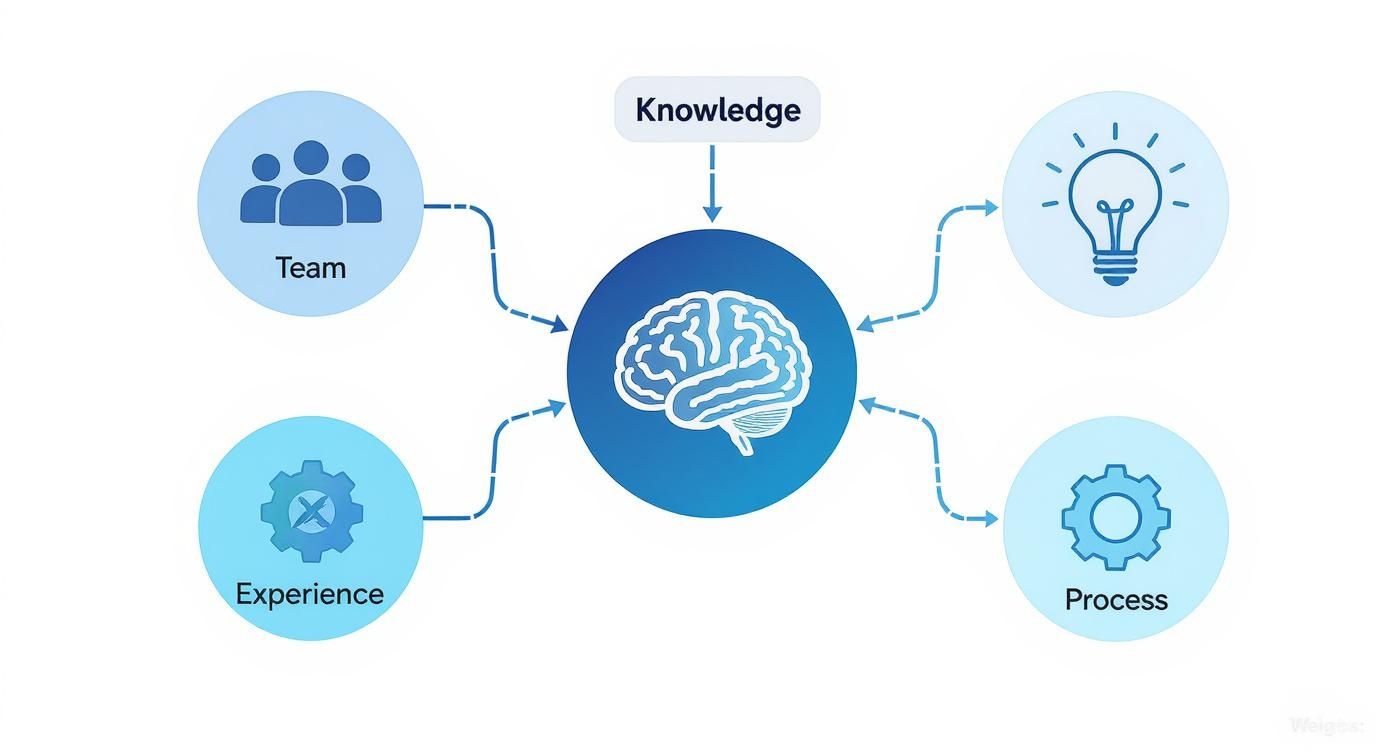
What this really shows is that institutional knowledge isn't one static thing. It's a dynamic mix of human insight and structured procedure, which is precisely why it's both incredibly valuable and so darn hard to pin down.
The key takeaway is simple: Your team already has the answers. The real challenge isn’t creating more information—it's accessing the wealth of knowledge that already exists, trapped in conversations, email threads, and individual minds.
This knowledge includes all the mission-critical details that never make it into a formal guide:
- Client Nuances: Why a particular client insists on weekly updates via email instead of a Slack channel.
- Troubleshooting Shortcuts: That one-line command a senior engineer knows to fix a recurring software bug.
- Historical Context: The real story behind a pivotal project decision made two years ago that still impacts your work today.
When this kind of knowledge is easy to find, your whole team starts operating with a shared brain. Instead of constantly starting from scratch, they can build on a solid foundation of collective wisdom. Suddenly, all those repetitive questions can become a source of instant, automated answers, right where the work is already happening: inside Slack.
The Hidden Costs of Knowledge Drain

When a key team member walks out the door, they take more than just their laptop. They take years of unwritten rules, hard-won lessons, and critical project history with them. This is knowledge drain, and it's a silent killer of productivity that slowly but surely chips away at your business.
It’s not some dramatic, one-time event. It’s a slow bleed, made up of tiny, frustrating moments that create a massive operational drag. It’s the feeling of knowing the answer exists somewhere but having no idea where to even start looking.
This isn't just an abstract theory; it's a collection of daily headaches we've all felt. It’s the project that suddenly stalls because the one person who knew the client’s quirky approval process is gone. It's the new hire who takes six months to get up to speed because they're stuck asking the same questions over and over.
The Real-World Consequences
Knowledge drain shows up in ways that directly hit your team's morale and your company's bottom line. Think about the cost of re-learning the same lessons.
When a marketing team launches a campaign that fails for the exact same reason a similar one did two years ago, that isn’t just bad luck. It's a classic symptom of lost knowledge. The wisdom from that first attempt was never captured, so the new team was doomed to repeat history.
A study found that knowledge workers spend nearly one full day per week—a staggering 20-30% of their time—just searching for information. That's not productive work; it's a direct tax on your team's talent.
Recognizing the Symptoms in Your Organization
So, how can you tell if your company is bleeding knowledge? The signs are usually hiding in plain sight, disguised as everyday friction.
- Endless Onboarding: Are new hires constantly interrupting senior staff for basic information? This happens when there's no self-serve way to find answers about past projects or internal processes.
- The
Human Bottleneck
: Does progress grind to a halt because one specific person is on vacation or out sick? If no one else knows the procedure or the history, you have a single point of failure. - Recurring Mistakes: Do your teams keep running into the same preventable problems? They solve it, the solution vanishes, and the next team is forced to start from scratch.
- Decision Paralysis: Are simple decisions getting bogged down in meetings? This is often because the context behind a previous choice—the
why
—was never recorded, leaving everyone to second-guess the past.
Each of these moments is more than just an inconvenience. It's a point where progress stops, frustration mounts, and valuable time is burned. This is a significant business risk. When your institutional knowledge depends entirely on individual memory, your ability to innovate, scale, and compete is just as fragile.
The solution isn’t just to write more things down. It’s about fundamentally changing how your team finds and uses the collective intelligence you already have.
Why Your Best Insights Are Trapped In Slack
Let's be honest, Slack is the digital office. It's where your team works through tough problems, brainstorms killer ideas, and makes the dozens of tiny decisions that actually push the business forward. In many ways, it's a goldmine of your company's real-time brainpower.
But there’s a massive catch. Slack is also where that incredibly valuable institutional knowledge goes to die. A game-changing decision made in a thread on Tuesday is completely buried under a mountain of new messages, GIFs, and pings by Wednesday morning.
Your team's best insights—the debates, the context behind a choice, the final aha!
moment—are fleeting. They sparkle for an instant and then get swept away by the endless scroll, making them nearly impossible to find even a day later.
The Black Hole of The Search Bar
We’ve all been there. You have a vague memory of a coworker sharing a crucial link a few months back
in the #marketing-team channel, and now you desperately need it. You plug a few keywords into the search bar and brace yourself for the wall of irrelevant noise that comes back.
You scroll, you try a dozen different search terms, you burn ten minutes, and you finally surrender. What do you do? Exactly what you were trying to avoid: you interrupt your teammate to ask them to dig it up for you. This isn't just you; it's a fundamental flaw in the system.
Your team’s communication platform has unintentionally become a knowledge graveyard. The very tool meant to make you more productive is creating friction, forcing you to either waste time searching or break someone else's focus.
Transforming Communication Into Intelligence
The answer isn't to ditch Slack. And it certainly isn't to force your team into some rigid documentation process that everyone is too busy to follow. The real fix is to turn this chaotic but brilliant firehose of information into a living, breathing brain for your entire company.
Imagine if you didn't even have to search anymore.
- No more digging: Instead of wrestling with the search bar, you just ask SAI in Slack, like you'd ask a colleague.
- No more interruptions: You get an immediate, accurate answer pieced together from past conversations, letting your teammates stay focused.
- No more context switching: The information comes to you right where you're already working, without ever leaving the app.
This is how you turn every conversation from a temporary chat into a permanent asset. It breaks the frustrating cycle of asking and re-asking the same questions and finally puts your team's collective intelligence to work.
Turn Slack Into Your Single Source of Truth
Imagine a workday without the frantic search for information. What if you didn't have to toggle between a half-dozen tabs, dig through forgotten shared drives, or interrupt a colleague just to get an answer?
This isn’t about adding another tool to your tech stack. It’s about transforming how your team accesses its own collective intelligence. It's about making your existing Slack workspace the one place you go for everything.
The goal is to finally kill the context-switching that drains our energy and create a workflow where answers find you, right where you’re already working.
The End of the Digital Scavenger Hunt
Think about your day so far. How many times did you stop what you were doing to track down a single piece of information? How often did you ask a question you just knew had been answered before, somewhere out there in the digital ether?
This constant searching isn't just a minor annoyance; it's a massive drag on focus and momentum.
Now, picture this instead. You need the latest update on Project Phoenix.
Instead of scrolling endlessly through channels, you just ask SAI in Slack: What's the current status of Project Phoenix?
Instantly, you get a clear, synthesized answer pulled from every relevant public conversation on the topic. It even includes links back to the original discussions if you need to dig deeper. That’s what effortless knowledge retrieval feels like.
The real shift happens when your team stops seeing information as something to be hunted down and starts treating it as an on-demand resource. You no longer need to know who to ask or where to look—you just need to ask.
This empowers everyone, from the newest hire to the most seasoned veteran, to find what they need on their own. And the impact on efficiency is huge. Research from Bloomfire shows a staggering 98.5% of employees believe better knowledge sharing would significantly boost their productivity, and 46% say better access to internal info would make their days more efficient.
Capture Knowledge Without Any Extra Work
Let’s be honest: the best systems are the ones you don’t even notice you’re using. The classic problem with knowledge bases is that they require your team to stop their real work to do more work—documenting processes, updating wikis, and categorizing files.
A modern solution should work in the background, woven directly into the fabric of your day. Tools like SAI operate this way, passively absorbing the valuable institutional knowledge shared in your public Slack channels.
There’s no capture
button to press or form to fill out. Your team just communicates like they always do.
- When an engineer solves a tricky bug and explains the fix in
#dev-ops, that solution becomes a permanent, searchable asset. - When a salesperson shares a winning tactic for handling an objection in
#sales-team, that insight is saved for everyone. - When the design team finalizes the hex codes for a new brand update in
#design-assets, no one ever has to ask for them again.
This automated process ensures that the wisdom generated from daily collaboration isn't lost to the endless scroll. It’s captured the moment it’s created, strengthening your team's collective brain with every single conversation. When knowledge flows this freely, you'll naturally foster a stronger team connection in Slack.
Every question answered and every problem solved builds an intelligent, self-updating library of your team's unique expertise. It’s always there, ready to be surfaced the next time someone needs it. The workday is no longer about searching; it's about asking and doing.
Building A Resilient Knowledge Culture

Let's be clear: truly managing your company's institutional knowledge isn't a project with a start and end date. It's about fundamentally changing how your team operates. You’re aiming to create a new, smarter, and more resilient way of working that becomes second nature. The goal isn't just to install a new tool; it's to build a culture where capturing and sharing wisdom happens automatically as a byproduct of your daily work.
Picture what this actually looks like. A senior engineer explains a tricky bug fix in a public Slack channel once, and that's it—they never have to answer that exact question again. A new hire finds the answer to an onboarding question in seconds, no shoulder-tapping required. A project manager instantly pulls up the rationale behind a key decision made two years ago, sidestepping a mistake that could have cost thousands.
This is the world you create when your company’s collective brain is always on and always accessible. It’s an environment where crucial insights are captured for good, completely insulated from the inevitable reality of employee turnover. The old game of who knows what
becomes obsolete when the what
is available to everyone, right when they need it.
From Manual Effort to Automatic Intelligence
The old way of doing this was just painful. It relied on brute force: endless documentation, wiki page maintenance, and constantly bugging your busiest people to write down what they know. This approach was always destined to fail because it adds one more task to an already overflowing plate.
A resilient knowledge culture completely flips that model. Instead of asking people to do more work, it uses smart systems to pull value from the work they’re already doing.
The real shift happens when preserving knowledge stops being a chore and becomes an automatic function of just talking to each other. Every conversation in Slack doesn't just solve today's problem; it builds a smarter, more capable organization for tomorrow.
This change creates a ripple effect across your entire team:
- Senior Experts Are Liberated: They spend far less time acting as a human Google for repetitive questions and more time tackling the big, complex problems that actually move the needle.
- New Hires Are Empowered: They can find information on their own, ramp up faster, and start making a real contribution from day one.
- The Entire Team Is Aligned: Everyone is working from the same playbook, which drastically cuts down on confusion, missteps, and wasted effort.
This is about so much more than a simple efficiency boost. It's about building an organization that learns, adapts, and gets stronger with every single conversation. It's time to stop letting your most valuable asset—your team's collective wisdom—vanish into thin air.
Start building a more self-sufficient organization today. You can explore more strategies for building a strong internal knowledge system on the SAI blog.
Frequently Asked Questions
Figuring out how to manage all the knowledge floating around your company can feel like a huge project, but the right approach is often simpler than you'd expect. Here are a few common questions we hear about turning everyday conversations into a real, lasting advantage.
What’s The Difference Between Institutional Knowledge And A Knowledge Base?
Think of a traditional knowledge base as a library. It’s a collection of articles and documents that someone has to manually write, organize, and—most importantly—keep updated. It holds your explicit knowledge, but the moment it's published, it starts to get stale. It’s a snapshot.
True institutional knowledge, on the other hand, is alive. It includes all that static information, but it also captures the 80% of valuable tacit knowledge that rarely gets written down. This is the why
behind a big decision, the subtle context from a client chat, or the unwritten rules that explain how your team actually gets things done. A tool like SAI doesn't just store files; it plugs directly into the stream of expertise flowing through your team's conversations, creating a knowledge hub that’s always up-to-date.
How Can Busy Teams Capture Knowledge Without Extra Work?
This is the killer. Any system that relies on people manually documenting their work is doomed from the start. Asking a busy engineer or salesperson to stop what they're doing to write up a detailed wiki page is a fantasy. That's how you end up with an empty, untrustworthy knowledge base that no one ever uses.
The only way this works is by making knowledge capture an automatic, invisible part of the daily workflow. By integrating directly into a platform like Slack, an AI tool can work silently in the background. It learns from the solutions, decisions, and crucial insights being shared in public channels without anyone having to do a single extra thing.
Your team doesn't change a thing. They just talk, solve problems, and collaborate like they always have, and their collective wisdom is automatically saved and made searchable for everyone.
How Does This Make Onboarding New Hires Faster?
The classic onboarding experience is a mess. New hires get hit with a firehose of information on day one, then spend the next few weeks nervously tapping senior team members on the shoulder for every little question. It’s a slow, painful process for them and a constant productivity drain for your veterans.
Now, imagine a new hire could just ask a question in a Slack channel and get an instant, clear answer pulled from years of your company’s actual discussions. They could ask, What is our process for client kickoffs?
and get a perfect summary, complete with links to the original conversations for full context.
This lets them find their own answers, ramp up faster, and really understand the nuances of how your company operates. They become contributing team members in a fraction of the time, and your senior staff gets to stay focused on their own work. If you want to see how this translates into a real-world setup, you can explore the different options available by checking out SAI's pricing models.
Ready to stop watching your team's best ideas disappear into the void? Add SAI to your Slack workspace for free and turn your team’s conversations into your most powerful asset. Get started with SAI today.