What Is Knowledge Management and How Can It End Repetitive Questions?
Let's be honest, what is knowledge management? In a nutshell, it’s the way your company gathers up all the smart stuff your team knows, organizes it, and makes it dead simple for anyone to find and use. It’s about turning scattered tribal knowledge—stuck in emails, chat threads, and people's heads—into a reliable resource that works for you.
The whole point is to break the cycle of asking the same questions over and over and wasting precious time hunting for answers.
Imagine a Day Without Searching for Answers
Picture this: you start your workday and don't spend a single minute digging for information. No more scrolling through endless Slack channels, sorting through cryptic file names in a shared drive, or trying to remember which project tool holds that one critical update. This isn’t some far-off fantasy; it's what good knowledge management actually delivers.

It’s about getting back the 25% of the workweek that most employees lose just searching for information. Think about that cost. It's not just about the lost hours, but the constant interruptions. Every quick question
or DM asking Hey, where's the latest deck?
yanks a teammate out of deep work, causing delays and frustration that ripple across the entire company.
The True Cost of Inaccessible Knowledge
When information is hard to find, it’s like a hidden tax on your team's productivity. You see it in subtle, damaging ways every single day.
It’s the new hire who feels stuck and unproductive, waiting hours for a simple answer. It’s the support agent who accidentally gives a customer an outdated solution. It's the project manager who has to remake a decision because the original reasoning is buried in a long-forgotten chat thread.
This daily friction really adds up. It leads directly to:
* Slower decision-making: When data is buried, teams are forced to guess, or worse, delay important actions.
* Inconsistent processes: Without a single source of truth, everyone invents their own way of doing things, which is a recipe for errors.
* Employee burnout: Your experts get drained from answering the same questions, and your team gets frustrated having to ask them.
The core idea of modern knowledge management is simple: Your team shouldn't have to stop working to find the information they need to do their work. The answers should come to them, right where they are.
A New Way of Working
Now, let's flip the script. Imagine that instead of opening ten browser tabs or pinging three different colleagues, you just ask a question right in Slack and get an instant, accurate answer. That's the idea behind tools like SAI, an AI assistant that learns from your team’s conversations to build a collective brain that works for you.
This approach stops treating knowledge like a dusty library you have to visit and turns it into a dynamic, active partner in your daily workflow. It empowers your team to onboard new hires in record time, solve customer problems faster, and finally focus on work that matters instead of playing digital detective.
This shift is exactly why the knowledge management market is exploding. Valued at US$885.6 billion, it's on track to hit US$2.5 trillion by 2030. This massive investment sends a clear signal: companies are getting serious about making their internal expertise easy to access and act on. You can read the full research about knowledge management market trends to see just how much cloud-based solutions are driving this change.
How Modern Knowledge Management Actually Works
Let's be honest, knowledge management
can sound a little stuffy. It probably brings to mind clunky wikis and dusty digital folders no one ever looks at. But modern knowledge management is something else entirely. It's not a chore; it's a dynamic, living system that fuels how your team works.
Think of it like a master chef’s kitchen. You don't just toss ingredients into a pantry and hope for the best. Everything is sourced, prepped, and organized so you can create incredible dishes on the fly. That's what a good KM process does for your business—it turns scattered bits of information into smart, fast outcomes. This isn't about adding more work; it’s about making everyone’s job easier by building on what you already know.
It all boils down to a simple, four-part cycle.
1. Capture Knowledge Where It Happens
The real gold at your company isn't in a perfectly polished report. It’s in the everyday conversations—that Slack thread where an engineer found a brilliant workaround, the quick brainstorm that solved a customer's weird problem, or the marketing discussion that sparked a new campaign idea.
Great knowledge management doesn't ask people to stop their work to document
something. It plugs directly into the workflow and captures these moments as they happen. It listens to the conversations your team is already having. This means every question asked and answered in a public channel automatically becomes a reusable asset, with zero extra effort.
2. Organize It with Intelligence
Once you've got all this great information, it needs to be organized so people can actually find it. A messy shared drive is the digital equivalent of that junk drawer we all have—you know there’s something useful in there somewhere, but good luck digging it out when you need it.
A modern system acts like an expert librarian, automatically tagging information based on its context. It just knows the difference between a question about PTO and a technical bug report. This is the secret sauce that makes instant answers possible. If you want to dive deeper into the nuts and bolts, you can explore what is a knowledge management system and see how all the pieces fit together.
The real goal is to make
searchinga thing of the past. When someone has a question, the system should surface the single best answer, not a list of 20 documents to wade through.
3. Share It Without the Friction
In too many companies, knowledge gets trapped. The marketing team has data the sales team could use to close deals. The support team has customer feedback that the product team would kill for. Good knowledge management demolishes these silos.
This isn't about creating a free-for-all. It's about building a central, searchable brain for your company that delivers the right information to the right person, right when they need it.
- New hires can get up to speed in days, not weeks, by getting instant answers to their questions on everything from processes to company culture.
- Support agents can resolve customer issues in seconds, providing consistent, top-notch service every time.
- Project teams can look back at past decisions and project histories, so they stop reinventing the wheel and start building on past successes.
4. Use It to Make Smarter Moves
At the end of the day, knowledge is only valuable if you use it. When your team has the company's collective wisdom at their fingertips, the entire business levels up.
Those repetitive questions that used to eat up your experts' time? Gone. Now they can focus on work that actually moves the needle. Decisions get made faster and with more confidence because they’re grounded in real data and historical context.
This cycle—capture, organize, share, and use—creates a powerful flywheel. Every question answered makes the system smarter. And a smarter system empowers your team to work better, innovate faster, and drive real growth from the ground up.
Let’s be honest. Every company has a digital graveyard, and it’s usually called the “company wiki.”
You start with the best of intentions, right? You create folders, meticulously write up process docs, and dream of a single source of truth. But fast forward a few months, and it’s a wasteland of outdated guides, duplicate files, and abandoned drafts. Sound familiar?
So, Why Do Company Wikis Always Fail?
It’s not because your team is lazy. It’s because traditional tools like wikis or shared drives live completely outside your team's natural workflow. They demand constant, manual gardening.
Think about it. Every time an expert drops a golden nugget of information in a Slack channel, the process breaks. Someone has to remember to stop what they’re doing, open a separate tool, find the right page (good luck), and paste in the new insight. It’s a chore. And chores get ignored.
This creates a vicious cycle. The wiki becomes unreliable, so people stop using it. And because no one uses it, no one bothers to update it. The digital graveyard gets another tombstone.
The Curation Bottleneck
The fatal flaw in this old model is the curation bottleneck. It forces a handful of people to play librarian for the entire company. This manual process isn't just slow; it’s completely unsustainable as your team and its collective knowledge grow.
A healthy knowledge system shouldn't feel like a series of manual tasks. It should be a fluid, self-sustaining loop where insights are captured, organized, and applied almost effortlessly.
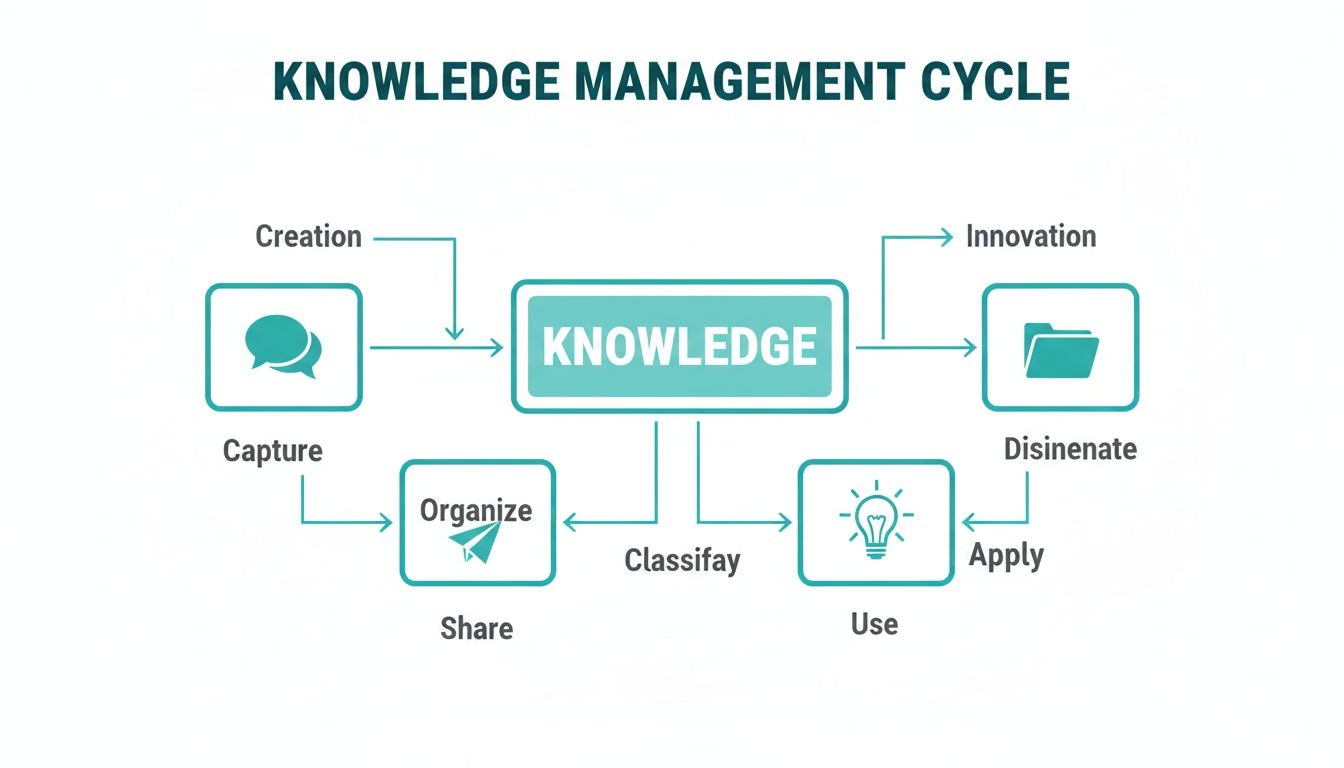
The goal is to make each step feed into the next, creating a system that gets smarter on its own instead of depending on constant human intervention.
Bringing Knowledge Directly into the Workflow
Now, imagine a different reality. Instead of forcing your team to go to the knowledge, what if the knowledge came to them? What if every question asked and answered in a Slack channel automatically made your company smarter?
This is the whole idea behind a modern, “in-flow” approach. It completely removes the tedious documentation step. The system learns directly from the organic conversations your experts are already having, turning their daily chats into a searchable, reliable knowledge base. No one has to lift a finger.
The difference between the old way and the new way is stark. The old way relies on documentation that's separate from your work, while the new approach embeds knowledge directly into it.
Traditional vs. Modern Knowledge Management
| Feature | Traditional KM (e.g., Wiki, Shared Drive) | Modern KM (e.g., AI Assistant in Slack) |
|---|---|---|
| Knowledge Capture | Manual and requires dedicated effort. | Automatic and learns from conversations. |
| Accessibility | Requires leaving your workflow to search another tool. | Answers are delivered instantly within your workflow. |
| Maintenance | Constant manual updates needed; quickly becomes outdated. | Self-maintaining and stays current with new discussions. |
| User Adoption | Low, because it's an extra, disruptive step. | High, because it requires no change in user behavior. |
| Finding Info | Slow, keyword-based search that often fails. | Fast, contextual search that understands intent. |
Ultimately, a modern system removes the friction that causes old-school wikis to fail in the first place.
The best knowledge management system isn't the one with the most features. It's the one your team actually uses because it requires almost no extra effort.
When knowledge is captured and shared this way, the entire dynamic shifts. You’re no longer asking people to adopt a clunky new habit. You're meeting them exactly where they are—in Slack. By simply doing their jobs and collaborating with colleagues, they are simultaneously building a powerful, collective brain for the entire organization.
An AI assistant like SAI is designed around this very principle. It plugs into your team's conversations, understands the context of a question, and delivers the right answer instantly. It doesn't just store information; it makes that information an active, helpful participant in your team's daily work.
The Role of AI in Automating Knowledge Flow
AI is what transforms knowledge management from a chore into a superpower. Forget the old days of manually building a knowledge base, tagging documents, and begging your team to keep things updated. AI works silently in the background, building a smart, self-maintaining brain from your team's natural workflow.
Imagine never having to open another browser tab to search for an answer again. No more digging through wikis, shared drives, or cluttered project management boards. Instead, you just ask a question right inside Slack—the same way you'd ask a colleague—and an AI assistant like SAI finds the answer and brings it to you in seconds. This isn't just a faster search; it's a completely new way of working, where you never have to leave your flow to find information.
From Manual Curation to Automated Understanding
The biggest shift here is getting away from constant human curation. You don't need a dedicated team of digital librarians trying to keep everything organized anymore. AI, especially the generative kind, automates the entire process.
It all starts with understanding the real intent behind a question. When a team member asks, What's our policy on working from home?
the AI knows they aren't just looking for a document with those keywords. It gets the context and instantly scans all your connected sources—past Slack conversations, official HR documents, and even buried email threads—to pull together the most relevant, up-to-date answer.
This ability to grasp natural language is what makes using artificial intelligence to answer questions fast in Slack such a game-changer. It cuts out all the guesswork and delivers precisely what your team needs to get on with their work.
Turning Conversations into a Collective Brain
Just think about the sheer volume of valuable information that flies through Slack every single day. A senior developer helps a junior engineer with a tricky problem. The sales team figures out how to handle a new objection. HR clarifies a question about benefits. In the past, all that knowledge would just get buried in the chat history, lost forever after a few days.
AI completely flips this on its head by treating your Slack channels as a living, breathing source of truth.
- It learns organically: As your team talks, the AI absorbs new information, solutions, and processes directly from their conversations.
- It stays current: When a process gets updated in a chat, the AI learns the new way of doing things, solving the
stale content
problem that makes traditional wikis so unreliable. - It connects the dots: The AI can pull bits and pieces from multiple conversations to give you a complete answer that you wouldn't find in any single document.
This approach makes powerful knowledge management a reality for any team, no matter their size or budget. You don't need to kick off a massive project to see the benefits; you just need to let the AI learn from the work you're already doing.
The real magic is that your team doesn't have to change their behavior at all. By simply collaborating as they normally would, they are continuously building and refining a powerful, collective company brain.
This is exactly why a striking 44% of knowledge management experts believe generative AI is the most important technology in the field today. With 80% of customer support agents saying that better access to cross-departmental data would supercharge their work, the need for intelligent, automated systems has never been clearer.
At the end of the day, AI just removes the friction. It makes finding information as easy as asking a question, freeing up your team to focus on solving real problems and moving the business forward.
See How Other Teams Ended Repetitive Questions
Enough with the theory. The real magic of knowledge management isn't found in a textbook or a fancy framework; it's in the quiet, focused hum of a team that's no longer drowning in shoulder taps and redundant questions. It’s about creating a place where answers flow as freely as the work itself, finally breaking that frustrating cycle of asking the same things over and over again.

Picture a day where your team doesn't have to open another tab, dig through five different cloud drives, or ping a coworker for an answer they know they've given before. Instead, they just ask a question right in Slack and get an instant, accurate response. This isn't some far-off dream—it's exactly how smart teams are working right now.
For the Overwhelmed Customer Support Team
Before: The support team's Slack channel was a vortex of chaos. New agents were constantly asking for help on niche customer problems, while senior agents were spending half their day playing internal help desk instead of closing tickets. Any brilliant solution shared a month ago was lost to the infinite scroll. The result? Slower response times and wildly inconsistent customer experiences.
After: They added an AI assistant like SAI to their main Slack channel, instantly turning their entire conversation history into a living, searchable brain. Now, when a new agent has a question about a tricky refund policy, they just ask SAI. The assistant pulls the perfect answer from a conversation that happened weeks ago, complete with all the crucial context a senior team member originally provided.
The difference is night and day:
* Instant Resolutions: Agents find verified answers in seconds, which means customers aren't left waiting.
* Expert Time Reclaimed: Senior agents are finally free from the barrage of internal pings, letting them tackle the toughest customer cases.
* Consistent Service: Every single agent, from the rookie to the veteran, has the same high-quality information, ensuring every customer gets the same right answer.
For the Busy Human Resources Team
Before: Onboarding was a manual, soul-crushing grind for the HR team. With every new hire class, their inboxes and Slack DMs were flooded with the same questions about benefits, payroll, and IT setup. The team was so buried in administrative busywork that they had no time for the strategic stuff, like employee development or improving company culture.
After: The HR team set up an #ask-hr channel and plugged in an AI assistant. New hires can now ask anything from How do I set up my 401k?
to What's the expense report process?
and get an immediate, automated answer. The AI pulls information directly from past HR announcements and Q&A threads, turning the channel into a self-serve onboarding machine.
The impact was immediate:
* Automated Onboarding: New employees get up to speed on their own terms, feeling more empowered from day one.
* Reduced HR Workload: The HR team spends way less time on repetitive tasks, freeing them up for high-value projects that actually move the needle.
* 24/7 Availability: Employees can get their HR questions answered anytime, without having to worry about time zones or business hours.
We're saving at least **10 hours per week** across the team. Senior members are no longer the primary source for every little question, which has been a complete game-changer for our focus and productivity.
For the Detail-Oriented Operations Team
Before: The Ops team was fighting a losing battle with process consistency. Project instructions, vendor lists, and approval workflows were scattered across Google Docs, rogue spreadsheets, and forgotten email chains. Every new project required a long kickoff meeting just to get everyone on the same page, and even then, people would often slide back into their old, inconsistent habits.
After: Now, the Ops team uses their AI assistant in Slack to pull up standardized processes on demand. When someone needs the correct procedure for a new software request, they just ask. The AI delivers the step-by-step instructions, links to the right forms, and even provides the original conversation where the process was decided. Meetings are shorter and more strategic because everyone already has the foundational knowledge at their fingertips.
Your Blueprint for an Effortless Rollout
The phrase implementing knowledge management
can sound intimidating. It often brings to mind massive, six-month projects filled with endless meetings and software that nobody uses. We've all seen those failed company wikis—the ones that start with big promises but end in burnout and become another digital graveyard.
But it doesn't have to be that way.
The secret isn't a huge, top-down overhaul. It’s about starting small, getting a quick win, and solving a real pain point for your team right now. Forget about boiling the ocean. This is about making one part of your team's day dramatically easier, and you can start today. Think of it as a simple, four-step recipe for instant relief.
Step 1: Start with a Single Channel
First, find the epicenter of repetitive questions. Every company has one. It might be the #support-team channel where new agents are constantly asking for help, or #it-helpdesk which is perpetually flooded with the same password reset requests.
This is your ground zero. Don't try to solve everything for every department at once. Pick that one public Slack channel where your experts feel the most overwhelmed and the team is the most frustrated. This targeted approach guarantees your first effort will deliver a noticeable, high-impact win and build momentum for what comes next.
Step 2: Add an AI Assistant
Once you've picked your channel, this next step takes about two minutes. Add an AI assistant like SAI directly to it. This is not your typical software rollout. There are no long configuration meetings, no complicated setup guides, and absolutely no manual data entry.
You just invite the bot to the channel, and it gets to work. Its entire job is to start listening and learning from the conversations that are already happening. This is the critical difference: you’re not building a knowledge base from scratch; you're letting the AI build it for you from your team's existing expertise.
The goal is to remove friction, not add another tool to your team's plate. A successful rollout should feel like flipping a switch, not starting a construction project.
Step 3: Let It Learn Passively
Here comes the best part: you do almost nothing. For the next day or so, just let the AI observe. It will quietly analyze the historical conversations in that channel, picking out the common questions and the expert answers that resolved them. It learns your team’s language, understands the context, and starts building a reliable brain without anyone having to lift a finger.
This passive learning phase is what makes modern knowledge management so effective. It completely bypasses the tedious documentation process that dooms older systems. Instead of begging your experts to spend hours writing down what they know, you’re capturing their knowledge organically, as it happens.
Step 4: Encourage a New Habit
Finally, it’s time to nudge your team toward a small shift in behavior. The next time someone has a question in that channel, encourage them to ask the AI assistant instead of pinging a specific person. This simple change is the key to unlocking the whole system's value.
Every question asked and answered reinforces the learning loop, making the assistant smarter and more accurate with each interaction. Before you know it, your team will realize they can get instant, reliable answers 24/7 without having to interrupt a colleague. This simple blueprint transforms knowledge management best practices from a theoretical concept into a practical, daily reality.
By starting small with just one channel, you can prove the value in a controlled environment and experience the benefits firsthand—in minutes, not months.
Got Questions? We've Got Answers
Thinking about what modern, AI-powered knowledge management really looks like in practice? Let's tackle some of the most common questions that come up.
How Much Upfront Work Is Involved?
You might be picturing a massive setup project, but with an AI tool built for Slack, you can forget all that. Getting started is astonishingly simple.
You just add an assistant like SAI to a public channel. That’s it. It immediately starts learning from the conversations already happening, building its knowledge base on its own. It's built to deliver answers right away—no manual data entry or tedious training sessions required.
Is Our Company's Information Safe?
This is a big one, and the answer is yes. Security isn't an afterthought; it's the foundation. Top-tier AI assistants are designed with enterprise-grade security from the ground up.
They only access information from the specific public channels you invite them into, period. All the data is handled with strict protocols to respect your privacy and keep your company's internal knowledge exactly that—internal.
Your team's conversations are your source of truth. A modern system respects that by making sure the knowledge built from it stays secure and is only ever seen by your team.
How Does the AI Stay Current?
This is where older systems fall apart, but modern AI thrives. The best tools learn in real-time.
When someone on your team answers a question or provides an update in a Slack thread, the AI absorbs that new information. The knowledge base is constantly evolving right alongside your team's work. This approach completely sidesteps the stale wiki
problem because the information is refreshed organically from the daily flow of conversation. Your knowledge base literally gets smarter with every single question your team answers.
Ready to put an end to endless searching and answering the same questions over and over? SAI learns from your Slack conversations to give your team instant answers, freeing them up to focus on what really matters.
Add it to one channel for free and see the difference for yourself. Get started at sai-bot.ai.