10 Best Practices Knowledge Management: Your 2025 Guide to Instant Answers
Picture your ideal workday. A question pops into your head—about a client's project history or the updated PTO policy. Instead of opening a dozen browser tabs, digging through shared drives, or interrupting a colleague, you simply ask the question in Slack and get an instant, accurate answer.
This isn't a fantasy. It's the direct result of implementing modern, best practices knowledge management. The old way involved clunky wikis and documentation that pulled your team from their actual work. The new approach meets you where you collaborate, transforming existing conversations and documents into an intelligent knowledge source that requires zero context switching. Imagine a day where your team never has to hunt for information again.
This guide is not about building another system to maintain. It's a blueprint for eliminating the daily friction of finding information, ending repetitive questions, and reclaiming your team’s focus. We will walk through 10 actionable strategies to create a seamless flow of information, turning your organization's collective wisdom into a powerful, on-demand asset. You’ll learn how to capture, organize, and surface critical knowledge effortlessly, empowering your team to spend less time searching and more time achieving.
1. Establish a Centralized Knowledge Repository
Imagine a workday where you never have to ask, “Where can I find…?” again. No more digging through old Slack channels, sifting through shared drives, or interrupting a coworker to find that one crucial piece of information. This is the reality a centralized knowledge repository creates. It acts as your company's 'single source of truth' for everything from HR policies to project documentation, ending the daily scavenger hunt for information.
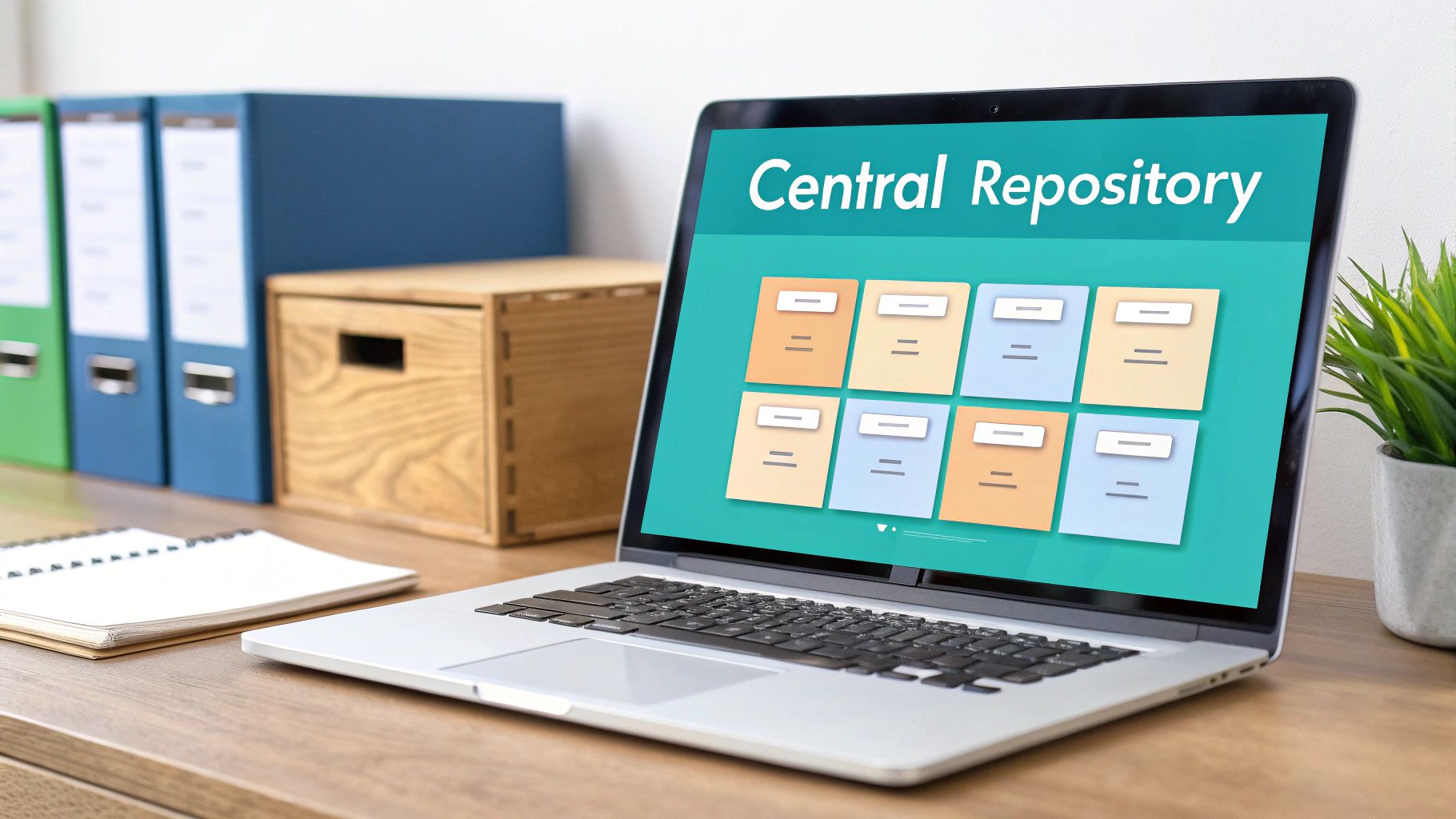
This approach is one of the most fundamental best practices in knowledge management because it directly combats information chaos. When everything lives in one place, you eliminate guesswork and redundant questions, empowering your team to find verified answers instantly.
Why It's a Game-Changer
A centralized hub transforms how your team operates. It moves knowledge out of individual inboxes and private messages into a shared, accessible space. Instead of your team constantly switching between apps, they can find what they need right where they work.
For a tool like SAI, this hub becomes the brain it uses to deliver instant, accurate answers directly within Slack. The fragmented, multi-app search process is replaced by a single, simple question. Your team stays focused, getting the information they need without ever leaving their workflow.
How to Get Started
Implementing a central repository doesn't have to be a massive undertaking. Start small and build momentum.
- Prioritize Critical Knowledge: Begin by documenting the information your team asks for most frequently. Focus on areas like onboarding processes, IT support FAQs, and core product details.
- Establish Clear Structure: Define a simple, intuitive folder structure and naming convention from day one. Consistency is key to long-term success and user adoption.
- Assign Ownership: Make sure every piece of content has a designated owner responsible for keeping it current. This prevents information from becoming outdated and unreliable.
By consolidating your company’s intelligence, you create a foundation for a smarter, more efficient workflow. Explore this concept further by reading our guide to modern knowledge management systems.
2. Create a Knowledge Management Culture
A powerful tool is only as effective as the people who use it. Even the most advanced knowledge repository will fail if your team doesn't embrace a culture of sharing and collaboration. This means making knowledge sharing a natural, celebrated part of the workday, not another task on the to-do list.
This approach is one of the essential best practices in knowledge management because it addresses the human element. It creates an environment where team members feel empowered to ask questions, contribute insights, and learn from mistakes without fear of judgment. This cultural foundation is what turns a static information database into a living, evolving ecosystem of collective intelligence.
Why It's a Game-Changer
A strong knowledge-sharing culture dismantles the knowledge is power
mindset, replacing it with shared knowledge is power.
It shifts the default behavior from hoarding information in private DMs to contributing it to a collective space.
For a Slack-first team, this culture is the engine that fuels your centralized knowledge hub. It ensures that the information used by tools like SAI is constantly enriched by the team's daily contributions. This creates a virtuous cycle: the more people share, the smarter the system becomes, and the more value everyone gets from it. The result is fewer repetitive questions and faster problem-solving for everyone.
How to Get Started
Fostering a new culture is about consistent, deliberate action, not a one-time announcement. Start with small, visible changes.
- Lead from the Top: Executive sponsorship is crucial. When leaders visibly participate in sharing knowledge and celebrate others who do, it sends a powerful message that this behavior is valued.
- Recognize and Reward: Publicly acknowledge team members who contribute valuable knowledge, answer questions, or update documentation. Link these contributions to performance evaluations to formalize their importance.
- Integrate into Onboarding: Make knowledge sharing a core part of the new hire experience. Teach newcomers how to find and contribute information from day one to establish it as a fundamental habit.
By intentionally building this culture, you transform knowledge management from a top-down mandate into a bottom-up, team-driven movement. Read more about fostering this environment in our guide to building a knowledge-sharing culture.
3. Implement Effective Knowledge Capture and Documentation
What happens when your most experienced engineer leaves? Or when a critical decision made in a meeting is forgotten a week later? Without a system to capture it, that invaluable knowledge walks out the door or evaporates into thin air. Effective knowledge capture is the process of recording your team's expertise, decisions, and processes so they become permanent, reusable assets for everyone.
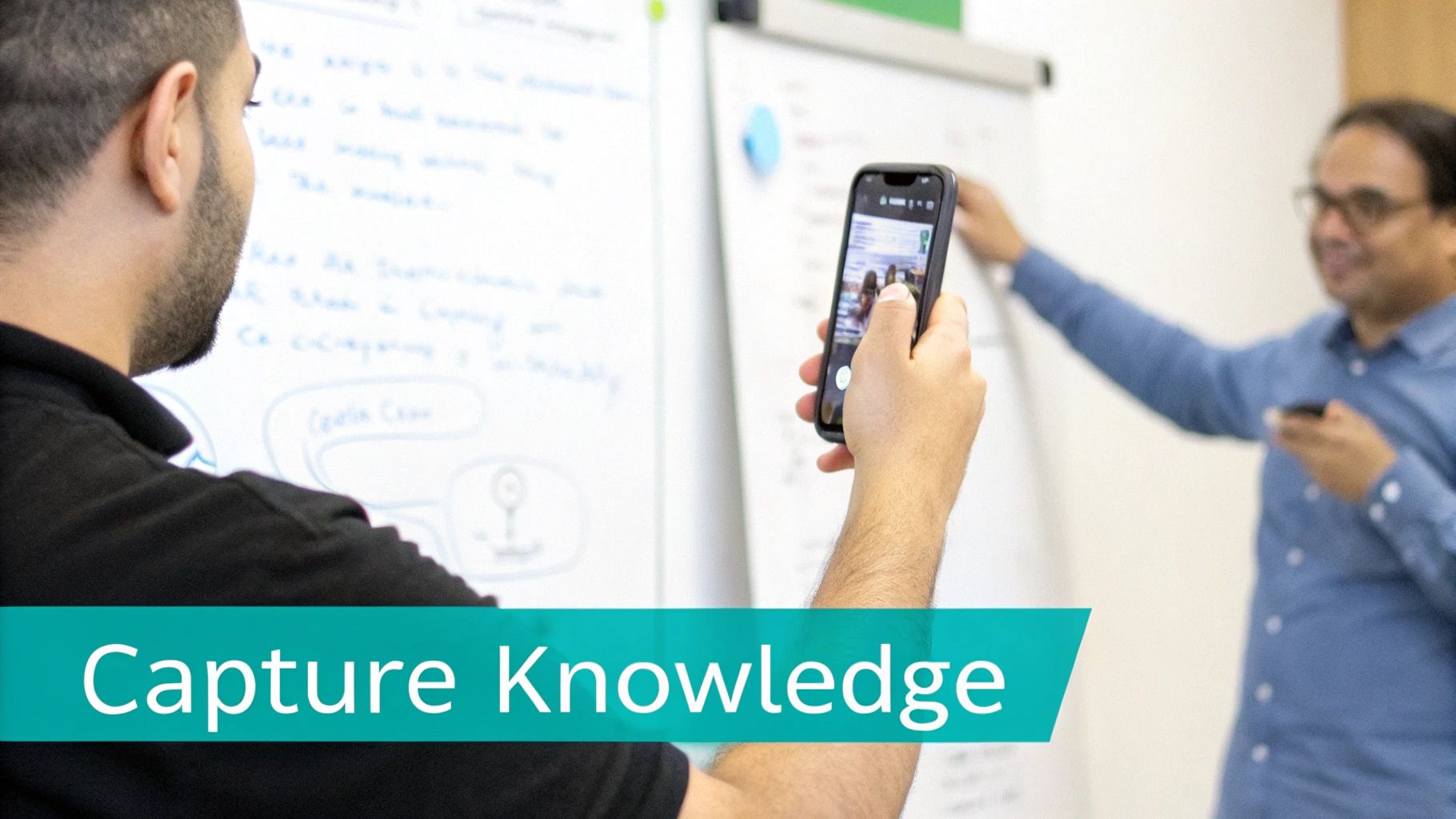
This discipline is one of the essential best practices in knowledge management because it transforms fleeting conversations and individual experience into a lasting organizational brain. It ensures that insights gained from a project win or a customer support challenge are not lost but are instead captured and made available, preventing the team from reinventing the wheel.
Why It's a Game-Changer
Systematic capture turns the know-how
in your experts' heads into explicit knowledge that anyone can access. It stops valuable information from being siloed in private Slack DMs or meeting notes on a personal laptop. This creates a reliable foundation for your centralized repository.
For tools like SAI, this captured knowledge is the fuel it runs on. When you document a new sales process, SAI learns it instantly. The next time a team member asks about it in Slack, they get an immediate, accurate answer based on that captured expertise. No more tracking down the original expert or waiting for a response; the answer is already there.
How to Get Started
Building a culture of documentation starts with making the process simple and rewarding.
- Use Templates: Standardize how information is captured. Create simple templates for meeting notes, project retrospectives, and standard operating procedures (SOPs) to ensure consistency and completeness.
- Capture It Fresh: Document insights immediately following a meeting or project milestone while the context is still clear. Don't wait for memory to fade.
- Designate Capture Moments: Make knowledge capture a formal part of your workflow. For example, dedicate the last 10 minutes of a project kickoff to documenting key decisions and action items.
By turning capture into a consistent habit, you build a powerful, ever-growing knowledge asset. For more details, see our guide on how to write a standard operating procedure.
4. Develop a Robust Knowledge Governance Framework
Imagine a knowledge base that is always trustworthy. Every document is up-to-date, every policy is accurate, and sensitive information is securely managed. This isn't just wishful thinking; it's the result of a robust knowledge governance framework. This framework establishes the rules and roles for managing your company's information, ensuring it remains a reliable asset instead of a chaotic liability.
This approach is a critical component of the best practices in knowledge management because it creates a system of accountability. Without governance, even the best repository can become a digital junkyard filled with outdated, conflicting, or inaccurate information. Governance ensures quality control, security, and long-term value from your knowledge.
Why It's a Game-Changer
A strong governance framework transforms your knowledge base from a passive storage unit into an active, intelligent resource. It provides the structure needed to maintain the integrity of your 'single source of truth', preventing the information chaos that undermines productivity.
When a system like SAI accesses your knowledge, it needs to be confident in the information's accuracy. A governance framework guarantees that the answers delivered in Slack are not just instant but also verified and secure. It’s the difference between your team getting a quick guess versus receiving a definitive, trustworthy response every single time.
How to Get Started
Implementing governance doesn't mean creating bureaucratic bottlenecks. It's about establishing clear, simple guidelines to maintain quality and security.
- Define Content Ownership: Assign a clear owner or team to every piece of knowledge. These owners are responsible for reviewing and updating their content on a set schedule.
- Establish a Review Cadence: Create a simple process for periodic content reviews. For example, high-impact documents might be reviewed quarterly, while evergreen policies are checked annually.
- Create Access Tiers: Not all information is for everyone. Implement role-based access controls to ensure team members only see the knowledge relevant and appropriate for them, protecting sensitive data.
By setting these ground rules, you build a sustainable, scalable system that protects your company’s most valuable asset: its collective knowledge.
5. Leverage Communities of Practice (CoPs)
Imagine tapping into a dedicated, internal network of experts to solve your most complex challenges instantly. Instead of relying on a single go-to
person, you access a collective brain of specialists who are passionate about a specific topic. This is the power of Communities of Practice (CoPs): groups of people who share a common interest and come together to learn, innovate, and problem-solve.

This approach is one of the most dynamic best practices in knowledge management because it focuses on creating and sharing tacit knowledge—the kind of expertise that is difficult to write down. It moves beyond static documentation to foster a living ecosystem of continuous learning.
Why It's a Game-Changer
CoPs break down departmental silos and accelerate innovation. They provide a forum for peer-to-peer learning where your team can share war stories, brainstorm solutions, and develop best practices organically. For example, a CoP for your customer support team could meet to discuss difficult ticket resolutions, while an engineering CoP could explore new coding techniques.
The knowledge generated in these communities is invaluable. When their key insights and solutions are captured, tools like SAI can surface this peer-vetted expertise instantly in Slack. This transforms complex, niche questions that would normally require interrupting a senior team member into a simple query with a proven answer.
How to Get Started
Fostering successful CoPs is about creating the right environment for organic collaboration, not forcing top-down initiatives.
- Identify a Shared Passion: Launch a CoP around a genuine business challenge or an area of high interest, like
AI in Marketing
orCustomer Onboarding Excellence.
- Appoint a Facilitator: Choose an experienced and respected team member to act as a community leader who can guide discussions, set agendas, and keep the momentum going.
- Document and Share: Create a dedicated Slack channel or space in your knowledge base for each CoP. Document key takeaways, decisions, and successful solutions to make this valuable knowledge discoverable for the entire organization.
By nurturing these internal expert networks, you cultivate a powerful engine for innovation and unlock a deeper layer of organizational intelligence.
6. Implement Knowledge Management Technology Infrastructure
Imagine a world where your knowledge base isn't just a passive library but an active, intelligent partner. The right technology infrastructure makes this possible, turning your scattered documents and conversations into a responsive, cohesive system that works for you. It's the engine that drives modern knowledge management.
This approach is one of the most critical best practices in knowledge management because the tools you choose directly impact efficiency. Without the right platform, even the best-documented knowledge remains difficult to find. The goal is a seamless flow of information, not another cumbersome tool your team has to learn.
Why It's a Game-Changer
The right technology stack transforms knowledge from a static asset into a dynamic service. Instead of employees manually searching through multiple platforms, the infrastructure works for them, delivering answers directly within the applications they already use every day, like Slack.
For a tool like SAI, this robust infrastructure is the foundation it needs to operate. It connects to your existing systems, indexes the information, and uses it to provide immediate, context-aware answers in Slack. This eliminates the need for your team to ever leave their primary workspace to find information, turning a multi-step search process into a single, effortless question.
How to Get Started
Choosing your technology is a strategic decision that should be tailored to your team's unique needs.
- Assess Your Workflow: Before picking a tool, map out how your team currently creates, shares, and searches for information. Identify the biggest points of friction.
- Prioritize Integration: Select platforms that integrate smoothly with your existing tools, especially your primary communication hub like Slack. This reduces context-switching and encourages adoption.
- Focus on User Experience: A complex, hard-to-use system will be ignored. Prioritize platforms with an intuitive interface that makes contributing and finding knowledge simple for everyone.
By implementing a smart technology infrastructure, you build the framework for a truly intelligent and frictionless workflow. To better understand your options, dive deeper into what a knowledge management system is and how to choose one.
7. Develop Knowledge Management Metrics and Analytics
You can’t improve what you don’t measure. Without data, your knowledge management strategy is just guesswork. Developing clear metrics provides concrete evidence of your program's health and business impact, turning your efforts from a cost center into a proven value driver.
This data-driven approach is one of the most crucial best practices in knowledge management because it proves ROI and guides continuous improvement. By tracking what matters, you can identify knowledge gaps, celebrate wins, and show stakeholders exactly how your initiatives are boosting productivity and reducing friction.
Why It's a Game-Changer
Metrics transform your knowledge base from a passive library into an active business asset. Instead of assuming your documentation is helpful, you can see which articles are most viewed and what search terms lead to no results.
For a tool like SAI, these analytics are built-in. It doesn't just answer questions in Slack; it provides a dashboard showing which questions are asked most often, which answers are most effective, and where your knowledge gaps lie. This empowers you to proactively fill those gaps, ensuring your team gets instant, accurate information every time they ask.
How to Get Started
Implementing a measurement strategy is about starting with clear goals and building from there. Focus on a few key metrics that align with your business objectives.
- Define Your Goals: Before choosing metrics, define what success looks like. Is it faster onboarding, fewer support tickets, or quicker access to sales collateral?
- Track Key Performance Indicators (KPIs): Start by monitoring adoption rates (e.g., search volume, page views) and then move to impact metrics like resolution time for customer support or time saved per employee.
- Communicate and Iterate: Create simple dashboards to share insights with stakeholders. Use the data to identify popular topics, outdated content, and areas where new knowledge is needed, then adjust your strategy accordingly.
By measuring the performance of your knowledge, you can optimize your system to deliver maximum value, making your entire organization smarter and more efficient. For a deeper look into this topic, explore our complete guide to knowledge management.
8. Create Mentoring and Apprenticeship Programs
Some knowledge can't be captured in a document; it lives within the experience and intuition of your most seasoned employees. This tacit knowledge is often the most valuable and the most difficult to transfer. Mentoring and apprenticeship programs create a structured pathway for passing this expertise directly from one person to another.
These programs formalize the natural process of learning from experts, ensuring that critical skills are passed down to the next generation of leaders. This is one of the most powerful best practices in knowledge management because it addresses the human element of knowledge sharing, fostering deep learning and professional growth.
Why It's a Game-Changer
A well-designed mentoring program cultivates a culture of learning where senior team members are empowered to teach and junior members have a clear path to mastery. This personal connection is vital for transferring the nuanced, how-to
knowledge that never makes it into a wiki.
For Slack-first teams, these relationships can be nurtured through dedicated channels and scheduled check-ins, creating a support system that complements asynchronous work. When a mentee learns a new process, that knowledge can then be captured and added to your central repository, making it accessible to everyone and trainable for AI tools like SAI.
How to Get Started
Building an effective program requires structure and clear intentions. You don't need a complex system, just a clear framework to guide the relationships.
- Set Clear Objectives: Define what success looks like for both the mentor and mentee. Is the goal to develop leadership skills, master a specific software, or understand company culture?
- Provide Mentor Training: Not everyone is a natural teacher. Offer mentors a brief training on how to give constructive feedback, set goals, and guide a mentee effectively.
- Establish a Formal Check-in Process: Schedule regular meetings and create a simple structure for them. This ensures accountability and keeps the relationship productive and on track.
By investing in these programs, you are not just transferring knowledge; you are building your company's future leaders and creating a resilient, self-sustaining learning culture.
9. Promote Cross-Functional Knowledge Sharing and Collaboration
Imagine your engineering team instantly understanding a key customer pain point from a support ticket, or your marketing team leveraging sales insights to craft the perfect campaign message. This is the outcome of intentionally breaking down departmental silos. Promoting cross-functional knowledge sharing turns isolated pockets of expertise into a powerful, collective intelligence that drives the entire organization forward.
This strategy is one of the most impactful best practices in knowledge management because it directly combats the tunnel vision that can cripple innovation. When knowledge flows freely between teams, you unlock new perspectives, solve problems faster, and create a more cohesive, aligned company culture.
Why It's a Game-Changer
A collaborative environment prevents valuable insights from getting trapped within a single team's Slack channel. For example, the product team's research shouldn't just live in their private channels; it should be easily discoverable by marketing, sales, and support to inform their own strategies.
This is where a tool like SAI becomes a powerful bridge. It can access and synthesize information from multiple departments' documented knowledge, delivering a holistic answer to a query in Slack. An engineer can ask about a customer feature request and receive a response that combines insights from support, product, and marketing, all without leaving their workflow.
How to Get Started
Fostering this level of collaboration requires deliberate effort, but the payoff is immense. Start with small, manageable steps to build momentum.
- Create Shared Objectives: Establish clear, cross-functional KPIs for specific projects. For instance, a product launch's success could be measured by metrics owned jointly by product, marketing, and sales.
- Launch Project-Based Teams: Assemble
two-pizza teams
with members from different departments to tackle specific initiatives. This creates a natural environment for knowledge exchange and co-creation. - Document and Share Learnings: After a cross-functional project concludes, create a
lessons learned
document. Store this in your central repository so the entire organization can benefit from the insights gained.
By actively connecting your teams' expertise, you build a resilient, innovative organization where the best ideas can come from anywhere and benefit everyone.
10. Establish a Knowledge Audit and Continuous Improvement Process
Imagine a knowledge base that never goes stale. Information isn't just stored; it evolves, improves, and stays perfectly aligned with your business needs. This is the result of a deliberate knowledge audit and continuous improvement process—a systematic review to find gaps, remove outdated content, and ensure everything is accurate and relevant.
This proactive approach is one of the most powerful best practices in knowledge management because it prevents your single source of truth
from becoming a digital graveyard. By regularly auditing, you guarantee that the information your team relies on is trustworthy, which is essential for making smart, fast decisions.
Why It's a Game-Changer
A commitment to continuous improvement turns your knowledge base from a static library into a dynamic, living resource. It ensures that when your team asks a question, they get the right answer, not just an old one. This builds trust and encourages adoption across the entire organization.
For tools like SAI, a well-maintained knowledge base is fuel for its engine. Regular audits ensure the AI is trained on the highest quality, most current information. The result is fewer I don't know
responses and more precise, context-aware answers delivered instantly within Slack, eliminating the risk of someone acting on obsolete advice.
How to Get Started
Implementing a knowledge audit cycle can be straightforward and incredibly impactful. You don't need a complex system, just a consistent process.
- Set a Cadence: Establish a regular schedule for audits, such as quarterly reviews for fast-changing product information or annual checks for company policies.
- Use a Simple Framework: Assess content based on key criteria: Is it accurate? Is it still relevant? Is it easy to find and understand? Involve content owners and frequent users in this process.
- Create Actionable Plans: Prioritize findings based on business impact. Create clear tasks to update, archive, or create new content to fill identified gaps, and track the progress of these improvements.
By embedding audits into your workflow, you create a self-healing system that ensures your company’s collective intelligence remains a powerful strategic asset. Learn more about maintaining a healthy knowledge ecosystem in our guide to knowledge governance.
10-Point Knowledge Management Best Practices Comparison
| Item | Implementation complexity 🔄 | Resource requirements ⚡ | Expected outcomes 📊 | Ideal use cases 💡 | Key advantages ⭐ |
|---|---|---|---|---|---|
| Establish a Centralized Knowledge Repository | High 🔄 significant taxonomy, versioning & access setup | High ⚡ platform licenses, migration, ongoing maintenance | 📊 Single source of truth, faster search, reduced duplication | 💡 Enterprises needing consolidated knowledge or regulated data | ⭐ Consistency, discoverability, better onboarding |
| Create a Knowledge Management Culture | High 🔄 long-term cultural change requiring leadership sponsorship | Moderate ⚡ training, recognition, time for behaviors to embed | 📊 Increased sharing, innovation, engagement, retention | 💡 Organizations aiming for sustained collaboration and innovation | ⭐ Stronger engagement, collective intelligence |
| Implement Effective Knowledge Capture and Documentation | Moderate 🔄 design templates, capture workflows, multimedia processes | Moderate ⚡ SME time, recording/transcription tools, editors | 📊 Preserved tacit knowledge, standardized procedures, faster onboarding | 💡 High-turnover teams, compliance contexts, complex operational roles | ⭐ Institutional memory, fewer errors, repeatable practices |
| Develop Robust Knowledge Governance Framework | Moderate‑High 🔄 policy design, steward roles, enforcement processes | Moderate ⚡ governance tools, audits, steward/admin time | 📊 Better quality, security, compliance and content lifecycle control | 💡 Regulated industries or large content estates | ⭐ Accuracy, accountability, reduced legal/compliance risk |
| Leverage Communities of Practice (CoPs) | Low‑Moderate 🔄 setup and facilitation with evolving norms | Low ⚡ participant time, facilitator support, collaboration platform | 📊 Rapid peer learning, innovation, informal knowledge transfer | 💡 R&D, field services, expert networks, cross-functional learning | ⭐ Fast learning, engagement, idea generation |
| Implement Knowledge Management Technology Infrastructure | High 🔄 complex integration, customization and migration | High ⚡ significant IT investment, licensing, implementation teams | 📊 Scalable search, analytics, AI insights, real-time collaboration | 💡 Large distributed organizations or knowledge‑intensive firms | ⭐ Speed of discovery, automation, scalability |
| Develop Knowledge Management Metrics and Analytics | Moderate 🔄 define KPIs, collect data, build dashboards | Moderate ⚡ analytics tools, data pipelines, analyst time | 📊 Demonstrable ROI, gap identification, data-driven improvements | 💡 Organizations measuring KM impact or optimizing programs | ⭐ Visibility, continuous improvement, stakeholder buy-in |
| Create Mentoring and Apprenticeship Programs | Moderate 🔄 program design, matching and oversight required | Moderate ⚡ mentor time, program coordination, evaluation | 📊 Effective tacit transfer, leadership development, retention | 💡 Professional services, healthcare, trades, succession planning | ⭐ Deep tacit knowledge transfer, personalized development |
| Promote Cross-Functional Knowledge Sharing & Collaboration | Moderate‑High 🔄 coordination, governance and role clarity needed | Moderate ⚡ time for cross‑team work, collaboration tools, facilitation | 📊 Improved innovation, alignment, reduced duplication | 💡 Product development, complex projects, process improvement | ⭐ Diverse perspectives, faster problem-solving, alignment |
| Establish a Knowledge Audit and Continuous Improvement Process | Moderate 🔄 periodic assessments, gap analysis and follow-up actions | Moderate ⚡ audit teams, assessment tools, stakeholder time | 📊 Identified gaps, prioritized improvements, healthier KM portfolio | 💡 Maturing KM programs or organizations preparing audits | ⭐ Targeted improvements, accountability, evidence-based decisions |
From 'Where Can I Find...' to 'Here Is the Answer'
We've explored ten foundational best practices for knowledge management, from establishing a centralized repository to implementing robust governance. Each practice is a pillar in building an organization that actively uses information as a strategic asset. The journey isn't about checking off a list; it's about fundamentally transforming your team's daily rhythm.
The core challenge these practices solve is the pervasive, productivity-killing hunt for information. How much of your team's last week was spent searching through old Slack channels, navigating complex cloud drives, or interrupting a colleague to ask a question that has been answered before? This isn't just an inconvenience; it's a constant drag on momentum.
The Shift from Searching to Knowing
Adopting these best practices is your roadmap to eliminating that drag. The goal is to move from a workplace defined by Where can I find...?
to one where the default response is an immediate Here is the answer.
This is the tangible result of embedding knowledge retrieval directly into the communication tools your team already uses every day, like Slack.
Imagine a new reality for your workday:
* No More Context Switching: Instead of leaving Slack to hunt through a wiki, a project management tool, and a shared drive, you simply ask a question and get an instant, verified answer right where you are.
* Onboarding in Hours, Not Weeks: New hires get up to speed by asking questions naturally, receiving immediate, accurate information sourced from your team's entire collective wisdom, without needing to bother senior team members.
* Every Question Answered Once: A customer support agent answers a complex client query. That solution is automatically captured and becomes an accessible asset for the next agent who faces the same issue. Knowledge is no longer disposable.
Your Actionable First Step
This transformation doesn't require a massive overhaul. Start small and focus on the area of greatest friction. Look back at the practices we covered: Is your biggest pain point disorganized documentation? Start with a knowledge audit. Are repetitive questions bogging down your experts? Focus on implementing a better knowledge capture process.
Key Takeaway: The ultimate goal of knowledge management is not to build a perfect library of documents. It's to make the right information available to the right person at the right time, with the least possible effort.
By committing to even one of these principles, you begin building a more resilient, efficient, and intelligent organization. You empower your team to stop rebuilding context and start building momentum. The compounding effect of small, consistent improvements is what separates high-performing teams from the rest. The most focused, productive workday for your team isn't a far-off dream; it's waiting on the other side of your first step.
Ready to eliminate the endless search and transform your Slack workspace into a single source of truth? SAI learns from your conversations and documents to provide instant, accurate answers, making the best practices for knowledge management an effortless part of your daily workflow. See how it works and start your free trial at SAI.