A Guide to Modern Knowledge Management Systems
Imagine your team's entire workday transformed. No more frantic searching through shared drives, old wikis, or endless chat threads. Instead of toggling between a dozen different apps just to find one answer, your team gets instant, verified information right where they already work.
For teams that live in Slack, this means you just ask a question and get the right insight, right away. It's not about adding another tool; it's about making the hunt for information completely disappear.
Imagine a Workday Without Searching

Think about your day so far. How many times have you stopped what you were doing to hunt for a file, a link, or a piece of data? How many browser tabs did you open? How many old chat conversations did you scroll through? This constant search-and-find
routine isn't a small annoyance—it's a massive drain on your team's focus and productivity.
Every minute someone spends digging for information is a minute they aren't spending on high-value work.
Now, picture a different way of working. You never have to leave Slack. You never have to open another resource. You just ask your question, and an AI assistant instantly combs through your company's entire collective knowledge—every document, every conversation, every policy—and brings back the correct, up-to-date answer.
This isn't some far-off, futuristic idea. It's the immediate transformation a modern knowledge management system delivers. You move from a frustrating 'search-and-find' day to a seamless 'ask-and-receive' workflow.
This shift completely changes the game for how your team finds and uses information.
The True Cost of Disorganized Knowledge
The problem runs deeper than just wasted time. When critical information is buried, it creates project bottlenecks, grinds decision-making to a halt, and forces your experts to answer the same questions over and over. It's a cycle that slowly chips away at both efficiency and morale.
A great KMS cuts through that chaos by creating one reliable hub for all your company’s intelligence. It’s not just another tool you have to manage; it's a fundamental upgrade to your operations that:
- Cuts Down on Interruptions: Teammates find answers on their own without ever having to ping your go-to experts for help.
- Speeds Up Onboarding: New hires get up to speed in record time because they have one central place to find processes, policies, and tribal knowledge.
- Drives Consistency: When everyone is working from the same verified information, you see fewer errors and less time spent on rework.
To see just how different the day-to-day experience is, take a look at this comparison.
From Scattered Searches to Instant Answers
| Your Day Today | Your Day with a Modern KMS |
|---|---|
Where's the Q4 marketing plan?You start a frantic search through Google Drive, Dropbox, and old emails, hoping to find the right version. |
Where's the Q4 marketing plan?You ask in Slack. The AI instantly links you to the final version, and you move on. |
How do I submit an expense report?You interrupt a colleague in #finance and wait for them to respond. |
How do I submit an expense report?You ask the AI in Slack and get a step-by-step guide with the correct link, immediately. |
| A new hire needs brand voice guidelines. They spend their first afternoon searching for a doc they're not even sure exists. | A new hire asks, What are our brand voice guidelines?and gets the official guide in seconds. No guesswork, no wasted time. |
| You need the latest sales deck. You find three different versions and have to ask your manager which one is current, creating a delay. | You ask, Show me the latest sales deck,and the KMS serves up the most recently approved version. Done. |
The difference is clear. One path is filled with friction and wasted effort, while the other empowers your team to stay focused and productive.
A Growing Market for a Critical Need
It's no surprise that businesses are catching on. The demand for these solutions is skyrocketing as companies realize they can't afford to let their internal knowledge go to waste. The global market for knowledge management systems was valued at around USD 7.88 billion and is on track to hit USD 20.46 billion by 2032.
This explosive growth points to a universal challenge in business today: making scattered information easy to find and actually use. You can read more about the growth of the KMS market from Verified Market Research.
By breaking free from the old way of working, you give your team the most valuable resource there is: immediate access to the right information, at the exact moment they need it.
Alright, let's give this section a more human, expert touch.
What a Knowledge Management System Really Is
Let's cut through the corporate jargon for a minute. When we talk about a knowledge management system (KMS), what we’re really talking about is building a single, shared brain for your entire company.
It’s not just another digital filing cabinet or a slightly more organized Google Drive. Think of it as a living, breathing system designed to stop the daily, soul-crushing hunt for information once and for all.
Imagine this: no more opening 15 browser tabs to find that one project brief. No more frantic scrolling through a month of Slack history, and definitely no more interrupting your go-to expert with Hey, quick question...
for the tenth time. You just ask, and you get the right answer, instantly. That’s the promise.
It's More Than Just a Digital Attic
Your typical shared drive is passive. It just sits there, holding files. It's on you and everyone else on your team to remember where things are, what they’re called, and which Final_v3_Final_Final.docx
is actually the final version. That old way of working puts all the pressure on your people, and the cost is staggering. Research shows employees burn nearly 20% of their workweek just looking for the information they need to do their jobs.
A modern knowledge management system completely flips that script. It does the heavy lifting for you.
A KMS isn't about storing data; it's about connecting people to answers. Its real job is to get the right information to the right person, right when they need it, with zero friction. It’s about turning a mess of scattered files into useful intelligence on demand.
This means the system isn’t just holding documents; it actually understands what’s inside them.
From Static Archive to Living Resource
Here’s an analogy I like: it's the difference between a dusty, old-school library and a quick chat with a seasoned expert.
In the library, all the information is technically there, but you have to do all the work—navigate the card catalog, find the right aisle, pull the books, and piece together the answer yourself. An expert, on the other hand, just gives you the answer.
A great KMS acts like that expert for your whole company. It works by:
- Capturing tribal knowledge: It saves those brilliant ideas and critical project details that usually evaporate from Slack threads or get lost when someone leaves the company.
- Organizing with intelligence: It automatically makes sense of your information, connecting dots between different documents and conversations in ways a human might miss.
- Delivering answers where you work: Instead of making you go somewhere else, it brings the knowledge to you—like when you ask an AI assistant like SAI a question directly in Slack.
At the end of the day, a knowledge management system isn't another piece of software you have to manage. It's a fundamental change in how your team works. It turns the frustrating, time-wasting scavenger hunt for information into a simple, productive conversation that keeps everyone moving forward.
How AI Transforms Knowledge Management
Think of a traditional knowledge management system as your company’s library. Now, think of AI as the expert librarian who has memorized every book, chapter, and footnote. This is where things get really interesting. For years, these systems relied on your team to manually tag every single document and remember the perfect keywords to find anything. It was clunky, slow, and frankly, often felt like more trouble than it was worth.
AI completely flips the script. Instead of forcing you to think like a computer, it lets the computer think more like you.
Imagine asking a question like, “What were the key takeaways from the Project Phoenix kickoff?” or “Show me our Q3 revenue from the European market last year.” You’re not just plugging in keywords; you’re having a conversation. The AI doesn’t just hunt for a file with Project Phoenix
in the title—it understands what you mean, pulls relevant info from meeting notes, chat logs, and reports, and gives you a straight, synthesized answer.
The change is fundamental: your knowledge base stops being a static, silent archive and becomes a dynamic, conversational partner. It surfaces insights you didn't even know you had, connecting dots across your entire organization automatically.
This isn’t just a small improvement. It’s a total reimagining of how teams work with information.
From Finding Documents to Getting Answers
The old way of working was all about document retrieval. You’d search for a file, open it, and then begin the real work of sifting through pages to find the one tiny nugget of information you needed. The whole process was riddled with friction and wasted a ton of time.
AI-powered knowledge management systems just skip that entire step. Their goal isn't to give you a list of links to click; it’s to give you the actual answer.
This is all possible thanks to a few game-changing advancements:
- Natural Language Understanding: The system gets the context and nuance of human questions, just like a coworker would. It knows that
sales numbers
andrevenue figures
are the same thing. - Intelligent Synthesis: It can grab data from a Google Doc, a Slack thread, and a Confluence page all at once, then merge it into a single, coherent response.
- Proactive Insights: Over time, the AI learns what your team asks about most. It can spot knowledge gaps and even suggest creating new documentation before anyone realizes it's missing.
Instead of your team having to bend to the system’s will, the system adapts to your team’s natural way of working. You can see how this works in the real world with this AI in Slack knowledge base example.
The Explosive Growth of Intelligent Knowledge Access
The business world is definitely taking notice. The market for AI-driven knowledge management isn't some tiny niche anymore; it's exploding. Valued at USD 5.23 billion, it’s projected to rocket to USD 7.71 billion in just one year. That momentum is expected to continue, with the market forecast to hit USD 35.83 billion by maintaining an extremely high compound annual growth rate. You can dig into more of the numbers behind this AI-driven market growth from The Business Research Company.
This incredible growth isn’t just hype. It’s fueled by a simple, powerful business case: when you make it dead simple for your team to tap into the company's collective brain, you unlock new levels of speed, efficiency, and innovation. The workday is no longer about searching; it's about doing.
Choosing the Right System for Your Team
Picking the right knowledge management system isn't just about comparing feature lists. It's about finding a tool that will fundamentally improve how your team works together. The wrong choice means another clunky piece of software and another roadblock standing between your team and their work.
But the right choice? It feels almost invisible. It weaves itself into your daily workflow so smoothly that it just makes everyone’s job easier without them even thinking about it.
Forget the technical jargon for a second. The real transformation you're after is a behavioral one. You want your team to stop asking repetitive questions in Slack channels, you want new hires to onboard faster, and you want to eliminate the time wasted hunting down that one specific document. The best system isn't the one with the most bells and whistles; it's the one your team will actually use because it's the easiest way to get an answer.
The ultimate goal is to reach a state where asking for information inside your company feels as natural and immediate as a Google search. If a system requires your team to leave their primary workspace, learn complex new interfaces, or manually tag documents, it has already failed.
Success really boils down to one simple idea: meet your team where they already are.
Focus on Outcomes, Not Features
It's easy to get lost in a sea of demos showcasing flashy dashboards you'll probably never touch. Instead, start by clearly defining the problems you’re trying to solve. Your entire evaluation should be laser-focused on the real-world impact the system will have on your team's day-to-day frustrations.
Before you even look at a single solution, ask yourself these questions:
- Where does our team waste the most time? Are they digging through a messy Google Drive, chasing down subject matter experts for answers, or trying to find the
final
final version of a critical document? - What is the real cost of a delayed answer? Does it bring a project to a grinding halt, frustrate a client, or force someone to redo hours of work?
- How does our team actually communicate? If your company lives and breathes in Slack, any system that doesn't integrate seamlessly is dead on arrival.
This philosophy is exactly why a tool like SAI is so effective. It’s an AI assistant designed to learn from your team’s existing conversations directly in Slack, which means it adapts to your workflow, not the other way around. This approach delivers immediate value without forcing you through a painful migration project or a steep learning curve. The transformation is instant because the friction is gone. For a deeper look at what’s out there, check out our breakdown of the 12 best internal knowledge base software options for 2025.
Your KMS Evaluation Scorecard
To help you cut through the marketing fluff and choose a system that delivers real business results, I recommend using a simple scorecard. This framework forces you to move beyond polished demos and assess each option based on what truly matters for adoption and impact.
Use this scorecard to rank potential knowledge management systems on a scale of 1 to 5 for each criterion below.
| Evaluation Criterion | Why It Matters for Your Team | Score (1-5) |
|---|---|---|
| Seamless Slack Integration | Does the system live inside Slack, or does it force users to switch contexts? Answering questions within existing channels is critical for adoption. | |
| Zero-Effort Setup | How much manual work is required to get started? A system that automatically learns from existing data sources delivers value from day one. | |
| Intuitive AI Search | Can users ask questions in natural language, or do they need to know precise keywords? The AI should understand intent, not just match words. | |
| Actionable Answers | Does it just provide links to documents, or does it synthesize information and deliver direct answers? The goal is to eliminate the search and findcycle. |
|
| Low Maintenance | Does the system require constant manual updates and tagging? The best platforms use AI to identify knowledge gaps and keep information fresh with minimal human effort. |
At the end of the day, choosing the right system is a bet on your team’s productivity. When you prioritize a user-first experience that solves real, tangible problems, you’re not just buying software; you’re investing in a more focused, efficient, and collaborative way of working.
Your Roadmap to a Successful Launch
Rolling out new software can feel like a herculean task, but getting a knowledge management system off the ground is really more about people than technology. The aim isn't to force another tool on your team. It's to introduce a clear, undeniable upgrade that makes their daily work feel less like a scavenger hunt. True success comes when the transition feels less like a corporate mandate and more like a welcome solution to a problem everyone knows they have.
The magic happens when adoption feels natural. Instead of a top-down command, you're looking to create a bottom-up pull, where people genuinely want to use the system because it solves their most annoying information bottlenecks.
Find Your Knowledge Champions
Every team has them. They’re the go-to experts, the natural helpers who always seem to have the answer or know exactly where that one critical file is buried. These are your knowledge champions, and they are your secret weapon for a smooth rollout. They aren't necessarily managers; they're the trusted, influential colleagues people already turn to for help.
Get them involved from the very beginning. Show them how the new KMS will save them from answering the same questions over and over again, empowering the rest of the team to find what they need on their own. When your champions become advocates, their genuine enthusiasm will do more to win over the team than any official memo ever could.
This visual gives you a simple framework for bringing a new system online—it’s all about integrating into your existing workflow, making search dead simple, and scoring everything based on how much it helps your users.
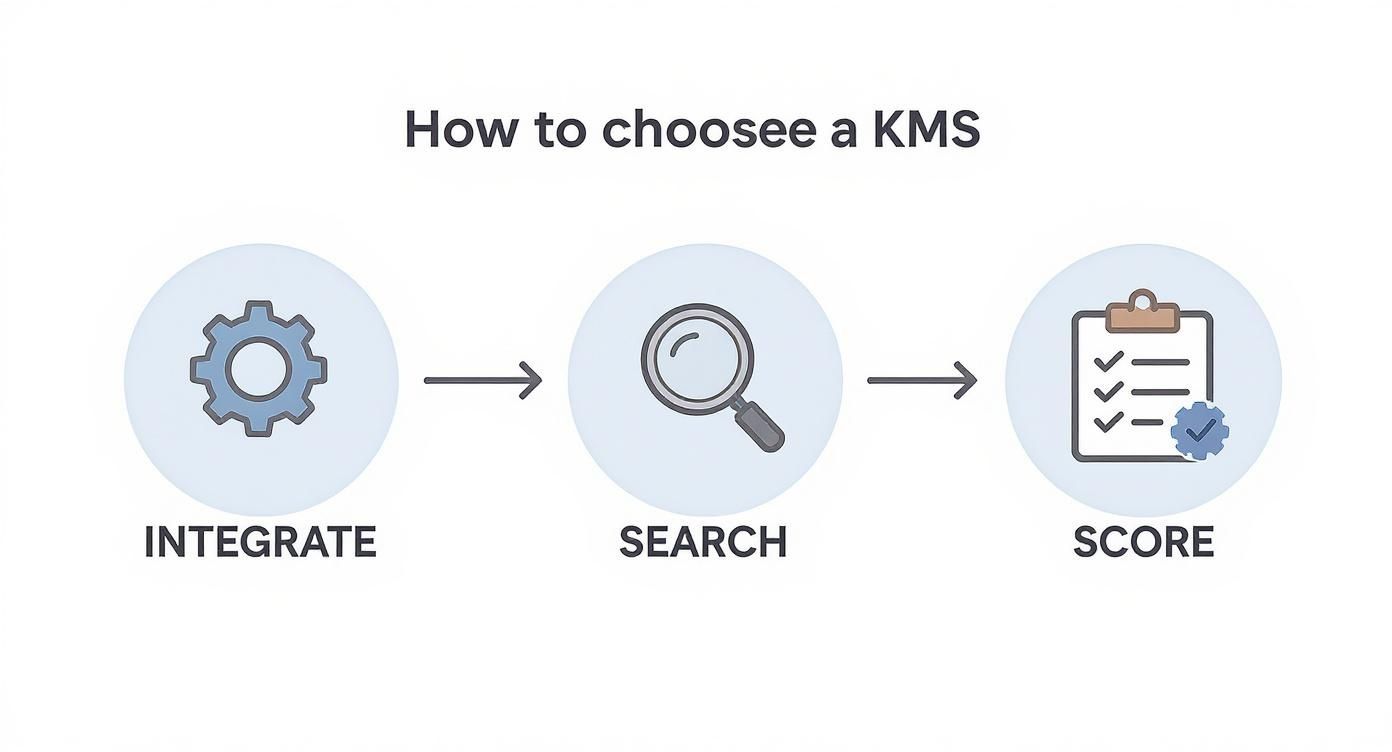
As the graphic shows, a great launch isn't about creating a new destination for people to visit. It’s about making knowledge a natural part of the work they’re already doing.
Deliver Immediate, High-Impact Wins
To get people excited, you need to show them value right out of the gate. Start with a quick and dirty knowledge audit. Forget trying to move every single document your company has ever created. That’s a recipe for disaster. Instead, sit down with your champions and pinpoint the top 5-10 most frequently asked questions or searched-for documents.
- What questions pop up constantly in your main Slack channels?
- Which onboarding processes always seem to trip up new hires?
- What crucial piece of information is currently stuck in one person's head or inbox?
Get that stuff into your KMS first. The moment a teammate asks one of those common questions in Slack and gets a perfect, instant answer from an AI assistant like SAI, the lightbulb goes on. That wow
moment is the most powerful change management tool you have. You can dig into more of these tactics by reviewing these 10 knowledge management best practices for 2025.
The key to driving adoption is to demonstrate quick, visible wins. Show your team how they can instantly resolve a complex issue that used to take hours of digging. That's how you turn skeptics into evangelists.
This approach turns the launch from some abstract IT project into a practical, everyday tool that just makes work easier. The demand for these solutions is exploding for a reason. The knowledge management software market, valued at USD 20.15 billion, is on track to hit USD 62.15 billion. According to Straits Research, that massive growth highlights just how badly companies need smarter ways to manage their collective intelligence.
How to Measure Your Business Transformation
So, how can you tell if your shiny new knowledge management system is actually pulling its weight? The answer isn't buried in vanity metrics like document uploads or login counts. The real proof is in the day-to-day, tangible shifts in how your team gets work done.
Let’s be clear: you're not just adding another piece of software to the stack. You’re making a real investment in changing how your business operates from the ground up. To justify that investment, you need to measure what actually matters—the outcomes that save precious time, slash frustration, and build a smarter, more self-sufficient organization.
Shifting from Activity Metrics to Impact KPIs
It’s time to stop tracking simple activity and start focusing on the Key Performance Indicators (KPIs) that prove your workforce is becoming more efficient and autonomous. These are the numbers that tell the real story of your ROI and paint a crystal-clear before and after
picture.
Think of it this way: your goal is to measure the friction you’ve successfully removed from everyone’s daily grind. When your KMS is truly working, your team spends less time hunting for answers and more time delivering high-value work.
The true measure of a great KMS is its invisibility. Success is when your team stops thinking about where to find information and simply asks for it, getting an instant answer without ever breaking their workflow.
This is the fundamental shift you're aiming for—from searching to asking. And that’s where your most powerful metrics live.
Key Metrics That Demonstrate Real Change
To build a rock-solid business case, you need to track a few critical KPIs that show the direct impact of your new system. These metrics are easy to grasp and tie directly to productivity and operational costs.
Here are the most important ones to get a handle on:
- Time Spent Searching for Information: This is the big one. Before you launch, survey your team to get a baseline for how much time they waste each week just looking for stuff. After your KMS has been in place for a bit, run the same survey. A major drop in search time is a direct line to reclaimed hours and a massive productivity boost.
- Reduction in Repetitive Questions: Pick your busiest Slack channels and, for one week, manually track how often the same basic questions pop up. After your KMS is live and your AI assistant is trained, measure again. A steep decline here is hard evidence that people are self-serving answers, which frees up your subject matter experts from being glorified help desks.
- Faster New Hire Onboarding Time: How long does it take for a new hire to become fully productive? This
time to value
is a huge hidden cost. A well-organized, easily searchable knowledge base absolutely crushes this metric, getting new folks contributing weeks sooner. In fact, research shows that organizations with effective knowledge management systems can slash their overall support costs by as much as 25%.
Visualizing Your Success
By focusing on these outcome-driven metrics, you completely change the conversation. It’s no longer about, Are people using the tool?
Instead, it becomes, How is this tool making our entire business better?
You’ll have the hard data to prove that your KMS isn't just another expense—it's the engine driving your company's efficiency, autonomy, and innovation.
Common Questions About Knowledge Management Systems
Bringing in any new tool is bound to stir up some questions. When teams start looking at modern knowledge management systems, a few common concerns always seem to bubble up. Let's tackle them head-on, so you can see past the buzzwords and understand the real-world impact on your team’s day-to-day.
The heart of these questions isn't really about the tech itself—it's about people. Will this genuinely make our jobs easier, or is it just one more login to remember and another platform to learn? Let's get into the nitty-gritty.
Will My Team Actually Use It?
This is the big one. Because if nobody uses it, the best system in the world is worthless. The biggest killer of any new tool is friction. If finding information means logging into a separate app, navigating a clunky interface, or even just switching browser tabs, people will default to what’s easiest: asking a coworker and interrupting their flow.
For any team that lives and breathes in Slack, this is non-negotiable. A knowledge system has to meet you where you already are.
A tool's success comes down to how easy it is to use. It needs to feel less like operating complex software and more like asking a question to the smartest person on your team.
When you can ask a question right inside the Slack channel you're already in, the biggest barrier to adoption simply vanishes. Getting an instant, accurate answer becomes the path of least resistance. That’s when adoption stops being a forced initiative and starts happening naturally.
How Do We Get Our Existing Documents Into The System?
Just thinking about a massive migration project—all that manual copying, pasting, and tagging—is enough to make anyone want to give up before they even start. The good news? With modern AI-powered systems, you don't have to.
The best tools today don't force you to move a single file. They simply connect to the places where your knowledge already lives, like:
Once you connect your accounts, the AI does the heavy lifting, indexing everything and making it all searchable from one spot. Your documents stay right where they are; you just get a much, much better way to find what's inside them. A smart approach is to start by connecting your most critical knowledge hubs first. You’ll see a huge impact right away, which proves the value and makes it easy to expand to other sources over time.
How Do We Keep Information From Getting Outdated?
This is the classic wiki problem, isn't it? A knowledge base quickly turns into a digital graveyard filled with outdated policies and forgotten project docs. That’s because keeping everything fresh has always been a manual, thankless task that nobody wants to own.
Here again, an AI-driven system completely changes the game. It flips knowledge maintenance from a reactive chore into a proactive, automated process.
For instance, the system can spot documents that haven't been touched in a while and automatically nudge the owner to give them a quick review. It's a simple, low-effort way to prevent bad information from causing problems down the line.
Even better, the AI can pay attention to the questions your team is asking. When people keep asking about something the system can't find an answer for, that’s a flashing neon sign pointing directly to a knowledge gap. This gives you a crystal-clear roadmap for what documentation you need to create next, ensuring your knowledge base is constantly evolving to meet the real needs of your team.
Ready to transform your team's workday from endless searching to instant answering? SAI learns from your existing Slack conversations to provide immediate, accurate responses, creating a zero-effort knowledge base that works where you do. Add SAI to a channel for free and see the difference today at https://sai-bot.ai.