AI in Slack: knowledge base example that delivers instant answers
How much of your team's day is lost to the search party? You know the drill. Someone pings you on Slack with a question you've answered a dozen times. You stop what you're doing, context switch, and start digging. Is the answer in Google Drive? A Confluence page from last year? Or buried deep in a Slack channel history? Each search is a small but significant drain on productivity, focus, and momentum. This cycle of hunt, find, and repeat costs teams thousands of hours and introduces constant friction into their workflow.
Imagine a different reality. A world where you never have to open another resource today. No more searching multiple places for a single piece of information. Instead, a team member simply asks a question in Slack and gets an instant, accurate answer. No more context switching. No more waiting for a reply. No more institutional knowledge walking out the door when an employee leaves. This isn’t about building yet another wiki that no one updates; it's about creating a single source of truth that lives and breathes where your team already works.
This article is your tactical guide to making that a reality. We're not just showing you generic templates; we are breaking down a powerful knowledge base example for every critical business need, from complex software documentation to internal HR policies. You will get copy-and-paste templates and, more importantly, the strategic blueprint to capture and surface this knowledge effortlessly within Slack. Prepare to end the search party for good and reclaim your team's most valuable asset: their time.
1. Software Documentation Knowledge Base
A Software Documentation Knowledge Base is the definitive source of truth for any tech product. Imagine your team no longer having to hunt through outdated documents or ping senior developers for API specs; instead, they get instant, accurate answers directly in Slack. This is a digital library designed to help developers and users understand, integrate, and troubleshoot software without ever needing to file a support ticket.
This type of knowledge base example is transformative. It houses everything from feature guides and API endpoint documentation to real-world code examples and step-by-step tutorials. By centralizing this critical information, you empower users to self-serve, which dramatically reduces the burden on your support and engineering teams. The goal is to create a frictionless experience where finding information is as simple as asking a question.

Why It's a Top-Tier Knowledge Base Example
Companies like Stripe and GitHub have set the gold standard with their developer documentation. Their success demonstrates how a well-maintained knowledge base can become a core part of the product experience, fostering user adoption and building a loyal developer community.
- Drastic Reduction in Support Tickets: When answers are easy to find, users solve their own problems.
- Faster Developer Onboarding: New hires can get up to speed on your codebase and APIs independently.
- Improved Product Adoption: Clear, accessible documentation removes barriers for users trying to implement your software.
Actionable Takeaways for Your Team
To build a world-class software documentation hub, focus on clarity, accessibility, and maintenance.
- Prioritize User Experience: Structure content logically with clear headings, a table of contents, and a powerful search function. Use real-world use cases and code snippets.
- Integrate with Your Workflow: Use a tool that connects your documentation directly to Slack. When a developer asks,
How do I authenticate with the API?
SAI can instantly pull the relevant article, complete with code examples, right into the channel. - Keep it Current: Your documentation is only valuable if it’s accurate. Implement a process to update articles with every single product release or API change.
2. SaaS Product Knowledge Base Template
A SaaS Product Knowledge Base Template provides a standardized foundation for your support hub, eliminating the guesswork of what to include. Imagine your customer success team no longer has to build a support portal from scratch; instead, they have a ready-made structure to populate, getting answers to users faster. It’s a pre-built framework with categories for onboarding, feature guides, and troubleshooting.
This type of knowledge base example is all about speed and consistency. It ensures every user gets the same high-quality, structured information, whether they're learning a new feature or solving a problem. By starting with a proven template, you empower your support team to focus on creating great content instead of designing layouts. The goal is to deploy a powerful self-service resource that feels intuitive and complete from day one.
Why It's a Top-Tier Knowledge Base Example
Companies like Notion and Help Scout thrive by offering powerful templates that users can adopt and customize. Their success shows that providing a solid starting point is critical for user empowerment. This approach not only streamlines internal processes but also significantly enhances the customer experience, building confidence and loyalty.
- Accelerated Time-to-Value: Launch a comprehensive and professional-looking knowledge base in a fraction of the time.
- Guaranteed Consistency: Ensure a uniform structure and user experience across all support articles.
- Reduced Support Overhead: Empower customers to find answers independently, freeing up your support agents for more complex issues.
Actionable Takeaways for Your Team
To leverage a SaaS product template effectively, focus on customization, user-centricity, and accessibility.
- Customize for Your Brand: Adapt the template to reflect your product’s unique terminology, features, and brand voice. Create distinct article templates for different user personas, like admins and end-users.
- Integrate Rich Media: Use the template's placeholders to embed video tutorials, GIFs, and screenshots. When a user in Slack asks,
How do I set up my dashboard?
SAI can deliver an article that includes a step-by-step video guide. - Choose the Right Foundation: Your template is only as good as the platform it's built on. Explore the best free knowledge base software options to find a solution that offers robust templating features and integrates seamlessly with your tools.
3. Internal Knowledge Management System
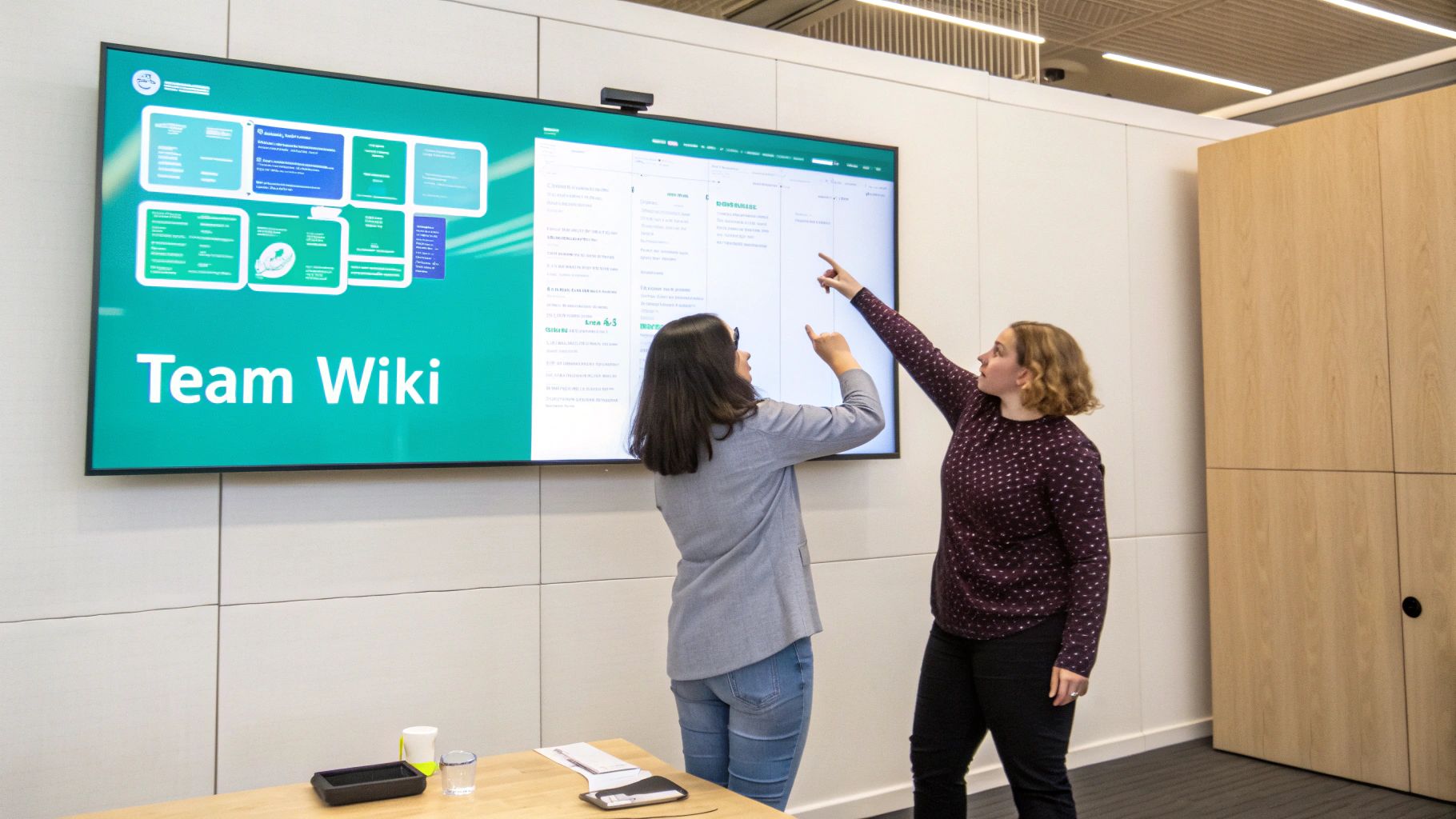
An Internal Knowledge Management System is your company’s single source of truth for all internal operations. Imagine your team never again having to ask where the latest marketing report is or what the onboarding process for a new client looks like; instead, they simply ask SAI in Slack and get the answer instantly. This is a centralized digital library for everything from standard operating procedures (SOPs) to company policies.
This type of knowledge base example is fundamental for scaling operations and breaking down information silos. It captures the invaluable institutional knowledge that often lives in scattered documents or in the minds of a few key employees. By centralizing this information, you empower every team member with the context they need to work efficiently, make informed decisions, and operate autonomously. This eliminates repetitive questions and frees up your senior staff to focus on high-impact work.
Why It's a Top-Tier Knowledge Base Example
Companies that use platforms like Atlassian Confluence or Notion as their internal hub demonstrate the immense value of accessible institutional knowledge. Their success proves that a well-organized internal wiki is not just a document repository but a strategic asset that fuels productivity and alignment across the entire organization.
- Eliminates Knowledge Silos: Makes critical information accessible to everyone, preventing dependencies on specific individuals.
- Accelerates Employee Onboarding: New hires can find answers to process and policy questions independently, getting up to speed faster.
- Improves Operational Consistency: Standardized procedures and documented best practices ensure everyone follows the same playbook.
Actionable Takeaways for Your Team
To create a powerful internal knowledge base, focus on making it easy to contribute to and consume. Learn more about how a Knowledge Management System can transform your team's workflow.
- Assign Clear Ownership: Designate a knowledge manager or a small team responsible for organizing content, promoting adoption, and ensuring information stays relevant.
- Integrate with Slack: Your team lives in Slack, so your knowledge should too. When someone asks,
What's our process for expense reports?
SAI can instantly pull up the official SOP right in the conversation, eliminating the need to search elsewhere. - Establish a Review Cadence: Knowledge becomes stale quickly. Schedule quarterly or biannual reviews of key documents to ensure they are accurate and reflect current processes.
4. Community-Driven Knowledge Base
A Community-Driven Knowledge Base is a powerful, crowdsourced ecosystem where your users are the experts. Imagine your most passionate users answering questions for newcomers in a dedicated Slack channel, with their best answers automatically captured and made searchable. This turns collective wisdom into an infinitely scalable resource, building a powerful knowledge base example with every interaction.
This approach transforms support from a one-way street into a dynamic, multi-directional conversation. Instead of your team being the sole source of truth, the entire community contributes, sharing unique use cases, troubleshooting tips, and real-world solutions. The result is a richer, more authentic knowledge base that grows organically and reflects how people actually use your product, all while reducing the content creation burden on your internal teams.
Why It's a Top-Tier Knowledge Base Example
Platforms like Stack Overflow and various Reddit communities have proven that collective intelligence is a game-changer. Their success illustrates how empowering users to help each other creates a self-sustaining ecosystem that builds loyalty, scales support, and generates invaluable product insights.
- Massively Scalable Support: Your knowledge base grows as your user base grows, without a linear increase in support staff costs.
- Authentic and Diverse Content: Users provide a wide range of solutions and perspectives that an internal team might never consider.
- Builds a Stronger Community: Empowering users to contribute fosters a sense of ownership and deepens their engagement with your brand.
Actionable Takeaways for Your Team
To cultivate a thriving community-driven knowledge base, you need to focus on moderation, incentives, and seamless integration.
- Establish Clear Guidelines and Moderation: Create a clear set of rules for content quality, tone, and accuracy. Appoint community moderators or use a reputation system to highlight trusted contributors and ensure information is reliable.
- Incentivize High-Quality Contributions: Recognize and reward your top contributors. This can be done through badges, exclusive access to features, or other perks that encourage users to share their expertise.
- Capture Knowledge Where It Happens: Use a tool that monitors public Slack channels. When a community member provides a stellar answer to a common question, SAI can capture that conversation, turn it into a verified knowledge article, and surface it the next time someone asks.
5. Video-Based Knowledge Base
A Video-Based Knowledge Base leverages the power of visual learning to explain complex processes. Imagine your team trying to master a new analytics dashboard; instead of deciphering dense text, they can watch a quick video in Slack that guides them through every click, making learning intuitive and fast. It's a dynamic library of screen recordings and tutorials designed to show, not just tell.
This type of knowledge base example is incredibly engaging, especially for visual learners. It's perfect for everything from product demos and feature tutorials to internal process training. By prioritizing video, you cater to modern learning preferences and make information more digestible and memorable. The goal is to eliminate confusion by providing clear, visual instructions that anyone can follow, reducing friction and accelerating mastery.
Why It's a Top-Tier Knowledge Base Example
Companies like Loom and Asana have championed video tutorials to explain their platforms, proving that a well-produced video can often be more effective than pages of text. Their success shows how video can simplify complexity and enhance the user onboarding experience.
- Higher Engagement and Retention: Visual and auditory information is processed more effectively by the brain, leading to better understanding and recall.
- Reduced Ambiguity: A video demonstration leaves little room for misinterpretation compared to written instructions alone.
- Accelerated Learning: Users can quickly grasp complex workflows by watching them in action, which speeds up training and adoption.
Actionable Takeaways for Your Team
To create an effective video-based knowledge base, focus on clarity, brevity, and accessibility.
- Keep Videos Short and Focused: Aim for videos under 5 minutes. Each video should cover a single, specific topic or task to make it easy for users to find exactly what they need.
- Make Content Accessible: Always include accurate transcriptions and captions. This not only helps those with hearing impairments but also allows users to search for keywords within the video content. When someone in Slack asks,
How do I create a new project?
SAI can find the video based on the transcript and share it. - Combine with Text: For complex topics, embed videos within a written article. This offers the best of both worlds, providing a quick visual guide alongside detailed written steps that users can reference.
6. AI-Powered Smart Knowledge Base
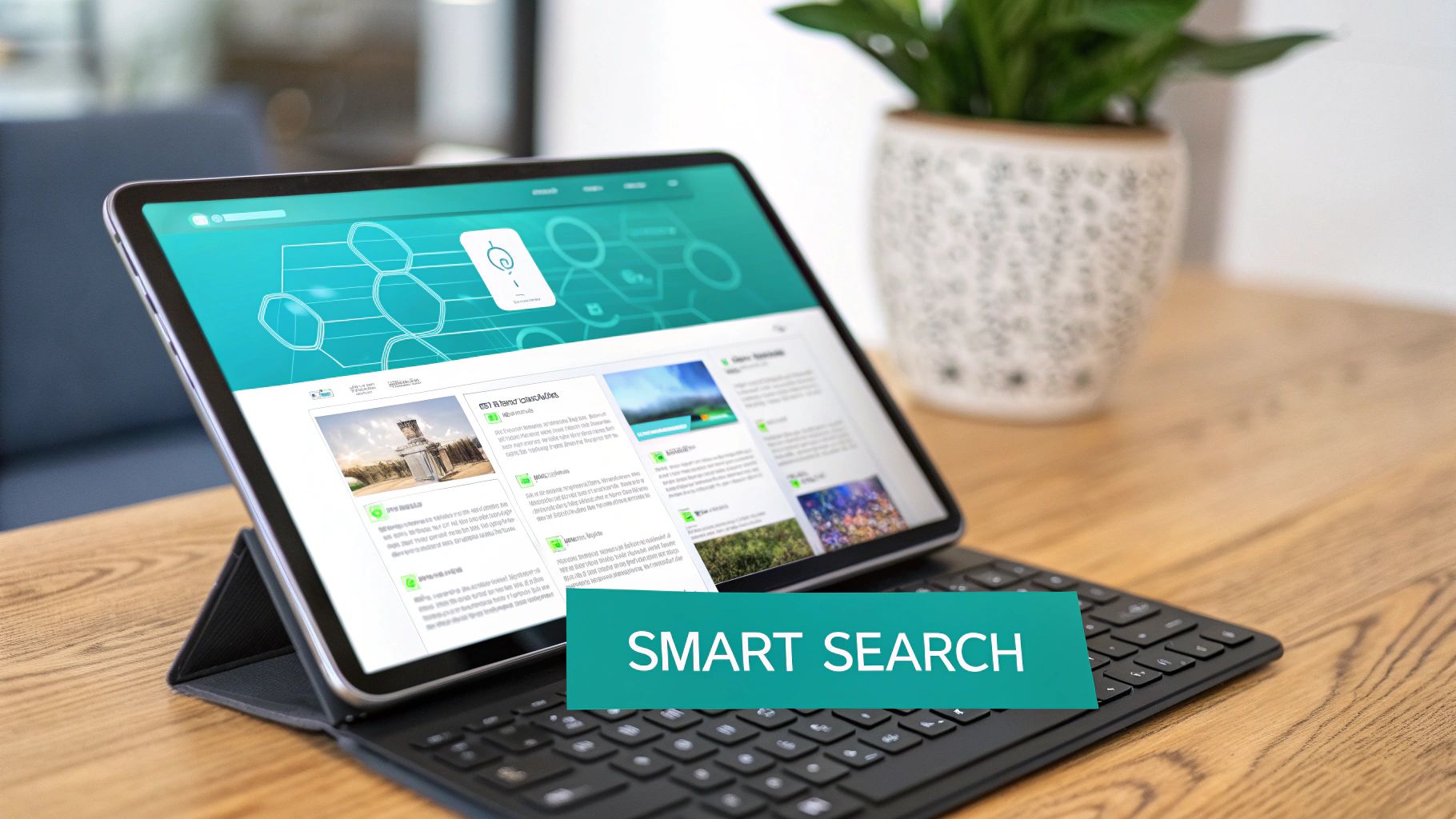
An AI-Powered Smart Knowledge Base is the evolution of information management. Imagine your team never having to sift through outdated wikis or search multiple platforms again; instead, they simply ask SAI a question in Slack and get an accurate, context-aware answer immediately. This intelligent system understands what your team needs and delivers answers directly within their workflow.
This type of knowledge base example completely transforms how information is accessed. It learns from every interaction, identifying knowledge gaps and predicting what your team needs before they even ask. By integrating with tools like Slack, it eliminates the friction of context-switching, making knowledge retrieval a seamless part of the daily conversation. The goal is to create an effortless experience where every employee has a personal expert on-demand.
Why It's a Top-Tier Knowledge Base Example
Companies like Intercom and Zendesk have pioneered this space, demonstrating how AI can turn a knowledge base from a passive repository into an active, intelligent assistant. Their success shows that embedding AI into support and internal operations doesn't just improve efficiency; it creates a fundamentally better user experience.
- Instant, Accurate Resolutions: AI understands natural language, delivering precise answers to complex questions without manual searching.
- Proactive Knowledge Curation: The system automatically identifies frequently asked questions and content gaps, prompting you to create the most needed documentation.
- Reduced Employee Onboarding Time: New hires get up to speed faster by asking questions in a conversational way, receiving instant guidance on processes, policies, and tools.
Actionable Takeaways for Your Team
To build an effective AI-powered knowledge base, focus on providing high-quality source material and integrating it deeply into your team’s daily tools.
- Start with High-Quality Content: Your AI is only as smart as the information you give it. Ensure your existing documentation is well-structured, up-to-date, and comprehensive before you begin.
- Integrate Directly into Slack: The true power of an AI knowledge base is its accessibility. Use a tool that allows employees to ask questions like,
What is our Q4 marketing budget?
and have SAI instantly pull the exact figures and context right into the channel. - Monitor and Refine: Use the AI's analytics to understand what your team is searching for. Regularly review its responses to ensure accuracy and use these insights to continuously improve your knowledge base content.
7. Industry-Specific Knowledge Base Framework
An Industry-Specific Knowledge Base Framework is a specialized repository built for unique regulatory and operational needs. Imagine your healthcare team instantly accessing HIPAA guidelines or your finance department pulling up the latest regulatory standards, all by asking a simple question in Slack instead of navigating complex compliance portals. This isn't a one-size-fits-all solution; it's a precision tool.
This type of knowledge base example is transformative because it bakes industry-specific rules directly into your team's daily workflow. It houses everything from legal case law references and financial compliance protocols to healthcare terminology. By centralizing this high-stakes information, you empower your team to operate confidently and compliantly, reducing risk and eliminating the frantic search for critical, sector-specific information.
Why It's a Top-Tier Knowledge Base Example
Companies like Epic Systems in healthcare and LexisNexis in the legal field have proven how indispensable these frameworks are. They don't just store information; they create a single source of truth that aligns directly with the stringent demands of their industries, turning compliance from a burden into a seamless operational advantage.
- Mitigates Compliance Risks: Centralizes up-to-date regulatory information, making it easy for teams to adhere to industry standards.
- Accelerates Specialized Onboarding: New hires in regulated fields can quickly learn the specific terminology, protocols, and compliance rules they need to know.
- Boosts Operational Efficiency: Eliminates time wasted searching for niche information, allowing teams to make faster, more informed decisions.
Actionable Takeaways for Your Team
To build an effective industry-specific knowledge base, focus on expertise, compliance, and accessibility.
- Consult with Subject Matter Experts: Collaborate with industry professionals to ensure your content is accurate, relevant, and comprehensive. Structure it with clear sections for regulatory content and glossaries.
- Integrate Compliance into Your Workflow: Use a tool that connects this specialized knowledge directly to Slack. When an employee asks,
What are our data retention policies under the new finance regulation?
SAI can instantly provide the documented answer, complete with links to the official standards. - Establish a Rigorous Update Schedule: Regulatory landscapes change constantly. Implement a strict process to review and update content in alignment with new laws, standards, and best practices to ensure it remains a reliable resource.
8. Self-Service Portal Knowledge Base
A Self-Service Portal Knowledge Base is your customer’s one-stop shop for answers. Imagine a world where your customers don't have to wait for a support agent; they just log in, search, and solve. It’s designed to empower customers to find solutions, manage their accounts, and troubleshoot issues entirely on their own by integrating a knowledge base with account tools and community forums.
This type of knowledge base example is more than just a collection of articles; it's a complete, interactive support experience. It centralizes all customer-facing resources, creating a single source of truth that deflects tickets and builds user confidence. The goal is to provide an intuitive, comprehensive hub where customers feel equipped to succeed with your product independently, strengthening their loyalty and reducing strain on your team.
Why It's a Top-Tier Knowledge Base Example
Industry leaders like Zendesk and Shopify have perfected the self-service model, demonstrating its power to enhance customer satisfaction while scaling support operations efficiently. Their portals are prime examples of how giving customers control over their support journey fosters a more positive and self-reliant user base.
- Significant Reduction in Support Volume: When customers can easily find their own answers, they don’t need to create a ticket for common questions.
- 24/7 Customer Support: A portal provides round-the-clock assistance, catering to a global audience without requiring a 24/7 support team.
- Improved Customer Satisfaction: Empowering users with self-service tools leads to faster resolutions and a greater sense of control and accomplishment.
Actionable Takeaways for Your Team
To build an effective self-service portal, focus on accessibility, comprehensiveness, and continuous improvement.
- Prioritize the Search Experience: Make the search bar the most prominent feature. Implement smart search with autocomplete and filters to help users find relevant content instantly.
- Create Clear Escalation Paths: Not every issue can be self-solved. Provide a clear, easy-to-find option to contact a human agent when a user gets stuck, preventing frustration.
- Use Analytics to Identify Gaps: Track search queries that yield no results and review user feedback on articles. This data is invaluable for identifying what content you need to create or improve next. You can learn more about the best internal knowledge base software options for 2025 to help power your portal.
8-Point Knowledge Base Comparison
| Item | Implementation Complexity 🔄 | Resource Requirements ⚡ | Expected Outcomes 📊 | Ideal Use Cases 💡 | Key Advantages ⭐ |
|---|---|---|---|---|---|
| Software Documentation Knowledge Base | 🔄 Medium–High — structured authoring, versioning | ⚡ Medium — technical writers, CMS, developer input | 📊 High — fewer tickets; better onboarding & SEO | 💡 APIs, developer docs, product reference | ⭐ Scalable, searchable, code examples, 24/7 availability |
| SaaS Product Knowledge Base Template | 🔄 Low — prebuilt structure, minimal setup | ⚡ Low — templates reduce authoring effort | 📊 Medium — faster launch; consistent content | 💡 Rapid launches, small teams, standardized products | ⭐ Speeds time-to-launch; enforces consistency |
| Internal Knowledge Management System | 🔄 Medium — governance, access controls, integrations | ⚡ Medium — KM owner, migration effort, platform costs | 📊 High — reduced onboarding time; less knowledge loss | 💡 SOPs, onboarding, cross-department knowledge | ⭐ Preserves institutional knowledge; improves consistency |
| Community-Driven Knowledge Base | 🔄 Medium — moderation workflows and governance | ⚡ Low–Medium — community managers, moderation tools | 📊 Medium — diverse solutions; higher engagement | 💡 Developer communities, crowd-sourced support, forums | ⭐ Scales content creation; builds community advocacy |
| Video-Based Knowledge Base | 🔄 Medium–High — production workflows and hosting | ⚡ High — recording, editing, captions, hosting | 📊 High — higher engagement & retention; fewer tickets | 💡 Complex workflows, visual tutorials, training | ⭐ Effective at demonstrations; repurposable content |
| AI-Powered Smart Knowledge Base | 🔄 High — ML models, semantic search, integrations | ⚡ High — AI infra, training data, monitoring | 📊 Very High — faster resolution; personalized support | 💡 Large-scale support, chatbots, personalized FAQs | ⭐ Improves search accuracy; automates and scales support |
| Industry-Specific Knowledge Base Framework | 🔄 High — compliance, domain modeling, audits | ⚡ High — expert input, legal review, ongoing updates | 📊 High — reduced compliance risk; faster industry onboarding | 💡 Regulated sectors (healthcare, finance, legal, education) | ⭐ Built-in compliance, industry credibility, targeted content |
| Self-Service Portal Knowledge Base | 🔄 High — portal integrations, personalization, UX | ⚡ High — dev resources, analytics, continuous content upkeep | 📊 High — significant ticket reduction; improved CSAT | 💡 Customer portals combining docs, status, and tickets | ⭐ Comprehensive self-service; reduces support costs and time |
Your Single Source of Truth is Already Here—in Slack
Throughout this guide, we’ve explored a wide range of knowledge base example templates, from intricate software documentation to dynamic community-driven hubs. We’ve analyzed SaaS product guides, internal IT protocols, and even video-based learning portals. But the single most powerful takeaway isn't found in any one template or format. It’s the realization that you don’t need to build a separate, cumbersome library that your team will inevitably forget to use.
Your organization's true single source of truth is already alive and growing, every single day, inside your Slack channels. The real challenge isn't creating more documentation; it's unlocking the immense value trapped within your team's existing conversations and workflows.
From Static Documents to Dynamic Answers
The examples we dissected aren't just different types of documents. They represent different categories of questions your team asks constantly.
* The Software Documentation
example is about answering, How does this feature work?
* The Internal Knowledge Management System
is about answering, What's our policy on X?
* The Self-Service Portal
is about answering, How do I fix this common problem myself?
Traditionally, solving this required meticulously crafting articles and hoping employees would find and read them. This old model forces your team to stop what they're doing, leave their primary communication hub, search an external system, and dig for an answer. It’s a workflow filled with friction, context switching, and wasted time.
The shift we're seeing is from building a place
for knowledge to delivering instant, contextual answers
where work happens. An AI-powered assistant doesn't ask your team to go find a knowledge base example; it brings the answer directly to their conversation in Slack. It transforms your team's collective intelligence into an on-demand utility.
Imagine Your Team's New Reality
Take a moment and picture what this transformation looks like for your team next week. Imagine a new hire getting onboarded not by chasing down mentors, but by asking questions in a channel and getting immediate, accurate answers drawn from past conversations and documents.
Imagine your senior engineers no longer being interrupted with the same basic questions about the codebase, freeing them to focus on complex problem-solving. Think of your HR and IT teams, liberated from the endless cycle of answering repetitive policy and troubleshooting queries. This isn't about simply generating documents; it's about eliminating the entire search for information
tax on your team's productivity.
The ultimate knowledge base isn't a destination. It's an intelligent, invisible layer that empowers every member of your team to be more autonomous, informed, and efficient. It stops the endless searching across drives, wikis, and old conversations. The right answer simply appears, right when and where it's needed. This is the future of knowledge management, and it’s built directly into the tool your team already lives in: Slack.
Ready to stop building archives and start delivering answers? Add SAI to your Slack workspace for free and watch as it instantly turns your team's conversations into a living, intelligent knowledge base. Transform your workflow in minutes by visiting SAI and creating your single source of truth today.