10 Transformative Knowledge Management Strategies for 2026
Imagine a workday where you never have to search for information again. No more digging through wikis, interrupting colleagues with a “quick question,” or waiting for an answer you know has been asked a dozen times before. Instead of hunting through endless folders or searching multiple platforms, you simply ask in Slack and get an instant, accurate response.
This isn't a futuristic dream; it's the tangible result of adopting modern knowledge management strategies that actually work. Traditional approaches bury your team’s most valuable asset-its collective knowledge-in forgotten documents and clunky, outdated intranets. This friction costs your team thousands of hours in lost productivity and creates a constant cycle of repetitive questions that grinds progress to a halt. The single source of truth
becomes a dozen scattered, inconsistent sources that no one trusts.
In this guide, we cut through the noise. We will explore 10 prioritized, actionable strategies designed to meet your team right where they already work. You will learn how to transform Slack from a primary source of interruptions into a centralized hub of instant, reliable knowledge. We'll provide step-by-step implementation tips, Slack-focused examples, and measurable outcomes for each strategy, showing you how to build a system that captures, retrieves, and scales team intelligence automatically.
Get ready to reclaim your team’s focus and empower everyone to do their best work, free from the constant context switching and information bottlenecks. It's time to stop searching and start knowing.
1. Conversational Knowledge Capture
Stop forcing your team to document everything. The most valuable, up-to-date knowledge in your company isn’t sitting in a static wiki; it’s flowing through everyday conversations. Conversational Knowledge Capture is one of the most transformative knowledge management strategies because it meets your team where they already work, automatically preserving the expertise shared in real-time communication channels like Slack.
Instead of interrupting workflows with tedious documentation tasks, this strategy uses AI to identify and index critical information directly from team discussions. Imagine a world where you no longer need to hunt through old channels, search multiple platforms, or ping a colleague for an answer you know was shared last week. You just ask in Slack, and the answer, sourced from a past conversation, appears instantly. All that collective intelligence is captured effortlessly, ready for anyone to access.

Why It Works So Well
This approach excels because it’s frictionless. It recognizes that solutions to complex problems, client-specific details, and internal process clarifications happen organically in chat. By capturing this knowledge at the source, you build a living, breathing knowledge base that reflects how your team actually operates, not how you wish they would document.
How to Implement Conversational Capture
- Choose Your Tool: Implement a platform designed for this purpose. For example, a tool like SAI integrates directly into Slack, learning from public channel discussions to build a repository of verifiable answers without manual effort.
- Establish Clear Guidelines: Decide which channels contain the most valuable
knowledge-rich
conversations. Focus on support, project, and team-specific channels first. - Encourage Detailed Problem-Solving: Foster a culture where team members explain their reasoning and solutions clearly in public channels. This creates higher-quality source material for the AI to learn from.
- Create a Feedback Loop: Regularly review and validate the captured knowledge. Tools like SAI allow subject matter experts to approve, edit, and refine answers, ensuring the system becomes more accurate over time.
2. Distributed Knowledge Base Architecture
The idea of a single, all-encompassing company wiki is outdated. A truly effective strategy embraces the reality of modern work: knowledge lives where work happens. A Distributed Knowledge Base Architecture connects the dots between the tools your teams already use, like Slack, project management software, and code repositories, creating a unified network of information.
This approach doesn't force your engineering team to leave GitHub or your support team to abandon their ticketing system. Instead, it intelligently syncs and surfaces knowledge from these specialized platforms, making it accessible from a central point of contact. Imagine your team asking a question in Slack and getting an answer sourced directly from a GitHub wiki, without ever needing to open another app. This is one of the most powerful knowledge management strategies for a modern, tool-diverse company.
Why It Works So Well
This strategy succeeds because it doesn’t fight against established workflows; it enhances them. By integrating disparate knowledge sources, you eliminate the friction of tool-switching and ensure that valuable, team-specific information isn’t siloed. It meets each department on their own turf while providing a universal access point, boosting adoption and preventing knowledge from becoming fragmented or lost.
How to Implement a Distributed Architecture
- Identify Your Knowledge Hubs: Map out where each team’s most critical information is created and stored. Common hubs include GitHub for developers, a CRM for sales, and SharePoint for HR.
- Choose a Central Integration Tool: Implement a system that can connect these disparate sources. A tool like SAI acts as the intelligent layer, retrieving information from various platforms and delivering answers directly in Slack.
- Establish Clear Ownership: Define which team is responsible for the knowledge in each specific tool. This ensures that the information remains accurate and up-to-date at its source. For a deeper dive into structuring your system, explore this ultimate internal knowledge base guide.
- Promote a Central Query Point: Train your team to ask questions in one primary place, like a dedicated Slack channel. This allows your integration tool to do the heavy lifting of searching across all connected platforms, delivering a seamless experience.
3. AI-Powered Contextual Answers
Stop treating your knowledge base like a library where you need the exact Dewey Decimal System to find anything. Your team doesn't search for information with perfect keywords; they ask questions naturally, often with typos, slang, or unique phrasing. AI-Powered Contextual Answers is one of the most impactful knowledge management strategies because it understands intent, not just text. It’s the difference between a search bar that returns zero results and an intelligent assistant that knows wifi password
and how do I get on the internet
mean the same thing.
This approach uses advanced AI to decipher the context and meaning behind a question, delivering the precise answer instantly within your workflow. Imagine your team never having to leave Slack to hunt through five different platforms or rephrase a search query a dozen times. They simply ask a question in Slack, and the AI delivers the correct information, sourced directly from your collective knowledge, without any of the usual friction.

Why It Works So Well
This strategy eliminates the search query guesswork
that plagues traditional knowledge bases. It dramatically reduces repetitive questions and frees up your subject matter experts from being human search engines. By understanding the user's true intent, it delivers a superior experience that encourages adoption and makes finding information feel effortless, not like a chore.
How to Implement Contextual Answers
- Deploy an AI-Powered Tool: Integrate a solution built for contextual understanding directly into your primary communication hub. For instance, a tool like SAI lives in Slack and uses AI to interpret the nuances of employee questions, providing instant and accurate answers without requiring precise wording.
- Establish a Feedback Mechanism: Your AI is a learning machine. Implement a process for users to verify or correct answers. This creates a powerful feedback loop that continually refines the system’s accuracy and relevance.
- Analyze Query Patterns: Regularly review the questions people are asking. These analytics reveal critical knowledge gaps and show you how your team naturally phrases their inquiries, helping you improve your knowledge base content.
- Enrich with Diverse Examples: When documenting information, include common variations and examples of how the knowledge applies in different scenarios. You can learn more about how AI delivers instant answers in Slack and see how it works in practice.
4. Just-In-Time Knowledge Delivery
Stop making your team hunt for answers. The best knowledge is useless if it’s not available the moment a question arises. Just-In-Time Knowledge Delivery is one of the most powerful knowledge management strategies because it brings information directly to your team within their existing workflow, precisely when they need it. This eliminates the costly context-switching of searching wikis, folders, or asking colleagues for help.
This strategy shifts the burden of knowledge retrieval from the employee to the system. Instead of remembering where to look, team members simply ask a question in Slack and get an immediate, relevant answer without ever leaving their conversation. Imagine your team closing support tickets faster or resolving project blockers in seconds because the correct information appears instantly, right where the work is happening.
Why It Works So Well
This approach is highly effective because it removes friction and boosts productivity. By delivering answers in the flow of work, you empower your team to make faster, more informed decisions. It transforms knowledge from a passive, stored asset into an active, on-demand resource that directly supports task completion and operational efficiency.
How to Implement Just-In-Time Delivery
- Integrate Knowledge Into Your Workflow: Choose a tool that operates where your team communicates. A platform like SAI lives inside Slack, delivering verified answers instantly when questions are asked in-channel, acting as an always-on expert.
- Optimize for Speed: The
just-in-time
promise hinges on instant delivery. Test your system's response times to ensure answers appear without delay, preventing users from reverting to slower, manual methods. - Prioritize Scannable Answers: Format knowledge to be concise and easily digestible. Use bullet points and bold text so users can grasp the key information in seconds and get back to their work. Provide links to more detailed documentation for those who need it.
- Monitor and Identify Gaps: Track the questions your team asks. This data is invaluable for identifying blind spots in your knowledge base and understanding where more support is needed, allowing you to proactively fill knowledge gaps.
5. Community-Driven Knowledge Contribution
Stop treating knowledge management as a top-down mandate. The most practical and resilient expertise isn't owned by a single department; it’s distributed across your entire team. Community-Driven Knowledge Contribution is one of the most sustainable knowledge management strategies because it empowers everyone to collaboratively build, refine, and own the company's collective intelligence.
This approach transforms documentation from a chore into a shared responsibility, mirroring the community-led models of Wikipedia or Stack Overflow. Instead of a few designated experts creating content in isolation, this strategy harnesses the frontline insights of practitioners who solve real-world problems every day. Imagine a knowledge base that grows organically as your team members share their discoveries, best practices, and solutions, creating a resource that is constantly evolving and improving from the ground up.
Why It Works So Well
This strategy thrives because it fosters a sense of ownership and relevance. When employees contribute to the knowledge base, they are more invested in its quality and accuracy. It recognizes that the person who just solved a tricky customer issue or optimized a workflow is the best person to document that solution, ensuring the information is practical, timely, and field-tested.
How to Implement Community-Driven Contribution
- Lower the Barrier to Entry: Make contributing knowledge as simple as possible. Instead of complex forms, allow team members to contribute directly within their workflow, such as flagging a valuable Slack conversation for inclusion in the knowledge base.
- Create Dedicated Spaces: Establish specific Slack channels for different domains or
communities of practice,
like#dev-best-practicesor#marketing-analytics. This encourages focused discussions where experts can share and validate information. - Implement Recognition Systems: Acknowledge and reward top contributors. This can be as simple as a shout-out in a company-wide channel, a
knowledge champion
role, or small bonuses. Public recognition motivates participation and highlights valuable expertise. - Establish a Lean Review Process: Use peer reviews or subject matter expert approvals to ensure quality without creating bottlenecks. An AI-powered tool like SAI can help by suggesting knowledge from conversations and routing it to the right expert for quick validation, automating much of the curation process.
6. Asynchronous Communication and Documentation
Break free from the meeting-heavy culture that drains productivity. Instead of relying on real-time conversations that exclude team members in different time zones, this strategy champions creating durable, written knowledge. Asynchronous Communication and Documentation is one of the most effective knowledge management strategies for remote and distributed teams, ensuring everyone has equal access to information, regardless of when or where they work.
This approach prioritizes capturing expertise in formats that persist, can be consumed on demand, and are easily searchable. Imagine a new hire getting up to speed by reviewing a detailed project thread in Slack or a developer solving a bug by watching a pre-recorded Loom video, all without scheduling a single meeting. Knowledge becomes a reusable asset, not an ephemeral conversation lost in a video call.
Why It Works So Well
This strategy thrives because it decouples communication from time. It fosters deep, focused work by reducing interruptions from instant pings and unnecessary meetings. By documenting processes and decisions in writing, you create a single source of truth that is more reliable and scalable than individual memory, empowering team members to find answers independently and inclusively.
How to Implement Asynchronous Documentation
- Standardize Your Formats: Create simple templates for common documentation needs, like project briefs, meeting summaries, and how-to guides. Consistency makes information easier to find and consume.
- Document as You Work: Encourage the habit of documenting solutions right after they are found. A quick summary of a solved problem in a Slack thread can become a permanent, searchable answer for the entire team.
- Embrace Visuals: Supplement text with screenshots, diagrams, and short video recordings (e.g., using Loom). Visual aids often explain complex processes far more clearly and quickly than words alone.
- Automate Asynchronous Answers: Use a tool like SAI to capture the knowledge shared in public Slack channels and make it instantly available 24/7. This turns your team’s asynchronous discussions into an automated FAQ, allowing anyone to get verified answers without waiting for a colleague to come online.
7. Automated Repetitive Question Handling
Stop letting the same five questions derail your team’s focus every single day. Automated Repetitive Question Handling is one of the most impactful knowledge management strategies for freeing up your experts’ time. Instead of subject matter experts manually answering questions about benefits, software access, or project statuses over and over, this approach uses AI to instantly provide verified answers directly where the questions are asked.
This strategy transforms your team's workflow by eliminating the constant shoulder taps
in Slack that kill productivity. Imagine a new hire asking a question about their onboarding schedule in Slack and getting an instant, correct answer without ever interrupting HR. This is a workday where your experts stay focused on their real jobs, and everyone else gets the information they need without delay.
Why It Works So Well
This method delivers an immediate and measurable return on investment by tackling high-volume, low-complexity questions. It works because it provides instant gratification for the question-asker and uninterrupted focus for the expert. By automating the mundane, you preserve your team’s most valuable resource: their attention for critical, high-value tasks.
How to Implement Automated Question Handling
- Identify Top Repetitive Questions: Start by analyzing your Slack channels. Pinpoint the questions that appear most frequently in #hr, #it-support, or team-specific channels. These are your prime candidates for automation.
- Deploy an Automation Tool: Implement an AI-powered tool like SAI that integrates directly into Slack. It can learn from existing conversations and documentation to begin answering these FAQs automatically.
- Create Clear Escalation Paths: Ensure there's a seamless process for questions the AI can't answer. The system should make it easy to tag a human expert when a query is too complex or novel for the automated system.
- Review and Refine: Regularly check the performance metrics of your automation. Use feedback on answer quality to refine and update the knowledge base, ensuring the information remains accurate and helpful. For a deeper dive, explore this guide to ending repetitive Slack questions.
8. Knowledge Lifecycle Management
Don’t let your knowledge base become a digital graveyard of outdated information. Stale answers erode trust and cause more confusion than they solve. Knowledge Lifecycle Management is one of the most critical knowledge management strategies because it treats information as a living asset with a distinct lifecycle: creation, validation, use, refinement, and eventual archival.
This approach ensures that the answers your team relies on are always accurate, relevant, and trustworthy. Instead of treating every piece of documentation as eternally true, it implements a system for regular review and updates. Imagine a world where every answer you find comes with a stamp of recent verification, eliminating the doubt and second-guessing that plague outdated wikis. Your team can act with confidence, knowing the information is current.
Why It Works So Well
This strategy directly combats knowledge decay. Processes evolve, products update, and policies change. Without a lifecycle approach, your knowledge base quickly falls out of sync with reality, forcing team members to constantly ask, Is this still correct?
By building in processes for review and deprecation, you maintain a high-trust information environment where the right answer is also the current answer.
How to Implement Knowledge Lifecycle Management
- Assign Clear Ownership: Every piece of knowledge, whether a wiki page or an AI-captured answer, must have a designated owner responsible for its accuracy.
- Establish Review Cadences: Set automated reminders for owners to review their knowledge assets on a regular schedule (e.g., quarterly for processes, monthly for product details). A tool like SAI can tag subject matter experts to verify answers directly in Slack, making this process seamless.
- Create Simple Update & Archival Processes: Make it easy for owners to update information or mark it as obsolete. Archived knowledge should remain searchable for historical context but clearly flagged as outdated.
- Track Verification Dates: Display a
Last Verified On
date for all knowledge. This simple data point builds immediate trust and empowers users to gauge the relevancy of an answer at a glance.
9. Role-Based Knowledge Access and Personalization
Stop overwhelming your team with irrelevant information. Not everyone needs access to everything, and flooding your engineers with sales collateral or your sales team with deployment scripts is a recipe for confusion. Role-Based Knowledge Access is one of the most effective knowledge management strategies because it tailors information delivery to an individual's specific function, ensuring they see only what's relevant to them.
This approach filters the noise, delivering personalized knowledge that accelerates onboarding, reduces errors, and empowers employees to find what they need without sifting through a sea of data. Imagine a new marketing hire seeing a curated feed of brand guidelines and campaign playbooks, while a senior developer gets immediate access to architectural documents and API keys, all within the same system. This is the power of personalized access.
Why It Works So Well
Relevance is speed. By presenting information in the context of someone’s role, you eliminate the cognitive load of determining what applies to them. This dramatically improves efficiency and decision-making. It also enhances security by ensuring sensitive information like financial data or HR policies is only accessible to authorized personnel, minimizing risk.
How to Implement Role-Based Access
- Map Your Organizational Roles: Start by clearly defining the distinct roles and departments in your company. Document the unique knowledge requirements for each, such as different onboarding materials for sales versus engineering.
- Tag Knowledge with Metadata: Tag every piece of content with relevant role or department metadata. This allows your knowledge management system to filter and display information correctly based on user profiles.
- Build Role-Specific Pathways: Create curated
knowledge pathways
or dashboards. A manager’s view might show team performance data, while an individual contributor sees project-specific tasks and documentation. - Automate with Smart Tools: A platform like SAI can leverage user roles within Slack to deliver personalized answers. When a question is asked, it can consider who is asking and provide a response tailored to their department's known processes or access level, ensuring the information is always contextual and appropriate.
10. Analytics-Driven Knowledge Optimization
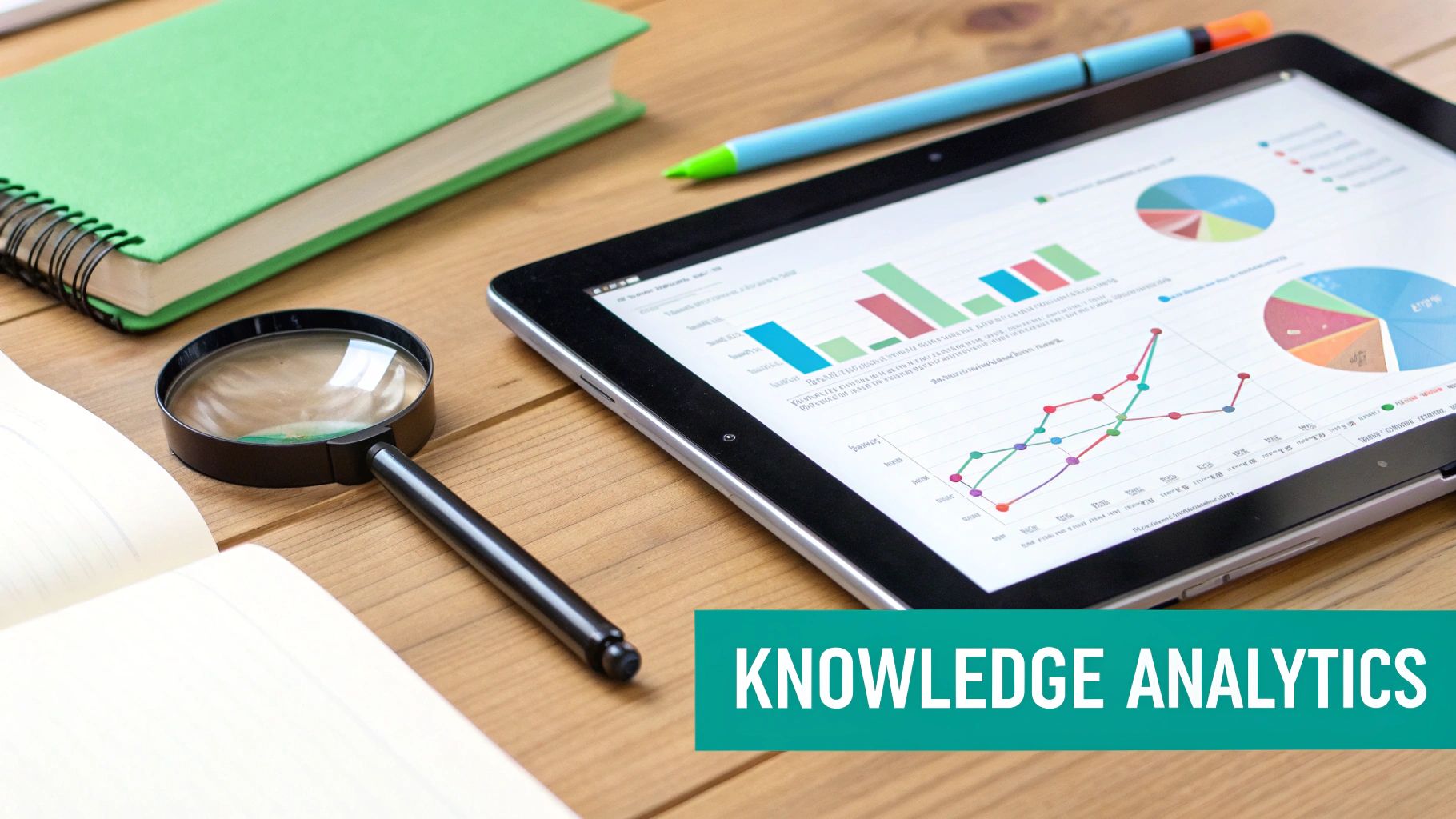
Stop guessing what your team needs to know. Instead of managing knowledge based on assumptions, use data to pinpoint exactly where your system is succeeding and where it’s falling short. Analytics-Driven Knowledge Optimization is one of the most powerful knowledge management strategies because it replaces intuition with hard evidence, ensuring your efforts are focused on high-impact improvements.
This strategy involves using metrics to understand what questions are asked most frequently, which answers are most helpful, and where critical knowledge gaps exist. Imagine having a dashboard that shows you the top 10 questions your team couldn't answer last week, allowing you to proactively create documentation that solves real, recurring problems. It’s about making your knowledge base smarter, more efficient, and demonstrably more valuable.
Why It Works So Well
This approach provides a clear, objective view of your knowledge management ROI. It transforms knowledge management from a cost center into a strategic asset by showing exactly how it improves key business outcomes, such as reduced ticket resolution times, faster employee onboarding, and fewer interruptions for subject matter experts.
How to Implement Analytics-Driven Optimization
- Establish Baseline Metrics: Before making changes, benchmark your current state. Measure metrics like the volume of questions in key Slack channels, average response times, and employee satisfaction with information access.
- Leverage Built-in Analytics: Use tools with robust reporting. For instance, SAI’s analytics dashboard reveals the most frequently asked questions, identifies unanswered queries, and calculates the cost savings generated by automated answers.
- Create Visibility: Build and share dashboards that track the health of your knowledge system. Make these metrics visible to team leads and stakeholders to foster a data-informed culture and demonstrate value.
- Act on Insights Regularly: Schedule monthly or quarterly reviews to analyze the data. Use these insights to identify top unanswered questions, refine popular answers, and set clear, data-driven goals for continuous improvement.
10-Point Knowledge Management Strategies Comparison
| Strategy | 🔄 Implementation Complexity | ⚡ Resource Requirements | ⭐ Expected Outcomes | 📊 Ideal Use Cases | 💡 Key Advantages / Tips |
|---|---|---|---|---|---|
| Conversational Knowledge Capture | Medium — integrate with chat + monitoring | Medium — integrations, storage, moderation | ⭐⭐⭐⭐ — captures tacit, current answers in context | High-chat teams (Slack), support, ops | Low friction; captures real conversations; tip: validate periodically |
| Distributed Knowledge Base Architecture | Low–Medium — cross-tool integrations | Medium — APIs and sync infrastructure | ⭐⭐⭐⭐ — higher adoption, less context-switching | Cross-functional teams using multiple tools | Meets users where they work; tip: enable cross-platform search |
| AI-Powered Contextual Answers | High — NLU models, training pipelines | High — training data, compute, model ops | ⭐⭐⭐⭐⭐ — high relevance, fewer failed searches | Complex queries, enterprise knowledge retrieval | Understands intent; tip: monitor confidence and feedback loops |
| Just-In-Time Knowledge Delivery | Medium — context triggers + fast retrieval | Medium — real-time infra, low-latency caching | ⭐⭐⭐⭐ — faster decisions, reduced switching cost | In-workflow help, customer support, remote teams | Delivers answers when needed; tip: ensure sub-second response times |
| Community-Driven Knowledge Contribution | Medium — governance + moderation workflows | Low–Medium — engagement tooling, review capacity | ⭐⭐⭐⭐ — broad, practical coverage over time | Developer teams, knowledge-sharing cultures | Diverse perspectives; tip: use reputation and clear review rules |
| Asynchronous Communication and Documentation | Low–Medium — process and standards | Medium — time to create and maintain content | ⭐⭐⭐⭐ — searchable, timezone-friendly knowledge | Distributed teams, onboarding, training | Persistent reference materials; tip: use templates and review cadence |
| Automated Repetitive Question Handling | Low — pattern detection + automation rules | Low — initial setup, ongoing monitoring | ⭐⭐⭐⭐ — fewer interruptions, cost savings | HR FAQs, onboarding, common support queries | Saves time on routine Qs; tip: define clear escalation paths |
| Knowledge Lifecycle Management | High — workflows, approvals, ownership | Medium–High — owners, review schedules, tooling | ⭐⭐⭐⭐ — maintains accuracy and trust | Regulated environments, evolving processes | Keeps content fresh; tip: assign owners and regular reviews |
| Role-Based Knowledge Access & Personalization | Medium — role mapping and access controls | Medium — metadata, personalization engine | ⭐⭐⭐⭐ — improved relevance, less overload | Large orgs, role-specific onboarding | Reduces noise for users; tip: tag content by role and audit access |
| Analytics-Driven Knowledge Optimization | Medium–High — analytics stack + reporting | Medium–High — data collection, analysts, dashboards | ⭐⭐⭐⭐ — identifies gaps, measures ROI | Scaling KM programs, prioritization, leadership reporting | Data-driven improvements; tip: track both qualitative and quantitative metrics |
Your Day Without Interruptions Starts Now
We’ve explored ten powerful knowledge management strategies, from conversational capture to analytics-driven optimization. Each one represents a piece of a larger puzzle: reclaiming your team's focus and unlocking its collective intelligence. The core lesson isn't about adopting every single strategy at once. It’s about recognizing that the old way of managing knowledge, through static wikis, scattered documents, and endless shoulder taps, is fundamentally broken. It costs you more than just time; it costs you momentum, innovation, and employee sanity.
The true transformation lies in shifting from a system where people hunt for information to one where information finds them. Imagine your workday, but without the constant context switching. No more digging through Confluence pages for a process doc from last year. No more interrupting your top engineer for the third time this week with the same onboarding question. No more searching three different shared drives for a single client file. This is the tangible outcome of effective knowledge management strategies.
From Strategy to Effortless Reality
The path forward isn't about implementing a complex, top-down system that requires months of training. It’s about meeting your team where they already work and making knowledge sharing a natural byproduct of their daily conversations. By embedding intelligence directly into your workflow, you make the right answer the easiest one to find.
Consider the most impactful takeaways from our discussion:
- Capture Knowledge at the Source: Your most valuable insights are already being shared in Slack. The key is to capture them automatically, without adding another task to anyone's plate.
- Deliver Answers, Not Links: Team members need immediate, contextual answers, not a list of documents to read through. AI-powered contextual delivery is non-negotiable for modern teams.
- Automate the Repetitive: A significant portion of internal questions are duplicates. Automating the response to these frees up your experts to focus on high-value, strategic work.
These principles form the foundation of a truly modern approach. This isn't just theory; it's a practical roadmap to a more productive, less stressful work environment.
The Future of Your Team's Knowledge is Here
The ultimate goal of any knowledge management strategy is to create a seamless, self-sustaining ecosystem of information. It's an environment where a new hire feels as empowered as a senior leader because they have instant access to the team's entire history of decisions, processes, and solutions. It’s a culture where asking a question in a public channel is celebrated because it contributes to a shared brain that benefits everyone.
By implementing these strategies, you’re not just organizing information; you are fundamentally upgrading your company's operational nervous system. You are building a resilient, intelligent organization that can adapt, scale, and innovate faster than the competition. The focus and deep work you've been chasing are not out of reach. They are the direct result of having the right knowledge, in the right place, at the right moment. Your day without interruptions is not a distant dream; it's a strategic choice you can make today.
Ready to turn these strategies into your team's reality without the heavy lifting? SAI integrates directly into your Slack workspace, automatically capturing knowledge from conversations and providing instant, accurate answers when your team needs them most. Start building your team's effortless knowledge base today by adding SAI to a Slack channel for free.