The Ultimate Internal Knowledge Base Guide for Productive Teams
Imagine a workday where you never have to open another tab to hunt for information. No more digging through shared drives, no more scrolling through endless chat histories, and no more interrupting your teammates for answers you know are floating around somewhere.
Instead, you just ask a question right inside Slack, and the correct answer appears in seconds. That's the power of a modern internal knowledge base. It's not another piece of software to manage; it's a seamless transformation of your workflow, turning your team's biggest source of friction into its greatest strength.
End the Endless Search for Information
Let's be honest, how much of your day is spent just looking for stuff? You're digging through old emails for client feedback, scrolling through a month's worth of Slack messages for a link someone shared, or tapping a coworker on the shoulder for a question you know has been answered before. Each little search is a detour, pulling you out of your flow and killing your momentum.
This constant hunt isn't just a minor annoyance; it's a massive, hidden tax on your team's productivity. Studies have shown that knowledge workers can spend nearly 20% of their workweek just searching for internal information. That's a full day, every week, lost to navigating a maze of disconnected documents, outdated wikis, and buried chat threads. This chaos creates friction, stalls projects, and just plain burns people out.

From Chaotic Search to Instant Answers
Now, imagine a different world. Instead of juggling a dozen tabs and bothering your teammates, you just ask a question right where you're already working, like inside Slack. Seconds later, a clear, accurate answer appears. You never left the conversation, you never lost your train of thought. This isn't some futuristic dream; it’s how high-performing teams operate with a modern internal knowledge base.
This is about shifting from a culture of searching to a culture of knowing. It’s about creating a work environment where information finds the people who need it, exactly when they need it. Think of it as the difference between digging through a messy attic and walking into a perfectly organized library with a super-smart librarian on call 24/7.
A modern internal knowledge base eliminates the context-switching and mental tax that comes from information chaos. It’s about reclaiming your team’s focus and empowering everyone to move forward without friction.
When you make this shift, the impact on your team is immediate and profound. It means:
- No more repetitive questions: Those common questions about HR policies, project specs, or IT setups get answered once and are captured forever.
- Faster onboarding: New hires can find answers on their own, becoming productive members of the team without constantly needing hand-holding.
- Consistent decision-making: Everyone is working from the same playbook, which keeps teams aligned and projects on track.
Ultimately, a great internal knowledge base does more than just store information. It gives your team back its most valuable asset: time. It builds a seamless workflow where answers are instant, interruptions disappear, and people can finally focus on the work that actually matters.
What Is a Modern Internal Knowledge Base?
Let’s be honest: when you hear internal knowledge base,
you probably picture a dusty, forgotten company wiki. A digital graveyard of outdated documents that no one trusts and even fewer people use. That’s the old way.
A modern internal knowledge base is something completely different. It’s a living, breathing ecosystem—a true shared brain
for your entire team. It doesn't just store information; it actively learns from every single conversation, decision, and solution your team generates.
This isn’t a library you have to manually stock. It’s an intelligent partner that remembers who asked about the new server setup, who had the answer, and what the final fix was. It becomes your company's memory, always on and ready to help, without demanding constant upkeep.

From Manual Data Entry to Organic Knowledge Capture
The old way of building a knowledge base was a nightmare. It was all about tedious data entry, endless meetings to document procedures, and nagging people to become wiki gardeners.
The result? A repository that was often out of date the second you hit publish.
It's no wonder so many of them fail.
The modern approach completely flips the script. Instead of forcing your team to feed some separate, clunky system, it captures knowledge organically, right from the conversations you’re already having in tools like Slack. This is where AI assistants like SAI change everything.
SAI works quietly in the background of your team’s chats. When a senior developer answers a question about deployment or the finance lead clarifies the expense policy, SAI captures it. That single interaction, which would normally vanish into the scrollback, is instantly preserved as a permanent, searchable piece of your company's intelligence.
This shift transforms knowledge management from a chore into an automatic byproduct of daily work. The goal is no longer to build a knowledge base but to simply let it grow from the valuable conversations you’re already having.
A Single Source of Truth That Thrives on Questions
The real magic of this new model is how accessible it makes information. The answers aren't locked away on another platform you have to remember to log into. Knowledge lives right where your team works. Think about it: a day where you never have to open another tab to hunt for an answer. You just ask a question in Slack and get an instant, context-aware response.
This goes way beyond simple efficiency; it’s about creating a smarter, more empowered work environment where:
- Answers are instant: No more waiting around for a colleague in another time zone to get back to you.
- Knowledge is preserved: When a key employee moves on, their expertise doesn’t walk out the door with them.
- Everyone is aligned: Your entire team operates from the same playbook, ensuring consistency across the board.
The demand for these systems is exploding. The internal knowledge base software market is on track to grow from $1.5 billion in 2025 to nearly $4.0 billion by 2033. This isn’t just about buying new tools; it represents a fundamental shift in how businesses operate, turning knowledge from a bottleneck into an asset.
For a deeper dive into the foundational concepts, explore our guide on what a knowledge management system is and how it all works.
The True Cost of Repetitive Questions
Ever feel like you're living in the movie Groundhog Day at work? The same questions pop up in Slack over and over, and every time, it feels like a tiny piece of the company’s momentum just… vanishes. This isn't just an annoyance; it's a silent killer of productivity, and it's costing you more than you think.
It starts with the small stuff. Where are the latest logo files?
pings a new marketer. What's the staging deployment process again?
a junior dev asks a senior. What's our official refund policy for annual plans?
asks a sales rep. Each question seems innocent enough, just a quick interruption. But when you add them all up, they create a massive drag on your entire operation.
Think of it as a hidden interruption tax.
Every time a senior team member has to stop their deep work to answer a question that's been asked before, your company pays that tax. And it’s steep. Research shows it can take over 23 minutes to get back into the zone after being interrupted. That's a huge price for an answer that was already floating around somewhere.
The Ripple Effect of Knowledge Gaps
This tax doesn't just hit one person's to-do list; it sends ripples across the entire organization. When crucial information is trapped in individual brains or scattered across a dozen different channels, you create bottlenecks that slow everyone down.
The consequences are real, and they hurt:
- Painful Onboarding: New hires feel like they're constantly pestering people for basic info. Instead of adding value, they spend their first few weeks on a frustrating scavenger hunt, which kills their confidence and slows them down.
- Inconsistent Customer Support: Nothing erodes customer trust faster than getting different answers from different support agents. Without a single source of truth, that’s exactly what happens, damaging your reputation one ticket at a time.
- Stalled Projects: A project can grind to a halt just because the one person with a critical password or document is on vacation. Progress becomes dangerously dependent on specific people, not your collective team intelligence.
- Expert Burnout: Your most experienced people turn into human search engines, their days shattered by an endless stream of shoulder taps and Slack DMs. They can't focus on high-impact strategic work because they're stuck in a loop of repetitive questions.
The hidden cost isn't just about wasted time. It's about lost opportunity, stalled innovation, and the slow drain on morale that comes from constant, unnecessary friction.
Let’s Put Some Numbers on It
Still not convinced? Let's make it painfully clear.
Imagine a senior engineer whose time is valued at $100 per hour. If they get interrupted just four times a day with routine questions, and each interruption—including the time it takes to refocus—burns 30 minutes, you're losing two hours of their most valuable time. Every single day.
That adds up to 10 hours a week. Over a month, that's 40 hours—an entire workweek spent just dealing with interruptions. The financial hit is obvious, but the opportunity cost is even worse. That’s time that could have been spent shipping a critical feature, mentoring a junior developer, or solving a massive architectural challenge.
An internal knowledge base acts as your team's shared brain. Without one, you’re basically paying a premium for inefficiency. You're paying people to hunt for information, paying others to be interrupted, and paying to recreate the same knowledge from scratch, day after day.
Before we dive into the solution, let's take a hard look at the financial and operational drain of a disconnected system. The table below breaks down the stark reality of what a disorganized knowledge system is secretly costing your business.
The Hidden Costs of a Disorganized Knowledge System
| Business Impact Area | Without an Internal Knowledge Base | With an AI-Powered Internal Knowledge Base |
|---|---|---|
| Employee Onboarding | New hires take weeks or months to ramp up, relying on 1-on-1 time with senior staff. | New hires get up to speed 50% faster by self-serving answers to common questions. |
| Productivity & Focus | Experts lose up to 2 hours per day answering repetitive questions, killing deep work. | Teams reclaim hundreds of hours per month as the AI handles routine queries instantly. |
| Customer Support | Inconsistent answers lead to frustrated customers and a 15% higher churn rate. | Consistent, accurate information improves first-contact resolution by 30% and boosts CSAT scores. |
| Project Timelines | Projects are delayed an average of 5-7 business days per quarter due to knowledge bottlenecks. | Teams access critical information instantly, eliminating dependencies and keeping projects on track. |
| Operational Costs | The company wastes an estimated $4,500 per employee per year on time spent searching for information. | Drastically reduced search time and fewer interruptions lead to significant operational savings. |
| Employee Morale | Experts feel burnt out and undervalued, while others feel frustrated and blocked. | Team members feel empowered and supported, leading to higher engagement and retention. |
This isn't just about convenience; it's about building a smarter, more resilient organization. By centralizing your knowledge, you're not just saving time—you're reinvesting it into growth, innovation, and work that truly matters.
Reimagine Your Workflow Inside Slack
Let's be honest about your team's typical workday. How many times does a simple question completely shatter someone's focus? Instead of pushing forward on a critical project, they have to stop, pop open a new browser tab, and start the treasure hunt. They might poke around the shared drive, sift through a clunky wiki, and finally give up and just ping a coworker in Slack.
This isn't just a minor inconvenience. It's a relentless cycle of context-switching that drains mental energy and kills momentum.
Now, imagine that same day, but without the friction. No new tabs, no dead-end searches, and zero interruptions. Your team gets answers without ever leaving Slack. They just ask a question in-channel, and an AI assistant delivers the correct, up-to-the-minute information in seconds. This isn't about piling on another tool; it's about making the one you already live in—Slack—infinitely smarter.
This is the real magic of an AI-powered internal knowledge base. It transforms your communication hub into your single source of truth, creating a seamless environment where information is instant and deep work is protected.
A Day in the Life with an AI Assistant
To really grasp the difference this makes, let’s walk through a few real-world situations. You'll see how different teams can work with an intelligent knowledge base right inside Slack, and just how slow and frustrating the old way truly was.
Scenario 1: The Support Agent
- The Old Way: A customer asks about the refund policy for a specific plan. The agent, not 100% sure, puts the customer on hold. They open a massive Google Doc named
Refund Policies,
hit Ctrl+F, and start skimming through walls of text, praying the info is current. The whole ordeal takes five minutes, the customer is getting antsy, and the agent's ticket queue is piling up. - The New Way: The agent stays right in their support channel and asks, “@SAI what are the steps to process a refund for a 'Pro Annual' plan?” In seconds, SAI replies with a clean, numbered list detailing the exact procedure, even including a direct link to the right form in Stripe. The entire interaction wraps up in less than 30 seconds.
Scenario 2: The New Developer
- The Old Way: A fresh hire needs to get their local development environment running. They find an onboarding guide in Confluence, but it's two years old. The links are broken and repository names have changed. They burn half the day interrupting senior devs, asking for help and feeling like they’re being a nuisance.
- The New Way: The developer simply posts in the
#engineeringchannel, “@SAI how do I set up my local environment for the main web app?” SAI instantly provides the updated, step-by-step instructions, complete with the right commands and links—all sourced from a recent chat between two senior engineers. The developer is up and running before lunch, without bothering a soul.
This is the core transformation—moving from a world where knowledge is something you have to hunt down to one where knowledge is delivered to you the moment you need it.
Scenario 3: The HR Manager
- The Old Way: An employee in a different time zone asks about the new remote work equipment stipend. The HR manager has to dig up the official PDF on the shared drive, download it, and attach it to an email with a friendly note.
- The New Way: The employee just asks in the
#ask-hrchannel, “@SAI what is our current equipment stipend for remote employees?” SAI gives them the exact dollar amount and a link to the relevant section of the employee handbook. The HR manager never even sees the question because it was handled automatically.
Making Your Most-Used Tool Your Smartest Tool
In every one of these cases, the change is huge. An AI-powered knowledge base isn't some separate destination you have to visit; it’s woven directly into the daily workflow. It meets your team exactly where they are.
By building a comprehensive wiki for Slack, you turn scattered conversations and documents into a living, reliable asset. This doesn't just save time—it builds a culture of empowerment.
Team members are no longer blocked waiting for someone to get back to them. Your senior experts are freed from the constant drip of repetitive questions. And best of all, the company's collective intelligence gets stronger with every single question asked and answered, all without anyone having to remember to update the wiki.
How AI Makes Knowledge Capture Effortless
Let's be honest. The single biggest reason traditional knowledge bases fail is friction. They demand constant, manual work.
Someone has to remember to document a process. An expert has to be pulled away from their real job to write an article. A team gets stuck with a never-ending wiki cleanup
project. It’s a chore that, without fail, sinks to the bottom of the priority list.
This old model is fundamentally broken because it fights against the natural way people work. It asks your busiest, most knowledgeable people to stop what they're doing and perform a separate, tedious task. But what if your internal knowledge base didn't require any extra work at all? What if you could just ask questions in Slack and get answers, without ever needing another resource?
That’s the game-changing shift AI brings to the table. Modern AI assistants like SAI transform your team's conversations into an instantly accessible source of truth.
From Manual Logging to Passive Learning
Think about your company’s Slack channels. Every single day, they are buzzing with valuable, organic knowledge. A senior developer helps a junior with a tricky bug. The HR lead clarifies a new company policy. A support agent shares a clever workaround for a tricky customer issue.
In the past, all that wisdom was lost, buried in an endless scroll of conversations. With SAI, these moments become the building blocks for your company’s shared brain.
SAI works quietly in the background, understanding when a definitive answer has been given and making it instantly available for the next person who asks. No one has to manually log anything or fill out a form. The answers just become part of your team's collective memory, ready to be recalled on demand.
Your internal knowledge base builds itself, organically and continuously, from the conversations you're already having. This means the information is always current, relevant, and captured in the exact language your team actually uses.
This diagram perfectly illustrates the powerful shift in workflow—from the old, manual way to the new, AI-assisted approach.
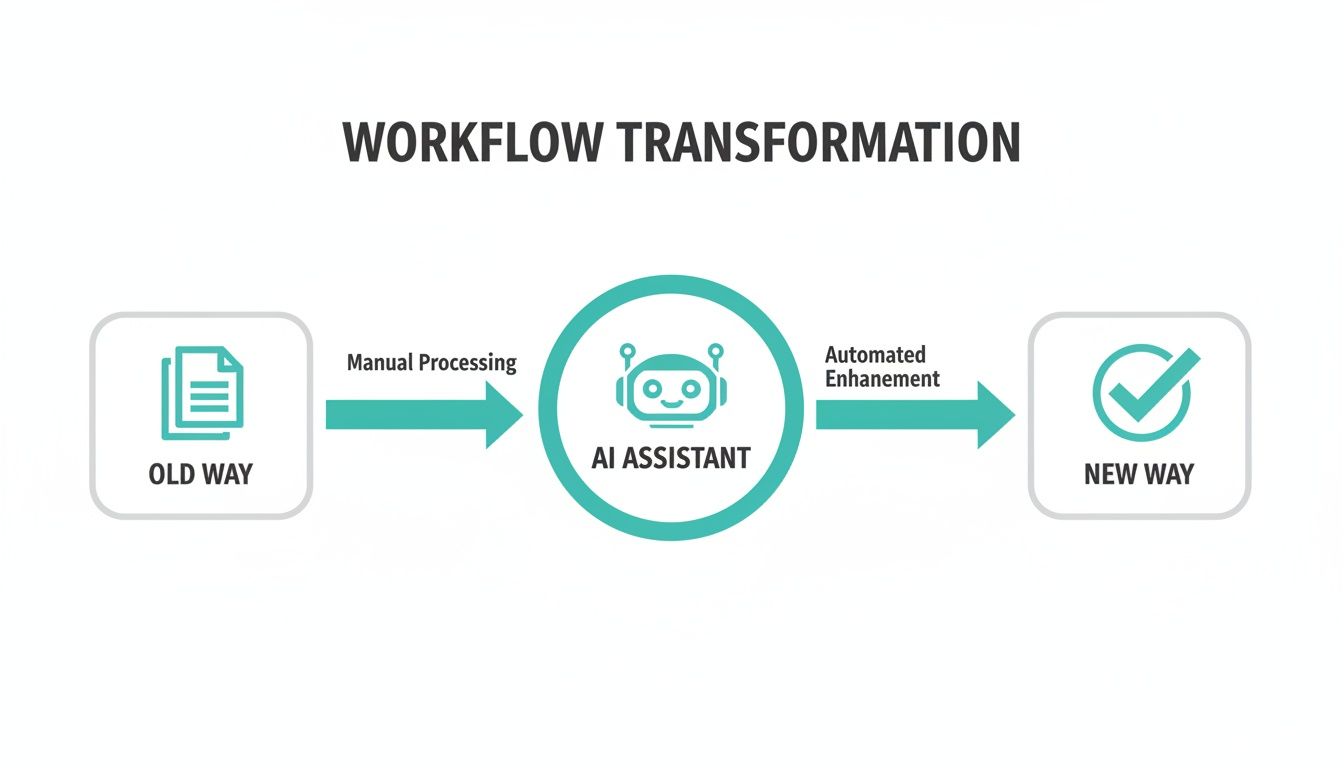
As you can see, the AI assistant intercepts the disorganized flow of information and transforms it into a structured, reliable resource for everyone.
A Self-Updating Source of Truth
This passive capture method solves the problem of stale, outdated information for good. An old-school wiki is only as good as the last time someone remembered to update it. An AI-powered knowledge base, on the other hand, evolves in real-time right alongside your team.
- When a process changes: The new way of doing things is discussed and confirmed in Slack, and SAI learns the updated information instantly.
- When a new tool is adopted: Questions about its setup and best practices are captured as they’re answered.
- When a policy is updated: The clarification shared in a channel immediately becomes the new source of truth.
This isn't just a niche idea; it's rapidly becoming the standard. Artificial intelligence is now a dominant trend, with research showing that approximately 68% of companies worldwide now use AI-powered automation in their knowledge solutions. Why? To get better answers, faster, and to slash the manual effort. This widespread adoption signals a clear understanding that old systems just can't keep up with the speed of modern business. You can dive deeper into the trends in the knowledge base software market if you're curious.
Ultimately, you and your team can stop even thinking about maintaining a knowledge base.
Instead, you can simply trust that the answers are being captured and are ready the moment you need them. It's time to close those dozen browser tabs and stop digging through multiple shared drives. Just ask in Slack, and get the right answer, instantly.
To see what's out there, check out our guide on the best AI knowledge management tools available today.
Your First Step Toward Instant Answers
So, you've seen what a truly smart internal knowledge base can do for a team. Now, picture what tomorrow could look like. Instead of searching endlessly through old folders or tapping a coworker on the shoulder, you just ask SAI a question right inside Slack. Simple as that.
This isn't about rolling out some massive, complicated piece of software that requires months of planning. Getting started is literally as easy as inviting a new person to a single Slack channel—except this team member happens to know everything. You're not adding another tool to the pile; you're making your team's favorite tool dramatically better.
Forget about long-term strategic overhauls. This is a tactical, immediate upgrade to your team's productivity that you'll feel on day one.
See the Difference This Week
The path to a workday without friction starts with one small, painless step. We want you to feel the relief of getting instant answers without having to sign a contract or pull out a credit card. Just watch how many of those repetitive, time-wasting questions get answered automatically, letting everyone get back to their real work.
This is your chance to stop the endless searching and start getting immediate answers. Your first step is not a purchase; it's an experiment in efficiency.
By trying this out, you’ll start to reclaim the most precious resource your team has: time. You can finally shield your experts from constant interruptions, get new hires up to speed in record time, and make sure that crucial company knowledge doesn't just walk out the door when someone leaves.
Ready to see how it works for your team?
- No credit card required: You can get started right now with zero financial commitment.
- Instant value: Just add SAI to one Slack channel and watch it start working immediately.
- Completely free: Experience the full power of automated answers, on us.
Take that first step toward building your team's shared brain. Add SAI to a Slack channel for free and watch the repetitive questions finally disappear.
Frequently Asked Questions
Jumping into a new tool can feel like a big commitment, but a modern internal knowledge base should make your life easier, not more complicated. Let's walk through some of the honest questions teams have before they go from hunting for information to getting instant answers.
Will an AI Knowledge Base Just Create More Work for My Team?
Nope. In fact, it’s the complete opposite. A smart system like SAI is built to eliminate work, not add to it. It hums along quietly in the background, learning from the Q&A that’s already happening organically in your Slack channels.
Think about it: you never have to manually write another wiki article or bug someone to update a stale document again. When a subject matter expert on your team answers a question, that knowledge gets captured on the spot. The system builds and updates itself, which means your team can get back to doing what they were hired to do instead of playing knowledge librarian.
How Secure Is Our Information with an AI Assistant in Slack?
We get it—security is everything when it comes to your company's private data. Any modern tool worth its salt, including SAI, is built from the ground up with enterprise-grade security in mind.
The AI lives and breathes entirely within your own Slack workspace. It can only see the public channels you specifically invite it into, and it’s bound by strict data privacy protocols. All the knowledge it gathers is for your team and your team only. It's never shared outside your workspace, so you can be confident your proprietary info stays locked down.
How Quickly Will We Actually See Results?
This isn't one of those old-school software rollouts that takes a full quarter to show any value. With an AI assistant, the payoff is almost immediate. The second you add it to a Slack channel, it starts learning from all the conversations—both past and present.
You won't be waiting around for a progress report. Most teams see a noticeable drop in repetitive questions within the first few days.
And that value just keeps compounding. Every single day, more knowledge gets absorbed, turning your Slack channels into a dependable source of truth that’s always on, ready to serve up instant answers 24/7.
What Happens If the AI Gives a Wrong Answer?
That's a fair question, and it's something these systems are designed to handle. Modern AI is built with a human-in-the-loop
approach. If SAI ever offers up an answer that’s off the mark or outdated, anyone on the team can easily correct it or add the right info right there in the Slack thread.
This feedback isn't a bug; it's a feature. Every correction is a teaching moment that makes the AI smarter and the entire knowledge base more reliable over time. It’s a true partnership where your team's expertise continually refines the system, creating an incredibly powerful, self-improving brain for your company.
Ready to stop the endless searching and give your team the gift of instant answers? SAI transforms your Slack into a self-updating internal knowledge base, capturing your team’s wisdom without any extra work. Add SAI to a Slack channel for free and see how many repetitive questions disappear this week.