10 Transformative Strategies for Knowledge Management in 2026
Imagine your workday without the constant hunt for information. No more Where do I find that?
Slack messages interrupting your focus. No more time wasted digging through shared drives, outdated wikis, or endless email threads just to locate a single document. Instead, you and your team simply ask a question in Slack and get an immediate, accurate answer, never having to open another resource. This isn't a far-off dream; it's the direct result of implementing effective strategies for knowledge management.
This article provides a blueprint for ending the cycle of repetitive questions and lost productivity. We're not just talking about building another information silo that nobody uses. We're talking about creating a living, breathing knowledge ecosystem that works for you, directly within your workflow. You'll discover how to transform scattered data and tribal knowledge into an instantly accessible, on-demand resource that empowers your team to make faster, smarter decisions.
We will explore ten actionable strategies designed to stop the endless searching and start the focused doing. From leveraging conversational AI that surfaces answers in Slack to establishing powerful knowledge-sharing networks, each strategy is designed for practical implementation. The goal is simple: to help your team spend less time looking for information and more time using it to drive results. Let's dive into the methods that will turn your team's collective expertise from a hidden liability into your most powerful asset.
1. Conversational AI and Natural Language Processing
Imagine your team's workday completely transformed. Instead of toggling between a dozen apps, searching through cluttered drives, or interrupting colleagues for answers, you simply ask a question in Slack. And you get an instant, correct answer. This is the reality of leveraging Conversational AI, one of the most powerful strategies for knowledge management today. It's not about complex systems; it's about making knowledge as easy to access as talking to a coworker.
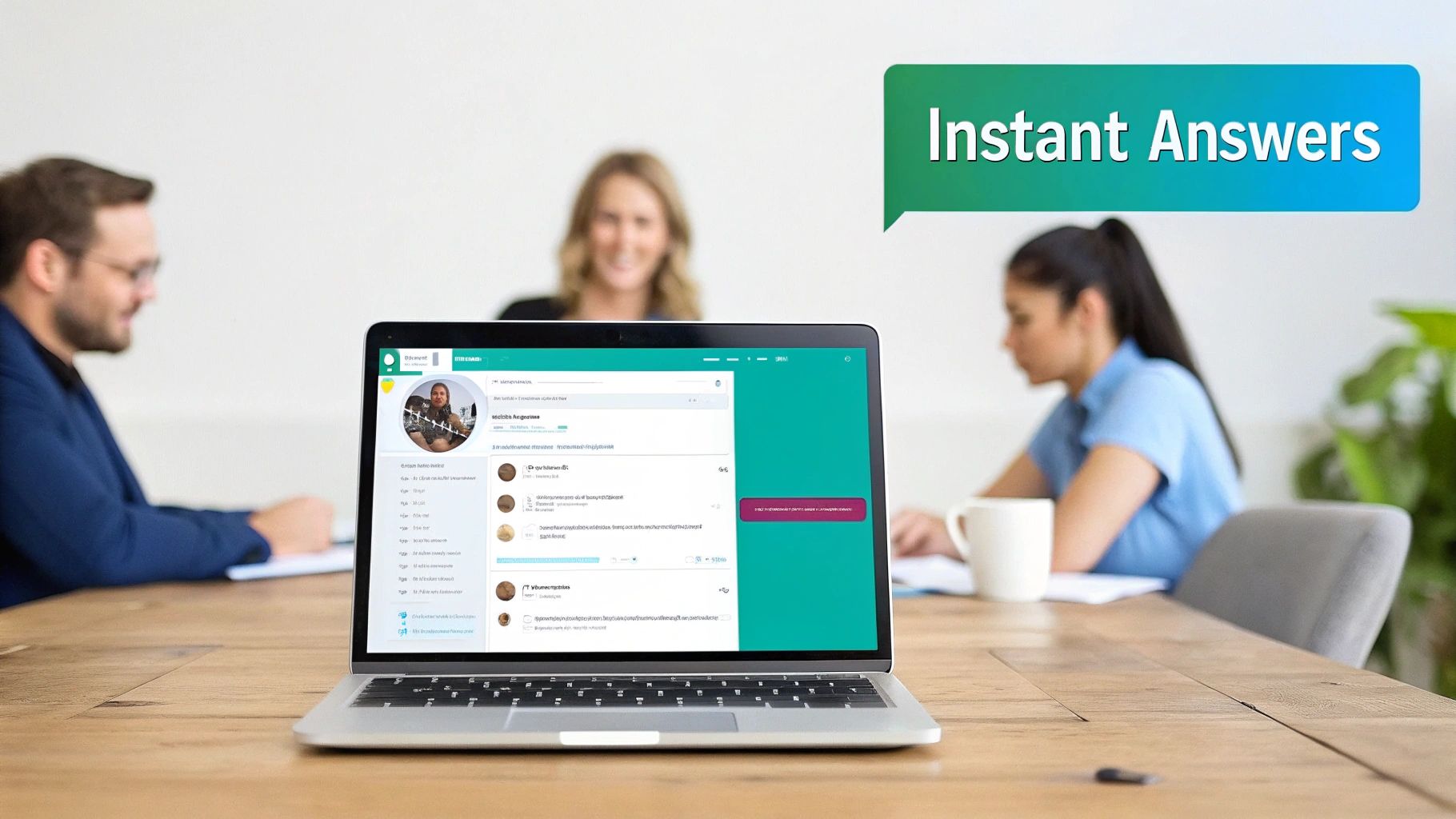
This strategy brings knowledge directly to where your team already works. Conversational AI understands questions asked in plain language, just like a person would. It learns from your team's existing documents and conversations to provide answers that feel less like a database search and more like getting help from your most knowledgeable expert, right inside Slack.
Why It Works So Well in Slack
Picture this: someone on your team asks a question in a public channel, and an expert answers it. With a tool like SAI, that exchange is automatically captured. The next time someone asks the same question, they don't have to wait for an answer or interrupt anyone. The proven solution is provided instantly. This stops repetitive questions in their tracks and turns your team's everyday conversations into a powerful, self-growing knowledge source. To see how this can reshape your team's productivity, you can learn more about the fundamentals of conversational AI.
How to Implement This Strategy
- Target High-Volume Channels: Begin by deploying the AI in Slack channels where repetitive questions are most common, such as
#ask-hr,#it-support, or a team-specific help channel. - Encourage Natural Language: Coach your team to ask questions as they normally would, not in formal
search
terms. The more natural the input, the better the AI learns context. - Establish a Feedback Loop: Use built-in feedback mechanisms (like emoji reactions or buttons) to let the AI know when an answer was helpful or incorrect. This is crucial for continuous improvement.
- Monitor for Knowledge Gaps: Regularly review analytics to see which questions the AI struggles with. This highlights where you need to create or centralize new documentation.
2. Asynchronous Knowledge Capture and Documentation
Picture a workplace where crucial information isn't locked away in meeting recordings or dependent on someone’s immediate availability. Instead, knowledge is captured and shared as a natural byproduct of daily work, accessible to anyone, anytime, regardless of their time zone. This is the essence of asynchronous knowledge capture, a powerful strategy for distributed and remote-first teams that prioritizes documentation over real-time meetings.
This approach shifts the focus from synchronous communication, where everyone must be present simultaneously, to documenting conversations and decisions as they happen. It turns your team's communication platform into a living, searchable archive of expertise. This method is not just about writing formal documents; it's about capturing the context-rich discussions and solutions that emerge organically in your daily workflow.
Why It Works So Well in Slack
Pioneered by remote-first companies like GitLab, this model thrives in environments like Slack. Instead of letting valuable answers disappear into the endless scroll, you can capture them in the flow of work. For instance, a detailed answer provided in a Slack thread becomes a permanent, searchable asset. Tools like SAI automate this process by identifying when a question is asked and answered in a public channel, capturing that exchange to build an intelligent, self-growing knowledge base without any extra effort from your team. This makes it one of the most efficient strategies for knowledge management.
How to Implement This Strategy
- Champion Threaded Conversations: Mandate the use of threads for all questions and replies. This keeps discussions organized and makes it easy to find a complete answer in one place.
- Use Pins and Bookmarks: Pin critical decisions, key answers, or important announcements to the top of relevant channels for high visibility and quick access.
- Establish Channel-Specific Norms: Create clear guidelines for what kind of information belongs in each channel (e.g.,
#project-phoenix-updatesfor decisions,#ask-marketingfor questions). - Automate Capture: Leverage AI tools that automatically save validated question-and-answer pairs from conversations, turning your team’s daily interactions into a reliable knowledge source without manual documentation.
3. Centralized Knowledge Base with Smart Indexing
Imagine a world where every crucial piece of company information, from HR policies to project specs, lives in one reliable, organized place. No more hunting through scattered documents in Google Drive, outdated wikis, or lost email threads. This is the power of a centralized knowledge base, a foundational pillar among effective strategies for knowledge management. By creating a single source of truth, you eliminate information silos, reduce duplicate work, and ensure everyone on your team is operating with the most current, accurate data.
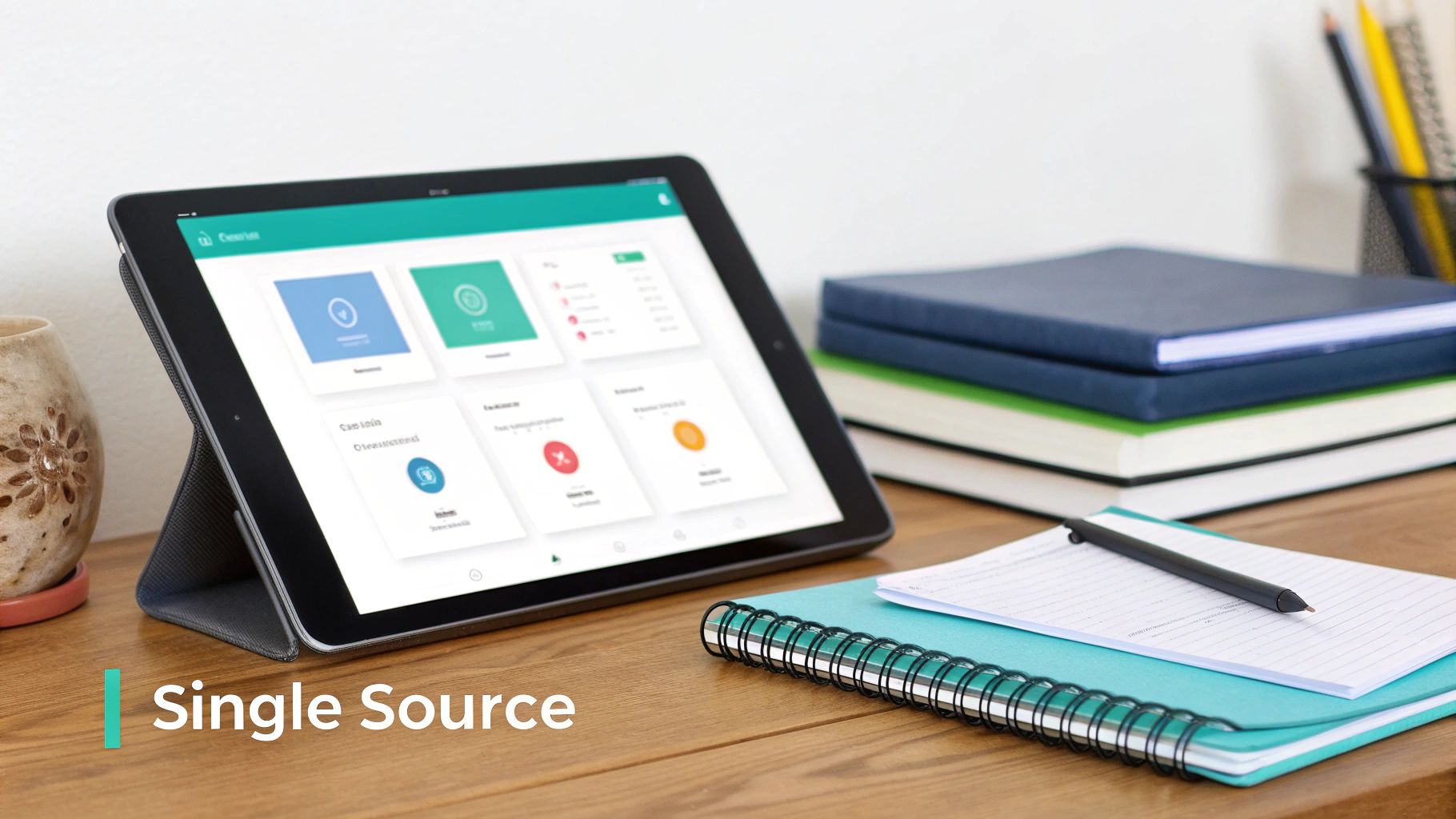
At its heart, this strategy involves consolidating knowledge into a dedicated platform like Notion or Confluence. But the real magic comes from smart indexing,
where modern tools use AI to automatically tag, categorize, and organize content. This makes retrieval incredibly fast and intuitive, ensuring that the information isn't just stored; it's easily discoverable. This approach transforms a static library of documents into a dynamic, living resource that supports your entire organization.
Why It's a Foundational Strategy
A well-maintained knowledge base serves as the backbone for other automated systems. For example, a conversational AI like SAI can integrate with your knowledge base, pulling verified, long-form answers directly into Slack conversations. This hybrid approach gives your team instant access to both quick, validated answers from past conversations and detailed documentation from your central repository, all without leaving their primary communication hub. If you're looking to build this core asset, you can explore this guide to creating a powerful internal knowledge base.
How to Implement This Strategy
- Establish Clear Ownership: Assign owners to different sections of the knowledge base (e.g., HR owns the employee handbook, Engineering owns technical documentation) to ensure accountability for updates.
- Create Intuitive Categories: Structure your information with clear, descriptive naming conventions and logical categories that mirror how your team thinks and works.
- Implement a Review Cadence: Schedule regular reviews (quarterly or bi-annually) to audit content, archive outdated information, and identify knowledge gaps.
- Integrate with Your Workflow: Use integrations to connect your knowledge base with tools like Slack, allowing for easy sharing and surfacing of information where conversations happen.
4. Mentorship and Knowledge Sharing Networks
Imagine your most experienced employees seamlessly transferring their wisdom and context-rich insights to newer team members, accelerating their growth and preventing knowledge loss. This isn't about writing another dense document; it's about fostering human connection. Building mentorship and knowledge sharing networks is one of the most impactful strategies for knowledge management because it directly addresses the transfer of tacit knowledge, the how
and why
that documents often miss.
This approach formalizes the natural process of learning from experts. Instead of hoping junior employees find the right person to ask, you create structured pathways for them to gain expertise. It transforms individual experience into a scalable, shared asset that strengthens your entire team's capabilities, ensuring critical skills and institutional memory are passed down effectively.
Why It Works So Well in Slack
Platforms like Slack are the natural habitat for these networks to thrive. A dedicated channel like #mentorship-circle or #dev-learning-group becomes a living repository of expert advice and peer support. Questions asked and answered in these channels build a searchable history of solutions, turning one-on-one guidance into a resource for everyone.
SAI can amplify this by capturing key Q&A from these channels. When a mentee asks a question that an expert has already answered, the AI can surface that proven advice instantly. This allows mentors to focus on providing new, higher-level guidance instead of repeating the same foundational lessons, making the entire mentorship program more efficient and valuable.
How to Implement This Strategy
- Formalize the Program: Pair mentors and mentees based on skills and career goals. Set clear expectations, establish a regular check-in cadence, and define what success looks like for the relationship.
- Create Peer Learning Groups: Establish dedicated Slack channels for functional groups (e.g.,
#sales-best-practices,#ask-marketing-seniors) where peers can ask questions and share insights collectively. - Recognize and Reward Mentors: Publicly acknowledge the contributions of your mentors. Their time and effort are critical investments in your team’s future, and recognition encourages others to participate.
- Document Key Learnings: Encourage participants to summarize key takeaways from their sessions in a shared space or channel. This helps codify tacit knowledge for the broader team.
5. Communities of Practice and Subject Matter Expert Networks
Imagine a workplace where your most knowledgeable experts aren't just isolated problem-solvers but active hubs in a thriving network. Instead of expertise being siloed within individuals, it’s shared, refined, and amplified across the organization. This is the core idea behind building Communities of Practice (CoPs) and Subject Matter Expert (SME) networks, one of the most powerful organic strategies for knowledge management. This approach organizes knowledge around specific domains or functions, creating dedicated spaces where experts and practitioners collaborate, share insights, and solve problems together.
At its heart, a Community of Practice is a living, breathing knowledge base. It's where your go-to engineering expert can mentor junior developers, or where customer success managers can collectively workshop solutions to tricky client issues. These communities transform tribal knowledge from a liability into a structured, accessible asset, ensuring critical information flows freely instead of getting stuck in private DMs or individual inboxes.
Why It Works So Well in Slack
Slack is the natural home for modern Communities of Practice. A dedicated channel like #community-customer-success or #guild-frontend-eng becomes a central hub for focused discussions, problem-solving, and peer-to-peer learning. Tools like SAI can amplify this effect by passively monitoring these expert conversations. When a senior team member provides a detailed answer to a complex question, that knowledge is captured and made instantly available the next time a similar issue arises, preserving expert insights long after the initial conversation has scrolled by.
How to Implement This Strategy
- Designate a Community Facilitator: Appoint a leader to guide discussions, schedule regular meetings or
office hours,
and ensure the community stays active and focused. - Establish a Clear Purpose: Define the community's mission. Is it for solving technical challenges, sharing best practices, or mentoring new members? A clear goal drives engagement.
- Encourage Documentation: Motivate SMEs to document their insights in a shared repository or wiki, creating a formal record of the community's collective wisdom.
- Capture Organic Knowledge: Use an AI tool to automatically capture the valuable Q&A that happens naturally in the community's Slack channel, turning real-time conversations into a searchable knowledge source.
6. Structured Onboarding Playbooks and Checklists
Imagine your new hires feeling confident and productive from day one, instead of lost and overwhelmed. No more endless, repetitive questions flooding your team channels or key information falling through the cracks. This is the power of implementing structured onboarding playbooks and checklists as one of the most effective strategies for knowledge management. By standardizing the onboarding journey, you create a consistent, scalable process that equips every new team member for success.
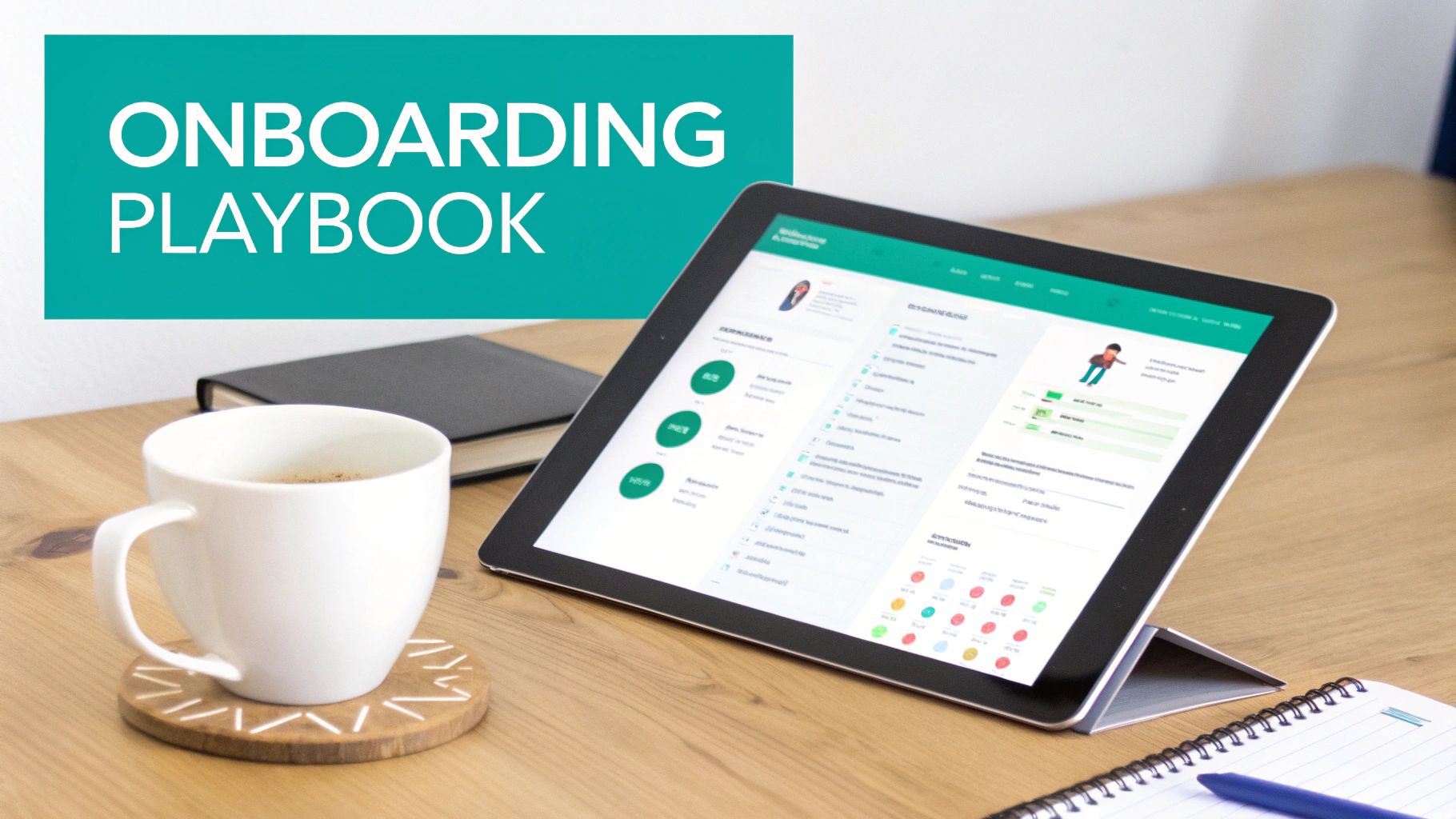
At its core, this strategy involves creating documented, repeatable guides that outline the essential knowledge, tools, and procedures a new employee needs. Checklists ensure no critical step is missed, from initial system access to understanding team-specific workflows. This approach not only accelerates ramp-up time but also transforms a historically chaotic process into a predictable and positive experience.
Why It Works So Well in Slack
A dedicated onboarding channel in Slack can serve as the central hub for this process, but it often becomes noisy with the same questions asked by every new cohort. This is where tools like SAI become indispensable. By capturing the answers to common onboarding questions, the AI can instantly respond to new hires, freeing up HR and team leads. Instead of manually answering Where do I find the benefits guide?
for the tenth time, the AI handles it, allowing your team to focus on more strategic integration. For a deeper dive into building an effective process, you can find a comprehensive new employee onboarding checklist to get started.
How to Implement This Strategy
- Create Role-Specific Playbooks: Develop tailored onboarding guides for different positions (e.g., engineering, sales, marketing) that cover role-specific tools, goals, and key contacts.
- Dedicate an Onboarding Channel: Set up a
#new-hiresor#onboardingchannel in Slack where new employees can ask questions and access pinned resources. - Automate Common Questions: Deploy an AI tool to monitor this channel and automatically answer frequently asked questions about IT setup, company policies, and team processes.
- Establish a Feedback Loop: Schedule a check-in at the 30-day mark for new hires to provide feedback on the onboarding playbook, identifying any gaps or unclear information.
- Track Onboarding KPIs: Monitor metrics like time-to-first-contribution and onboarding completion rates to measure the effectiveness of your playbook and identify areas for improvement.
7. Decision Documentation and Rationale Capture
Imagine onboarding a new team member who can instantly understand the history behind a critical product decision made six months ago. No more shoulder-tapping senior staff, no more rehashing old debates, and no more repeating past mistakes. This is the power of implementing Decision Documentation and Rationale Capture, one of the most vital strategies for knowledge management for building institutional memory. This approach goes beyond just recording outcomes; it captures the context, the why
behind the what,
creating a transparent and searchable log of your team's most important turning points.
At its core, this strategy involves creating a standardized process for documenting significant decisions, including the options considered, the stakeholders involved, and the evidence that guided the final choice. This record becomes an invaluable asset, preventing decision churn and providing a solid foundation for future work. Instead of relying on fragmented memories in meeting notes or direct messages, your team builds a cohesive and accessible organizational memory.
Why It Works So Well for Organizational Memory
This practice is crucial for preventing knowledge silos and ensuring that valuable context isn't lost when team members leave. By making these records accessible, you empower everyone to understand the strategic thinking that shapes your projects and processes. For instance, Architecture Decision Records (ADRs) in engineering teams ensure that architectural choices are well-documented and can be revisited, saving countless hours of future guesswork. This transforms tribal knowledge into a durable, shared resource.
How to Implement This Strategy
- Create a Simple Template: Develop a straightforward template for decision records. It should include the decision statement, date, key stakeholders, context, options considered, and the final rationale.
- Centralize and Make it Searchable: Store all decision documents in a central, accessible location like a shared drive or wiki. More importantly, ensure the key takeaways and rationales are captured in public Slack channels so tools like SAI can index them for easy discovery.
- Integrate into Workflow: Make decision documentation a required step in your project management or product development lifecycle. Don't treat it as an afterthought.
- Review and Revisit: Schedule periodic reviews of major decisions to validate if the underlying assumptions still hold true. This ensures your knowledge base remains current and relevant.
8. FAQ and Troubleshooting Databases
Imagine your support and operations teams having instant access to a library of proven solutions for every common problem they face. No more reinventing the wheel for recurring issues or leaving customers waiting while someone hunts for the right answer. This is the power of building a dynamic FAQ and Troubleshooting Database, one of the most practical strategies for knowledge management for any team handling repetitive inquiries. Unlike a static, top-down knowledge base, this approach creates a living repository that grows organically from the real questions your team encounters daily.
At its core, an FAQ database is a centralized, easily searchable collection of common questions, problems, and their verified solutions. It’s designed for rapid problem resolution, empowering team members to find what they need in seconds. This is especially crucial for customer support, IT helpdesks, and HR teams, where speed and accuracy directly impact employee and customer satisfaction. The goal is to turn tribal knowledge about how to fix X
or what to do when Y happens
into a structured, reliable asset.
Why It Works So Well in Slack
The real magic happens when you bring this database directly into your team's conversational workflow. Instead of forcing users to leave Slack and search a separate portal, tools like SAI can instantly surface relevant FAQs right in the channel where the question is asked. If a team member asks, How do I reset my VPN connection?
, the AI can pull the exact, pre-approved troubleshooting steps from your database and present it as an instant answer. This transforms your FAQ from a passive resource into an active, automated support agent.
How to Implement This Strategy
- Identify High-Volume Questions: Start by analyzing your support tickets or public Slack channels to identify the top 10-20 most frequently asked questions. Focus on these first for maximum impact.
- Structure for Scannability: Write answers with a clear, concise summary at the top, followed by detailed, step-by-step instructions. Use formatting like bold text and bullet points to make them easy to follow.
- Automate Answer Surfacing: Integrate your database with a conversational AI in Slack. This ensures that when a known question is asked, the documented answer is provided automatically, reducing the burden on your experts.
- Establish a Review Cadence: Knowledge becomes outdated. Assign owners to key FAQs and set a regular schedule (e.g., quarterly) to review and update them, ensuring all information remains accurate and relevant.
9. Analytics and Knowledge Gap Identification
Imagine trying to improve your team’s performance without knowing where they struggle most. You might create documentation, but is it what they actually need? This is where a data-driven approach becomes one of the most powerful strategies for knowledge management. Instead of guessing where knowledge gaps exist, this strategy uses analytics to systematically uncover what questions are asked most, which topics lack clear answers, and how information flows (or gets stuck) within your organization.
This method transforms knowledge management from a reactive, manual process into a proactive, strategic function. By analyzing search queries, help desk tickets, and conversational data, you get a clear map of your team’s informational needs. This allows you to prioritize content creation and ensure your efforts are focused on solving the most frequent and impactful problems, rather than waiting for them to derail a project.
Why It Works So Well in Slack
The constant stream of questions and answers in Slack is a goldmine of data. Tools like SAI tap into this by providing built-in analytics that reveal the most common questions, the accuracy of automated responses, and areas where human experts are still needed. This feedback loop is invaluable; you can see exactly which knowledge isn't being captured and use those insights to create precise documentation that addresses real-world, recurring issues. It stops the cycle of repetitive questions at its source.
How to Implement This Strategy
- Establish a Baseline: Before making changes, capture current metrics. How many repetitive questions are asked per week? What is the average time to get an answer? This baseline will demonstrate the ROI of your efforts.
- Focus on Unanswered Questions: Use your analytics dashboard to identify queries that receive no answer or an unhelpful one. These are your top priorities for creating new knowledge assets.
- Track Knowledge Usage: Monitor which documents, articles, or automated answers are used most frequently. This helps you understand what content is most valuable and should be kept meticulously up-to-date.
- Share Insights with Stakeholders: Create a simple, regular report for team leads and management. Visualizing the reduction in repetitive questions and the increase in self-service answers builds buy-in for continued knowledge management initiatives.
10. Collaborative Filtering and Peer Recommendation
Imagine your team's knowledge surfacing organically, with the most relevant information finding its way to the right person without anyone having to search for it. This is the power of Collaborative Filtering and Peer Recommendation, a dynamic approach that transforms your knowledge base from a static library into a living, intelligent ecosystem. Instead of relying solely on keyword searches, this method uses collective intelligence to proactively suggest content that colleagues with similar roles or problems have found valuable.
At its heart, this strategy operates on a simple principle: people who ask similar questions often need similar answers. By observing which documents, conversations, or answers users find helpful, the system learns to predict what will be useful to others. It’s the same logic that powers recommendations on platforms like Netflix or Amazon, but applied internally to your team's unique knowledge. This is one of the most proactive strategies for knowledge management because it anticipates needs rather than just reacting to queries.
Why It Works So Well in Slack
In a fast-paced environment like Slack, where information flows constantly, this method excels at cutting through the noise. Systems can track which answers receive positive emoji reactions (like a ✅) or are marked as helpful. When a new team member asks a question, the system can recommend a highly-rated answer that a senior team member previously provided to a similar query. This surfaces validated, peer-approved knowledge instantly, building trust and accelerating problem-solving without manual intervention.
How to Implement This Strategy
- Implement Feedback Mechanisms: Introduce simple ways for users to rate the usefulness of an answer or document, such as emoji reactions, upvotes, or
Was this helpful?
buttons. - Track User Journeys: Monitor which resources users access after asking certain types of questions to identify common solution paths.
- Surface Recommendations Contextually: Display recommended articles or answers directly within the user's workflow, such as in a sidebar when they are typing a related question.
- Analyze Top-Rated Content: Regularly review the most highly-rated answers to identify knowledge trends, update documentation, and discover new best practices emerging from your team.
Knowledge Management Strategies — 10-Point Comparison
| Strategy | Implementation Complexity 🔄 | Resource Requirements ⚡ | Expected Outcomes ⭐ | Ideal Use Cases 📊 | Key Advantages 💡 |
|---|---|---|---|---|---|
| Conversational AI and Natural Language Processing | Moderate 🔄 — setup & tuning | Low–Moderate ⚡ — infra + monitoring | ⭐⭐⭐ — fast, conversational answers | Slack-centric teams, high-volume repetitive Q&A | Immediate, low-friction access to team knowledge |
| Asynchronous Knowledge Capture and Documentation | Low 🔄 — lightweight process change | Low ⚡ — existing chat + discipline | ⭐⭐ — durable, time-zone independent records | Remote/distributed teams, async workflows | Captures knowledge in flow; reduces meetings |
| Centralized Knowledge Base with Smart Indexing | High 🔄 — migration & governance | Moderate–High ⚡ — storage, integrations, curators | ⭐⭐⭐ — consistent, searchable single source | Large orgs, compliance, onboarding at scale | Improves discoverability; reduces duplication |
| Mentorship and Knowledge Sharing Networks | Moderate 🔄 — program setup & pairing | High ⚡ — mentor time and coordination | ⭐⭐ — deep tacit knowledge transfer | Complex, context-dependent skills; career development | Transfers tacit expertise; builds culture & retention |
| Communities of Practice and SME Networks | Moderate 🔄 — facilitation & cadence | Moderate ⚡ — participant time, leadership | ⭐⭐ — curated domain expertise | Domain-specific problems, cross-functional learning | Builds expertise clusters; encourages innovation |
| Structured Onboarding Playbooks and Checklists | Moderate 🔄 — content creation & updates | Moderate ⚡ — authoring and maintenance | ⭐⭐⭐ — faster time-to-productivity | New hires, rapid team scaling | Ensures consistency; reduces onboarding variance |
| Decision Documentation and Rationale Capture | Low–Moderate 🔄 — templates & discipline | Low ⚡ — documentation effort | ⭐⭐ — fewer repeated debates; clearer context | Architecture, product strategy, governance | Preserves why decisions were made; prevents rework |
| FAQ and Troubleshooting Databases | Low 🔄 — collect & organize top Qs | Low–Moderate ⚡ — populate + curate | ⭐⭐⭐ — immediate ROI via self-service | Support teams, ops, customer-facing functions | Reduces ticket volume; quick problem resolution |
| Analytics and Knowledge Gap Identification | Moderate–High 🔄 — instrumentation & analysis | Moderate–High ⚡ — tooling & analysts | ⭐⭐⭐ — prioritized improvements; measurable ROI | KM optimization, resource allocation, leadership | Data-driven prioritization; reveals high-impact gaps |
| Collaborative Filtering and Peer Recommendation | High 🔄 — algorithm design & feedback loops | Moderate–High ⚡ — usage data & tuning | ⭐⭐ — personalized, improving recommendations | Personalized discovery, ambiguous queries | Leverages collective behavior; improves with use |
From Knowledge Chaos to Instant Clarity
We've explored ten powerful strategies for knowledge management, from leveraging conversational AI and asynchronous capture to building communities of practice and using analytics to spot knowledge gaps. Each strategy offers a unique lens through which to view and improve the flow of information within your organization. But implementing them isn't about checking boxes or adding more tools to your tech stack. It's about a fundamental shift in how your team accesses and shares expertise.
The ultimate goal is to erase the friction between question and answer. Think about the cumulative hours lost each week to searching through outdated wikis, scrolling through endless chat threads, or interrupting a colleague for information they've already shared a dozen times. This isn't just an inconvenience; it's a silent killer of productivity and a major source of employee frustration.
The True Transformation: A Single Source of Truth in Motion
Adopting these strategies culminates in a single, transformative experience for your team. Imagine a workflow where every question, from What's our policy on personal days?
to Where is the latest project brief for the Q4 launch?
is answered instantly, right where the conversation is happening: in Slack.
No more context-switching. No more opening a dozen browser tabs. No more guessing which system holds the correct document. The vision is simple yet profound: you ask, you get an answer. This isn't a static, dusty knowledge base that requires manual upkeep. It's a living, breathing system that learns from every interaction.
By embedding knowledge capture and retrieval directly into your team's daily conversations, you create a self-improving ecosystem. Every question asked and answered strengthens the collective brain of your organization, making it smarter and more efficient with each passing day.
Your Actionable Path Forward
Moving from theory to practice can feel daunting, but the journey starts with a single step. You don't need a massive, top-down overhaul to begin seeing results. The most effective strategies for knowledge management are often those that start small and build momentum.
Here’s how you can begin transforming your team’s workflow today:
- Identify One High-Friction Point: Pinpoint a single team or channel that suffers most from repetitive questions. Is it your customer support team answering the same tickets? Your HR channel managing benefits inquiries? Start there.
- Automate the Capture: Implement a tool that can listen to the conversations happening in that channel and automatically capture the valuable questions and answers that emerge organically. This removes the burden of manual documentation from your team.
- Test and Iterate: Introduce this new, automated knowledge source to the team. Encourage them to ask questions directly within Slack and watch as the system provides instant, accurate answers. Gather feedback and observe the change in behavior.
The power lies in meeting your team where they already work. By bringing the knowledge to the conversation, you eliminate the adoption hurdles that cause so many knowledge management initiatives to fail. You’re not asking them to learn a new platform; you’re simply making their existing one more intelligent. This is the future of work: a seamless integration of knowledge and collaboration, where institutional memory is built automatically, not through manual effort. The result is a more focused, empowered, and resilient organization, ready to tackle its biggest challenges with instant clarity.
Ready to eliminate repetitive questions and give your team the gift of uninterrupted focus? SAI embeds directly into Slack, automatically capturing and surfacing the answers your team needs, when they need them. Start transforming your knowledge management by adding SAI to a channel for free and witness the shift from chaos to clarity.