What is conversational ai? Boost Your Workflow in Slack
So, what exactly is conversational AI? In simple terms, it's technology that lets computers understand and respond to everyday human language. Think of it as teaching your software how to have a conversation. For your business, this means creating an intelligent assistant that taps into your company's collective knowledge to give instant answers, completely changing how your team finds and shares information.
Stop Searching and Start Asking
Picture your typical workday. How much time is lost digging for information? You're sifting through old wikis, bugging coworkers with just one quick question,
or spelunking through a maze of shared drives for that one document. Now, imagine a day where you never have to open another resource again. A day where you never have to hunt for information in multiple places. That's the simple, powerful promise of conversational AI.
It’s like having an always-on expert on your team who has read every single document, message, and policy your company has ever produced. This expert is available 24/7, ready to give you and your team the answers you’re looking for, right in Slack.
This isn't just a minor tweak to your workflow; it's a fundamental shift in how work gets done. You're moving away from the tedious, manual process of finding information and stepping into a new reality where you can simply ask for it. This is more than just a time-saver—it’s about finally tearing down the information silos that slow your entire organization down.
The Shift From Searching to Asking
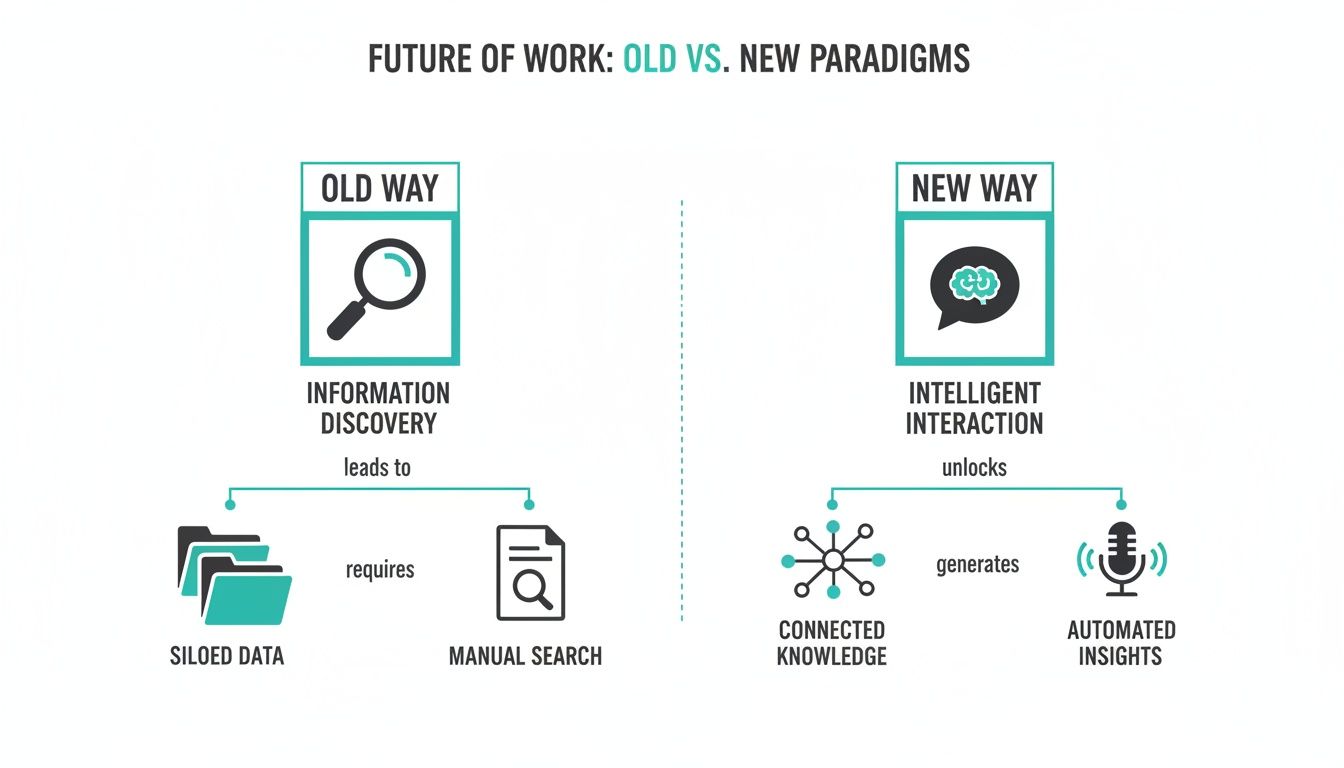
The old way of doing things feels clunky and slow once you've seen what's possible. The new way feels like magic. This table breaks down the practical, day-to-day changes your team will experience.
| The Old Way of Finding Information | The New Way with Conversational AI |
|---|---|
| Manual Search: You have to know where to look (Jira, Confluence, Google Drive, Slack channels). | Direct Questions: You just ask your question in plain English, right inside Slack. |
| Interrupting Colleagues: You tap a coworker on the shoulder (or ping them), breaking their focus and yours. | Instant, On-Demand Answers: The AI finds the answer instantly without disrupting anyone. |
| Outdated Information: You find an old wiki page or document and aren't sure if it's still correct. | Up-to-Date Knowledge: The AI learns from the latest conversations and documents, providing current information. |
| Wasted Time: You spend minutes, or even hours, hunting for an answer, losing momentum on your actual work. | Frictionless Workflow: You get the answer in seconds and stay focused on the task at hand. |
This isn't just about making things easier; it's about unlocking a more productive and focused way of working for everyone.
This change eliminates the constant friction of switching between apps, waiting for replies, and losing your train of thought. It allows your team to stay in the zone and maintain momentum on the work that actually matters.
An Era of Effortless Knowledge
When answers are just a question away—right inside the Slack channels your team already lives in—the entire dynamic changes. This goes way beyond a simple efficiency boost. It helps build a culture where knowledge is shared effortlessly.
The real power of conversational AI in the workplace isn't just answering questions faster. It's about unlocking the collective intelligence that already exists within your team's daily conversations and making it instantly available to everyone, anytime.
Instead of needing someone to build and manually update a formal knowledge base, the AI learns organically from the work already happening. Every question asked and answered helps build a smarter, self-maintaining intelligence layer over your company's operations.
If you're curious about how this works in practice, you can see how to boost team knowledge with a wiki for Slack and centralize answers quickly. It’s an approach that ensures your most valuable asset—your team's expertise—is never lost or hard to find again.
Understanding True Conversational AI
Let's be honest. When most people hear AI assistant,
they think of those clunky, old-school chatbots. You know the ones—they get stuck the second you ask a question that isn't on their script. It's more frustrating than helpful, usually ending with that dreaded Sorry, I don't understand
message.
But true conversational AI is a completely different ballgame. It's not about rigid rules and pre-programmed answers; it's about genuine intelligence.
This kind of AI gets the bigger picture. It understands context, nuance, and what you’re really trying to ask, just like a seasoned colleague would. It’s not just matching keywords; it’s comprehending intent. And here's the best part: it actually learns from every single conversation, getting smarter and more helpful every day.
The Expert vs. The Script Reader
Think about it this way. Imagine you're stuck on a tricky software problem. You have two choices for getting help.
- The Script Reader (Basic Chatbot): This is like calling a support line and getting an agent who can only read from a pre-written script. If your problem isn't listed, they can't help. You’re stuck in their rigid, often useless, process.
- The Experienced Expert (Conversational AI): This is like talking directly to the engineer who built the software. They listen, understand the root cause even if you explain it poorly, and give you a real solution. They tap into a deep pool of knowledge to solve your unique problem, not just follow a flowchart.
That’s the difference. Conversational AI acts like that expert in the room. Instead of making you click through a confusing wiki or search a dozen different shared drives, it simply lets you ask. No more hunting for information or worrying if what you find is even up to date.
Imagine typing this into Slack:
What’s our Q3 marketing budget for the new product launch?and instantly getting the exact number, pulled from the latest financial reports. You didn't search; you just asked.
This is what we mean by genuine help, not another frustrating roadblock. The goal is to get rid of the soul-crushing busywork of information hunting so your team can focus on what they were hired to do. It’s not about creating yet another knowledge base to maintain; it’s about making your company’s collective intelligence available with a simple question.
Unlock Your Team’s Collective Knowledge
Let's be honest: your company's most valuable information is probably scattered everywhere. It's tucked away in dozens of Slack channels, lost in old email threads, and buried deep within meeting notes. This is your team’s collective knowledge, but most of it is practically invisible, lost in the daily shuffle.
This information chaos fuels a frustrating cycle. Senior team members get pinged with the same questions over and over, while new hires waste hours trying to find that one crucial document. Imagine a different reality: one where all that expertise is at your team's fingertips. A single question in Slack gives them the answer they need, instantly.
It works behind the scenes, learning from the expertise shared in everyday conversations and making it available on demand. This is how you finally break down those information silos and build a team that’s truly on the same page.
From Scattered Conversations to Centralized Intelligence
The real game-changer here isn't about building yet another knowledge base that no one has time to update. It’s about tapping into the expertise that’s already there and putting it to work for you.
Imagine a workplace where knowledge just flows.
For New Hires: A junior engineer is stuck. Instead of interrupting a senior dev for the third time, she just asks the AI in Slack,
What are the steps for deploying a staging build?
She gets an instant, spot-on answer and gets back to work. No waiting, no context switching for someone else.For Sales Teams: A sales rep is on a call with a huge prospect who asks a really specific technical question. Instead of saying,
I'll have to get back to you,
the rep privately asks the AI, gets the exact spec sheet in seconds, and closes the deal with confidence.For Operations: Someone needs to find the latest expense policy. They don’t have to dig through a messy shared drive. A quick question in a dedicated Slack channel brings up the correct, up-to-date document right away.
This is about more than just saving time; it’s about creating a culture of empowerment. When everyone can tap into the company’s collective brain, they make smarter decisions, solve problems on their own, and work with a new level of autonomy.
This isn’t just a nice idea; it’s a massive shift happening right now. The global conversational AI market was pegged at USD 11.58 billion in 2024 and is expected to rocket to USD 41.39 billion by 2030. You can discover more insights about this rapidly expanding market to see just how quickly businesses are adopting these tools.
Ultimately, you get a workplace with far fewer interruptions and much faster decision-making. Your team spends less time searching for answers and more time doing the work that actually matters. That’s how you finally unlock the incredible potential of your team’s shared knowledge.
What This Actually Looks Like in Your Daily Grind
Let's get out of the clouds and talk about what conversational AI actually does on a typical Tuesday morning. This isn't some abstract, futuristic idea. It’s a tool that smooths out the countless little bumps in the road that drain your team's energy and kill their momentum.
Imagine a world where your team doesn't have to constantly switch tabs, dig through shared drives, or tap a coworker on the shoulder just to get a simple answer. They just ask. Right where they are.
From Departmental Roadblocks to Instant Answers
Every department has its own flavor of information scavenger hunts. Here’s a before-and-after look at how the workday changes when you replace that friction with an AI that delivers answers right inside Slack.
Marketing Team: Before, a designer drops a message in the channel:
Anyone have the latest logo for the Q3 campaign?
This kicks off a chaotic thread of replies, old links, and confusion. Now, they just ask the AI and get the correct, approved file in seconds. No more back-and-forth.Sales Team: A sales rep is on a crucial call when the prospect asks about a specific competitor. Instead of panicking and trying to find the right battlecard, they quietly ask the AI in another window. They get the exact talking points needed to handle the objection and close the deal.
HR Department: A new hire needs to know the details of the parental leave policy. In the past, this meant finding the right HR person and waiting, pulling that person away from more strategic work. Today, they get a confidential and immediate answer, sourced directly from the employee handbook.
These aren't just small quality-of-life improvements. This is a fundamental shift in how knowledge flows through your company. You can see a great walkthrough in this AI in Slack knowledge base example to see how this instant value is delivered.
This move toward self-serve answers is why adoption is exploding. North America, for instance, accounted for about 33.62% of global conversational AI revenue in 2025. You can read the full research about these adoption trends to see how sales, marketing, and especially healthcare are leading the way.
The real win here is measured in reclaimed time. Every question the AI fields is another few minutes your team gets back to focus on what they were hired to do, not hunt for information.
When you remove these constant, tiny interruptions, you create a workplace where speed and focus become the norm. Your team stays in the zone, decisions get made faster, and your company's collective brainpower is finally put to good use for everyone.
Implement Your AI Partner Safely and Securely
Let’s be honest: bringing any new tool into your company’s ecosystem, especially one that touches your data, raises big questions about security and privacy. As you explore what conversational AI can do, a major concern is likely, Will our confidential information *stay* confidential?
The good news? Enterprise-grade AI partners are built with security as the absolute foundation, not a flimsy add-on. This isn't about blind trust; it's about choosing a solution engineered to protect your most valuable asset: your knowledge.

This kind of operational upgrade doesn't mean you have to compromise on safety. In fact, the right AI tool actually enhances your control over how information is shared, making sure sensitive data stays exactly where it belongs.
Prioritizing Your Data Protection
When looking at a conversational AI for Slack, security isn't just a feature on a list—it's the bedrock of the entire relationship. You need a partner that treats your data with the same level of care that you do. Here are the core principles that leading platforms live by, giving you total peace of mind.
Robust Encryption: Your data, whether it's sitting on a server or in transit, must be locked down with strong encryption. Think of it as an unbreakable digital safe. Even if someone managed to get their hands on it, the information would be completely unreadable.
Strict Access Controls: The AI should be smart enough to respect your existing permissions. It only knows what you allow it to know, and it will only give answers to people who already have the authorization to see that information.
Compliance with Regulations: Reputable providers go through the wringer to comply with global standards like SOC 2 and GDPR. This isn't just paperwork; it’s proof of a serious commitment to security and responsible data handling.
Choosing a partner that prioritizes security means you're not just getting a smart tool; you're getting a secure one. Your proprietary information, client details, and internal strategies are shielded by enterprise-grade protections from day one.
The setup process should be just as secure and transparent, giving you the final say on which data sources the AI can connect to. For a deeper dive into rolling this out smoothly, check out our guide on building your artificial intelligence enablement playbook.
Ultimately, unlocking your team’s collective knowledge with conversational AI can and should be a safe move. By keeping these key security pillars in mind, you can empower your team with confidence, knowing your company's data is never at risk.
How to Measure the Impact of Instant Answers
So, how do you actually put a number on fewer shoulder taps and faster answers? You can't really clock reclaimed focus time
with a stopwatch, but you can absolutely track the real-world business outcomes that a good conversational AI brings to the table.
The goal is to stop thinking about technical stats and start looking at how your team is actually working. When asking the AI in Slack becomes the default reflex instead of interrupting a colleague or spelunking through a dusty wiki, you know you're onto something. The value isn't just in the few seconds saved on a single question; it's the ripple effect of uninterrupted work and a more self-reliant team.
This is how you build a rock-solid case for the ROI that gets leadership's attention.
Key Performance Indicators for Success
To draw a straight line from launching an AI assistant to seeing your business move faster, focus on these practical KPIs. They tell a story that everyone can understand—one of better efficiency and smoother collaboration.
Faster New Hire Onboarding: How long does it take for a new team member to get up to speed and start contributing meaningfully? When they can get immediate answers to all those
newbie
questions about tools, processes, and company policies, their ramp-up time shortens significantly.Increased Self-Service Rate: This one is huge. Keep an eye on how many common questions the AI handles completely on its own, without a human ever getting involved. A high self-service rate is a direct indicator that your subject matter experts are getting their time back for high-impact work.
The real win is when your team stops searching for information. Success isn't just finding an answer faster; it's making the whole hunt for knowledge obsolete, freeing up everyone's day for the deep work that matters.
The explosive growth of this market just confirms the business impact. Projections show conversational AI revenue climbing from USD 14.6 billion in 2025 to USD 30.8 billion by 2029. That's a 110% increase fueled by the technology's proven ability to automate work and deliver immediate cost savings.
You can learn more about these market growth findings to see how other businesses are cashing in. This kind of momentum is a clear signal of the measurable, bottom-line value that instant answers provide.
Got Questions About Conversational AI? We’ve Got Answers.
Jumping into any new tech brings up a lot of what ifs
and how does it
questions. That's a good thing. Before you bring conversational AI into your team's workflow, you need clear, honest answers that tackle the real-world concerns.
Let's break down the most common questions we hear from teams who are tired of digging for information and are ready to just ask.
How Is This Any Different From a Website Chatbot?
Think about the difference between a call center agent reading from a script and a seasoned expert who’s been with the company for a decade. That’s the leap we’re talking about.
Most website chatbots are the scripted agent—they’re programmed with a rigid, limited set of answers for common customer FAQs. A conversational AI inside Slack, on the other hand, is your internal expert. It doesn't just follow a script; it taps into the deep well of your company's collective brain—all those Google Drive documents, Confluence pages, and past Slack conversations.
This lets it handle tricky, context-specific questions with real understanding, making it more of a trusted knowledge partner than a simple Q&A bot.
Is Our Company’s Private Data Secure?
This is non-negotiable, and the answer is a firm yes. Security isn't an afterthought; it's the foundation of any enterprise-ready platform.
Here’s what that looks like in practice:
* Rock-solid encryption protects your data both when it's stored (at rest) and when it's being accessed (in transit).
* Strict access controls mirror the permissions you already have set up, so no one sees anything they shouldn't.
* Full compliance with major security standards like GDPR and SOC 2 is a must.
The AI only ever learns from the information you explicitly grant it access to. Your sensitive data stays locked down and confidential, just as it should be.
How Much Work Is It to Set Up and Maintain?
You’re probably picturing a months-long IT project, but modern conversational AI tools are built to be surprisingly low-lift. Getting started is usually as simple as adding the app to Slack and pointing it to your knowledge sources.
From there, the system does the heavy lifting. It learns and gets smarter on its own with every interaction, which means you’re not stuck constantly tweaking settings or manually updating its knowledge base. The whole point is to save you time, not create another chore.
Ready to see the difference for yourself? Add SAI to a Slack channel for free and give your team the gift of instant answers. Get started today.