Your Artificial Intelligence Enablement Playbook
Let's be honest. AI enablement really boils down to one thing: giving your team the power to get immediate, correct answers right where they work.
Imagine never having to open another tab, dig through a shared drive, or search through old chat logs again. Imagine your sales lead getting the latest competitor specs piped directly into Slack moments before a big call. Or a support agent pulling up the exact troubleshooting steps for a weird error code just by asking a question. This isn't some far-off vision; it's the new reality of how top teams get things done.
Redefine Your Team's Workday
Forget the abstract buzzwords for a minute. The real point of AI enablement is to get rid of all the tiny, invisible bits of friction that slow your business down every single day.
Just think about the daily scavenger hunt for information. Your team is constantly digging through messy shared drives, scrolling through ancient chat threads, or tapping a coworker on the shoulder—all to find one simple piece of information. This constant search is more than just inefficient. It’s a total momentum killer.

True enablement transforms that chaos into a single, clean action. Instead of juggling a dozen tabs and pinging three different people, your team can simply ask a question in the app they live in all day, like Slack, and get an instant answer.
- A new hire asks for the guest Wi-Fi password and gets it on the spot.
- A support agent needs the latest refund policy and has it in hand immediately.
- A marketer wants the approved logos for a new campaign and receives the correct link instantly.
This was never about replacing people. It’s about making them better and faster by eliminating the mind-numbing, repetitive hunt for knowledge.
The Real Cost of Just Looking for Something
That constant hunt for information has a much bigger impact than you’d think. It's like a hidden tax on your team's productivity that adds up, day after day.
Every time someone has to stop what they're doing to find something, their focus shatters. Once they (hopefully) find what they need, they have to waste even more time getting back into the flow of their real work.
This shift from searching to asking fundamentally changes the whole rhythm of your business. It moves your team from being reactive information hunters to proactive, focused doers. The question is no longer
Where is that thing?butOkay, what's next?
To see this in action, just look at how everyday work changes.
The Shift From Traditional Workflows to AI-Enabled Workflows
| Traditional Task | AI-Enabled Transformation |
|---|---|
| Onboarding a new hire involves sending them a 50-page PDF and a link to a messy wiki. They spend their first week asking basic questions. | The new hire asks the AI bot in Slack, What's our holiday schedule?or How do I set up my VPN?and gets instant, clear answers. |
| A sales rep needs to know how our product compares to a specific competitor. They ping the product marketing channel and wait for a response. | The sales rep asks in their team channel, @AIbot, give me the top 3 differentiators against Competitor X.The answer appears in seconds. |
| A support agent gets a ticket with a new error code. They search the knowledge base, can't find it, and escalate the ticket, increasing resolution time. | The agent asks, What are the troubleshooting steps for error 404-B?and immediately gets the latest, verified guide. |
The difference is night and day. One is slow and full of roadblocks; the other is fast, self-sufficient, and keeps people focused on high-value work.
From Tech Project to Practical Tool
This playbook is all about a practical, business-first way to introduce AI. We’re not treating this as some massive, complex IT project, but as a genuine force multiplier for every single person in your company.
The global artificial intelligence market is exploding, with some projections showing it will hit $1.01 trillion by 2031. That kind of growth tells you this is no longer a fringe trend—it's a fundamental shift in business. If you want to dig deeper, these AI adoption statistics show just how dramatically this is reshaping corporate investment.
We’ll walk you through how to start small, prove the value quickly, and build a culture where getting instant knowledge isn't a perk; it's just the way you work.
Building Your Foundation for AI Success
Before you can truly change how work gets done, you need to build a solid launchpad. I’ve seen time and again that the most effective artificial intelligence enablement strategies don't start with buying new tech; they start by connecting AI's potential directly to your most frustrating business problems. It's all about finding the signal in the noise.
Think about the daily frictions that slow your teams to a crawl. Is your customer success team drowning in a sea of repetitive questions about basic features? Does your marketing team waste precious hours hunting for the latest approved brand assets, buried somewhere in a maze of folders? These aren't just minor inconveniences—they're real, tangible roadblocks to productivity.
Pinpoint Your First High-Impact Use Case
The key here is to start small and targeted. Instead of trying to boil the ocean, focus on identifying one high-impact, low-complexity problem within a single team. This initial focus is crucial because it lets you deliver a clear, undeniable win that builds momentum for everything that follows.
A great place to start is by looking for workflows that are constantly bogged down by information retrieval. Where are people getting stuck just waiting for an answer?
- Customer Support: Think of agents searching for the same troubleshooting steps or refund policy details over and over again.
- Sales Teams: Reps scrambling to find the latest competitive battle cards or case studies right before a big client call.
- HR Departments: Fielding the exact same questions about benefits, holiday schedules, and expense reporting policies every single week.
These scenarios are perfect candidates for an initial AI pilot. They represent a massive time sink with a surprisingly straightforward solution. The goal is simply to make this information instantly accessible, turning a frustrating, multi-step search process into a single, quick question.
In many ways, this is an extension of what a good knowledge management system should do, but with the added horsepower of conversational AI. You can learn more about the fundamentals in our guide on what is a knowledge management system.
The objective isn’t to find the most technically complex problem AI can solve. It’s to find the most annoying human problem you can eliminate quickly, creating an immediate and visible improvement in someone's workday.
Assemble Your Vanguard Team
Once you’ve locked in on a promising use case, you need a small, agile group to champion it. This isn't about forming some large, slow-moving committee. It's about putting together a nimble vanguard team
with three specific roles.
This small group will be your internal proof-of-concept, responsible for steering the pilot program from a great idea to a measurable success story that others will want to replicate.
Your Ideal Vanguard Team:
- The Team Lead: This is the manager of the department you’ve chosen. They understand the team's daily pain points better than anyone and can clearly articulate the business value of solving them.
- The Power User: Find an influential, non-managerial team member who is respected by their peers. They will be the one using the tool hands-on, providing invaluable feedback, and helping drive adoption from the ground up.
- The Sponsor: You need a leader with the authority to greenlight the project and clear any organizational roadblocks. Their public support signals to everyone that this initiative is a priority.
This targeted approach—a clear problem combined with a dedicated, focused team—is what separates successful AI adoption from failed experiments. This isn't just a theory; it reflects a massive shift happening right now. Today, 78% of companies are already using AI in some capacity, and many are moving well past the experimentation phase. Enterprise AI adoption has become mainstream, with 87% of large enterprises and 75% of mid-market companies now implementing solutions. This shows that artificial intelligence enablement is no longer a side project but a core business function. To see how this trend is playing out across different industries, you can explore the full AI adoption in enterprise statistics from SecondTalent.
With your use case defined and your team in place, you’re ready to move from planning to action.
Launching Your Pilot Program for Quick Wins
This is where all that planning meets the real world. A pilot program isn't about a massive, company-wide overhaul. Think of it as your small, controlled experiment designed to prove the value of AI—quickly and decisively. Your goal is to create one undeniable success story that gets everyone else buzzing.
Let’s paint a picture. Your top salesperson is prepping for a huge call. The prospect casually mentions a key competitor. The old way involved a frantic scramble through shared drives, a desperate search through old Slack channels, or a hopeful ping to the product marketing team. The clock is ticking.
Now, imagine the new way. The rep simply asks in their team’s Slack channel: @SAI, what are our key differentiators against Competitor X?
Seconds later, a perfect, accurate summary appears. They walk into that call armed with confidence. That’s a pilot program in action.
Defining Success You Can Actually Measure
The whole point of a pilot is to notch a quick, visible win. To get there, you need to define what success looks like with metrics that actually matter to the business, not just some abstract tech stats. It all comes down to the before and after
story.
Instead of just tracking the number of queries,
you need to measure the real-world impact on your team's day. This is how you shift the conversation from using a new tool
to solving a painful business problem.
- Time Saved: What if you could cut the average time to find competitive intel from a chaotic 10 minutes down to a simple 10-second question?
- Faster Resolutions: Imagine reducing the average time it takes a new support agent to resolve a common ticket by 30% because they have instant access to verified troubleshooting guides.
- Improved Onboarding: Think about a new hire who can find answers to basic HR and IT questions on day one, all on their own. How much faster do they become self-sufficient?
These are the kinds of results that make leaders sit up and take notice. A great pilot doesn't just show that the AI works; it proves it makes the business work better.
This simple framework is all you need to get your pilot off the ground.
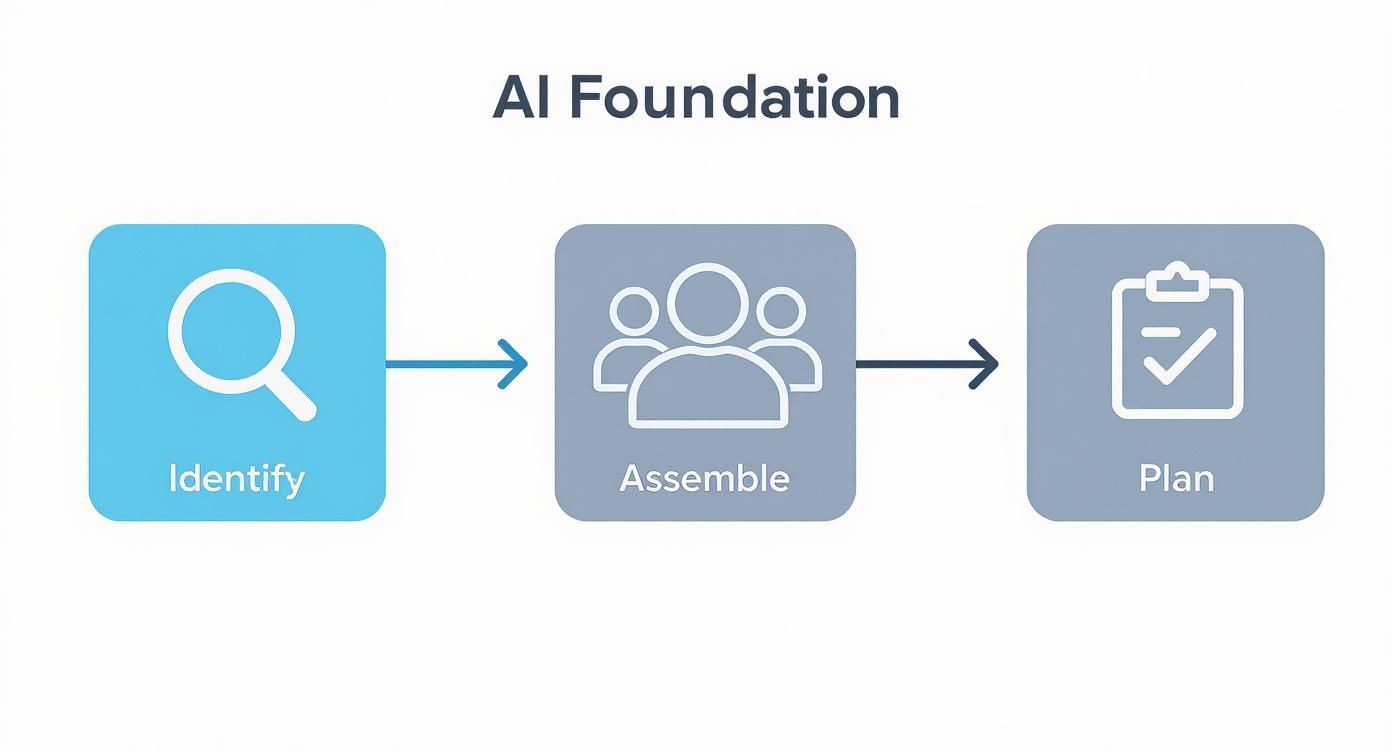
It’s really not that complicated. You just need to identify a real pain point, assemble a small, motivated team, and plan for an outcome you can actually measure.
Turning a Quick Win into a Compelling Story
Once your pilot is done, the final piece of the puzzle is packaging your success into a story that builds momentum across the whole company. The data is your proof, but the human element is what makes people care. Your mission is to create internal evangelists who can't wait to share what they've experienced.
Go gather some powerful testimonials from your pilot team. Don't settle for generic praise like it was great.
You need to dig deeper with specific questions that capture the real transformation.
The most valuable part of a pilot isn't the technology itself, but the proof it creates. When one team can show a clear, measurable improvement in their daily work, it removes skepticism and sparks genuine curiosity in others.
A truly effective testimonial highlights a tangible business outcome, not just a feeling. A great way to get these is by asking questions that force a before-and-after comparison.
Questions to Ask Your Pilot Team:
- Before this pilot, how much time did you waste each week just looking for information?
- Can you tell me about a specific moment where getting an instant answer saved a deal or helped a customer?
- How has this changed the way you approach your daily work?
- What would you tell another team that's on the fence about trying this?
Combine these authentic stories with your hard metrics, and you’ve got a killer internal case study. This becomes your blueprint for expansion, showing not just potential value but proven results. This hands-on, evidence-based approach is a core principle you can apply elsewhere, too—for instance, when you need to build a better employee training plan template, you focus on real-world application over abstract theory.
When people see their own colleagues benefiting, adoption stops being a top-down mandate and starts spreading naturally.
Scaling Your AI Initiative Across the Business
So, your pilot program was a hit. You've got the data to prove it, the team is raving, and now other departments are knocking on your door asking, When is it our turn?
This is a critical moment. It's incredibly tempting to declare victory and just flip the switch for the entire company.
Don't do it.
A sudden, top-down mandate is the fastest way to create resistance. It feels like just another tool being forced on people. The secret to scaling AI successfully is to create a pull, not a push. You need to expand organically, using the excitement from your pilot to build a groundswell of interest that pulls the technology into new corners of the business.
The best way to do this? Your pilot team is your new secret weapon. They are your internal evangelists. They’ve seen the before and after
firsthand, and they aren't executives pushing an agenda. They're peers who can authentically say, This thing *actually* makes my job easier.
Turn Your Pilot Team into Evangelists
Your pilot group holds the most powerful currency for driving change: credibility. When a salesperson hears from another salesperson how they closed a deal faster, it hits with a force that no corporate memo ever could.
Your first move is to empower these early adopters to share their stories.
Start by organizing short, informal lunch and learn
sessions. Have a pilot team member walk another department through how they use the AI in their day-to-day. Frame these as peer-to-peer showcases, not stiff training sessions.
Let them explain, in their own words, the difference it made. A support agent can show the HR team how they stopped digging through a clunky wiki for return policies and started getting instant answers in Slack. That's a story that will stick, far more than any slideshow.
The goal isn’t to force everyone into the same pace of change, but to ensure everyone can see how AI connects directly to their work. When someone sees a colleague solve a real problem with it, they’re far more likely to be ready to try it themselves.
Focus on the What's in It for Me?
As you bring new teams into the fold, your communication has to be laser-focused on their specific, daily frustrations. Vague benefits like improved efficiency
are meaningless. You have to speak their language and solve their problems.
This means your rollout plan should be a highlight reel of department-specific wins.
- For Human Resources: Imagine never having to manually answer another question about the holiday schedule or benefits enrollment deadlines.
- For Engineering: Picture immediate access to the right API documentation or deployment checklists without ever leaving your workflow.
- For Marketing: Think about getting the latest approved brand assets or campaign messaging with a simple question, ending the hunt through endless folders.
Each example paints a crystal-clear picture of a frustrating task being eliminated. This is how you build genuine excitement. When the value is this obvious, adoption feels less like a chore and more like a long-overdue upgrade. This kind of clarity is crucial, much like when you're creating any kind of business documentation. In fact, you can learn more about this in our guide on how to write a standard operating procedure, as the same principles of clarity and focus absolutely apply here.
A Simple Change Management Checklist
To keep your rollout on track and build momentum, just focus on three things: communication, training, and celebration. This isn't about complex project management; it's about guiding people through the change smoothly.
- Consistent Communication: Announce which team is coming onboard next. To build anticipation, share a specific success story from the team that just launched.
- Practical Training: Keep it short and hands-on. Spend less than 30 minutes showing the team how to ask questions relevant to their jobs. Give them a few prompts to try right away.
- Celebrate Early Wins: The moment the new team has its first
aha!
moment, broadcast it. A quick Slack message like,Big shout-out to the HR team! They've already cut down on **10+** policy questions this week using SAI!
makes the progress feel real and inspires everyone else.
By taking this phased, people-first approach, you're not just implementing a tool. You're weaving AI into the very fabric of your company until it becomes just how we work now
—a natural evolution that makes everyone's job just a little bit easier.
Measuring Real Business Impact and Governance
Once your teams start using AI regularly, the conversation quickly turns from Are they using it?
to Is it actually helping?
and Can we trust it?
Launching a new tool is just the starting line. The real win comes from proving its value and making sure it’s used responsibly—that's what cements its place in your company for the long haul.
This isn't about creating a bunch of corporate red tape. It's about building a simple, practical framework to measure what matters and govern with common sense.
Think of it like the dashboard in your car. It doesn't just show your RPMs (an interesting but secondary metric). It shows your actual speed, your fuel level, and if the engine is overheating—the critical outcomes that tell you if you’ll get where you're going. The same logic applies to your AI strategy.

Moving Beyond Vanity Metrics
It's tempting to track activity, like the number of questions asked per day. And while that shows people are engaged, it doesn’t tell a compelling business story. Your leaders and the people who hold the purse strings need to see how this investment is moving the needle on what they care about.
Your measurement strategy has to connect the dots between AI usage and tangible business results. The goal is to build a narrative, backed by data, that even your CFO will get excited about.
From Vanity Metrics to Business Outcomes:
- Instead of: Tracking total queries per week.
Measure this: A 25% reduction in new hire onboarding time. New employees get instant answers instead of waiting on HR or their manager.
Instead of: Counting how many people have used the AI.
Measure this: A 15% drop in time-to-resolution for common support tickets. Your agents are finding verified solutions in seconds.
Instead of: Reporting on the number of documents connected.
Measure this: A 10% shorter sales cycle. Your reps have immediate access to the exact competitive intelligence and case studies they need to close deals.
This is the data that serves as your ultimate proof point. It transforms the AI from a nice-to-have
tool into an essential part of your operational engine, giving you the clear ROI story you need to justify and expand the investment.
The most powerful metrics aren't about the technology's activity; they are about the business's velocity. Success isn't how many questions are asked, but how much faster the business gets answers.
Establishing Simple, Smart Governance
“Governance” sounds heavy and complicated, but it doesn't have to be. For a tool like an AI assistant in Slack, it’s really just about setting a few clear, common-sense ground rules to keep things consistent, secure, and trustworthy. You already have guardrails for other business communications; this is simply an extension of that.
Keep your governance plan light and practical. Just focus on three core areas.
A Practical Governance Checklist:
- Define Clear Access Rights: Decide who can add new knowledge sources to the AI. I’ve seen this work best when it’s limited to team leads or designated subject matter experts. This prevents a free-for-all and maintains the quality of information the AI learns from.
- Set Guidelines on Data Usage: Gently remind teams that the AI operates within your company's existing data security and privacy policies. Information in a private channel stays private, and sensitive customer data should be handled with the same care as always.
- Create a Vetting Process for New Knowledge: Before connecting a new information source, have a simple review process. This prevents outdated or inaccurate documents from polluting your knowledge base. A quick sanity check by a team lead is often all that's needed to ensure the AI remains a trusted resource.
This straightforward approach builds confidence across the organization. It ensures that as usage scales, the quality of the AI's answers remains high. By focusing on real business outcomes and pairing them with light-touch governance, you create a sustainable foundation for your AI program—turning a successful pilot into a lasting competitive advantage.
Sidestepping the Common AI Enablement Traps
Even with the best intentions, an AI rollout can hit some surprisingly common and predictable snags. I’ve seen it happen time and again. The good news is that knowing where the landmines are is the best way to avoid them. Success isn't just about picking the right tech; it's about sidestepping the very human mistakes that can stop a project in its tracks.
The single biggest mistake? Chasing the latest shiny object instead of solving a real, nagging business problem. Leaders get caught up in what AI can do, but they forget to ask the most important question first: What tedious, frustrating part of my team's day can this actually fix?
When the focus is on the tool and not the outcome, your AI initiative starts to feel like a solution in search of a problem. That's when you lose momentum, fast.
Don't Promise a Magic Wand
It’s easy to get carried away and set wildly unrealistic expectations. This tool isn't a sci-fi oracle that knows all; it’s a smart assistant built to give your team a hand, not replace them entirely. Overpromising is a surefire way to breed disappointment.
You have to frame it right from the get-go. This is a productivity multiplier. Its job is to eliminate the soul-crushing task of digging for information that you know exists somewhere. It gives your people instant access to the collective knowledge they’ve already created, freeing them up for the strategic, creative work that actually matters. That kind of realistic positioning builds trust and gets people to actually use the thing.
A smart AI strategy doesn't promise to answer every question in the universe. It promises to instantly find the answers your team has already worked hard to create, freeing up brainpower for what's next.
Garbage In, Garbage Out Still Applies
Your AI is only as good as the information you feed it. This brings us to the classic garbage in, garbage out
problem. If your knowledge sources—your wikis, shared drives, and project docs—are a mess of outdated, conflicting, or just plain wrong information, your shiny new AI will serve up that same garbage with total confidence. Nothing kills trust faster.
Before you go wide, do a quick health check on the information you plan to connect. It doesn't have to be a massive overhaul. Just archive the old stuff, clarify who owns what, and clean up the most obvious messes. A little bit of knowledge housekeeping pays massive dividends down the road.
It's Not Set It and Forget It
Finally, don't treat this like a one-and-done project. The best AI rollouts are treated as living, breathing parts of the company's toolkit. They require a bit of ongoing care and, most importantly, continuous feedback from the people using them every day.
Create a simple way for teams to flag answers that are off, incomplete, or unclear. This feedback is pure gold. It's how you refine the knowledge base and make the tool smarter over time. When your team actively participates, the AI evolves right alongside your business, ensuring it keeps delivering real value long after the initial launch.
Common Questions (and Straight Answers) About AI Enablement
Let’s be honest, bringing AI into your team’s workflow can feel like a huge undertaking. We hear a lot of the same questions from leaders who are trying to figure out where to even begin. Here are the answers to the most common concerns, based on what we’ve seen work in the real world.
How Technical Do We Need to Be?
You'll be relieved to hear this: far less than you probably think.
Modern AI tools aren’t built for data scientists; they're built for the people doing the actual work. The most important skill you need is the ability to pinpoint a real, nagging problem in your daily operations.
If you can say, “We can never find the latest competitive battle cards when we need them,” you’re already halfway there. Getting started is usually a low-code affair—think connecting your Google Drive or Confluence, not writing complex algorithms.
What's the Secret to a Successful Pilot?
Focus. Don’t try to boil the ocean. A successful pilot program zeroes in on one high-impact, frustrating workflow for a single team and absolutely nails it.
The point of a pilot isn't just to show that the AI works. It's to prove, with numbers, that it makes someone's job tangibly better. A small, focused win gives you a powerful story that will get everyone else excited.
For instance, instead of a vague goal, get specific. Try something like, Our new support agents spend **20%** of their day just digging for troubleshooting steps for Product X.
Solve that one problem, and you’ve got a clear, measurable victory.
How Do We Get Our Team to Actually Use It?
People will use a new tool if it solves a real headache and, crucially, if it's right where they already work. If your team lives in Slack, your AI needs to be there too. Forcing them to switch contexts is a recipe for failure.
Getting adoption right is all about the human side of things. You have to:
- Explain the 'why' with examples that resonate with each person's role.
- Offer quick, hands-on training that’s immediately useful.
- Shine a spotlight on your early adopters and celebrate their wins publicly.
When asking the AI is genuinely faster and easier than shoulder-tapping a colleague or digging through a shared drive, adoption will take care of itself.
Ready to stop searching and start answering? SAI learns from your Slack conversations to provide instant, accurate answers right where your team works. Add it to a channel for free and see the difference today. Get started with SAI.