Build a Better Employee Training Plan Template
A good employee training plan template is more than just a document; it's a reusable roadmap that standardizes how you bring new people on board and develop your existing team. Think of it less as a simple checklist and more as a strategic, repeatable system that gets everyone performing at their best, fast.
Move Beyond Static Onboarding Checklists
What if your new hires felt completely confident and were already contributing meaningfully in their first week? What if your senior people could focus on their actual jobs instead of answering the same questions day in and day out? This isn't a pipe dream. It’s what happens when you ditch the old, static checklists for a living, breathing employee training plan.
This guide is about building that framework. We're not creating another document that will collect digital dust. We're building a system that streamlines everything from day-one basics to long-term skill development. The goal is to create a single source of truth that you can adapt for any role on any team.
The True Cost of Inconsistent Training
Without a standard plan, every new hire's experience is a roll of the dice. One might get a great manager who guides them perfectly, while another is left adrift in a sea of disorganized files and constant shoulder-tapping. This chaos quietly drains your company's resources.
- Productivity sinks. Your senior team becomes the unofficial help desk, constantly pulled away from high-value work.
- Ramp-up time drags on. New employees take far longer to become productive when they don't have a clear path to follow.
- Turnover spikes. Nothing sends a new hire heading for the door faster than confusion and a lack of direction. People want to do a good job, and a messy onboarding process sets them up to fail.
The impact of a structured training program is huge. Companies with strong, formal onboarding programs see new hire retention improve by an incredible 82%. That's not a minor tweak; it's a massive competitive advantage that all starts with a solid plan. You can dig into more of the data on why this matters in this detailed report.
From Reactive Answers to a Proactive System
A well-crafted training template fundamentally shifts your team's culture from putting out fires to preventing them in the first place. It anticipates what your employees need to know before they even think to ask. You stop reinventing the wheel for every person who joins and start building a powerful asset that helps everyone succeed.
Think about a new hire who needs the Wi-Fi password or wants to know how to file an expense report. Instead of interrupting a colleague, they find the answer instantly in a central, easy-to-use resource. That's the kind of efficiency we're talking about.
This is about more than just saving time; it's about fostering a culture of independence and empowerment. For a perfect complement to your training plan, you can build a streamlined new employee onboarding checklist to handle all the crucial day-one details. When your team knows exactly where to turn for information, they feel more confident and capable in their roles. It’s time to build a system that empowers your people.
Crafting Your Foundational Training Blueprint
Alright, let's get down to business. Moving from a good idea to a real-world tool is where the magic happens. We're going to build the core structure of your employee training plan template, focusing on the essential sections that actually drive performance. This isn't about creating some rigid, corporate document nobody reads. It's about designing a flexible foundation you can easily adapt for any new hire, from a sales exec to a software engineer.
The financial upside of getting this right is just too big to ignore. The numbers don't lie: companies with formal training programs see a whopping 218% higher income per employee compared to those that don't. And according to the World Economic Forum, 87% of companies are already dealing with skills gaps, while 52% of workers will need to learn new skills in the next year just to keep up. A structured plan is your best defense against falling behind.
The 30-60-90 Day Framework
I'm a huge believer in the 30-60-90 day plan. It’s the backbone of any training template that works. Why? Because it breaks down the often overwhelming first three months into bite-sized, manageable phases. It gives new hires a clear roadmap and gives managers an easy way to track progress without micromanaging.
Days 1-30: Learning the Ropes. The first month is pure absorption. Your new hire should be focused on understanding company culture, getting the hang of key tools, learning internal processes, and figuring out their team's dynamics. The goals here are all about learning, not performing.
Days 31-60: Starting to Contribute. In month two, the focus shifts to application. The employee should start taking on smaller, independent tasks and contributing to team projects. This is where they put all that knowledge from the first 30 days into action.
Days 61-90: Taking Ownership. This final phase is about autonomy and initiative. By now, the employee should be handling their core duties with minimal supervision and even starting to spot areas for improvement on their own. They're becoming a fully-fledged, proactive member of the team.
Must-Have Sections for Every Role
While the nitty-gritty details will obviously change from role to role, the main categories within your template should stay consistent. A solid foundation means you never miss a critical piece of the puzzle. Think of these as the non-negotiable building blocks for your blueprint.
A great template is basically a standard operating procedure for developing your people. It creates a consistent, high-quality experience that reinforces company values from day one—a crucial part of scaling your culture as you grow.
If you want to dig deeper into documenting your core processes, our guide on how to write a standard operating procedure is a fantastic resource. The framework there perfectly complements what we're doing here.
Here’s a quick look at what a well-organized plan might look like in practice, with clear sections for contacts, goals, and schedules.
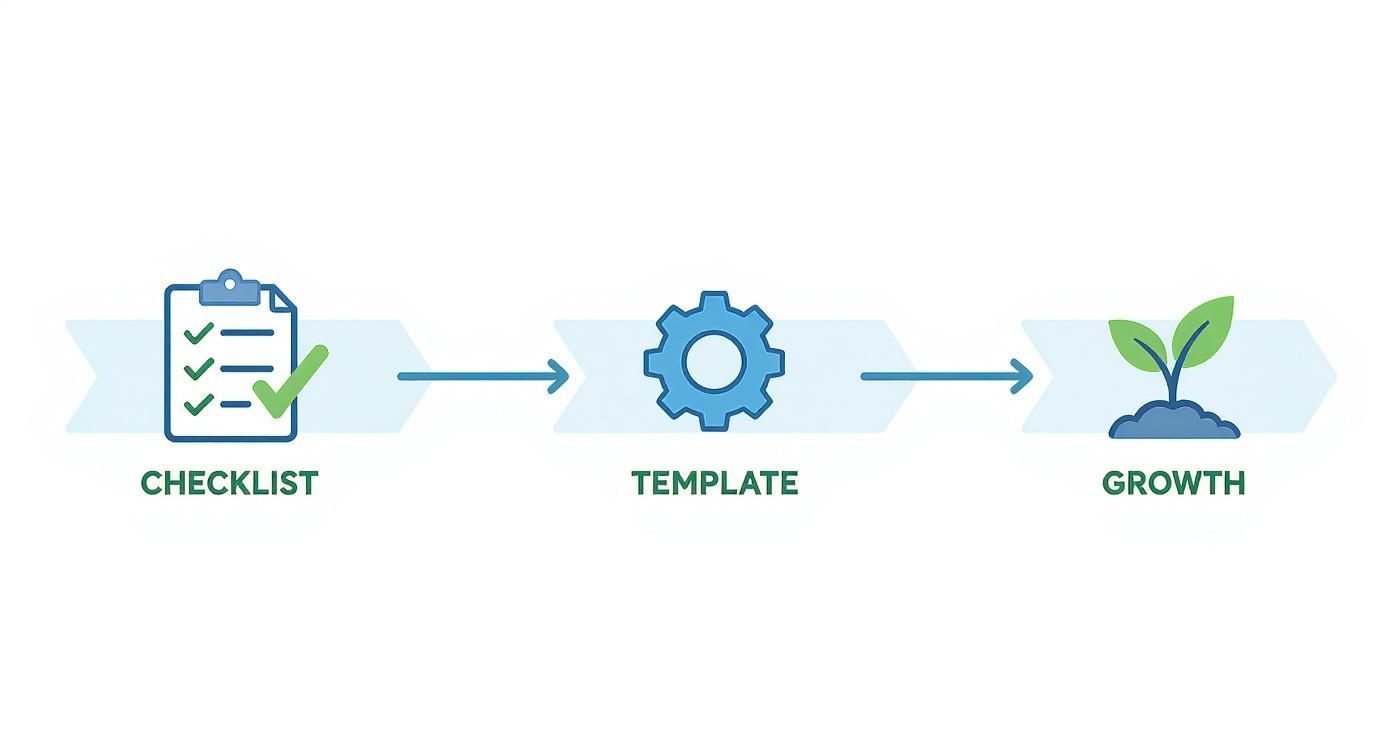
This kind of visual structure makes it incredibly easy for both the manager and the new hire to see the entire onboarding journey at a glance.
Tailoring the Blueprint for Different Roles
The real power of a template isn't its rigidity; it's its adaptability. The structure stays the same, but the specific goals, activities, and metrics are customized for the role. This gives you the best of both worlds: company-wide consistency and highly relevant, role-specific guidance.
Let's look at a couple of real-world examples.
For a Sales Executive:
- 30-Day Goal: Complete product certification and shadow 5 senior sales calls.
- KPI: Score at least 90% on the final product knowledge assessment.
For a Software Engineer:
- 30-Day Goal: Get the local development environment fully set up and successfully merge 1 small pull request into the staging branch.
- KPI: Receive code review approval from two senior engineers without needing major revisions.
See how that works? By using a flexible blueprint, you're not just handing over a checklist. You’re building a strategic tool designed to get people performing at their best, faster, no matter what department they're in.
Make Onboarding an Experience, Not Just a Process
Let's be honest, a great onboarding plan is about more than just getting paperwork signed. It’s your first real chance to prove to a new hire that they made the right choice in joining your team. This is where you shift from a simple administrative task to actively building loyalty and excitement. It's about creating an experience that inspires confidence, not one that leaves them feeling lost and overwhelmed.

That first week is absolutely crucial. It sets the tone for everything that follows. A well-thought-out training plan ensures this critical time is immersive and genuinely helpful. Forget just ticking boxes; think about crafting meaningful moments that make them feel like part of the team from day one.
Go Beyond the Standard Buddy System
Pairing a new person with a seasoned team member is a classic for a reason, but we can do so much better. A truly impactful experience formalizes this relationship while still leaving plenty of room for genuine connection. It's the perfect blend of structured learning and informal mentorship.
For example, your training template could build in specific touchpoints that go beyond just work tasks:
-
Coffee & Culture
Chat: Block out 30 minutes in the first week for the mentor and new hire to just talk. This is for all the unwritten rules—how meetings really run, who the best person is for a weird IT problem, and just the general office vibe. - Planned Cross-Departmental Intros: Don't leave it to chance. Schedule quick, 15-minute meet-and-greets with key people from other teams they'll interact with. This helps demystify the organization and immediately starts building their internal network.
- First Project Shadowing: Instead of just throwing tasks at them, have the new hire shadow their mentor on a small, low-stakes project. They get to see the real-world workflow in action before they have to tackle it alone.
This turns a passive buddy
into an active guide, drastically speeding up how quickly they understand not just their own role, but how they fit into the bigger picture.
The goal isn't just to make someone feel welcome. It's to prove to them, through action, that your company invests in its people's success right from the start. This builds loyalty far more effectively than any welcome lunch ever could.
Meaningful check-ins are the other side of this coin. Instead of a manager just asking, How's it going?
, your plan should prompt deeper questions. Regular, structured chats can uncover small snags before they turn into major frustrations.
Unlocking Your Company's Tribal Knowledge
Every single company runs on a current of unspoken wisdom—all the little things about how we *really* do things around here.
This is the stuff new hires are desperate to learn, but it's almost never written down. A great training plan makes capturing and sharing this tribal knowledge a priority.
This is where you see a real business impact. A global survey found that companies with solid training programs are 17% more productive and see 21% more profit. Yet, somehow, only 15% of full-time workers say they feel 'highly involved and enthusiastic' at their jobs. That gap is a massive opportunity. Great training isn't just about skills; it's about making people feel connected and engaged. You can discover more insights on the link between training and profitability from the full research.
By making a formal effort to pass on this unwritten knowledge, you’re not just helping the new hire—you're making your entire organization stronger and more resilient. Your template can even include sections for mentors to jot down answers to common how-to
questions that pop up, slowly building a shared knowledge base.
Imagine a new hire confidently handling a tricky customer request in their second week. Why? Because their training included real-world scenarios and tips from your top performers. That's the difference between an employee who is simply trained and one who is truly empowered. This is how you turn a good hire into a long-term, high-impact member of the team.
Make Company Knowledge Instantly Accessible
What if your team never had to hunt for information again? Imagine a world where every question about your company—from What's the guest Wi-Fi password?
to What's our Q3 sales strategy?
—is answered instantly, without ever leaving Slack.
This isn’t about creating another dusty, forgotten knowledge base. It’s about ending the frustrating daily ritual of searching through old documents, digging through shared drives, or interrupting a colleague just to get a simple answer. It's about giving your team back the time they lose every day to information scavenger hunts.

When your employee training plan template is connected to a single source of truth, it stops being a static checklist and becomes a dynamic system. Your team can finally break the cycle of lost productivity and focus on what matters.
Escape the Knowledge Graveyard
We’ve all seen it. A company launches a new wiki or internal database with the best of intentions, but it quickly becomes a knowledge graveyard
—a collection of outdated, untrustworthy, and ignored information.
Why does this happen? Because keeping these systems updated is a manual chore that nobody has time for. Before long, your team stops trusting the official source and reverts to what's easy: asking a coworker. This creates a huge bottleneck, especially when the one person with the answer is busy, on vacation, or in another time zone.
Your training plan shouldn't point new hires toward a resource that even your veterans don't trust. The only way to win is to capture knowledge where it’s already being created: in your team's everyday conversations.
Turn Slack Into Your Single Source of Truth
Here’s a secret: the most valuable information in your company isn't in a formal document. It's in the hundreds of questions asked and answered in public Slack channels every week. It's a goldmine of practical knowledge that, until now, has just disappeared into the scrollback abyss.
With an AI assistant like SAI, you can transform Slack into your company's intelligent brain. When someone asks a question and an expert answers, the AI learns from that exchange. The next time anyone asks that question—or a similar one—SAI delivers the verified answer instantly, right in the channel.
It creates a powerful, self-improving feedback loop:
* A question gets asked in a public channel.
* A teammate provides the right answer.
* SAI captures that Q&A and adds it to the company's collective knowledge.
Suddenly, every answer shared strengthens your entire organization. This is the foundation of modern knowledge management systems that actually work, because it doesn't force a new workflow on anyone. It simply works where your team works.
Imagine this: no one on your team ever has to open another tab, search in multiple places, or wait for a response again. They just ask SAI in Slack and get the exact information they need, right now.
This is a fundamental shift in how work gets done. It gives everyone, from a day-one new hire to a seasoned executive, immediate access to the collective wisdom of the entire company.
A Training Plan That Evolves in Real Time
Now, let's bring this all back to your employee training plan template. Instead of linking to static handbooks, your template can direct new hires to the one place they know they'll get an instant, accurate answer: Slack.
For a new Sales Rep:
* Instead of digging for a 50-page PDF, they can just ask in the #sales channel, What are our top three differentiators against Competitor X?
and get an immediate, battle-tested answer compiled from your top performers.
For a new Engineer:
* Instead of struggling with an outdated setup guide, they can ask, What's the command to run the local testing suite for the new mobile feature?
and get the correct, current command without derailing a senior developer's focus.
This approach transforms your training plan into a living document. It guarantees that new employees are always learning from the most current information, because your knowledge base is updated with every conversation. You completely eliminate the risk of training someone on an obsolete process.
Your company moves faster, new hires get up to speed in record time, and your senior team is freed up to do the high-impact work that truly moves the needle.
Measure the Real-World Impact of Your Training
Let's be honest. How do you actually know if your training is working? It’s easy to get caught up in tracking course completion rates or happy-face
survey results, but those numbers tell you next to nothing about whether you’re actually moving the needle.
A truly great training plan isn't measured by how many people clicked complete
—it's measured by real, tangible improvements in how people do their jobs.
https://www.youtube.com/embed/9p6tWCHbtPQ
If you want to prove the value of your training and get the budget you need to keep going, you have to start speaking the language of your leadership team. That means shifting your focus from vanity metrics to the key performance indicators (KPIs) they actually care about.
Look Beyond Completion Rates
Celebrating a 100% completion rate on a new course feels good, but what does it really mean? All it confirms is that your team clicked through a bunch of slides. It doesn't tell you if they learned anything, if they can apply those new skills, or if their performance has actually gotten better.
To get a true picture of your training's ROI, you have to connect it directly to business outcomes.
- Time-to-Productivity: How long does it take for a new hire to get up to speed and start hitting their goals? A solid training plan should be systematically shortening this ramp-up period.
- Skill Mastery vs. Job Needs: Are your people actually gaining the skills they need for their roles? You can track this through practical assessments, manager feedback, and performance reviews—not just a simple quiz at the end of a module.
- Post-Training Confidence: This is a powerful, often overlooked metric. After a training session, ask employees to rate their confidence in applying the new skill on a scale of 1-10. A significant jump is a fantastic sign that your training hit the mark.
The goal isn't just to dump information on people; it's to build capability. When you start measuring capability, you start asking better questions and getting far more meaningful answers about your training's success.
Connecting training to business results is what separates the good from the great. For example, after rolling out a new training for your customer support team, you should be able to point to a measurable drop in average ticket resolution time or a clear uptick in CSAT scores. Now that’s a result you can take to the bank.
Building a Metrics Dashboard That Matters
Instead of drowning yourself and your stakeholders in a sea of data, pick a handful of metrics that tell a clear, compelling story. Your dashboard should draw a straight line from a training activity to a business outcome. It’s less about what we did
and more about what changed because of it.
This is all about reframing how you think about success. Let's look at how to shift from traditional metrics to ones that truly show impact.
Training Success Metrics That Matter
A quick glance at this table shows the difference between metrics that feel good and metrics that prove value.
| Metric Category | Traditional Metric (Avoid) | Impact Metric (Focus On) |
|---|---|---|
| New Hire Onboarding | Percentage of onboarding tasks completed. | Reduction in new hire Time-to-First-Contribution. |
| Sales Training | Number of training modules finished. | Improvement in Sales Cycle Length or Win Rate. |
| Technical Skills | Score on a multiple-choice test. | Decrease in Code Review Revisions for engineers. |
| Support Training | Hours spent in training sessions. | Reduction in First-Contact Resolution Time. |
Focusing on the right-hand column ensures you’re always evaluating your training based on its ability to solve real business problems. This is how you demonstrate undeniable value.
Let Feedback Fuel Your Flywheel
Numbers tell you what is happening, but it’s the qualitative feedback that tells you why. Never underestimate the power of asking a few open-ended questions in your post-training surveys.
Simple prompts like, What was the most valuable part of this training?
or What's one thing you're still unclear on?
will give you absolute gold.
This kind of feedback helps you pinpoint exactly which parts of your training are hitting home and which are falling flat. Use these insights to constantly tweak and refine your template, making it more effective with every single new hire. This feedback loop is what turns a static document into a living, breathing tool that drives ever-increasing returns.
Got Questions About Your Training Plan Template? Let's Get Them Answered.
Even the most buttoned-up training plan template is going to spark a few questions. That's a good thing. Anticipating these questions is the key to creating a strategy that’s not just practical and sustainable, but one that your team will actually embrace.
Let's dive into some of the most common hurdles I've seen teams face and how to clear them. Think of your template less as a static document and more as a dynamic system for empowerment. The real goal here is to build a business where knowledge flows freely and no one is ever stuck waiting for an answer.
How Do I Adapt One Template for Different Departments?
This is a classic trap. You don't want one massive, convoluted template that tries to be everything to everyone. The secret is to think modularly.
Picture it like building with LEGOs. You start with a set of standard, core pieces and then add specialized pieces for specific functions.
Your Core Module
is the foundation. It's the universal stuff every single employee needs, regardless of their role. This is where you put:
* The company's mission, vision, and core values.
* How-to's for essential tools like email, Slack, and your HR software.
* Crucial security protocols and company-wide policies.
From there, you build out role-specific modules. You'll have a Sales Module
packed with scripts and CRM guides, an Engineering Module
detailing coding standards and deployment checklists, and so on for each team. When a new person joins, you just hand them the Core Module plus their department’s specific module. This approach keeps your company-wide information perfectly consistent while delivering super relevant, targeted training for their actual day-to-day job.
What Is the Best Way to Keep a Training Plan Updated?
A stale training plan is worse than no plan at all. Don't let yours become a digital fossil. The most effective way to keep it fresh is to weave it directly into your team's daily workflow.
First off, assign clear ownership. Someone—whether it's an HR lead or a department head—needs to be responsible for its upkeep. I recommend a quick review every quarter to hunt down and eliminate outdated processes, tools, or goals.
But here’s the real game-changer: create a dead-simple feedback loop. Actively ask managers and new hires for their suggestions after their first 90 days. Better yet, you can make this process nearly automatic. When you use an AI tool like SAI right within Slack, every question that gets answered in a public channel can instantly become a part of your company's living knowledge base. Your training content literally evolves in real-time without anyone having to manually update a document.
How Can I Ensure Managers Actually Use the Plan?
Let's be honest: manager buy-in is everything. If they see the plan as just another piece of administrative busywork, it’s dead on arrival. You have to position it as a tool that solves their biggest headaches.
Start by getting them involved in creating their department's training module. When they help build it, they have a sense of ownership. Next, integrate the plan directly into their existing routines. Make the 30-60-90 day check-ins a required part of their one-on-one meeting agendas.
Finally, let the results speak for themselves. When a manager sees a new hire contributing meaningfully in weeks instead of months, the value is undeniable. The moment they realize they’re no longer answering the same five questions every single day, they'll become the template’s biggest advocates. They'll see it for what it truly is: a tool that gives them back their most valuable resource—time.
Ready to stop the endless cycle of repetitive questions and lost knowledge? With SAI, you can transform your Slack channels into an intelligent, self-updating knowledge base that gives your team instant answers, 24/7. See how it works and add SAI to your team for free.