8 Transformative Documenting Processes Examples for 2026
Imagine a workday where you never have to leave Slack to find an answer. No more digging through Confluence, chasing down the one person who knows the process, or deciphering outdated wikis. The constant drain of searching, waiting, and rebuilding context after every interruption is costing your team more than just time, it's killing momentum and focus.
This isn't about creating more heavy documentation no one reads. It's about transforming how your team accesses crucial information instantly. We've compiled a definitive list of documenting processes examples that show you exactly how to capture your team's operational knowledge.
The goal is to turn your scattered procedures into a living, breathing knowledge base right inside the tools you already use. When you pair these methods with a powerful AI assistant, every question gets an instant, accurate answer directly in Slack. Forget endless searching and context switching. Prepare to see a future where your team is free to do the deep, meaningful work they were hired for, with every process detail just a quick question away. This is how you stop searching and start doing.
1. Standard Operating Procedures (SOPs)
Standard Operating Procedures (SOPs) are the foundational blueprints for consistency and quality in your business. They are detailed, step-by-step instructions that codify how to perform routine tasks, transforming chaotic, ad-hoc activities into predictable, repeatable workflows. Think of them as the ultimate playbook for everything from resolving a customer support ticket to processing payroll.
For teams running on Slack, documenting these processes is not just about creating static documents. When you feed these SOPs into an AI like SAI, you turn your team’s collective knowledge into an instant, conversational resource. Imagine your team members never having to hunt through wikis, shared drives, or old Slack messages again. Instead, they just ask a question like, What's the process for an urgent bug fix?
and get an immediate, accurate answer right in Slack.
Strategic Breakdown: From Chaos to Clarity
Here’s one of the most powerful examples of documenting processes: an IT team standardizing its new hardware request workflow.
- Before: An employee needs a new monitor. They might DM the IT lead, post in a general channel, or send an email. The IT team wastes time tracking down approvals, hardware specs, and shipping details, leading to frustrating delays.
- After: The team creates an SOP detailing every step: where to find the request form, what information is required, the approval chain, and the expected timeline. This SOP is fed to SAI. Now, any employee can simply ask,
How do I request a new monitor?
and instantly receive the correct procedure and link.
Actionable Takeaways
To implement this effectively, start small and build momentum.
- Target High-Impact Processes: Begin with the most frequent and time-consuming tasks. What questions do your team leads answer over and over? Document those first.
- Make it Visual: Use annotated screenshots or brief screen recordings for complex steps. Clarity is key to adoption.
- Empower Your Team: Test the SOP with someone unfamiliar with the process. If they can follow it without help, you’ve succeeded. For a deeper dive, learn more about how to write an effective Standard Operating Procedure.
2. Process Flowcharts and Diagrams
Process flowcharts are the visual roadmaps that bring your workflows to life. Instead of relying on dense text, these diagrams use standardized symbols and arrows to map out sequences, decision points, and dependencies. They transform abstract procedures into intuitive, easy-to-follow visual guides, making it simple for anyone to understand how work gets done.
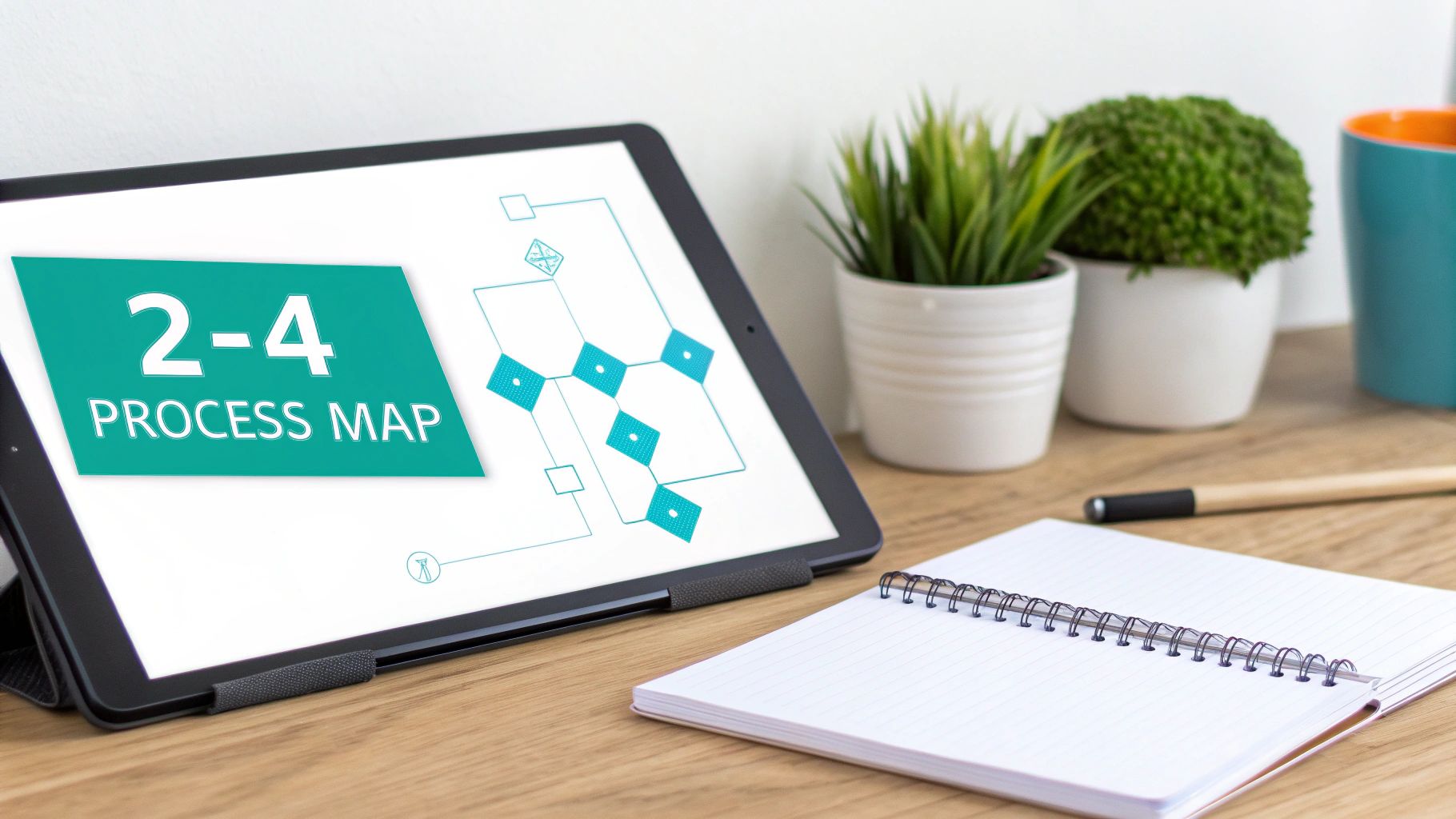
When you integrate these visual maps with an AI like SAI, you're not just creating a picture; you're building an interactive guide. A team member can ask, What happens after a budget request is denied?
and SAI can reference the flowchart to deliver a precise, contextual answer directly in Slack. This eliminates confusion and the need to decipher complex procedural documents, turning every question into a quick, visual learning moment.
Strategic Breakdown: From Ambiguity to Action
One of the most valuable documenting processes examples is a marketing team mapping its content approval workflow.
- Before: A new blog post is ready for review. The writer messages the editor, who then needs to find the designer for graphics, and finally track down a manager for final approval. The process is undefined, leading to bottlenecks, missed deadlines, and endless
who's next?
questions in Slack. - After: The team creates a flowchart in Miro. It clearly shows the handoffs from writing to editing, design, and final sign-off, including what happens if revisions are needed. When linked to SAI, anyone can ask,
Where does the draft go after the editor reviews it?
and get an instant, clear answer based on the visual map.
Actionable Takeaways
To make flowcharts a dynamic part of your documentation, focus on clarity and accessibility.
- Start with the 'Happy Path': First, map out the ideal, smoothest version of the process from start to finish. You can add exceptions and alternative paths later.
- Use Collaborative Tools: Platforms like Lucidchart or Miro allow your team to build and update flowcharts together in real-time, ensuring the diagram reflects reality.
- Keep it Simple: For workflows involving multiple teams, use swimlane diagrams but limit them to 3-4 key roles to avoid visual clutter. The goal is immediate understanding, not overwhelming detail.
3. Runbooks (Operational Playbooks)
Runbooks, or operational playbooks, are the hyper-specific, action-oriented guides that keep your technical systems running smoothly. They are the essential recipes for handling everything from routine server restarts to high-stakes security incidents, providing exact commands and decision trees needed for reliable execution. In high-pressure situations, a clear runbook is the difference between a minor hiccup and a major outage.
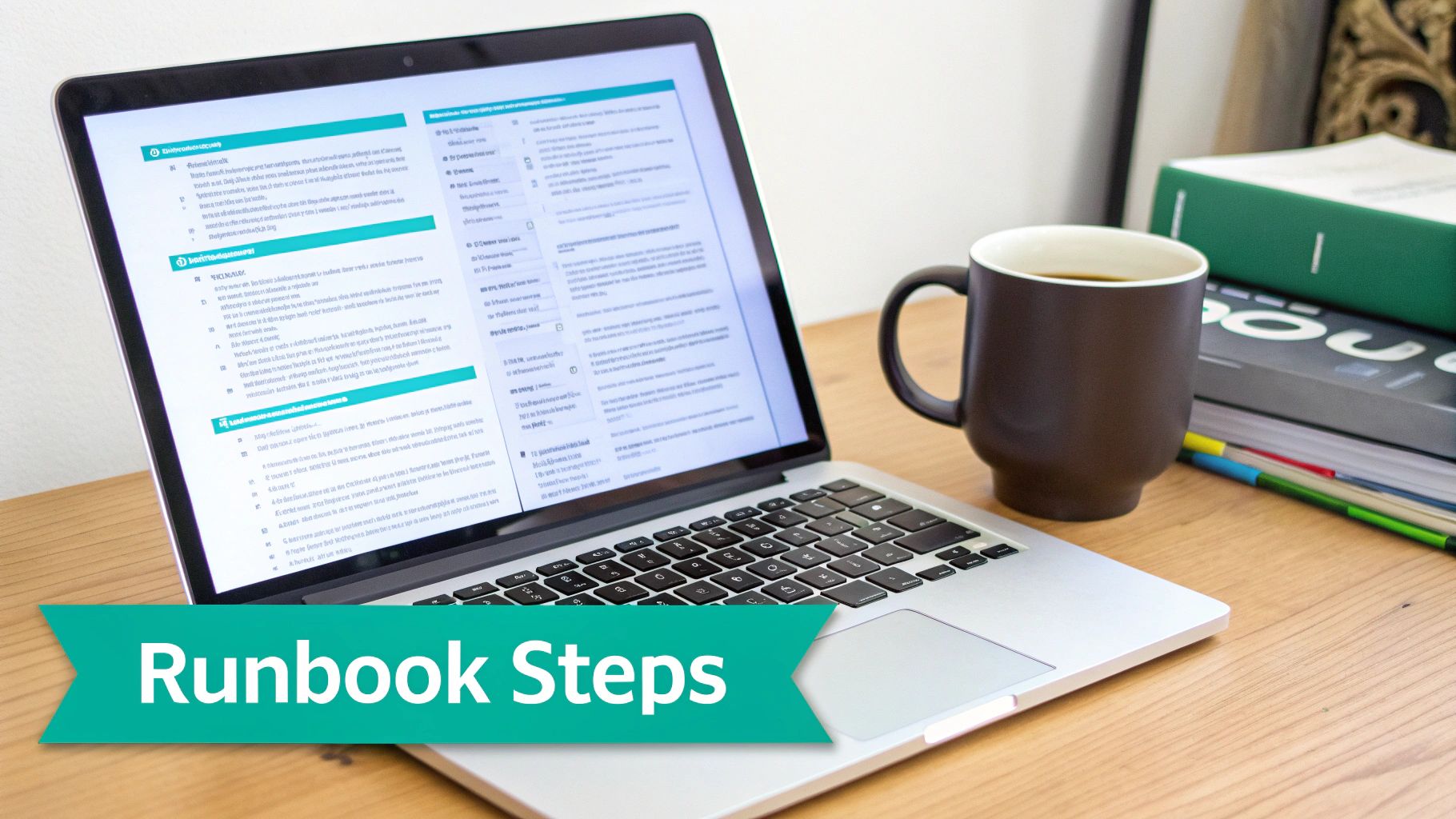
When these playbooks are accessible via an AI like SAI in Slack, they become a lifeline for your on-call teams. Instead of frantically searching a wiki or old documents during an incident, an engineer can simply ask, What's the runbook for restarting the production database?
and get an immediate, step-by-step guide. This transforms your incident response from a stressful scramble into a calm, controlled procedure.
Strategic Breakdown: From Reactive to Resilient
Here is a classic example of documenting processes: a DevOps team codifying its incident response for a web application failure.
- Before: An alert fires at 2 AM. The on-call engineer wakes up, logs in, and tries to remember the complex restart sequence. They waste precious minutes running diagnostic commands and scrolling through old Slack messages to find the correct procedure, while the system remains down.
- After: The team documents the entire process in a runbook, including diagnostic commands, restart scripts, and escalation contacts. This runbook is fed to SAI. Now, when the alert fires, the engineer asks,
How do I troubleshoot a web-app outage?
and instantly gets the exact checklist, turning a 30-minute firefight into a 5-minute fix.
Actionable Takeaways
To create effective runbooks, focus on clarity under pressure.
- Write for 2 AM: Assume the person reading it is tired and stressed. Use simple language, clear commands, and leave no room for interpretation.
- Include Diagnostics: Don’t just list the fix; include commands to verify the problem first. This prevents engineers from applying the wrong solution.
- Version Control Everything: Always date your runbooks and log changes. An outdated runbook is more dangerous than no runbook at all. Make your operational knowledge discoverable in Slack so your team has a single source of truth.
4. Knowledge Base Articles
Knowledge base articles are your organization's centralized library of truth. They are comprehensive, searchable guides that explain concepts, answer common questions, and detail procedures, serving as the go-to reference for employees and customers alike. These articles transform tribal knowledge into a durable, accessible asset for your entire team.
When you connect this knowledge base to an AI like SAI, it becomes more than just a static library; it becomes a dynamic, conversational expert. Imagine a world where your team no longer needs to hunt through different apps, folders, or wikis. Instead, they just ask a direct question in Slack, like What are the key features of our new product update?
and get a precise, immediate answer sourced directly from your knowledge base.
Strategic Breakdown: From Reactive to Proactive
Here’s a powerful example of documenting processes with knowledge base articles: a customer success team creating onboarding documentation.
- Before: New customers bombard the success team with the same set of basic questions via email and Slack. The team spends hours answering repetitive queries, leading to slow response times and an inconsistent onboarding experience.
- After: The team creates a series of knowledge base articles covering every step of the onboarding process, from initial setup to advanced features. This library is fed to SAI. Now, a new customer can ask,
How do I integrate with Salesforce?
and get an instant, detailed guide right in Slack, freeing the success team to focus on strategic, high-value customer engagement.
Actionable Takeaways
To build a knowledge base that truly works, focus on accessibility and relevance.
- Solve Real Problems: Start by documenting the answers to the top 10 most frequently asked questions your team receives. This ensures immediate value and adoption.
- Use Rich Media: Don't just write text. Embed short videos, GIFs, or annotated screenshots to clarify complex steps and make the information easier to digest.
- Iterate and Improve: Regularly review which articles are most viewed and gather feedback from the team. Use this data to refine existing content and identify gaps in your knowledge. For a deeper understanding, explore what a knowledge management system is and how it can help.
5. Video and Screen Recording Tutorials
Video and screen recording tutorials are dynamic, visual walkthroughs that bring complex processes to life. Instead of just reading instructions, team members watch the task being performed in real-time, combining on-screen action with clear narration. This method is incredibly effective for visual learners and for documenting intricate, multi-step workflows that are clunky to explain with text and static screenshots.
For modern teams collaborating in Slack, these tutorials offer powerful, asynchronous training. But their true value is unlocked when the content is made searchable. By including a transcript or summary with each video and feeding it to an AI like SAI, you transform a passive video library into an interactive, on-demand expert. Your team no longer needs to scrub through videos to find a specific step; they can just ask a question and get a precise, time-stamped answer or a direct link, all within Slack.
Strategic Breakdown: From Confusion to Competence
One of the most impactful examples of documenting processes using video is a sales team standardizing its CRM data entry protocol.
- Before: A new sales rep joins the team. They receive a 20-page text document on how to use the CRM. They struggle to find the right fields, miss crucial steps, and create inconsistent records, leading to a messy sales pipeline and inaccurate forecasting.
- After: The sales manager records a series of short, 3-minute Loom videos, each demonstrating a specific CRM task, like
How to Create a New Opportunity
orHow to Log a Customer Call.
These videos and their transcripts are fed to SAI. Now, a new hire can ask,Show me how to update a deal stage,
and instantly get a link to the exact video tutorial.
Actionable Takeaways
To make video tutorials a core part of your process documentation, focus on clarity and accessibility.
- Keep it Short and Focused: Create a series of micro-videos (under 5 minutes) covering one specific task each. This is far more effective than a single, hour-long training session.
- Include a Transcript: Always add a text summary or full transcript. This is crucial for accessibility and allows tools like SAI to index the content, making your video's knowledge instantly searchable.
- Narrate Clearly: Speak slowly and clearly, explaining not just what you are clicking but why. Context is just as important as the action itself. For more ideas, explore how top teams use asynchronous video for onboarding and training.
6. Decision Trees and Diagnostic Checklists
Decision Trees and Diagnostic Checklists are structured frameworks designed to guide users through complex troubleshooting or decision-making. They transform sprawling, uncertain problems into a clear, sequential path of targeted questions. Think of them as a GPS for problem-solving, systematically eliminating variables until a solution is found, making them one of the most effective documenting processes examples for support and IT teams.
When this logic is integrated into an AI like SAI, it revolutionizes how teams find answers in Slack. Instead of a support agent manually clicking through a static flowchart, they can interact conversationally. SAI asks the relevant diagnostic questions one by one, guiding the user directly to the resolution without them ever leaving their workflow. Imagine your IT helpdesk resolving a connectivity issue in minutes, not hours, just by asking and answering questions in a thread.

Strategic Breakdown: From Chaos to Clarity
Here’s a powerful example of this process documentation in action: a customer support team diagnosing a product malfunction.
- Before: A customer reports their device isn't turning on. The support agent asks a random series of questions based on memory, leading to back-and-forth emails, missed steps, and frustrated customers.
- After: The team builds a diagnostic decision tree. It starts with the most common issue:
Is the device plugged in and the outlet working?
From there, it branches into more specific checks. This entire flow is fed into SAI. Now, a junior agent can ask,How do I troubleshoot a device that won't power on?
and SAI initiates the entire diagnostic conversation for them.
Actionable Takeaways
To build effective decision trees, focus on clarity and efficiency.
- Start with Common Problems: Begin your tree with the most frequent symptoms or user complaints. This ensures you solve the majority of issues in the fewest steps.
- Keep Questions Binary: Frame questions to have simple
yes
orno
answers whenever possible. This removes ambiguity and makes the path forward clear. - Test Every Path: Run through every possible branch of your decision tree to ensure each one leads to a logical resolution or a clear escalation point. For more ideas on structured processes, explore this guide to building a new employee onboarding checklist.
7. Template-Based Documentation
Template-Based Documentation eradicates the dreaded blank page
problem by providing a standardized, reusable format for capturing critical information. These structured documents, with predefined sections and fields, ensure that every bug report, project kickoff, or incident post-mortem is documented with the same level of detail and clarity. This approach transforms information capture from a chore into a simple, fill-in-the-blanks exercise.
For teams operating in Slack, templates are a game-changer. When you use a template to document a new feature request or a process change within a Slack thread, you're not just creating a record. You're simultaneously training your AI assistant. SAI instantly absorbs this structured information, making it searchable and conversational. Your team can then ask, What was the root cause of last week's outage?
and get a precise summary from the post-mortem, without ever leaving Slack.
Strategic Breakdown: From Inconsistent to Insightful
One of the most effective examples of documenting processes using templates is a product team standardizing its bug reporting.
- Before: Developers receive bug reports via DMs, channel mentions, or emails. The reports are often vague, missing crucial details like reproduction steps, browser versions, or user IDs. This forces a frustrating back-and-forth, delaying fixes and wasting valuable engineering time.
- After: The team implements a bug report template in a dedicated Slack channel. The template requires specific fields like
Steps to Reproduce,
Expected Behavior,
andActual Behavior.
This SOP is fed to SAI. Now, anyone can ask,How do I report a bug?
and get the template and instructions instantly.
Actionable Takeaways
To make templates an integral part of your workflow, focus on accessibility and consistency.
- Keep it Concise: Limit your templates to 5-7 essential sections. Overly complex templates create friction and discourage use.
- Make Templates Accessible: Use Slack's pinned messages or slash commands to make your templates easy to find and use directly within the relevant channels.
- Train Your Team on the
Why
: Explain why each field in the template is important. When your team understands how their input contributes to faster resolutions or better decisions, they are more likely to adopt the process. For more ideas on structuring information, check out these best practices on Slack documentation.
8. Interactive Training and Micro-Learning Modules
Interactive Training and Micro-Learning Modules break down complex knowledge into digestible, bite-sized lessons. Instead of overwhelming employees with lengthy manuals, this approach delivers focused, engaging content (often 2-15 minutes long) that builds skills incrementally. Think of it as the difference between reading a textbook and completing a quick Duolingo lesson to learn a specific skill, like updating a Salesforce record or a new security protocol.
In a Slack-first environment, this method becomes even more powerful. When your documentation includes micro-learning modules, SAI can do more than just provide static answers; it can guide employees through interactive learning. Imagine a new hire asking, How do I use the new expense reporting tool?
Instead of just getting a link to a dense document, they receive a 5-minute interactive tutorial right within Slack, solidifying their understanding and reducing follow-up questions.
Strategic Breakdown: From Passive Reading to Active Learning
Here is a prime example of documenting processes with micro-learning: a sales team certifying its members on a new product feature.
- Before: The product team drops a 20-page PDF into a Slack channel. The sales team skims it, misses key details, and then asks repetitive questions for weeks. This leads to inconsistent messaging with customers and missed sales opportunities.
- After: The team creates a short series of micro-learning modules with quick quizzes. This training is fed to SAI. Now, a sales rep can ask,
How do I explain the new AI analytics feature?
and SAI not only provides the key talking points but also links them to a 3-minute interactive module to practice the pitch.
Actionable Takeaways
To effectively integrate micro-learning, focus on immediate application and reinforcement.
- Start with Knowledge Checks: Begin modules with a quick quiz to gauge existing knowledge. This primes the learner and focuses their attention on what they need to learn.
- Keep it Short and Focused: Aim for modules under 10 minutes. Each one should cover a single, specific skill or concept for maximum retention.
- Make it Scenario-Based: Root your training in real-world situations your team faces daily. This makes the content more relevant and immediately applicable, proving why this is one of the most effective documenting processes examples.
8-Method Process Documentation Comparison
| Knowledge Artifact | Implementation Complexity 🔄 | Resource Requirements 💡 | Expected Outcomes ⭐📊 | Ideal Use Cases ⚡ |
|---|---|---|---|---|
| Standard Operating Procedures (SOPs) | Medium–High — structured writing and governance | Time, SMEs, reviewers, periodic updates | ⭐⭐⭐⭐ — consistent execution, compliance, lower error rates | Routine operations, onboarding, compliance |
| Process Flowcharts & Diagrams | Low–Medium — mapping skills; complexity grows with detail | Diagram tools, facilitator time, collaboration sessions | ⭐⭐⭐ — improved clarity, quicker bottleneck identification | Process mapping, handoffs, improvement workshops |
| Runbooks (Operational Playbooks) | High — technical detail, testing, versioning | Engineers, test environments, change control | ⭐⭐⭐⭐ — reduced MTTR, repeatable incident response | On-call incidents, deployments, recovery procedures |
| Knowledge Base Articles | Medium — writing, structuring, ongoing maintenance | Writers, CMS/search, tagging, review cadence | ⭐⭐⭐⭐ — increased self-service, fewer repetitive questions | FAQs, product docs, internal policies, support docs |
| Video & Screen Recording Tutorials | Medium–High — recording and editing skills | Recording tools, editor time, hosting/storage | ⭐⭐⭐ — faster learning for visual tasks; high engagement | UI walkthroughs, feature demos, onboarding steps |
| Decision Trees & Diagnostic Checklists | Medium — logical branching and testing | SMEs, mapping tools, validation, SAI conversational flows | ⭐⭐⭐⭐ — quicker self-diagnosis, fewer irrelevant attempts | Troubleshooting, triage, support diagnostics |
| Template-Based Documentation | Low–Medium — design upfront; easy adoption | Template design, training, integration with workflows | ⭐⭐⭐⭐ — faster, more complete documentation at scale | Bug reports, post-mortems, feature requests, standard forms |
| Interactive Training & Micro-Learning | High — instructional design and platform support | Authoring tools, LMS/integration, content creators, analytics | ⭐⭐⭐⭐ — better retention, measurable skill improvements | Compliance, micro-upskilling, role-specific learning |
From Documenting to Doing: Your Single Source of Truth Awaits
We've explored a powerful array of documenting processes examples, from structured SOPs and visual flowcharts to dynamic runbooks and template-based guides. Each method offers a distinct pathway to clarity, consistency, and operational excellence. But the true goal isn't just to create a library of pristine documents stored away in a folder somewhere. The goal is to eliminate the daily friction your team faces when they need an answer, right now.
The real transformation occurs when these documented processes become a living, breathing part of your team's workflow. Imagine a day where no one has to switch tabs to search through a convoluted drive, ping a colleague and wait for a reply, or hunt through old conversations for that one crucial link. The power of these examples is unlocked when they are accessible and actionable where work actually happens: inside Slack.
Bridging the Gap Between Knowing and Doing
The strategic value of documenting processes isn't in the documents themselves, but in the outcomes they create:
- Reclaimed Productivity: Every documented process, like the incident response runbook or the support triage checklist, is a direct answer to a recurring question. By making these answers instantly available, you reclaim countless hours previously lost to repetitive inquiries and context switching.
- Empowered Autonomy: When a new hire can resolve an IT issue using a clear decision tree or a team member can follow a video tutorial for a complex task, they are empowered to act independently. This fosters a culture of self-sufficiency and confidence across the entire organization.
- Uninterrupted Focus: The ultimate competitive advantage is focus. By centralizing knowledge and making it instantly accessible, you remove the mental tax of searching for information. Your team can maintain deep work states for longer, driving innovation and delivering higher-quality results.
The most effective documentation isn't a static artifact; it's an intelligent, on-demand resource. The examples we’ve reviewed provide the raw material. The next step is to activate this knowledge, turning your team's collective wisdom into an instant, conversational expert that is always on and always accurate. This is where your single source of truth moves from a concept to a reality, one answered question at a time.
Ready to stop searching and start doing? Turn your documented processes into a 24/7 expert inside Slack with SAI. Stop managing documents and start empowering your team with instant, AI-powered answers by visiting SAI to see how it works.