A Modern Guide to Customer Oriented Service
Picture a workday where you're not constantly chasing down information. No more frantic searches through old Slack channels, no more bugging colleagues for that one link, and definitely no more wasted hours trying to piece together lost context. This is what a truly customer oriented service model looks like when you turn it inward—anticipating your team's needs before they even have to ask.
Move from Answering Questions to Anticipating Needs

This isn’t about working harder. It’s about building a smarter system that makes work just flow. Just think about the collective hours your team burns every week tracking down the same sales deck, re-explaining a process, or answering a question that’s already been asked a dozen times. Each one of those little interruptions is a tax on productivity, pulling people away from the work that actually moves the needle.
But what if all that friction just… vanished? Imagine a junior developer, instead of interrupting a senior engineer for the third time this week about API key protocols, simply asks SAI in Slack. The correct, vetted answer appears instantly. The senior engineer stays locked in their work, completely uninterrupted. This isn’t a technical fantasy; it’s a transformation in how your team experiences their workday.
The True Cost of Repetitive Questions
The problem goes way beyond the time it takes to type out an answer. The real killer is context switching. Research shows it can take over 23 minutes to get back into a deep state of focus after just one small interruption. This constant stop-and-start cycle creates a ripple effect of hidden costs:
- Delayed Projects: Small interruptions stack up, pushing timelines back and stalling progress on your most important initiatives.
- Reduced Innovation: When your best people are forced to act as human search engines, their brainpower for creative problem-solving shrinks.
- Team Frustration: It’s inefficient for new hires who feel like they're always asking for help, and it’s a recipe for burnout for your experts who are tired of repeating themselves.
A genuine customer oriented service culture treats internal teams with the same respect for their time and focus as it does paying customers. It operates on a simple principle: the easiest question to answer is the one that never has to be asked.
A New Way of Working in Slack
This guide gives you the blueprint for building that system right inside the Slack workspace you already use every day. Imagine a world where your team no longer has to open multiple tabs, search through messy shared drives, or second-guess if they have the latest information. They simply ask a question in Slack, and the answer finds them.
We’ll walk you through how this new reality is possible. You'll see how the knowledge already flowing through your daily conversations can create a permanent, intelligent resource that serves the entire team. Get ready to see how this simple change can unlock huge gains in productivity and team morale, freeing everyone up to do their best work.
What Customer-Oriented Service Actually Looks Like
Let's cut through the buzzwords. A genuinely customer-oriented service mindset isn't some lofty corporate theory discussed in endless meetings. It's about building efficiency and foresight directly into every single interaction. Think of it as evolving from a reactive, ticket-closing machine into a proactive, problem-solving partner for your team.
Imagine this: instead of just answering the direct question someone asks, your support system gets to the why behind it. It doesn't just hand over a link; it delivers a complete solution that anticipates the next three follow-up questions, stopping them before they're even asked. That's the heart of a customer-first culture—making things effortlessly simple for the person needing help.
Shifting from Reactive to Predictive
A team that truly embraces this approach doesn't just sit back and wait for problems to pop up. They build systems that solve issues before they ever become a drag on productivity. This means spotting patterns in the questions your team asks over and over, then using that insight to build a durable, easy-to-access source of truth.
True customer orientation is a commitment to reducing your team's effort. It’s about building a workflow where the correct answer is always the easiest and fastest thing to find, freeing up your experts to focus on the work that truly matters.
This proactive stance builds a foundation of trust and reliability. Team members learn they can get what they need without derailing a colleague’s focus. The shift is subtle but powerful: you move from interrupt-driven chaos to streamlined, self-service clarity.
The Power of Instant, Automated Answers
The future of internal support really hinges on this predictive model. Think about the daily grind of hunting for information—digging through old channels, asking the same questions, and trying to piece together lost context. Now, picture a new reality where that friction is gone. Your team simply asks SAI in Slack and gets the answer instantly.
This isn't some far-off concept; it's a practical, real-world application of a customer-first mindset. AI is already changing how teams handle these interactions. A staggering 90% of top customer experience organizations believe AI and automation will soon resolve most issues without a human stepping in, and some even predict that 85% of all interactions will be managed this way. This trend helps teams move from reactive fixes to predictive solutions, a change you can see in action with these powerful customer service experience examples to elevate your brand.
This transformation is supercharged by AI’s ability to create a shared, permanent knowledge base right from your team's existing conversations. Every answer given once by a person becomes an answer SAI can provide forever. It’s what customer-oriented service looks like in practice: less searching, more doing.
The Hidden Costs of Inefficient Internal Support
That constant trickle of repetitive questions isn't just an annoyance; it's a silent tax on your company's momentum, morale, and bottom line. Every time someone has to stop what they're doing to answer a question they've answered a dozen times before, you're not just losing a few minutes. You're losing focus, creative energy, and the forward motion of your projects.
This isn't a minor inconvenience—it's a productivity killer. Think about it: research shows it can take over 23 minutes to get back into a state of deep focus after just one interruption. Now, multiply that by the number of times it happens every single day, across every team. The delays start to compound, context gets lost, and your best people inch closer to burnout.
The True Price of Knowledge Silos
When crucial information lives only in one person's head or gets buried in the never-ending scroll of a Slack channel, it creates a massive drag on the entire business. This knowledge drain
isn't just inefficient—it's incredibly expensive. It traps your team in a frustrating loop, forcing them to hunt for answers instead of creating value.
Sound familiar? These scenarios play out in companies every single day:
- Lost Engineering Cycles: A junior developer is stuck, waiting for a senior engineer who’s tied up in meetings to answer a question. The project grinds to a halt, and the senior dev later gets pulled away from critical work to re-explain something for the tenth time.
- Stalled Marketing Campaigns: The marketing team can’t find the latest brand guidelines. They waste an hour digging through old channels and DMs, finally having to interrupt a designer, which pushes back the campaign launch.
- Frustrating Onboarding: A new hire spends their first week feeling like a burden, asking basic setup questions and pulling multiple people away from their actual jobs.
Inefficient support isn't just a process problem; it's a financial one. Accenture found that companies treating customer service as a strategic value driver grow revenue 3.5 times faster than those that do not. This principle applies just as strongly to your internal teams.
Once you see the real business impact, it becomes crystal clear that a proactive, customer-oriented system for your internal support isn't a nice-to-have.
It’s an essential strategy for growth.
Breaking the Cycle of Repetitive Work
The way out is to build a system that makes knowledge easy to find and built to last. Instead of letting good answers disappear into the ether moments after they’re given, you capture them. You turn them into a reliable, single source of truth for everyone.
This is the whole idea behind a smart internal support model. It’s about turning the daily chatter and one-off conversations your team is already having into a permanent, valuable asset.
When you do this, the same questions stop getting asked over and over, freeing up your experts to solve the big, complex problems they were hired for. If you want to go deeper, you can explore the concept in our guide on what is a knowledge management system and how it helps centralize expertise.
Ultimately, treating your internal teams with a customer oriented service mindset stops the bleeding. It stops the hemorrhaging of lost time, wasted energy, and drained productivity. It gives everyone the information they need, right when they need it, building a more focused, effective, and frankly, happier team.
How to Build Your Instant Knowledge Hub in Slack
Alright, let's get practical. Shifting to a true customer oriented service model for your internal teams doesn’t mean overhauling your entire tech stack. It’s about being smarter with what you already have. Your team's daily Slack conversations are sitting there, full of expertise—it's time to turn that chatter into a living, breathing knowledge hub that works for you.
Imagine your team never having to hunt for an answer again. No more scrolling through channels, no more shoulder-tapping colleagues, and definitely no more waiting around for a response. They just ask a question, and an AI assistant like SAI delivers the right information on the spot, 24/7. This isn't a futuristic dream; it's what an instant knowledge hub does.
The Power of Capturing Answers Once
The concept is brilliantly simple. Every time an expert on your team answers a question in a public Slack channel, they're creating a tiny piece of valuable knowledge. The problem is that value usually vanishes in minutes, buried under an avalanche of new messages.
But when you integrate an AI assistant, that answer gets captured, understood, and stored forever.
The best part? It's completely seamless. Imagine never needing to manually update a wiki or document a process again. You’re just using the work you already do to build a system that lightens everyone's load. One answer, from one person, one time, can now serve your entire team forever.
Without this, you're stuck in a costly and frustrating loop that looks a lot like this:
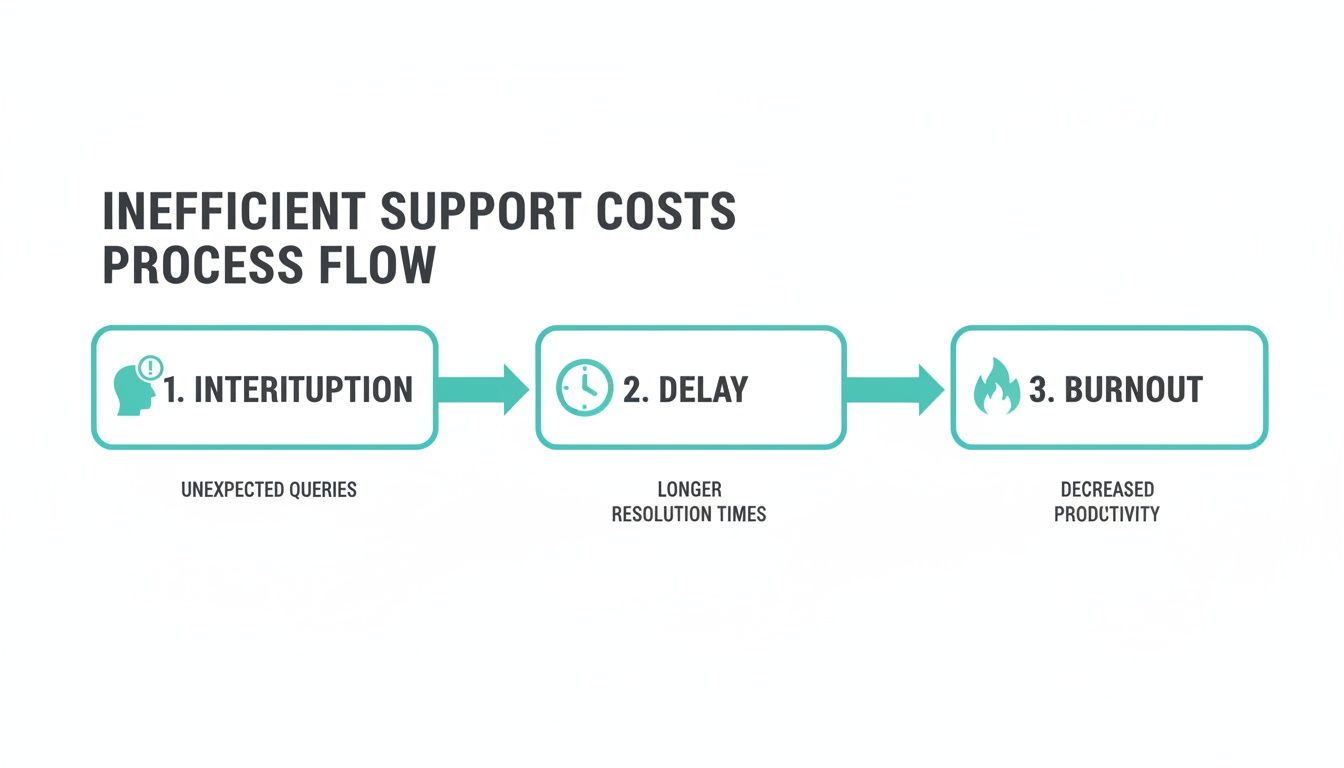
This cycle of interruption and burnout is precisely what a self-serving knowledge hub is designed to break. It turns a reactive, time-draining process into a proactive asset.
Transforming Conversations Into a Reliable Resource
So, how does a Slack chat actually become a dependable source of truth for your whole company? It's a natural evolution of how your team already works, not some complicated technical process.
Imagine a new reality for your team:
Effortless Learning: An AI assistant like SAI joins your key Slack channels. It doesn't interrupt, it just observes the natural flow of questions and answers, learning your company's unique language and processes.
Automatic Knowledge Capture: When a teammate asks a question and an expert provides a great answer, the AI recognizes this as a valuable piece of knowledge. Without anyone lifting a finger, it saves that exchange, building your company's brain.
Instant Answers for Everyone: The next time someone asks a similar question—even if they word it differently—the AI instantly delivers the verified answer it learned before. The expert isn't bothered, and the person asking gets what they need in seconds. No more searching, no more waiting.
This fundamentally changes the game for internal support. Knowledge stops being something you have to hunt down from a specific person and becomes a utility that’s always on, available to everyone.
Now, let's compare what this looks like in the real world.
Traditional Support vs AI-Powered Slack Support
The difference between the old way and the new way is stark. The old way drains time and energy from your best people, while the new way gives that time back.
| Metric | Traditional Manual Support | AI-Powered Support in Slack (SAI) |
|---|---|---|
| Response Time | Minutes to hours, depends on expert availability. | Instant, 24/7. |
| Expert Interruption | High. Experts are constantly pulled from deep work. | Minimal. Experts answer once, AI handles repeats. |
| Knowledge Capture | Zero. Answers are lost in the chat scroll. | Automatic. Every Q&A pair builds the knowledge base. |
| Consistency | Varies. Answers can differ based on who you ask. | High. Standardized answers for everyone. |
| Accessibility | Siloed. Knowledge is stuck with specific people. | Democratized. Available on-demand to the entire team. |
| Onboarding | Slow & manual. New hires rely on others for info. | Fast & self-serve. New hires get instant answers. |
As you can see, integrating AI isn't just a minor improvement; it's a complete shift in how your team accesses information and supports each other.
Your Step-by-Step Implementation Plan
Getting started is much easier than you think. Forget about a massive, company-wide project. The smart way is to start small, prove the value quickly, and expand from there. For a deeper dive, check out our guide on building a Slack knowledge management strategy that actually works.
Here’s a simple, four-step plan to get the ball rolling:
Identify High-Traffic Channels: Pick one or two public Slack channels where the same questions pop up over and over. Think
#dev-help,#sales-questions, or#it-support. These are your pilot channels.Invite Your AI Assistant: Add an AI tool like SAI to those channels. It's a quick setup, and it will start learning from conversations right away with zero configuration.
Encourage Natural Q&A: Just let your team do what they do best—ask and answer questions. The most crucial step is to simply let the system learn from these real-world interactions. This ensures the knowledge it gathers is authentic.
Observe and Expand: Before you know it, you'll see the AI start answering questions on its own. Your team will get instant help, and your experts will feel the sweet relief of fewer interruptions. Once you see the impact, you can confidently roll it out to other channels.
This simple approach breaks the painful cycle of repetitive questions for good. It’s the ultimate expression of customer oriented service applied internally—giving your team the effortless support they need to finally focus on what matters.
Key Metrics That Measure Real Progress
So, how do you actually prove your new customer-oriented service strategy is working? A big shift like this can’t be measured on good vibes alone. You need solid data to show leadership that building an instant knowledge hub isn't just a nice-to-have
—it's a serious engine for efficiency.
Success comes down to tracking the right key performance indicators (KPIs). The trick is to avoid getting bogged down in vanity metrics that look impressive on a dashboard but don’t tell you what’s really happening. Your goal should be to focus on numbers that show how you’re cutting down the friction in your team's day-to-day work.
Focusing on Efficiency and Satisfaction
When you put an automated, customer-first system in place with Slack, you're doing more than just closing tickets faster. You're fundamentally changing how your team finds information, works together, and stays in the zone. To really capture this impact, we have to look past the usual support metrics and measure what actually matters to your team’s momentum.
The most powerful metrics are often the ones that measure the absence of a problem. When your experts are no longer getting pinged all day and your team gets answers instantly, you've unlocked real, tangible value. That's the core ROI of a true customer-oriented service model.
Let's break down the KPIs that prove your new approach is delivering what you hoped it would. These metrics give you clear, compelling evidence that things are moving in the right direction.
Core KPIs for Your Instant Knowledge Hub
First things first: you need a before
picture. Start by tracking these metrics for a few weeks before you introduce a tool like SAI. This gives you a baseline. Then, measure again a month after you've made the change to see just how big the difference is.
Average Response Time: This one is a classic for a reason. Before, a response might take minutes or even hours, all depending on who was available. With an AI assistant, the goal is an instant response, 24/7. Seeing this number plummet is your first big win.
First Contact Resolution Rate: How often is a question answered correctly the first time, with no need for follow-ups or escalations? A high resolution rate shows that the AI is giving people accurate, complete answers, which is crucial for building trust in the new system.
Reduced Expert Interruptions: This might be your most important internal metric. You can track this with a simple Slack workflow for logging interruptions or by just surveying your subject matter experts. A 50% or greater reduction in repetitive questions hitting your senior people is a massive productivity gain. It’s hard proof you’re giving time back to your most valuable folks.
Tracking the Broader Business Impact
A great internal support strategy doesn't just help the team—it creates positive ripple effects across the whole organization. These metrics help you connect what you’re doing to the bigger picture and show a powerful ROI to leadership.
Increased Team Productivity: This can feel a bit squishy, but you can track it with proxy metrics like project completion rates or feature development velocity. When your engineers aren't stuck answering the same questions over and over, they ship code faster. When your sales reps get the info they need right away, they close deals quicker.
Improved Employee Satisfaction: A less-frustrated team is a happier, more engaged team. You can keep an eye on this with regular pulse surveys or by paying attention to feedback in team retros. Hearing things like,
I can finally focus on my actual work,
is qualitative gold.
By tracking these specific, practical indicators, you're no longer talking about abstract ideas. You’re talking about concrete business impact. This is how you show everyone that a customer-oriented service mindset, powered by smart automation, isn't just making work easier—it's making the entire business stronger.
Navigating the Bumps in the Road to Better Service
Making the switch to a smarter, more customer oriented service model is a game-changer, but let's be honest—it’s not always a straight shot. Any time you introduce a new way of working, you're bound to hit a few snags. The trick is knowing what they are ahead of time so you can steer right around them.
One of the first things you'll probably hear is a bit of anxiety about automation taking over. Team members might worry that an AI assistant is too cold or robotic, or that it will get in the way of building real connections with their colleagues. It’s a totally fair point, but it's usually based on a slight misunderstanding of what we're trying to achieve here.
The goal isn't to phase out human conversations; it's to get rid of the mind-numbing, repetitive tasks that drain our energy. When your top performers aren't stuck answering the same question for the tenth time, they're free to tackle the tough, collaborative problems that really push the business forward and build strong internal relationships.
Can We Really Trust the Bot?
Another hurdle is simple skepticism. Your team might not trust an AI to give out the right answers. What if it pulls up outdated info? What if it totally misreads a question and just makes things more confusing? These are crucial questions, and getting your team to trust the new system is make-or-break for getting them to actually use it.
The best way to handle this is to stop thinking of the AI as a mysterious black box and start treating it like a new hire that needs training. A tool like SAI doesn't just make things up; it learns directly from the real experts on your team. It’s designed to capture the proven, accurate information your people are already sharing every single day.
True success comes from viewing technology as a tool that empowers your best people, not as a replacement for them. It’s about amplifying your team's expertise, making their knowledge available 24/7 so they can focus on work only they can do.
You can build this trust organically by starting small. Set up a pilot channel and let the team watch the AI learn in real time. They can guide it, correct it, and see for themselves how it quickly becomes a reliable source for the right information, every time.
The If You Build It, They Will Come
Fallacy
Maybe the most dangerous trap of all is thinking that a great tool will just sell itself. You can roll out the most incredible system imaginable, but if your team doesn't get why it's useful or how it makes their lives easier, the project is dead in the water. Remember, over 50% of customers will ditch a brand after just one bad experience. The same goes for internal tools—if the new system feels clunky or confusing, people will just revert to their old, inefficient habits.
To make sure that doesn't happen, you need a simple, clear adoption plan:
- Explain the
Why,
Not Just theWhat
: Don't just announce a new tool is here. Start by talking about the problem it solves. Frame it as a way to kill constant interruptions and give everyone back their deep-focus time. - Find Your Champions: Pick a few well-respected team members to be your first users. When they start raving about it, their influence will do more to convince others than any official announcement ever could.
- Broadcast the Wins: Did someone get an instant answer that saved them an hour of digging around? Share that story! Post it in a public channel. Making the value real and visible is the fastest way to get everyone on board.
By getting out in front of these common issues—the fear of losing the human element, skepticism about AI accuracy, and the classic adoption challenge—you can build a transition plan that works. It's how you ensure your shift to a smarter, customer oriented service model doesn't just succeed, but creates a culture where technology truly works for your people.
Your Actionable Transformation Checklist

Alright, feeling motivated? Let's channel that energy into action. This isn't just theory; it's a practical roadmap to get your team's focus back and build a genuine customer-oriented service model, starting from within. Every step here is designed for you to implement right away, helping you stack up quick, noticeable wins.
Just picture it: a workday where your team isn't constantly hunting for information. No more sifting through old channels, chasing down colleagues for a link, or wasting hours trying to piece together lost context. They just ask a question in Slack and get an instant, accurate answer.
Phase 1: Laying the Groundwork
First things first, we need to find the friction points. This phase is all about pinpointing the repetitive questions that are stealing the most time and energy from your experts. This will give us a clear target for making the biggest impact.
- Pinpoint the Noise: Start by identifying the top 1-2 Slack channels where the same questions pop up over and over. This is where you'll begin.
- Identify Your Experts: Who are the go-to people getting pinged all day? Take note of who is being interrupted the most—they’re the ones who will benefit immediately.
- Establish a Baseline: Get a quick snapshot of how things work now. How long does it typically take to get an answer in those channels? This isn't for a formal report; it's so you can see just how much progress you're about to make.
Phase 2: Launching Your Pilot
Now, let's get moving. The goal here is to roll out your AI assistant in a small, controlled setting. This way, you can prove its value fast and get your team on board without a massive, disruptive launch.
This isn't about replacing people; it's about amplifying their expertise. You're building a system that lets one great answer serve your entire team forever, freeing your experts for the work only they can do.
- Deploy Your AI Assistant: Add an AI tool like SAI to your chosen pilot channel. The setup is fast, and it starts learning from your team's conversations from day one.
- Encourage Natural Q&A: Just let your team keep working as they normally would. The AI will quietly absorb the real-world knowledge being shared.
- Monitor and Guide: Keep an eye on the answers the assistant provides. You can help guide it where needed, showing your team that it’s a reliable partner in getting work done.
- Broadcast Early Wins: The moment the AI instantly answers a question that would’ve interrupted someone, celebrate it! Share that success story in a public channel. This builds powerful social proof and gets others excited to try it.
Ready to stop the endless searching and start doing? With SAI, you can turn your team’s existing Slack conversations into an instant, 24/7 knowledge base. Eliminate interruptions, boost productivity, and give your team the gift of focus. Add SAI to a Slack channel for free and start your transformation today.