A Slack Knowledge Management Strategy That Actually Works
Let’s be honest, a knowledge management strategy
sounds like corporate jargon for a solution that’s more work than it's worth. But what it really means is having a smart plan for how your team finds, shares, and actually uses information.
It’s about flipping the script—instead of constantly hunting for answers, the right information finds you. This transforms all those scattered Slack messages, forgotten documents, and buried email threads into a single, reliable source of truth you can tap into instantly.
Imagine a Day Without the Quick Question
Think about your average Tuesday. A new sales rep DMs you asking for the latest Q3 pitch deck. You know you saw it somewhere last week... but was it in the #sales-updates channel? A shared Google Drive? Was it an email attachment? You spend the next ten minutes digging around before finally giving up and pinging a colleague who might have it.
This little interruption seems harmless, but it's one of dozens that will derail your team before the day is over.
This constant, low-grade friction is a quiet productivity killer. It's not just a feeling; research from McKinsey shows that employees spend nearly 20% of their workweek—that's a full day every single week—just looking for internal information. It’s a tax on everyone's focus and a source of daily frustration we've just learned to live with.
But you don’t have to.
A real knowledge management strategy isn't about building yet another wiki that gets outdated in a month. It’s about embedding knowledge directly into your team's workflow.
Imagine never having to open another browser tab to find a document. Imagine never bugging a senior engineer for a link you know exists somewhere. Imagine just asking a question right in Slack and getting the correct answer back in seconds, every single time.
This isn’t some far-off fantasy. It's what's possible right now when you turn your team’s main communication hub—Slack—into its long-term memory.
The Hidden Cost of Just Asking
Every time someone asks a colleague a question that’s been answered before, two people stop what they’re doing. The person asking is blocked until they get a reply, and the expert they interrupt has to break their concentration, find the answer, and type it out. It’s a vicious cycle of lost productivity disguised as collaboration.
An effective strategy breaks this cycle entirely. It’s built around capturing the expertise that’s already flowing through your Slack channels and making it searchable for everyone. This modern approach delivers a few powerful shifts in how your team operates:
- From Reactive to Proactive: Instead of fielding constant interruptions, your team gets a tool that serves up information right when they need it.
- From Tribal Knowledge to Shared Intelligence: Critical info no longer lives exclusively in the minds of your most senior people. It becomes a permanent, shared asset that helps everyone, especially new hires, get up to speed faster.
- From Information Hunting to Instant Answers: The default behavior moves away from manual searching. People just ask an AI assistant like SAI, which has already learned from every conversation that’s happened before.
This guide is your roadmap to making this happen. We’ll get practical and walk through exactly how to design and roll out a strategy that gets rid of the daily where do I find...
grind, freeing up your team to focus on work that truly moves the needle.
Before we dive in, it helps to understand what a knowledge management system is and how it powers this whole process. We’re moving beyond the idea of a static database and toward a living, intelligent system that works right where your team already does.
Designing Your Slack-First Knowledge Blueprint
Before you can build anything that lasts, you need a blueprint. A great knowledge management strategy doesn't start with a frantic mission to document everything in sight. It begins by zeroing in on the real points of friction that slow your team down every single day.
Forget trying to boil the ocean. Seriously. Instead, figure out where the real pain is.
Where do the same questions pop up over and over again? Is it in the #new-hires channel, where folks are wrestling with basic setup issues? Or maybe it's the #sales-team channel, with reps constantly begging for the latest one-pager. It might even be in #support-escalations, where agents desperately need troubleshooting steps right now.
Your first mission is to pinpoint just one or two of these high-impact areas. When you start small, you create immediate, visible value. That’s how you build momentum and get everyone excited about what you're doing.
Capturing Your Team’s Unwritten Rules
Let's be honest: the most valuable information in your company isn't sitting in a formal wiki or some dusty folder on a shared drive. It’s the tribal knowledge—those unwritten rules, expert shortcuts, and hard-won lessons that live inside your team's heads and, more importantly, their Slack conversations.
This is the stuff that truly separates your top performers from everyone else. It’s the why behind a big decision, the clever workaround for a tricky bug, or the perfect response to a tough client objection. A Slack-first knowledge strategy is built specifically to catch this living, breathing expertise as it happens.
The goal is to create a living system, not a static library. Think of it less like building a dusty encyclopedia and more like cultivating a garden. You plant seeds in the most fertile ground, nurture them, and watch them grow into a resource that feeds the entire team.
This whole approach hinges on a subtle but critical mindset shift. Instead of asking people to stop what they're doing to go document something,
you make documentation an invisible, effortless byproduct of their daily conversations.
From Vague Ideas to Concrete Goals
A blueprint without clear success metrics is just a wish list. Your knowledge management plan needs accountability, which means you have to define what victory actually looks like in real business terms.
So, instead of a fuzzy goal like improve knowledge sharing,
get specific and measurable. Here’s what that looks like in the real world:
- Slash new hire onboarding time by 30% by giving them an instant, searchable resource for all their day-one questions.
- Cut down repetitive questions in the
#it-supportchannel by 50% within the first three months. - Decrease the time-to-first-response for customer queries by giving support agents immediate access to expert-verified solutions.
When you frame your goals this way, you tie the project directly to business outcomes. That makes it a no-brainer for getting leadership buy-in and proving undeniable ROI. This is about transforming how your team works, not just organizing files. For teams building this foundation, a well-structured wiki for Slack can centralize answers fast and become the bedrock of your entire knowledge blueprint.
Establish Simple Governance and Find Your Champions
Governance
sounds stuffy and corporate, but for a Slack-first approach, it can be incredibly simple. All it really means is setting a few ground rules for what’s worth capturing and identifying a few people to help champion the cause.
Start with just two steps:
- Define What's Valuable: Not every Slack message is a nugget of gold. Agree as a team on what kind of information is worth saving—things like solutions to recurring problems, official process clarifications, or key project decisions.
- Appoint Channel Champions: In your target channels, find one or two enthusiastic people who get it. Their role isn't to be a gatekeeper, but to encourage the new workflow, gently redirecting questions to your AI assistant and celebrating the early wins to get others on board.
This kind of light-touch governance ensures quality without creating a bunch of red tape. It also aligns with a massive shift happening in the industry. Looking ahead to 2025, integrating AI has shot to the top of the list for 41% of knowledge management teams globally. This trend shows that leaders now see that AI tools like SAI are at their best when guided by a smart, human-led strategy.
You can discover more about these 2025 KM priorities and see how they're shaping modern workplaces. Your blueprint is the essential first step to putting that intelligence to work.
Weaving Knowledge Capture into Your Daily Slack Workflow
The best knowledge management systems don't feel like systems at all. They don't force your team to learn new habits, adopt another tool, or break their focus. They work quietly in the background, right where your team already collaborates: inside Slack. It's time to ditch the old, clunky model of manually updating a wiki and embrace a workflow that captures expertise as it happens.
Imagine this: a senior engineer drops a brilliant solution to a complex bug in your #dev-help channel. In most companies, that invaluable insight vanishes within hours, buried under new messages. But with an intelligent workflow, an AI assistant like SAI instantly absorbs that Q&A. The next time a junior dev runs into a similar problem, they don't have to interrupt anyone. They just ask SAI in Slack and get the expert's answer on the spot.
This creates a powerful, self-fuelling loop. Your experts answer a question once, and that knowledge serves the entire team—both current and future members—forever. This isn't about adding more work; it's about magnifying the value of the work you’re already doing.
Making Knowledge Capture Invisible
Here’s the secret to making this stick: the process has to be completely effortless. When you ask a busy engineer or a swamped support agent to add that to the knowledge base,
it's just not going to happen consistently. The friction is too high.
The only way to win is to eliminate that friction entirely.
Instead of a manual chore, the workflow becomes invisible. You just add SAI to a Slack channel, and it learns from the conversations already happening. No one has to do anything differently. Your team’s collective brain simply expands with every question asked and answered, turning your busiest Slack channels into a living, breathing library of expertise.
This simple flow is what makes it work, connecting the dots from everyday friction to lasting solutions.
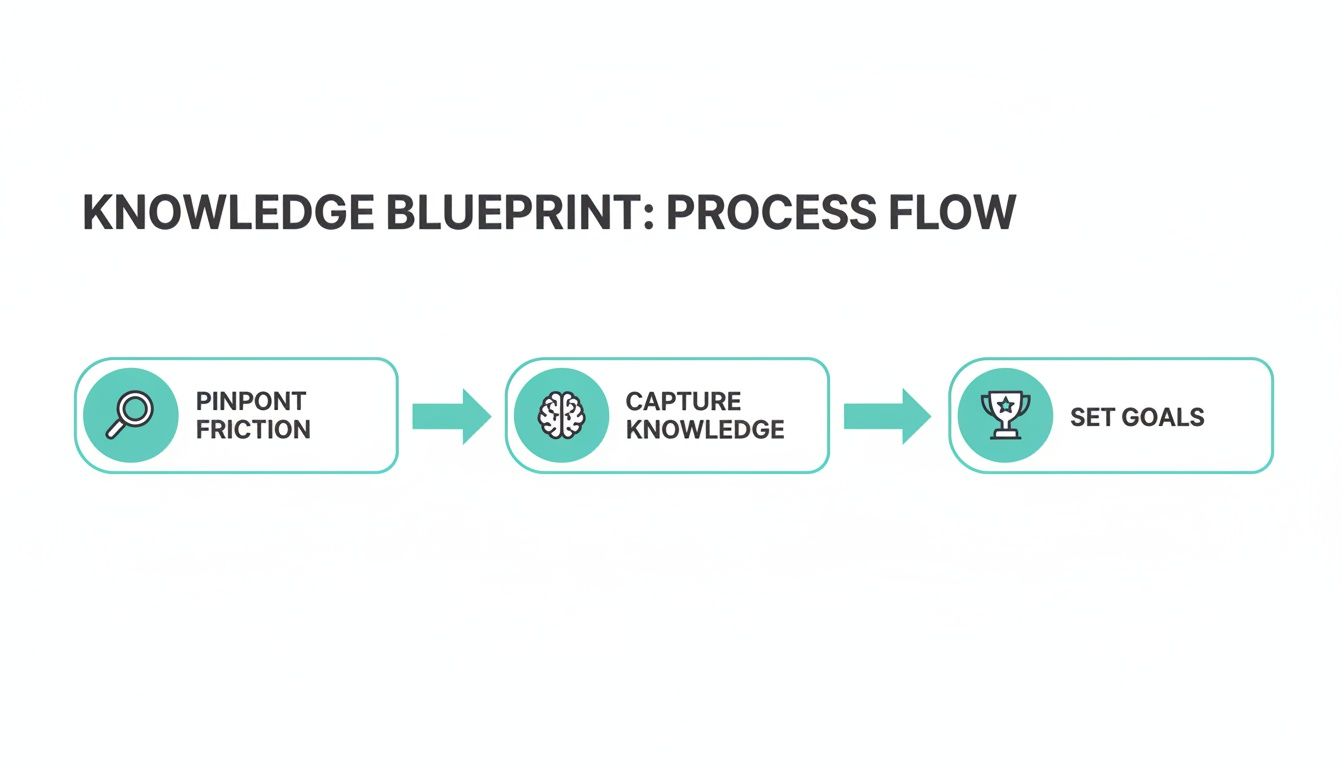
This visual lays it out perfectly: you pinpoint where people get stuck, capture the knowledge that unsticks them, and tie it all back to clear, measurable goals.
Bringing It to Life: Real-World Scenarios
Enough with the theory. How does this actually change the day-to-day grind for your teams?
- For Customer Support: An agent in
#tier-2-supportgets a final verdict on handling a tricky refund request. SAI learns this official procedure. A few hours later, another agent in a different time zone faces the exact same issue. They ask SAI and get the correct, standardized answer in seconds. The result? A consistent, high-quality customer experience. - For HR & People Ops: During open enrollment, the
#ask-hrchannel is on fire with benefits questions. The HR manager types out a detailed answer about adding a dependent to a health plan. From that moment on, SAI can handle every variation of that question, freeing up the HR team to focus on the human side of their work. - For IT & Operations: An ops team member outlines the multi-step process for provisioning a new software license in the
#it-helpdeskchannel. That workflow is now captured. The next time a manager needs a license for a new hire, they get the full instructions on-demand, which means no support ticket and no waiting.
In every case, nobody had to open a Confluence page, create a new doc, or make a mental note to write that down later.
The knowledge was captured and made reusable right in the flow of work.
This shift is profound. You stop bleeding institutional memory every time an expert is busy, on vacation, or leaves the company. Your Slack workspace becomes a durable, shared brain that never forgets.
This directly tackles a massive organizational headache. In fact, research shows that transferring expert knowledge will remain a top-three priority for 22% of businesses in 2025, especially as employee turnover threatens to wipe out years of hard-won experience. For teams in support, IT, and HR that basically live in Slack, losing that context means wasting time reinventing the wheel.
The difference between the old way and the new way is stark.
Traditional vs. AI-Powered Knowledge Capture in Slack
| Metric | Traditional Manual Approach | SAI-Powered Automated Approach |
|---|---|---|
| Effort Required | High. Requires someone to manually copy, paste, and format information in a separate tool. | Zero. Knowledge is captured automatically from existing conversations. |
| Time to Capture | Minutes to hours. Often delayed or forgotten completely (I'll do it later). |
Instant. The AI learns from the Q&A exchange in real-time. |
| Knowledge Coverage | Spotty and incomplete. Only captures what people remember to document. | Comprehensive. Captures the nuance and context of actual conversations. |
| Accessibility | Low. Information is siloed in a separate system that requires searching. | High. Answers are available directly within Slack, on-demand. |
| Adoption Rate | Low. Friction is high, so teams often abandon the process. | High. It's invisible and requires no change in user behavior. |
Moving to an automated system isn't just an incremental improvement; it fundamentally changes the game.
The real beauty here is how quickly you can get started and see results. Activate it in just one of your high-traffic channels, and you'll see value almost immediately. If you want a more detailed look, our guide on a real-world AI in Slack knowledge base example breaks down how to get this running and delivering instant answers. This is the core of a modern knowledge strategy—one that truly works for your team, not against them.
Driving Adoption and Measuring Business Impact
Let’s be honest: a brilliant knowledge management strategy is useless if it just gathers dust on a shelf. The most challenging—and ultimately, the most rewarding—part of this journey is turning your carefully crafted plan into a living, breathing part of your team's daily routine. Success isn't about just launching a new tool; it's about fundamentally changing how your team finds and shares information for the better.
The good news? Adoption doesn't have to be a constant uphill battle. When the new way of working is demonstrably easier, faster, and less disruptive than the old way, people will naturally gravitate toward it.
Frame the Change as an Undeniable Benefit
Your launch communication needs to be simple, direct, and focused entirely on what’s in it for the team. Forget the corporate jargon about synergizing our knowledge assets.
Instead, frame it as the solution to a universal pain point that everyone feels.
You can try a simple, powerful message like this:
From now on, **ask our AI first to get instant answers** and reduce interruptions for everyone. You get what you need in seconds, and our experts get to stay focused on their work.
This isn't just about rolling out software; it’s a new social contract. You’re giving your team a tool to reclaim their time and focus. Make sure you reinforce this during onboarding by making it a core part of the process for new hires. From day one, their default behavior should be to consult the AI, not to shoulder-tap a colleague.
Celebrate Early Wins and Build Social Proof
Momentum is everything. The fastest way to drive adoption is by making every success visible. Encourage your early adopters and champions to share their positive experiences right out in the open in public Slack channels.
Even a simple shoutout can be incredibly powerful:
-
Huge thanks to SAI for finding the Q3 reporting process in 5 seconds! Saved me a ton of digging.
-
Just a reminder: I asked SAI about our new vacation policy and got the answer instantly. No need to wait for HR!
These small endorsements act as social proof, showing the rest of the team that the new system actually works and is worth their time. It shifts the perception from a top-down mandate to a grassroots movement where colleagues are genuinely helping each other work smarter.
Move Beyond Vanity Metrics to Measure Real Impact
To prove the value of your knowledge management efforts and secure long-term buy-in from leadership, you have to connect it to concrete business outcomes. Forget vanity metrics like number of articles created.
We need to focus on KPIs that tell a compelling story of improved efficiency, productivity, and employee experience.
Your goal is to demonstrate undeniable ROI. The explosion of distributed workforces has made this more critical than ever. With teams scattered across time zones, the constant stream of repetitive questions in Slack creates huge bottlenecks. In fact, strategies that prioritize digital collaboration tools are now being embraced by 36% of KM teams as a direct response to this challenge. As you can read in the full report on knowledge management trends, solving this internal communication friction is a top priority for businesses everywhere.
Here are the metrics that truly matter.
Key Performance Indicators (KPIs) for Your KM Strategy
To show the real-world success of your Slack-based knowledge management initiative, you'll want to track a few key, actionable metrics. These KPIs move the conversation from activity to impact.
| KPI | What It Measures | How to Track It |
|---|---|---|
| Time to First Response (Internal Questions) | The speed at which employees get answers, reflecting reduced wait times and fewer bottlenecks. | Measure the time from when a question is asked in a key channel to when the AI provides an answer versus a human. |
| Reduction in Repetitive Questions | The decrease in the same questions being asked repeatedly in public channels, showing the AI is handling the load. | Track the frequency of common questions (e.g., Where is the deck?) over a 30/60/90-day period. |
| New Hire Time-to-Productivity | The time it takes for a new team member to become self-sufficient without constant supervision. | Survey new hires and their managers at the 30-day mark on their ability to find information independently. |
| Expert Interruption Rate | The reduction in direct messages and pings to your subject matter experts for routine information. | Run a periodic, anonymous survey with key experts asking them to estimate the change in quick questioninterruptions. |
By tracking these KPIs, you move the conversation from we launched a new tool
to we saved 40 hours of engineering time this month.
That's a language every business leader understands. This data-backed approach transforms your knowledge management strategy from a helpful initiative into an essential driver of business performance.
How to Refine and Scale Your Knowledge Ecosystem
Think of your knowledge management strategy as a garden, not a blueprint. You can't just set it up and walk away. For it to truly flourish, it needs ongoing care and attention. Launching the system is just planting the seed; the real payoff comes from cultivating a simple, sustainable process that lets your knowledge ecosystem evolve as your team does.
This doesn't have to be some soul-crushing, manual audit process. Forget that. Instead, your refinement loop is powered by the questions your team is already asking every single day. This keeps your knowledge base sharp, relevant, and perfectly in sync with what people actually need to know.

Turn Knowledge Gaps into a Growth Roadmap
Here's a perspective shift: every time your AI assistant can't answer a question, it's not a failure. It’s an opportunity. That I don't know
is a bright, flashing arrow pointing you directly to a hole in your collective knowledge.
This is your roadmap for what to document next. No more guessing what people might need. You get a real-time, demand-driven backlog of topics that matter right now.
Get a simple review process in place to turn these gaps into gold:
- Monitor Unanswered Questions: Make it a weekly or bi-weekly habit to look at the questions your AI couldn’t answer.
- Assign an Expert: When a gap pops up, tag the right subject matter expert to drop a clear, concise answer right there in the channel.
- Let the AI Learn: Once the expert chimes in, the AI instantly absorbs that new information. The next time someone asks, they'll get an immediate answer.
This simple workflow turns every single missed question into a win, creating a self-improving system that gets smarter with almost no extra effort.
Your AI's limitations are actually its greatest strength. Each unanswered query is a direct request from your team, telling you exactly what knowledge is most valuable at this moment. This is how you build a resource people love using—because it’s built for them, by them.
Scale Your Strategy by Empowering Champions
As your company grows, your knowledge strategy has to grow with it. The great thing about a Slack-based system is how naturally it scales. You can drop your AI assistant into new channels as they spin up—from #marketing-campaigns to a big cross-functional team like #project-phoenix.
But true scale isn't just about adding more channels. It’s about decentralizing the work and building a culture where everyone feels a sense of ownership. That's where channel champions come into play.
A channel champion is basically a gardener for their team's little corner of the knowledge base. They aren't gatekeepers; they're cultivators who help maintain the quality and accuracy of information in their specific domain.
Their role is pretty straightforward:
- Spot Outdated Information: If they see the AI give an answer that's a little stale, they can flag it or provide the correct info on the spot.
- Encourage Good Habits: They give gentle nudges, reminding teammates to ask the AI first and celebrating when it delivers a great answer.
- Close Knowledge Gaps: They take the lead on answering those flagged questions in their channel, building out a richer resource for their immediate team.
By empowering these champions, you shift from a top-down management chore to a distributed network of ownership. This doesn't just make the whole system more accurate and resilient; it weaves the practice of sharing knowledge deep into your team's DNA. It’s this cycle of continuous refinement that creates a truly intelligent, self-sustaining ecosystem for your entire organization.
Got Questions About Making This Work in Slack?
Rolling out a new knowledge management strategy in Slack always brings up a few good, practical questions. Let's tackle the most common ones I hear from teams making this shift.
How Do We Get People to Actually Use It?
This is the big one, isn't it? Real adoption comes from the top down. It starts with leadership not just endorsing the new way but actively modeling it.
Frame it as a win-win for everyone involved: less waiting around for answers for those who need them, and fewer shoulder taps for your subject matter experts. Team leads can make a huge difference by gently redirecting questions in-channel. A simple, @SAI, can you help with this?
does wonders. Once the team sees the AI delivering the right answer faster than a human can, they'll naturally start going to it first. It just becomes the path of least resistance.
The goal isn't to force a new tool on people. It's to offer them a shortcut that solves a universal pain point—waiting for answers. When the shortcut works, people will take it.
Oh, and make this a core part of your onboarding process for new hires. If it's the default from day one, it sticks.
What Happens If the AI Gets an Answer Wrong?
It’s going to happen, and that’s actually a good thing. Think of it less as a failure and more as the system showing you exactly where your knowledge gaps are. It’s a free audit.
The key is to have a dead-simple way for anyone on the team to flag an answer that's off-base or outdated. That feedback is pure gold. I usually recommend designating a few channel champions
to spend 15 minutes a week reviewing flagged answers. This small investment keeps your knowledge base fresh and, most importantly, trustworthy.
How Does This Fit with All Our Other Tools?
Most teams have knowledge scattered everywhere—Google Drive, Confluence, Notion, and of course, Slack itself. The idea isn't to move all that data, but to centralize access to it.
The end goal is for someone to ask a question right inside Slack and get the right answer, period. They shouldn't have to know if the source document lives in Drive or a Notion doc. A smart AI assistant can connect to these external tools.
But here’s my pro-tip: start with what's already inside Slack. That unstructured, conversational knowledge is often the most valuable and the hardest to find. Nail the workflow for capturing that first. Once that's running smoothly, then you can start plugging in your other repositories to create that single, powerful search point for everything.
Ready to turn your team's Slack from a chaotic message stream into its collective brain? SAI learns from your conversations to provide instant, accurate answers 24/7, killing repetitive questions and context switching for good. Add SAI to a channel for free.