Boost Your Team with a process document example: 5 Templates
Imagine your workday, but without the constant interruptions. No more digging through Confluence, chasing down subject matter experts, or waiting for a response to that one critical question. Instead, you just ask a question in Slack and get an immediate, accurate answer. This isn't a future-state fantasy; it's the reality for teams who master their process documentation.
This article provides more than just another process document example for you to copy. We're offering a blueprint to transform how your team finds information and resolves issues. We'll give you 8 battle-tested templates specifically designed to eliminate the friction that slows your team down.
For each template, we'll break down not just what to document, but how to transform that documentation into a living knowledge source right within Slack. By connecting your processes to an AI assistant like SAI, you can finally stop hunting for answers across multiple platforms. Your team gets instant, reliable information so they can spend less time searching and more time executing on what matters most. Let's dive in.
1. Standard Operating Procedures (SOP) Document Template
Standard Operating Procedures (SOPs) are the lifeblood of a consistent and scalable operation. Think of an SOP as a detailed, step-by-step guide that documents a recurring task from start to finish. It’s the ultimate playbook for ensuring every team member performs a critical function the same way, every time. This process document example is essential for any team looking to eliminate guesswork and reduce errors, especially within the fast-paced environment of Slack.
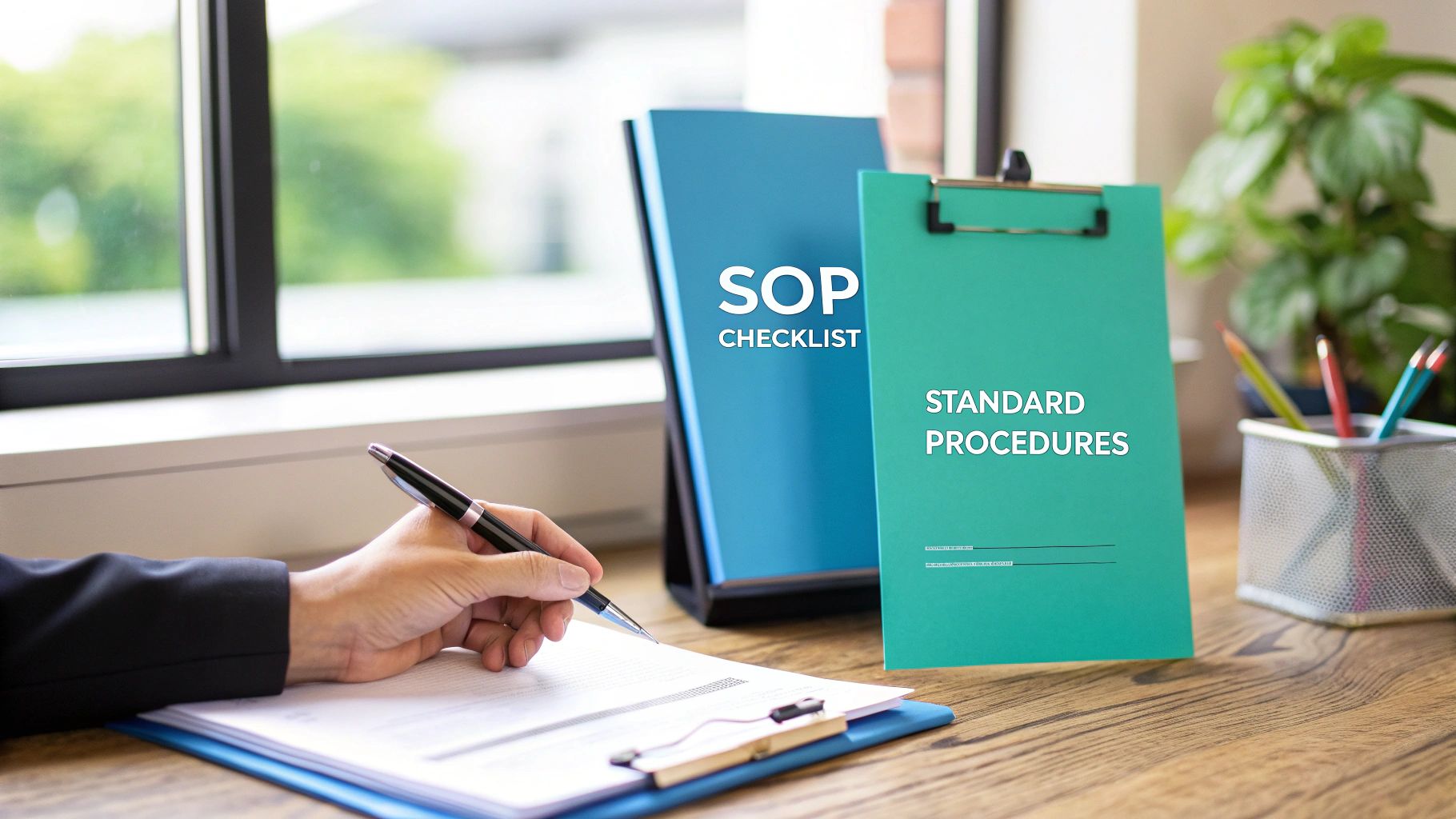
Imagine a world where your team no longer needs to hunt through multiple drives, wikis, or old Slack threads for answers. Instead, they just ask. When you create robust SOPs for processes like customer onboarding or invoice processing, SAI can instantly pull the exact step your team needs. It transforms your team's workflow from a frustrating scavenger hunt into a single, simple question in Slack.
Strategic Breakdown
- When to Use: SOPs are perfect for high-frequency, multi-step tasks that require precision and consistency. Use them for onboarding new hires, processing customer support tickets, or managing employee offboarding.
- Required Stakeholders: You'll need the Subject Matter Expert (SME) who performs the task, a Manager to review and approve the process, and the End-Users (the team members who will follow the SOP) to provide feedback on its clarity.
- Actionable Takeaway: Start small. Document just one critical, repetitive process your team handles in Slack this week. Use screenshots and short, clear sentences. As you build your library, you’ll see how a well-crafted SOP becomes the core of your team’s institutional memory. For a deeper dive, explore our guide on how to write an SOP your team actually uses and start creating powerful documentation today.
2. FAQ (Frequently Asked Questions) Document Template
An FAQ document is your team's first line of defense against repetitive questions. It’s a centralized repository of answers to the most common queries your team faces, from HR policy clarifications to technical troubleshooting steps. This powerful process document example moves tribal knowledge out of individual DMs and crowded channels into a single, reliable source of truth. It's designed to provide quick, consistent answers, minimizing disruptions and empowering self-service.
Picture this: no more derailing a project channel to ask about the expense policy or how to connect to the VPN. By compiling a robust FAQ, you create the perfect source for an AI assistant like SAI to deliver answers. Now, instead of hunting for a document or interrupting a colleague, your team simply asks a question in Slack and gets an instant, accurate response. Everyone is freed up to focus on more strategic work.
Strategic Breakdown
- When to Use: FAQs are ideal for capturing high-volume, low-complexity questions that don't require a full step-by-step SOP. Use them for product feature questions, internal policy clarifications (like PTO or expense reporting), and common IT troubleshooting issues.
- Required Stakeholders: You need Team Members to submit the questions they hear most often, Subject Matter Experts (SMEs) from relevant departments (like HR, IT, or Product) to provide the correct answers, and a Document Owner to maintain and update the FAQ regularly.
- Actionable Takeaway: Spend 30 minutes this week scrolling through your team's main Slack channels and identify the top five most-asked questions. Document the questions and their answers in a simple format. This initial document becomes the seed for a comprehensive knowledge base that transforms how your team accesses information. To learn more about building a knowledge foundation, check out our insights on leveraging a single source of truth.
3. Knowledge Base Article Template
A Knowledge Base Article is the definitive guide on a specific topic, feature, or policy. It goes beyond a simple Q&A to provide comprehensive context, background, and in-depth explanations. This process document example acts as the single source of truth for complex subjects, from company-wide policies to detailed technical troubleshooting guides. It’s the foundational content that powers an intelligent, always-on resource for your team within Slack.
Imagine your team never having to leave Slack to find an answer again. No more digging through Confluence or shared drives for that one crucial policy document. By creating detailed knowledge base articles, you feed your AI assistant, SAI, the exact information it needs to answer complex questions. When a team member asks about your expense policy or a specific product feature, SAI instantly delivers a precise, summarized answer drawn directly from your authoritative articles, right in Slack.
Strategic Breakdown
- When to Use: Ideal for documenting complex, evergreen information that requires more than a one-sentence answer. Use them for API documentation, in-depth feature guides, company policy explanations (e.g., benefits, code of conduct), and multi-scenario troubleshooting guides.
- Required Stakeholders: You need a Subject Matter Expert (SME) to provide the core content, a Technical Writer or Content Manager to structure and refine the article for clarity, and a Manager or Team Lead for final review and approval.
- Actionable Takeaway: Identify one frequently asked, complex question in your Slack channels this week. Write a clear, scannable knowledge base article to answer it, using headings, bullet points, and screenshots. Make this document available to SAI so the next time the question comes up, everyone gets an instant answer. To build a robust foundation, explore the ultimate internal knowledge base guide for productive teams.
4. Decision Tree/Flowchart Process Template
A Decision Tree or Flowchart is a visual map that guides team members through a process with multiple potential outcomes. It uses conditional logic (if-then scenarios) to direct users along the right path, simplifying complex decision-making into a series of simple, manageable steps. This visual process document example is perfect for clarifying workflows like customer support triage or IT troubleshooting, where the next action depends on the previous answer.

Stop forcing your team to dig through lengthy documents to find the one specific step that applies to their situation. A well-designed flowchart becomes an instant guide that an AI assistant like SAI can interpret and deliver in Slack. When a team member asks, What do I do for a P1 security incident?
SAI can instantly pull the correct branch from the flowchart, providing the exact steps without the noise. Your team’s complex problems get simple, actionable answers in seconds.
Strategic Breakdown
- When to Use: Ideal for processes with variable paths and conditional logic. Use them for customer support issue triage, IT troubleshooting guides, approval workflows based on budget or department, and access provisioning requests.
- Required Stakeholders: You need the Process Owner who understands all possible outcomes, Subject Matter Experts (SMEs) from each branch of the process, and End-Users to test the flowchart for clarity and accuracy.
- Actionable Takeaway: Map out a common
what if
scenario your team faces in Slack, like escalating a customer complaint. Use a simple tool like Lucidchart or Miro to create a visual flowchart with clear decision points (e.g.,Is the customer requesting a refund?
). By giving SAI access to this logic, you empower it to guide your team through any variable, transforming complex judgment calls into a simple, guided conversation.
5. Onboarding Checklist and Process Document Template
A stellar onboarding experience sets the tone for an employee's entire journey, transforming new hires into confident contributors faster. An Onboarding Checklist is a structured, chronological guide that walks a new team member through every critical task, from setting up their development environment to understanding core company values. This process document example is designed to eliminate the common chaos of the first few weeks, providing clarity and a clear path to productivity.
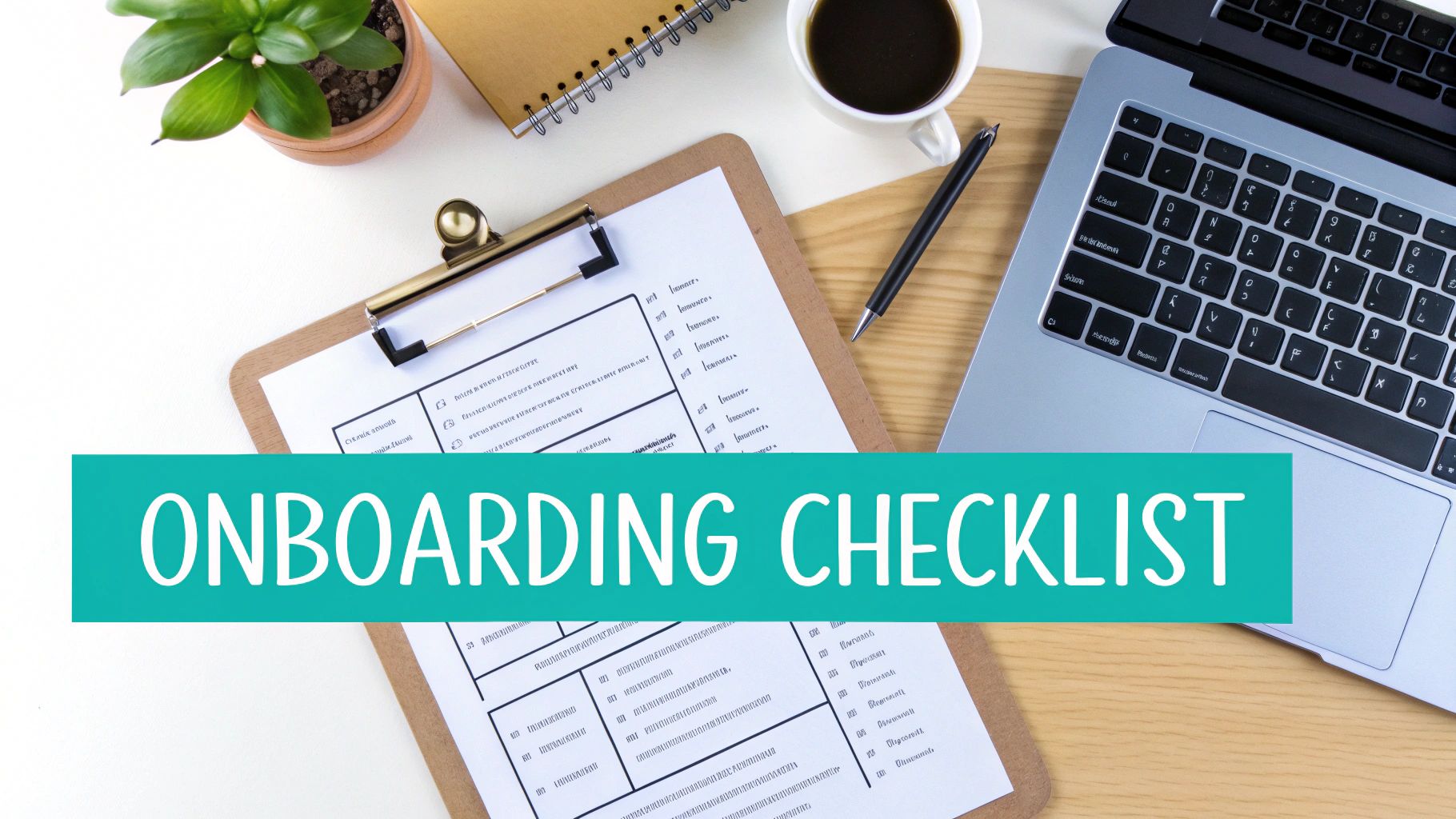
Imagine your new hires no longer having to ping five different people in Slack just to get access to a CRM or find the company holiday calendar. Instead, they have a single point of contact for every question. When you connect a comprehensive checklist to an AI assistant like SAI, repetitive onboarding questions disappear. The entire process becomes a simple conversation in Slack, freeing up your team's time and giving new employees the instant answers they need to feel supported from day one.
Strategic Breakdown
- When to Use: This is non-negotiable for every new hire, regardless of role. Create role-specific versions for software engineers (dev environment setup, repo access), sales reps (CRM training, territory assignment), and even leadership (strategic context, key stakeholder introductions).
- Required Stakeholders: You'll need an HR Manager to cover company-wide policies, the Hiring Manager for role-specific tasks and goals, an assigned Onboarding Buddy for cultural guidance, and IT/Operations for systems and tool access.
- Actionable Takeaway: Organize your checklist chronologically by day and week (Day 1, Week 1, First 30 Days). Assign a clear owner to each checklist item to ensure accountability. For a comprehensive guide, check out our resource on building your ultimate new employee onboarding checklist and start creating a world-class experience.
6. Meeting Notes and Action Items Template
Meetings often become black holes of information where critical decisions and action items are discussed and then forgotten. A Meeting Notes and Action Items Template turns these fleeting conversations into a structured, searchable knowledge asset. This process document example captures key discussions, decisions, and assigned tasks in a consistent format, shared directly in your team's Slack channels for immediate visibility.
Imagine a new team member trying to understand why a project pivoted three months ago. Instead of interrupting senior staff or digging through old calendars, they can simply ask. By documenting meetings, you create a rich, contextual history that an AI assistant like SAI can instantly parse. It transforms institutional knowledge from siloed memories into an on-demand resource, providing answers with full context right within Slack.
Strategic Breakdown
- When to Use: This template is essential for any recurring or decision-driven meeting. Use it for weekly team syncs, product planning sessions, cross-functional project kickoffs, and retrospectives.
- Required Stakeholders: You need a designated Note-Taker for each meeting, the Meeting Facilitator or host to guide the agenda, and Attendees who are responsible for reviewing the notes and confirming their assigned action items.
- Actionable Takeaway: Implement a simple rule: no meeting ends without documented action items and key decisions posted in the relevant Slack channel within 24 hours. Start with one recurring team meeting. Use a consistent format, bold key decisions, and @-mention individuals next to their tasks. This simple habit builds a powerful, searchable archive of your team’s progress and rationale over time.
7. Policy and Procedure Document Template
Policy and procedure documents are the bedrock of organizational governance, setting the official rules and guidelines for behavior, compliance, and decision-making. They translate high-level company values into actionable standards. This process document example is crucial for establishing clarity and fairness, from remote work policies to expense reimbursements. Without it, teams are left navigating a confusing landscape of unwritten rules and inconsistent enforcement.
Imagine your team members no longer having to guess the company's stance on PTO or data security. Instead of digging through an outdated intranet or asking HR in a public Slack channel, they can get an instant, confidential answer. By documenting these policies, you empower an AI assistant like SAI to serve as a reliable, on-demand HR and compliance expert right within Slack, turning policy questions from a bottleneck into a quick, private conversation.
Strategic Breakdown
- When to Use: These documents are non-negotiable for establishing foundational rules. Use them for time-off requests, codes of conduct, data security protocols, and any area where legal or ethical standards must be consistently applied.
- Required Stakeholders: You'll need input from HR/People Ops to draft the policies, Legal/Compliance to ensure they meet regulatory standards, Senior Leadership for final approval, and all Team Members as the end-users who must adhere to them.
- Actionable Takeaway: Document one frequently asked-about policy this week, like your expense reimbursement process. Write it in simple, direct language and include an FAQ section to address common edge cases. Making this document discoverable via an AI assistant in Slack immediately reduces administrative friction and ensures everyone has access to the same correct information, building a culture of trust and transparency.
8. Troubleshooting Guide and Resolution Matrix Template
A Troubleshooting Guide is a structured document that serves as the first line of defense against recurring problems. It systematically maps common issues to their potential causes and provides clear, step-by-step resolution paths. This process document example is crucial for technical support, IT, and customer-facing teams, transforming reactive firefighting into proactive problem-solving.
Imagine your team members no longer having to ping a senior developer or support lead every time a common error pops up. Instead of interrupting workflows and waiting for a response in a busy Slack channel, they can instantly get a verified solution. When you document troubleshooting steps for issues like login failures or software glitches, you empower an AI assistant like SAI to guide users through the fix directly in Slack, turning frantic searches into guided self-service.
Strategic Breakdown
- When to Use: Ideal for any scenario with recurring, diagnosable problems. Use it for IT support tickets (e.g., VPN connectivity), software bug resolution, customer support inquiries (e.g., billing questions), or developer deployment failures.
- Required Stakeholders: You need a Subject Matter Expert (SME), like a senior support agent or developer, to outline the problems and solutions. A Technical Writer or a team lead can help structure the guide for clarity, and End-Users are essential for testing the steps and providing feedback.
- Actionable Takeaway: Identify the top five most frequently asked support questions in your Slack channels this month. Create a simple guide for just one of them. Document the symptoms in plain language, list the step-by-step solution with screenshots, and save it. This single document is the first step toward building a powerful, self-service knowledge base that saves your team countless hours.
8-Template Process Document Comparison
| Template | Implementation 🔄 | Resources & Maintenance ⚡ | Expected Outcomes ⭐📊 | Ideal Use Cases 💡 |
|---|---|---|---|---|
| Standard Operating Procedures (SOP) Document Template | Moderate–High: detailed step-by-step writing, SME reviews, versioning | High initial effort; ongoing updates and version control required | High consistency & compliance; reduces training time; reliable SAI knowledge source | Customer support, operations, HR with repetitive workflows |
| FAQ (Frequently Asked Questions) Document Template | Low–Moderate: quick to assemble from conversations, needs curation | Low ongoing effort; regular pruning to stay relevant | Fast reduction in repetitive questions; aligns well with conversational AI | Support, HR, product, technical teams handling common queries |
| Knowledge Base Article Template | High: long-form content, structure, examples, SEO | High: authoring, editing, linking, periodic reviews | Authoritative references; fewer follow-ups; deeper contextual answers via SAI | Technical/product teams and large orgs with complex processes |
| Decision Tree / Flowchart Process Template | Moderate: map conditional logic and outcomes visually | Moderate: specialized tools; can be harder to revise as complexity grows | Clarifies conditional decisions; reduces interpretation errors; guides SAI branching | Triage, approval workflows, IT troubleshooting, operations |
| Onboarding Checklist & Process Document Template | Moderate: cross‑department sequencing and role variants | Moderate–High: frequent updates for tools and role-specific paths | Faster time-to-productivity; fewer onboarding questions handled by SAI | HR, startups, remote-first orgs, high-volume hiring |
| Meeting Notes & Action Items Template | Low–Moderate: disciplined capturing of decisions and actions | Low ongoing cost but requires timely sharing and tagging | Preserves context and reasoning; improves accountability and searchable history | Cross-functional teams, management, distributed teams |
| Policy & Procedure Document Template | High: legal/compliance review, clear scope and exceptions | High: regular review cycles; legal input and change management | Ensures compliance, consistent policy answers, audit readiness | HR, compliance/legal teams, regulated industries |
| Troubleshooting Guide & Resolution Matrix Template | Moderate–High: diagnostic paths, validated resolution steps | High: continuous updates, testing, tracking common paths | Reduces ticket volume; faster resolution; enables proactive SAI diagnostics | IT, technical support, customer success, operations |
Turn Documentation from a Chore into Your Competitive Advantage
The journey through each process document example in this article, from a standard operating procedure (SOP) to an intricate incident response plan, reveals a powerful, unifying truth: documentation is not a static archive. It's the active, living blueprint for operational excellence, consistency, and scalable growth. These templates are more than just starting points; they are strategic assets designed to eliminate ambiguity and empower your team with clarity.
We've broken down how to structure everything from a new hire onboarding checklist to a customer support escalation matrix. The goal isn't just to write things down. The goal is to create a single source of truth that preempts questions, standardizes quality, and frees your most valuable talent from the endless cycle of repetitive interruptions.
From Static Files to Dynamic Knowledge
Imagine a workday where your team isn't constantly toggling between apps, digging through shared drives, or interrupting colleagues to find an answer. Instead, they simply ask a question in Slack and get an instant, accurate response drawn directly from the very process documents you've so carefully crafted. This is the transformation we've highlighted.
The true power of a great process document example isn't realized when it's saved as a PDF in a forgotten folder. Its power is unleashed when it becomes an interactive, accessible resource that meets your team where they already work. By implementing these structured documents, you're building the foundational brain
for your organization. Integrating this brain with an AI assistant turns that static knowledge into a dynamic, on-demand expert.
Your Actionable Next Steps
The difference between a good company and a great one often lies in its systems. Great systems don't just happen; they are intentionally designed, documented, and optimized. Your next step is to move from inspiration to implementation.
- Choose One High-Impact Process: Don't try to boil the ocean. Select one area from the examples above that causes the most friction, whether it's onboarding, customer handoffs, or change requests.
- Adapt a Template: Use the relevant template from this article as your starting point. Involve the key stakeholders to fill it out, ensuring it reflects how your team actually works.
- Bring It to Life in Slack: The final, most crucial step is to make this documentation instantly accessible. Instead of letting it gather digital dust, connect it to a tool that can serve answers directly in your workspace.
Ultimately, mastering your process documentation is about reclaiming your team’s most valuable resource: time and focus. It’s about creating an environment where new hires become productive faster, critical incidents are resolved with calm precision, and your experts can dedicate their energy to innovation, not repetitive explanation. You are not just creating documents; you are building a more resilient, efficient, and autonomous organization.
Ready to turn your documentation into a 24/7 expert that lives in Slack? SAI connects directly to your knowledge sources, providing instant, trusted answers so your team can stop searching and start doing. Add SAI to a Slack channel for free and see how a great process document example becomes your team's greatest asset.