Intranet and Extranet: Your Guide to Smarter Business Collaboration
Let's be honest, we've all been there. It's Monday morning, and you're already on a digital scavenger hunt. You’re digging through old email threads, trying to remember which shared drive holds that one crucial file, and toggling between five different apps just to get a simple answer. It’s a frustrating, inefficient way to work.
This daily grind isn't just a minor annoyance—it's a massive productivity killer. Studies have found that knowledge workers spend nearly 20% of their workweek simply searching for internal information. That’s a full day, every single week, lost to preventable chaos. The cost isn't just measured in wasted hours; it's in the constant context-switching, the repetitive questions that break your focus, and the project momentum that stalls while you wait for a coworker to get back to you.
The Real Cost of Scattered Knowledge
The problem isn't that the information doesn't exist. It's that your company's collective intelligence is splintered across countless digital silos—trapped in personal inboxes, buried in forgotten Slack channels, and living in outdated documents.
When your knowledge is a mess, you end up with a workplace where:
- Simple questions become major hurdles. Finding the latest project brief or the updated vacation policy feels like a full-blown investigation.
- Onboarding is a slow, painful process. New hires are stuck asking the same basic questions over and over, interrupting senior staff and delaying their ability to contribute.
- Expertise vanishes. When a seasoned employee leaves, their institutional knowledge often walks out the door with them, forcing everyone else to start from scratch.
What if you could give your team all that lost time back? What if, instead of making people hunt for information, you brought the answers directly to them, right inside the tools they already use every day?
A Better Way to Find What You Need
This is where the idea of an intranet (your internal company hub) and an extranet (a secure space for partners) comes into play. They’re designed to be central, organized sources of truth. But the modern approach takes this a step further. Forget building yet another website people have to remember to check. The real magic happens when knowledge is instantly available within your team's natural workflow.
Imagine your team never having to open another app or search another shared drive to find an answer. Imagine them simply asking a question in Slack and getting an instant, accurate response from SAI, powered by your team's collective knowledge. This isn't just about finding documents faster; it's about transforming how your team gets work done.
You can learn more about how to stop the endless searching by exploring better knowledge management platforms that provide instant answers. It’s about moving from a culture of searching to one of asking and getting, creating a work environment that’s genuinely seamless and productive.
Your Digital Office vs. Your Private Meeting Room
Let’s cut through the jargon. To really get a feel for the difference between an intranet and an extranet, think of your company as a secure office building. All the internal chatter, big projects, and key decisions happen behind its locked doors.
Your intranet is that entire office building. It's a private, employees-only space where you need a keycard to get in. This is your digital HQ—the place you go to see company-wide announcements on the lobby screen, grab HR policies from the central filing cabinet, or huddle with your team in a project room. It’s the single trusted hub for everyone and everything inside the company walls.
Now, imagine that building is a chaotic mess. Files are everywhere, no one knows which meeting room is for what, and people are constantly asking for directions. That's what information overload looks like in a digital workspace, and it's a productivity killer.
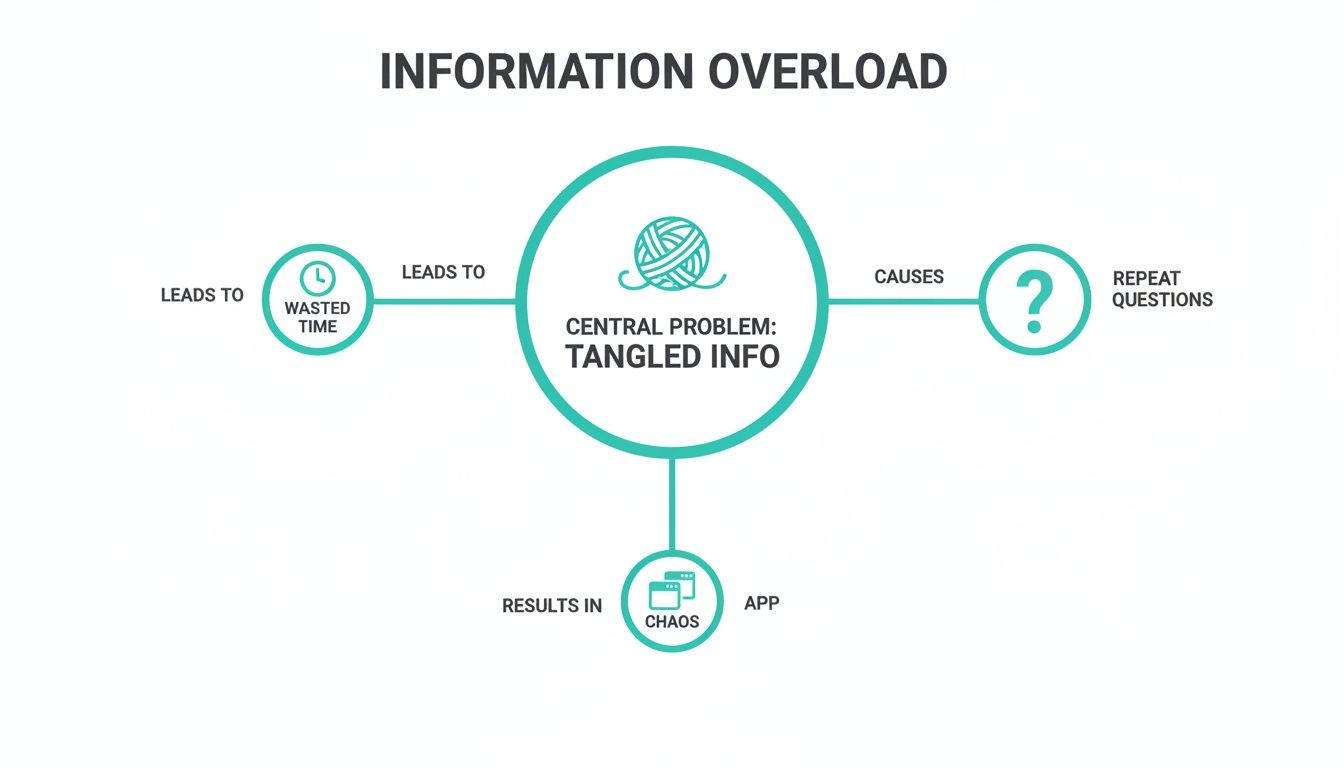
When information is a tangled web, you get exactly what this infographic shows: wasted time, the same questions asked over and over, and the headache of jumping between a dozen different apps. A poorly planned intranet or extranet only makes this worse.
Inside the Digital Office: The Power of an Intranet
At its heart, an intranet is all about creating internal unity and a cohesive company culture. It's the one place your team can go to find definitive answers and feel connected, ending the frustrating hunt through messy email chains and siloed apps.
Think about the real-world difference this makes. A new hire isn't bugging three different people to find the benefits guide; they find it instantly on the HR portal. Your project team isn't digging through their downloads for the latest design mockups; they're all in a dedicated, version-controlled workspace. The intranet becomes your company's single source of truth.
But the real magic isn’t just about organizing files. It’s about building a smoother, more intuitive way to work.
- No more repeat questions. Critical information is centralized and easy to find, which frees up your experts to do their actual jobs instead of being human search engines.
- A stronger, connected culture. Even with a remote or hybrid team, the intranet acts as a digital water cooler. It’s where company news, employee spotlights, and shared wins build a real sense of community.
- Faster, smarter decisions. When everyone is working from the same playbook, teams are aligned, and projects move forward with confidence.
The Secure Handshake: Granting Access with an Extranet
Now, what about the extranet? Let’s go back to our office building analogy. An extranet is like a dedicated, secure conference room with its own private entrance.
You wouldn’t give clients or vendors a keycard to roam the entire building—that's a huge security risk. Instead, you grant them escorted access to only that specific meeting room for a particular project. Inside, they can see shared timelines, review documents, and collaborate with your team, but they can't wander the halls or access anything else.
That controlled, firewalled environment is what defines an extranet. It’s built to let you work closely with outside partners without throwing open the doors to your entire internal world.
The core difference is all about who gets access and why. An intranet is for your employees—it builds internal efficiency. An extranet is for trusted partners—it fosters secure, external collaboration.
To bring this to life, we've put together a quick comparison table that lays out the fundamental differences.
Intranet vs Extranet At a Glance
| Attribute | Intranet (Your Private Office) | Extranet (Your Secure Meeting Room) |
|---|---|---|
| Primary Goal | Centralize internal knowledge, improve employee communication, and foster company culture. | Facilitate secure collaboration and information sharing with external partners, vendors, or clients. |
| Users | Employees only. It's a completely private network for people inside your organization. | Employees AND approved third parties. This includes clients, vendors, suppliers, and freelance partners. |
| Access Control | Access is granted based on employee status and is typically restricted to the company’s internal network (or via VPN). | Access is granted on a case-by-case basis to specific external users, often through a secure login portal over the internet. |
As you can see, one is an internal fortress, while the other is a guarded bridge to the outside world.
Think about how an extranet can elevate your client relationships. Instead of an endless email chain with 20 attachments, you provide a sleek, professional portal where your client can track progress and approve deliverables. For a supplier, an extranet could grant them real-time access to your inventory data, streamlining the entire supply chain.
Both tools are incredibly powerful for taming information chaos. By understanding their distinct roles—one as your private digital office, the other as your secure meeting room—you can make the right strategic choice to bring clarity and efficiency to your entire business.
Choosing a Modern Architecture for Your Team
Picking an internal communication platform today is about so much more than just buying software. It’s about choosing an architecture that mirrors how your team actually works. For a long time, the go-to solution was a traditional, on-premise intranet—a rigid, server-based system that was literally locked inside your office walls. This model demanded a huge upfront investment in hardware, a dedicated IT team for constant upkeep, and often delivered a clunky experience that employees actively dodged.
Frankly, that old way of thinking created more problems than it solved. Remote team members had a nightmare trying to connect securely. Simple updates were slow and expensive. And the system couldn't grow without throwing even more money and effort at it. It was less of a collaborative hub and more of a digital filing cabinet collecting dust.
The Shift to Cloud-First Intranets
Thankfully, things have changed. The entire market has pivoted to nimble, cloud-based solutions, often called Intranet as a Service (IaaS). Instead of buying and babysitting your own servers, you subscribe to a service hosted securely in the cloud.
This isn't just a technical detail; it's a strategic move that delivers real business value right out of the gate. The benefits are impossible to ignore:
- Lower Total Cost of Ownership: Forget the massive capital expense for servers and the endless costs of maintenance, upgrades, and IT overhead.
- Effortless Scalability: As your company grows, the platform scales right along with you. Adding new users or more storage is a matter of a few clicks, not a major IT overhaul.
- Secure Remote Access: Cloud-native platforms are built from the ground up for a distributed workforce. Your team can securely access what they need from anywhere, on any device, without fiddling with a clunky VPN.
The real advantage here is flexibility. Cloud architecture unshackles your business from the chains of physical hardware, letting you adapt to new challenges and focus your resources on what really matters—growth, not server maintenance.
The data backs this up completely. Public cloud models are taking over, and it's all thanks to their cost-effectiveness and scalability. Projections show the public segment will command more than 47.7% of the intranet as a service market share by 2035. That's nearly half the entire market. You can dig deeper into this trend in recent intranet as a service industry reports.
Aligning with How Your Team Already Works
If your organization already lives and breathes in a tool like Slack, this cloud-first mentality is just common sense. Your team is already used to a fluid, accessible, and connected digital workspace. Forcing them into a traditional on-premise system would feel like taking a giant step backward—a disconnected island in an otherwise seamless workflow.
A modern, cloud-based architecture for your intranet or extranet fits perfectly with a Slack-centric culture. It works with the tools your team already loves, creating a unified and future-proof ecosystem for all your company knowledge. This approach gets one thing right: the best tools are the ones that slide right into your daily routine, not the ones that force everyone to learn a whole new, disruptive way of doing things.
Ultimately, it’s about empowering your team with tools that are as quick and responsive as they are. If you want to build a knowledge-sharing culture that thrives in today's world, the choice is clear. You can learn more about how this approach boosts team productivity by reading our guide on getting cloud-based collaboration done right. It's time to ditch the rigid systems of the past and build on an architecture designed for the future of work.
What the Market Growth Means for Your Business
So, why should you care about intranet market trends? It’s not just about industry stats; it's about seeing where the future of work is headed and making sure your next big tech investment isn't already obsolete. Keeping an eye on these trends helps you sidestep outdated systems and pick a platform that will actually grow with your company. The market for intranet and extranet solutions isn't just expanding—it's evolving at a breakneck pace, and that shift brings some serious advantages to the table.
We’re not talking about a small, niche corner of the tech world, either. The intranet software market was recently pegged at USD 18.56 billion and is on track to hit a staggering USD 43.55 billion by 2035. That kind of growth, an 8.06% clip year over year, points to one thing: a massive, undeniable demand for better ways to connect and collaborate internally. You can dig into the numbers yourself in the full intranet market research report to see just how big this change is.
What does this boom mean for you? In short, the game has changed, and it's in your favor.
More Innovation and Better Tools
A hot market always fuels fierce competition, especially with heavyweights like Microsoft and Atlassian in the ring. This pressure forces providers to get creative. They're no longer just building digital filing cabinets; they're crafting dynamic, social platforms that feel a lot more like the consumer apps your team already knows and loves.
For you and your team, this translates into real, tangible benefits:
- Smarter Integrations: Modern intranets are designed to play nice with the tools you rely on every day, from Slack to project management software and HR systems.
- Engaging Features: You'll find more intuitive designs, personalized news feeds, and tools that help build a real sense of community, even when everyone’s working remotely.
- AI-Powered Assistance: The next wave is all about intelligence. Think systems that automatically surface the right information at the right time, cutting down the hunt for that one specific document.
This market explosion sends a clear signal: employee expectations have changed for good. People simply won't put up with clunky, hard-to-use software anymore. They expect their workplace tools to be as smooth and responsive as the apps on their phones.
Competitive Pricing and Greater Value
As more players jump into the market and fight for your business, pricing naturally becomes more competitive. This gives you more bargaining power and a wider array of options. With the rise of the Intranet as a Service
model, you can often sidestep massive upfront investments and instead opt for flexible subscription plans. You get top-tier technology without the eye-watering price tag.
By understanding these market forces, you’re in a much better position to make a smart, confident decision. You’re not just buying a piece of software; you’re investing in a solution built for the modern workplace—one that’s collaborative, engaging, and designed to put your team’s collective knowledge right at their fingertips. Aligning your choice with these trends means you’re not just fixing today’s problems but also gearing up for tomorrow’s opportunities.
The Future of Knowledge Is Already in Slack
Let's be honest. Most traditional intranets start with grand ambitions but quickly turn into digital ghost towns. They become cluttered, outdated archives that no one ever visits, sending your team right back into the frustrating loop of digging through shared drives or tapping a colleague on the shoulder just to find a simple answer. It’s a pattern we’ve all seen before.
But what if the answer isn't building a shinier, more complex destination for information? What if you could bring the knowledge directly to where your team is already working, collaborating, and solving problems every single day? The future of knowledge management isn't another platform to maintain; it's a smarter, more integrated approach that lives right inside Slack.
From Searching to Asking
Imagine a day where no one on your team has to leave Slack. Instead of opening another browser tab, searching a shared drive, or scrolling through endless channels, they just ask a question. An intelligent assistant like SAI instantly provides the right answer, sourced directly from your team's collective wisdom.
This is the core shift: moving from a model where people have to go find information to a system where information comes to them. It completely removes the small, frustrating roadblocks that kill productivity and morale. And those small moments add up. Consider that the average cost of a data breach hit $4.45 million in 2023, often caused by simple human error or internal information mishandling—risks that multiply when essential knowledge is buried and hard to verify.
When getting answers is this easy, the whole dynamic of your team starts to change.
- Onboarding gets way faster. New hires are up and running in days, not weeks, because they can find answers to foundational questions without feeling like they're interrupting senior staff.
- Decisions happen sooner. Project managers don’t have to wait for that one key person to get online to clarify a small but critical detail. The answer is already there, captured and ready.
- Expertise is shared, not siloed. That invaluable knowledge trapped in the heads of your top performers is organically captured and shared with everyone, creating a more resilient team.
The goal isn't just to build a better intranet or extranet. It's to make the entire concept of a separate knowledge base feel almost invisible. The best system is the one your team uses without even thinking about it.
An AI That Learns As You Work
Forget the tedious, manual process of writing, tagging, and organizing articles for a traditional knowledge base. An AI assistant like SAI learns directly from the real-time conversations your team is already having in Slack. You and your team just work as you normally would.
Every question asked and answered in a designated channel becomes a permanent, searchable piece of institutional knowledge. This creates a living, breathing information ecosystem that gets smarter and more refined with every interaction, without any extra effort from you. It captures the crucial context—the why behind a decision—that static documents and wikis so often miss.
This isn’t just a fancy search bar. It’s a complete reimagining of how team knowledge is created, valued, and shared. You're no longer just organizing files; you're building a collective intelligence that empowers every single person to do their best work. By shifting your focus from building a separate platform to enabling knowledge discovery right inside Slack, you’re not just adopting a new tool. You’re fundamentally upgrading how your team operates.
If you’re ready to make that shift, you can explore how to build a Slack knowledge management strategy that actually works. It’s all about meeting your team where they are and giving them what they need to stay focused, brilliant, and free from the endless hunt for information.
Turn Slack into Your Team's Knowledge Hub Today

If you’re a busy Slack admin, the idea of rolling out yet another system
probably sounds exhausting. But what if you could turn the tool your team already lives in into a powerful knowledge engine? The good news is, you can start building a smarter workspace today, without a massive administrative lift.
It all begins with simple, practical steps that don’t require any new software. Start by creating dedicated channels for Q&A, establishing clear emoji reactions to tag important conversations, and using Slack's pinning feature for mission-critical resources. These small habits bring much-needed structure to the chaos, making vital information easier to find.
Let AI Do the Heavy Lifting
Once you've got those basics down, the real magic can happen. By adding an AI assistant like SAI to just one of your Q&A channels, you instantly supercharge your efforts. The AI works quietly in the background, automatically capturing knowledge from conversations without needing any complicated setup.
Think about it: your team asks questions just like they always do, but now, every answer becomes a building block for a reliable, self-updating knowledge base. The next time that same question pops up, the AI delivers the answer instantly. The cycle of repetitive interruptions is finally broken.
This approach gives you a lightweight but powerful alternative to a traditional intranet and extranet, working with your existing communication flow, not against it. The demand for more agile solutions is clear—the Intranet as a Service market is projected to hit USD 19.88 billion by 2025. You can dig deeper into the rapid Intranet as a Service market growth to see just how fast this trend is reshaping the modern workplace.
By taking these small, actionable steps, you can start cutting down on repeat questions and building a lasting knowledge resource right now—all inside the familiar walls of Slack.
Frequently Asked Questions
When you're figuring out the best way for your team to collaborate, both internally and with outside partners, a lot of questions pop up. Let's tackle some of the most common ones head-on, focusing on what works in the real world.
Can a Small Business Just Use Slack as Its Intranet?
You bet. For a lot of small and medium-sized businesses, a thoughtfully organized Slack workspace is more than enough to act as the company intranet. Forget about a clunky, separate platform nobody uses.
The trick is to be intentional. Create dedicated channels for company announcements, specific projects, and even water-cooler chat. This turns Slack into the one place everyone goes for information. To really level it up, you can plug in an AI tool that learns from all those conversations. It transforms your team's chat history into a living, breathing knowledge base that answers questions on the spot, so your team can find what they need without breaking stride.
What Are the Biggest Security Risks with an Extranet?
With an extranet, the biggest headache is always access control. You're purposefully inviting outsiders—clients, vendors, contractors—into your digital space. The number one risk is that they'll see something they shouldn't.
This means you absolutely need rock-solid permission settings. It's not a set it and forget it
thing, either. You have to regularly audit who has access to what. The other major risk is data leakage. Without crystal-clear rules and secure file-sharing practices, sensitive information can easily walk out the digital door. Thankfully, modern extranets and secure collaboration tools are built for this, offering granular controls to keep your internal data locked down.
How Is an AI Assistant Different from a Traditional Knowledge Base?
A traditional knowledge base is like a dusty old library. Someone has to manually write every single book (or article), and then your team has to stop what they're doing, walk over to the library, and hope they can find the right one on the shelf. The whole process is clunky, which is why most knowledge bases are out-of-date and rarely used.
An AI assistant, on the other hand, lives right where your team works—inside a tool like Slack. It learns from the conversations that are already happening, so there’s no manual upkeep. When someone has a question, they just ask, and the AI delivers the answer instantly.
The real shift is moving from a system where you hunt for information to one where answers find you. Knowledge is captured as it’s created and delivered right when it’s needed, cutting out all the friction of a traditional setup.
This makes sure your team’s collective wisdom is always fresh and easy to tap into, turning everyday collaboration into a powerful, self-maintaining resource.
Stop the endless search for answers. SAI learns from your Slack conversations to provide instant, accurate responses to your team's questions, right where they already work. Add it to a channel for free today at https://sai-bot.ai.