The End of Search: Knowledge Management Platforms for Instant Answers
At their core, knowledge management platforms are simply systems built to help your team capture, organize, and share what they know. The official goal is to prevent valuable insights from being lost, but the real magic happens when you eliminate the daily, frustrating hunt for answers.
The Hidden Tax of Searching for Information

Think about a typical day on your team. A simple question pops up—What's the latest update on the Q3 project?
—and the search begins. You jump from your email inbox to a shared Google Drive, skim a few Slack channels, and then, in a last-ditch effort, you ping a coworker hoping they know where to find the link.
Sound familiar? This scattered, stop-and-start process is the unfortunate reality for most teams. It’s a constant cycle of context-switching where simple questions trigger a time-sucking scavenger hunt across a dozen different apps. Each interruption, no matter how brief, carries a hidden cost.
We call this the information tax.
It's the invisible friction that quietly drains your team's focus and momentum. These tiny disruptions add up, snowballing into a massive productivity drain that turns focused work into a choppy series of stops and starts. It's the silent killer of deep work.
Why Traditional Platforms Fall Short
For years, companies tried to fix this with old-school knowledge management platforms. Think of these as digital libraries—enormous, centralized repositories for documents, wikis, and manuals. The idea was good, but in practice, they often made the problem worse by forcing everyone to leave their work to go find something.
The core issue isn't a lack of information; it's the high-friction process of accessing it. When answers are stored in a distant library, employees must stop what they're doing, switch applications, and become librarians just to answer a simple question.
This approach creates a huge gap between where work happens and where knowledge lives. And the result is always the same: your beautifully organized knowledge base collects dust while your team defaults to the easiest option they have—interrupting an expert.
The True Cost of Inefficient Knowledge Sharing
The fallout from this constant searching is far more damaging than just a few wasted minutes. It sends a ripple effect through the whole organization, creating serious business problems.
- Delayed Decisions: When crucial data is buried, decision-making grinds to a halt. Projects stall and opportunities are missed.
- Expert Burnout: Your most experienced people turn into human search engines, spending their days answering the same questions instead of doing high-impact work.
- Inconsistent Customer Experience: Without a single source of truth, support agents give conflicting answers, which chips away at customer trust.
- Onboarding Friction: New hires are left to fend for themselves, struggling to find the information they need to get up to speed. This drags out ramp-up times and kills their early momentum.
The explosive growth in this space shows just how badly companies need a better way. The global knowledge management software market hit $31.41 billion in 2023 and is projected to skyrocket to $403.3 billion by 2034, all driven by the urgent need to tame this information chaos. You can discover more insights about this market growth and its drivers.
This isn't just about organizing files anymore. It's about fundamentally changing how work gets done. It's time to imagine a day where you never have to search for information again.
From Static Wikis to Living Knowledge
Let’s be honest: where does your company’s collective brain actually live? Is it tucked away in some forgotten, dusty folder that no one ever opens? Or is it alive, active, and right there in the thick of things where your team collaborates every day? This is the huge shift we're seeing with modern knowledge management platforms—a move away from static archives and toward a living, conversational way of sharing what we know.
For way too long, we’ve treated knowledge like it belongs in a museum. We've built company wikis and intranets that are basically digital encyclopedias. When you need an answer, you have to stop what you’re doing, go to the shelf,
find the right volume, and start flipping through pages, just hoping you stumble upon the right entry.
That old process is slow, clunky, and completely pulls you out of your workflow. It turns your team into information hunters, a job nobody actually signed up for.
From Hunting Documents to Asking Questions
The new way of thinking flips this entire model on its head. Instead of that dusty encyclopedia, imagine having an expert colleague sitting right next to you, ready with the perfect answer the moment a question pops into your head. You don't have to leave your desk, open another app, or even guess the right keywords for a search bar.
You just ask a question, the same way you’d ping a teammate in Slack. This is the core of the transformation: we’re moving from an experience of ‘hunting for documents’ to simply ‘asking for answers.’
The goal is no longer to build a perfect library of documents that might one day be useful. The goal is to deliver the exact piece of knowledge someone needs, at the exact moment they need it, right where they are already working.
This simple change has a massive impact. It makes tapping into your organization's collective intelligence as easy as sending a message.
Making Knowledge Sharing Effortless
This conversational model completely changes the game for knowledge management. The old way demanded so much effort. Someone had to decide a piece of information was important, take the time to write it up, format it perfectly, and file it away in the right digital folder. That created a huge barrier, which is exactly why most of your company's valuable knowledge never even makes it into the system.
A modern, conversational approach gets rid of that friction.
- Knowledge is captured automatically: The most valuable insights—the real gems—are often shared in team conversations. Modern tools like SAI learn directly from these exchanges, capturing expertise that would normally just get lost in the scrollback.
- Answers are instant: Instead of waiting for a busy colleague to get back to you, your team gets immediate, synthesized answers drawn from thousands of past conversations and documents.
- The system is always current: Because the knowledge base learns from real-time conversations, it stays up-to-date without anyone needing to manually go back and update old, stale wiki pages.
What you end up with is a living, breathing knowledge ecosystem that actually gets smarter with every single question your team asks and answers.
The Real-World Transformation
Think about the difference this makes in a normal workday. Your team stops juggling a dozen browser tabs, stops pinging senior engineers with the same questions over and over, and stops wasting time digging through multiple drives and platforms.
Instead, they just ask. A new sales rep types in the #sales-team channel, What's our current discount policy for enterprise clients?
and gets an immediate, accurate response. A support agent asks, What's the workaround for bug #472?
and instantly gets the solution that was hashed out in a thread weeks ago.
This isn’t just a more convenient way to find information. It's a fundamental change that makes your entire organization smarter, faster, and more focused by weaving knowledge directly into the flow of work.
How AI Unlocks Instant Answers in Slack
The real breakthrough in modern knowledge management platforms isn't a slicker interface or a slightly faster search bar. The magic is happening behind the scenes, making it possible to get instant, accurate answers right where your team works—inside Slack.
Imagine this: you never have to open another resource to find an answer. No more digging through drives, wikis, or old emails. Instead, you simply ask a question in Slack and get an immediate, synthesized response drawn from your company’s entire collective knowledge.
This is the future of knowledge management: it stops being a chore and becomes an automatic byproduct of your team's everyday work. The frustrating, time-wasting hunt for information is finally over.
From Keywords to True Understanding
For years, finding information was a guessing game. You'd punch Q3 marketing budget
into a search box and cross your fingers, then spend the next ten minutes scrolling through a mess of irrelevant files and ancient chat threads. That old model was all about matching words, not grasping meaning.
AI-powered assistants flip the script entirely. Imagine asking a colleague a question—you don't just use keywords, you use full sentences to explain what you need. That's how this works. The system understands your intent, not just the words you type. It grasps the context, the nuance, and the invisible threads connecting different bits of information scattered across your company.
The leap is from a system that finds documents containing your words to one that synthesizes an answer to your actual question. It’s the difference between being handed a stack of books and having an expert point you to the exact paragraph you need.
This allows the AI to connect the dots in ways a human just can't. It can spot that a question asked in a sales channel today is almost identical to a problem solved in an engineering thread three months ago, and it bridges that gap in an instant.
The diagram below shows this evolution perfectly—from static, dusty wikis to a dynamic AI assistant that constantly learns and serves up answers.
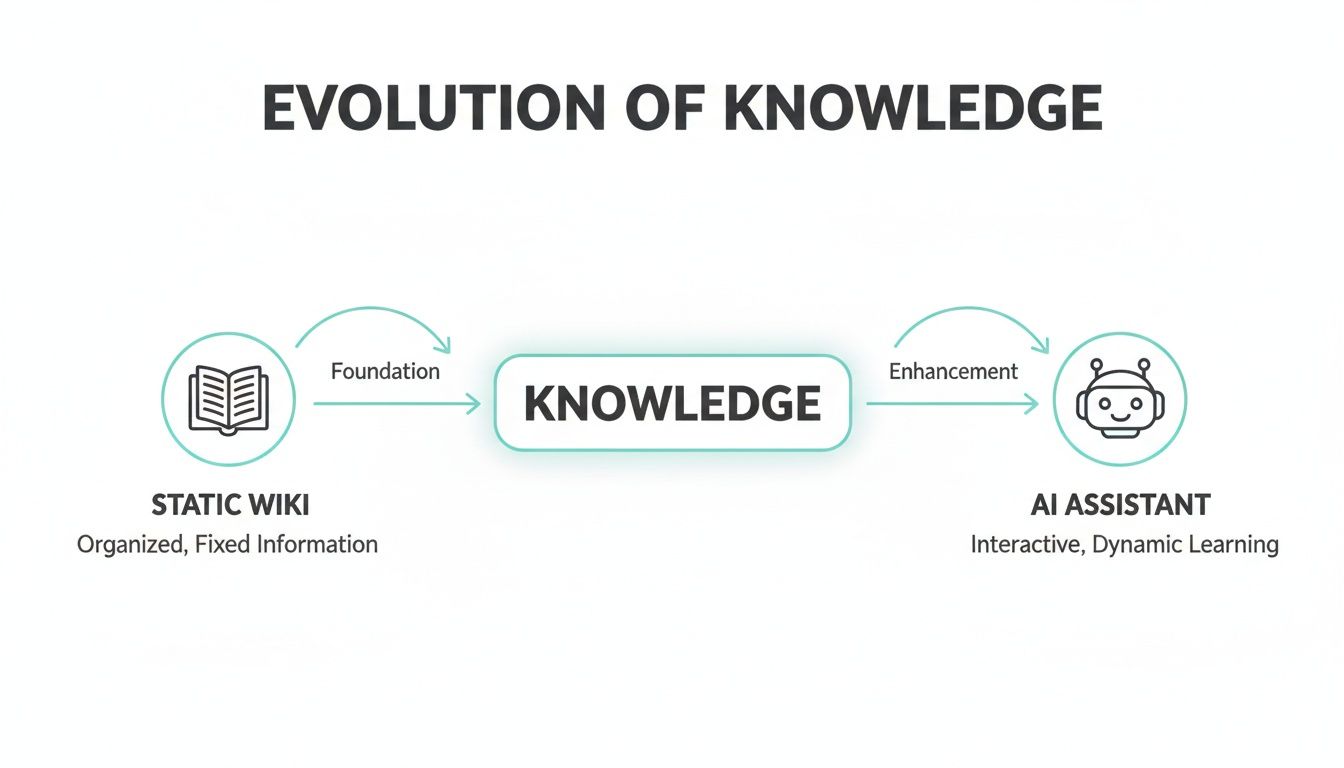
We're moving away from a high-effort, library-style approach to an effortless, on-demand model where knowledge finds you.
A Comparison: Old vs. New Knowledge Management
This shift from manual to automated isn't just a small upgrade; it's a completely different way of thinking about company knowledge. Here’s a quick breakdown of how traditional systems stack up against a modern AI assistant living in Slack.
| Capability | Traditional Knowledge Platforms | AI-Powered Slack Assistants |
|---|---|---|
| Knowledge Capture | Manual process; requires dedicated time to write and update articles. | Automated; passively learns from daily conversations and documents. |
| Information Access | Relies on keyword search; often returns links, not answers. | Understands user intent; delivers synthesized, direct answers. |
| System Maintenance | Needs constant gardening; content quickly becomes outdated. | Self-updating; knowledge base grows and refines itself over time. |
| User Experience | Disruptive; forces users to leave their workflow to search a separate tool. | Seamless; provides answers directly within the flow of conversation (e.g., in Slack). |
| Setup & Onboarding | Often involves a major migration project and extensive training. | Zero-setup; starts learning from existing conversations immediately. |
Ultimately, the new approach removes the friction that made old-school knowledge management feel like a second job. Instead of forcing people to feed a system, the system learns from the work people are already doing.
How AI Learns from Your Team’s Work
The most powerful thing about this technology is that it learns passively from the work your team is already doing. So much expertise is shared every day in Slack, but most of it just drifts away into the chat history, lost forever. An AI assistant acts like a silent scribe, capturing this valuable but fleeting knowledge.
Here’s the business transformation you’ll see:
- It monitors public channels: The AI observes the natural flow of questions and answers happening in the open.
- It identifies expertise: When a subject matter expert drops a great answer and gets a positive reaction (like a ✅ emoji), the AI takes note.
- It stores and connects the dots: That question-and-answer pair is cataloged and linked to related concepts, building a rich web of institutional knowledge.
This is a zero-setup process. You don't need a massive project to migrate documents or manually train a bot. The system starts learning from day one, turning your team's daily chats into a durable, searchable, and instantly accessible resource. For a concrete look at this in action, see this AI in Slack knowledge base example that delivers answers right away.
The market is betting big on this change. The AI in Knowledge Management market, valued at $6.7 billion in 2023, is projected to rocket to $62.4 billion by 2033. That’s a growth rate more than double that of traditional KM software. Why? Because AI doesn't just improve knowledge management—it completely changes the game.
What Does a Search-Free Day Actually Look Like?
Forget the jargon and the technical specs for a moment. Let's get real about what a massive shift in how we access information feels like on a random Tuesday morning. The real change isn't about getting a better search bar. It’s about creating a world where your team doesn't even have to think about searching for information in the first place.
Imagine a day where every question gets an answer, right then and there, in the flow of conversation. This isn't some far-off fantasy; it's what happens when teams move beyond the old, clunky search and retrieve
model. Let's walk through a few real-world examples.
Onboarding in Hours, Not Weeks
It’s 9 AM. A new software engineer, Maria, joins the team. In most companies, her first week would be a confusing mess of outdated onboarding docs, nervously shoulder-tapping senior devs, and just trying to piece together how anything gets done. She'd waste days just figuring out who to ask for what.
But here, her experience is totally different. She joins the #engineering-team Slack channel and asks a simple question: Where can I find the setup guide for the local development environment?
Instead of waiting for a busy senior developer to find a spare moment, an AI assistant like SAI instantly replies. It gives her a concise, step-by-step guide pulled directly from a conversation that happened months ago. A few minutes later, she follows up: What's our protocol for urgent bug fixes?
Bam. Another instant answer, summarizing the team’s established process.
By lunchtime on her first day, Maria is already pushing her first small commit. She hasn't interrupted a single person or felt that sinking feeling of being lost. This is the new standard for onboarding—slashing ramp-up time from weeks to just a few hours by making tribal knowledge instantly available.
Crushing Customer Issues in Minutes
Meanwhile, across the company, a support agent named David gets a thorny customer ticket. The customer is hitting a rare edge-case bug with a specific product integration. The old way? A frantic search through the company wiki, digging through old support tickets, and probably escalating to a Tier 2 engineer, all while the customer waits.
David doesn't go anywhere. He stays right in his team's Slack channel and types, @SAI, what’s the fix for the API timeout error when a customer connects with this specific third-party service?
The AI doesn’t just spit back a link. It pieces together the perfect answer, pulling the solution from a thread between two engineers who solved this exact problem six months ago. It even includes the code snippet they used and a quick explanation of why it works.
The most valuable knowledge in your company isn't in a formal document—it's locked away in past conversations. A search-free workplace finally unlocks it.
David copies the solution, resolves the customer's issue, and closes the ticket in less than five minutes. He never left Slack, never broke his focus, and never had to interrupt an engineer. The result? A faster resolution, a much happier customer, and an engineering team that gets to stay focused on building.
Making Big Decisions with Real Confidence
Later that day, a project manager, Sarah, is in a high-stakes planning meeting. A stakeholder throws a curveball: What was the customer feedback that made us deprioritize that reporting feature last quarter?
Normally, finding that specific insight would mean derailing the meeting to dig through old notes, CRM entries, and project boards—a task that could easily take hours.
Instead, Sarah just pulls out her laptop, opens Slack, and asks the AI assistant. In seconds, it surfaces the key takeaways from three different customer feedback calls and links to the project update where the team made the official call.
She reads the summary aloud, giving everyone the exact context they needed to move forward with confidence. The entire detour took less than a minute. This is what a search-free workplace is all about: making data-driven decisions in real-time, without killing the momentum of a crucial meeting.
Each of these moments points to the same truth. Modern knowledge management isn't about organizing files better. It's about giving your team a superpower: the ability to operate with more speed, focus, and intelligence by completely getting rid of the frustrating, time-wasting hunt for information.
Choosing a Platform That Works Where You Work
The dream of a search-free workday with instant answers is compelling, but let's be honest: not all knowledge management platforms deliver on that promise. Picking the right tool isn’t about ticking off the most features. It's about finding a system that fits into your team's existing habits so seamlessly they barely notice it’s there.
The wrong choice becomes just another app to juggle, another digital library
that pulls people away from what they’re actually doing. But the right one feels like a natural extension of your team’s brain, ready to help the moment a question pops up.
To make sure you end up with the latter, you need to ask the right questions—ones that cut through the marketing fluff and focus on how the tool will actually perform in the real world.
Is It Built for Questions or Just for Documents?
Here’s the big shift in modern knowledge management: it’s moving away from simply storing information to actually answering questions. Older platforms are basically digital filing cabinets. They’re great for organizing PDFs and official documents, but they still make your team do all the heavy lifting—sifting through files to find what they need.
A genuinely useful platform doesn't just store docs; it understands intent. It’s built for the way people actually communicate, letting someone ask a question in plain English and get a direct, synthesized answer. The goal isn't to make the hunt for information faster; it's to eliminate the hunt entirely.
Choosing a platform means deciding between a tool that gives you a link to a 10-page document and one that gives you the specific paragraph you actually need. One saves clicks; the other saves entire workflows.
Does It Work Where Your Team Works?
Context is everything. The number one reason knowledge bases gather digital dust is because they live outside the natural flow of work. If your team lives and breathes in a collaboration hub like Slack, forcing them to open a separate tab or app to find an answer is a death sentence for adoption.
The best solutions are Slack-native. They operate inside the very conversations your team is already having. This isn’t just about convenience; it’s about reducing friction to zero. When answers are available right where questions are asked, sharing knowledge becomes an automatic, effortless part of the daily routine.
Does It Require a Massive Project to Get Started?
Many traditional knowledge management platforms come with a huge catch: a massive, upfront setup project. You’re looking at a full-scale content audit, migrating thousands of documents, and manually mapping out a complex information architecture. It’s an exhausting, time-sucking endeavor before you see a single ounce of value.
Instead, look for a zero-setup solution. Modern, AI-driven tools like SAI don’t need a painful migration because they learn on their own from your team’s existing conversations and documents. They start capturing knowledge and providing value from day one, delivering an almost immediate return. You can see more on how these tools operate in our breakdown of knowledge base platform examples that reclaim your team’s time.
This move toward easy-to-deploy, cloud-based systems is a huge market trend. In fact, cloud deployments made up over 68.1% of the AI-enhanced knowledge management market in 2023. It’s clear businesses prefer scalable tools that fit modern, flexible work. You can read the full research about this trend in knowledge management.
By focusing on a solution that’s conversational, Slack-native, and zero-setup, you’re not just buying another piece of software. You’re investing in a smarter, more focused, and interruption-free way for your team to get work done.
Your First Step to an Interruption-Free Day
Let’s be honest: the constant hunt for information is a hidden tax on your team's focus. Every minute spent digging through shared drives, scrolling through old conversations, or shoulder-tapping an expert is a minute not spent on real work. It's a vicious cycle of context switching and waiting that grinds productivity to a halt.
But what if you could break that cycle? What if the solution wasn’t some massive, expensive new software suite that takes a year to implement? The answer is simpler than you think, and it starts by meeting your team exactly where they already are: inside Slack.
Imagine a day where every question finds an instant answer, right in the flow of conversation. No one ever has to open another tab or lose their train of thought. That’s the reality with a modern, AI-powered assistant that lives inside your workspace.
Reclaim Your Team's Time Today
Getting started doesn't have to be a headache. Forget the high-friction rollouts of the past. There’s no data migration to plan, no complex software to install, and absolutely no long, boring training sessions. You can start building a search-free workplace in just a few minutes.
The first step is to empower your team with a tool that learns from their existing expertise, turning those everyday conversations into a reliable, instantly searchable knowledge base. You can solve the knowledge drain today—without needing a huge budget or months of planning.
This isn't just about buying new tech. It's about making a deliberate choice to give your team back its most valuable resource: uninterrupted time to do their best work.
To take the next step, check out these 10 best practices for knowledge management and start building a more focused, effective work environment.
Frequently Asked Questions
Alright, so you see the potential. A workplace where answers find you, instead of you having to hunt them down. But it's natural to have questions about how a system like this actually works day-to-day. Let's dig into some of the most common ones we hear.
How Does an AI Actually Learn Our Company's Lingo and Processes?
This is where the magic happens, and it's simpler than you might think. Instead of you needing to feed it documents or manually train it, a modern AI assistant plugs right into your team's conversations in Slack.
It passively observes the Q&A happening in your public channels—the real-world problems and solutions your team discusses every single day. This is how it builds its brain. There's no big setup project or painful data migration. It just starts learning from day one, absorbing the unique context and tacit knowledge that defines how your team truly operates.
Does This Mean We Can Ditch Our Wiki like Confluence or Notion?
Not necessarily, and that's actually a good thing. Think of a Slack-native AI as your first line of defense for knowledge. It’s brilliant at capturing the fast-moving, conversational stuff that almost never gets documented—quick troubleshooting tips, in-the-moment decisions, and daily project updates.
Your Confluence or Notion is still the home for official, long-form documentation like company policies or project briefs. But the AI in Slack tackles the 80% of repetitive questions that interrupt your experts all day long. Over time, you’ll feel less pressure to keep those static docs perfectly up-to-date because the most current answers are already flowing right where your team works.
Is It Secure to Let an AI Read Our Slack Channels?
This is a critical question, and the answer has to be a resounding yes. Any serious knowledge management tool is built with enterprise-grade security as its foundation. Your data and privacy are non-negotiable.
A well-designed AI only learns from the specific public channels you invite it into. It has zero access to private channels, direct messages, or any other confidential space. That information remains completely untouched and secure.
Always do your homework, of course. Before committing, review any provider's security and privacy policies to make sure they line up with your company's standards for compliance and data handling.
How Quickly Will We Actually See a Return on This?
With a zero-setup tool, the payback starts almost immediately. From the moment the AI joins a channel, it’s learning. It can often start answering questions within the first day.
The real ROI is measured in reclaimed time. Every single question the AI deflects is an interruption you've saved your senior engineer, your sales lead, or your HR manager from handling. Most teams report a noticeable drop in repetitive questions and faster resolution times within the first week alone, which translates directly into more focused, productive work.
Ready to stop searching and start asking? See how SAI can give your team instant answers and an interruption-free day. Add SAI to Slack for free.