performance review examples to elevate your process in 2025
Performance reviews often feel like a necessary evil, a once-a-year scramble filled with vague feedback, awkward conversations, and minimal impact. Managers hunt for the right words, employees brace for criticism, and the entire process rarely sparks the meaningful growth it's supposed to. The result is a cycle of frustration and missed opportunities, where valuable feedback gets lost in translation or, worse, is never delivered at all. This cycle doesn't just demotivate your team; it directly stifles productivity and innovation.
Imagine a different reality. Picture managers confidently delivering feedback that is specific, actionable, and truly motivating. Envision employees leaving their reviews with a clear understanding of their accomplishments and a precise roadmap for their professional development. This isn't about finding a one-size-fits-all script; it’s about transforming your review process from a painful administrative chore into a strategic tool for driving tangible business results.
This guide provides the performance review examples you need to make that change. We’ve compiled 10 powerful frameworks and templates, from SMART Goals to 360-Degree Feedback, that cut through the ambiguity. You won't just get examples; you'll get a strategic breakdown of when to use each one, how to customize it for maximum impact, and the critical dos and don'ts that separate effective feedback from empty praise. Our goal is to make this the last resource you ever need to consult on this topic. Forget searching multiple sites and piecing together advice. Here, you will find the clarity and confidence to turn every performance review into a catalyst for individual and organizational success.
1. SMART Goals Performance review Template
When performance reviews feel vague, subjective, or disconnected from actual business impact, the SMART Goals template provides a powerful antidote. This framework anchors the entire evaluation process in objectives that are Specific, Measurable, Achievable, Relevant, and Time-bound. It transforms reviews from a routine discussion into a strategic conversation about tangible results.

Instead of relying on general feedback like great work this quarter,
this method forces managers and employees to define exactly what success looks like ahead of time. It creates a shared language for performance, eliminating ambiguity and aligning individual effort directly with organizational priorities.
Why It's a Top-Tier Performance Review Example
The SMART framework is effective because it builds clarity and accountability directly into the performance management cycle. There are no surprises; everyone knows the targets from day one.
- For Sales Teams: A goal to
Increase Q3 sales
becomesSecure 15 new enterprise clients, generating $250,000 in new recurring revenue by September 30th.
- For Software Developers: A vague task to
improve the user interface
becomesReduce the user onboarding process from 5 steps to 3 steps, cutting average completion time by 40% by the end of the next sprint.
Strategic Takeaways for Implementation
To get the most out of this approach, integrate it deeply into your workflow.
- Involve Employees: Co-create goals with your team members. This fosters a sense of ownership and ensures the objectives are truly achievable.
- Track Transparently: Use project management software or shared dashboards to track progress. This visibility keeps goals top-of-mind and facilitates real-time adjustments.
- Balance Metrics: Pair quantitative goals (e.g., revenue targets) with qualitative ones (e.g., improving a key client relationship) for a holistic view of performance. This ensures you're measuring not just what was done, but how it was done.
2. 360-Degree Feedback Performance Review
Moving beyond the traditional top-down review, the 360-Degree Feedback model creates a comprehensive, multi-dimensional view of an employee's performance. It systematically gathers anonymous feedback from an individual's entire professional circle: their manager, direct reports, peers, and sometimes even external clients. This method shifts the focus from a single perspective to a holistic understanding of an employee's impact, behaviors, and interpersonal skills.
This approach uncovers blind spots that a manager alone might miss. Instead of relying on a single source of truth, it builds a more balanced and fair assessment by crowdsourcing insights. It’s particularly powerful for evaluating soft skills like communication, teamwork, and leadership, which are critical but often hard to quantify.
Why It's a Top-Tier Performance Review Example
The 360-Degree Feedback framework is a game-changer for leadership development and fostering a culture of open communication. It provides individuals with a well-rounded view of their professional reputation and impact.
- For Team Leaders: A manager might see themselves as a clear communicator, but peer feedback reveals their instructions are often confusing, while direct reports feel they don't provide enough context. This multi-angle feedback provides a clear roadmap for improvement.
- For Individual Contributors: A skilled engineer might receive glowing reviews from their manager on technical output but get constructive feedback from peers about their collaboration style during code reviews. This helps them become a more effective team player.
Strategic Takeaways for Implementation
To implement this effectively, focus on creating a psychologically safe environment where honest feedback is encouraged.
- Guarantee Anonymity: Use a trusted third-party tool or a carefully managed internal process to ensure all feedback is anonymous and confidential. This is non-negotiable for receiving candid responses.
- Focus on Development, Not Discipline: Frame the 360-review as a tool for growth and development, not for making compensation or promotion decisions. This lowers defensiveness and encourages a receptive mindset.
- Provide Coaching on Interpretation: Don't just hand over a report filled with raw data. Train managers to help employees interpret the results, identify key themes, and create a concrete action plan. This transforms feedback into one of the most transformative training topics for leaders.
3. Balanced Scorecard Performance Review
Where many performance reviews focus narrowly on financial targets or task completion, the Balanced Scorecard (BSC) model offers a holistic, 360-degree view. This strategic framework evaluates performance across four crucial perspectives: Financial, Customer, Internal Processes, and Learning & Growth. It translates high-level organizational strategy into a tangible set of interconnected metrics that guide individual and team performance.
Instead of isolating performance to a single dimension, the Balanced Scorecard forces a broader conversation. It connects the dots between employee development (Learning & Growth), process efficiency (Internal Processes), customer satisfaction (Customer), and financial results (Financial). This makes it one of the most powerful performance review examples for creating strategic alignment.
Why It's a Top-Tier Performance Review Example
The Balanced Scorecard is effective because it prevents managers from overemphasizing one area of performance at the expense of others. It builds a sustainable, well-rounded picture of success and shows how every role contributes to the bigger picture.
- For Healthcare Organizations: A hospital can move beyond just financial metrics (like revenue per bed) to include patient satisfaction scores, readmission rates, and employee training certifications in a single, balanced review.
- For Manufacturing Companies: A production manager's review would balance output volume (Financial) with metrics like defect rate (Internal Process), on-time delivery (Customer), and team cross-training hours (Learning & Growth).
Strategic Takeaways for Implementation
To implement the BSC effectively, it must be cascaded from the top down and built collaboratively.
- Ensure Clear KPI Definitions: Every metric on the scorecard must be unambiguously defined. If
customer satisfaction
is a KPI, define precisely how it is measured (e.g., Net Promoter Score, survey results, or repeat business rate). - Link Individual Goals to Scorecard Metrics: The power of the BSC is lost if it remains at the corporate level. Work with employees to set personal goals that directly influence one or more of the scorecard’s four perspectives.
- Review and Recalibrate Quarterly: The business environment changes, and your scorecard should too. Use quarterly reviews not just to evaluate performance but also to assess whether your KPIs are still the right ones for driving your strategy forward.
4. Behavioral-Based Performance Review
Where traditional reviews can get lost in subjective assessments of personality, the behavioral-based performance review focuses on what truly matters: observable actions. This method evaluates how an employee achieves results by linking their on-the-job behaviors directly to core company competencies and values. It shifts the conversation from vague traits like being a team player
to concrete evidence of collaboration.
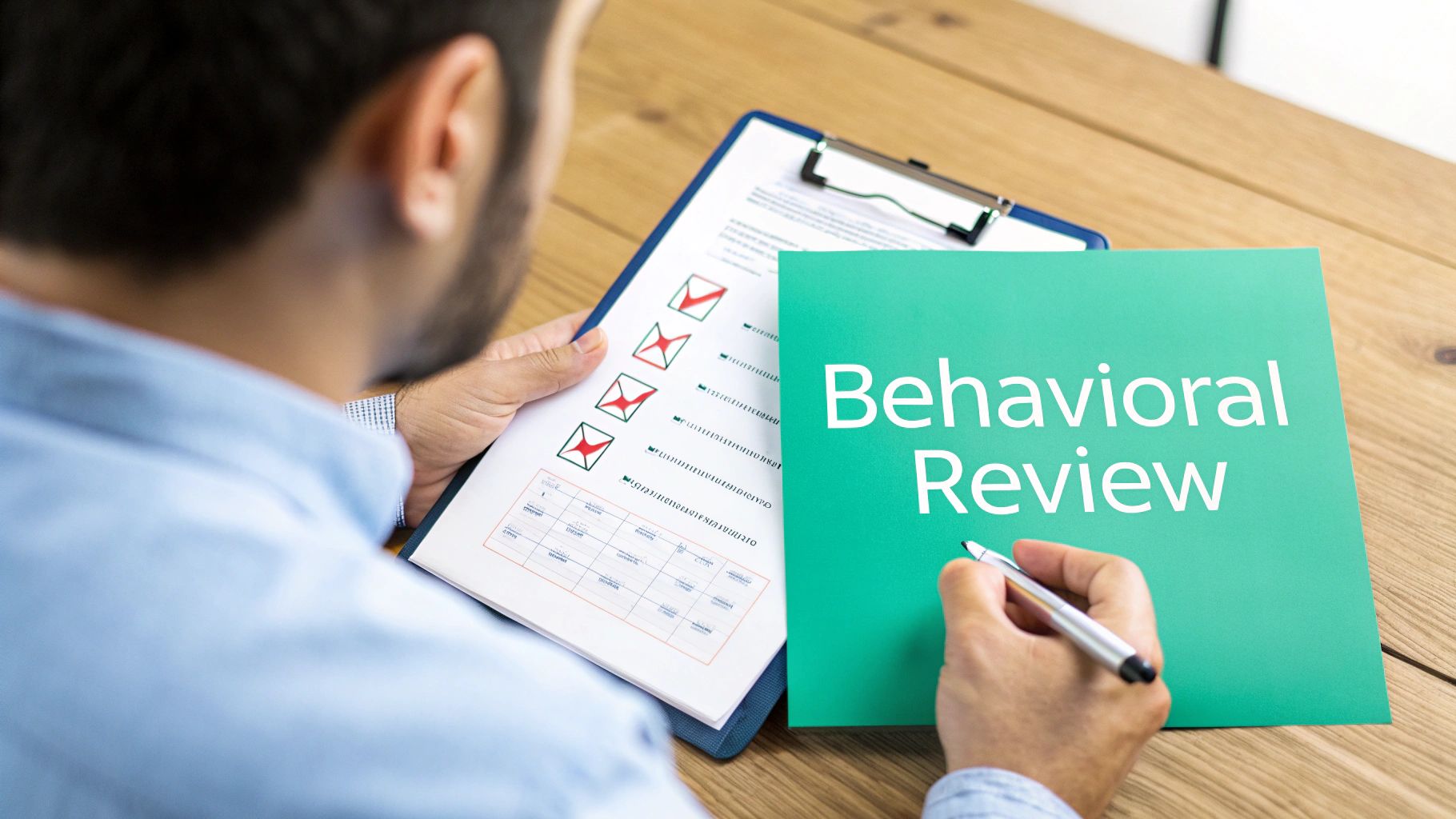
By documenting specific instances of behavior, this approach provides a fact-based foundation for feedback. It removes guesswork and personal bias, creating a fairer and more defensible evaluation system that clarifies exactly what successful performance looks like in action, day-to-day.
Why It's a Top-Tier Performance Review Example
The behavioral-based model excels because it provides clear, actionable feedback rooted in real-world events. It gives employees a precise roadmap for development by showing them the specific actions that drive success or create challenges.
- For Customer Service Teams: Instead of saying an employee has a
bad attitude,
you can cite specific instances:On three separate occasions this quarter, you interrupted customers before they finished explaining their issue, which led to lower satisfaction scores.
- For Manufacturing Supervisors: A general comment like
needs to improve leadership
becomes,During the production line stoppage on May 15th, you effectively delegated tasks to three team members and communicated the repair timeline clearly, minimizing downtime.
Strategic Takeaways for Implementation
To make this method work, you must build a system around consistent observation and documentation.
- Define Core Competencies: Clearly outline the key behaviors tied to success for each role and for the company as a whole (e.g.,
Proactive Communication,
Problem Ownership
). - Use Critical Incident Logs: Train managers to keep a running log of significant positive and negative behavioral examples throughout the review period. This avoids recency bias and provides a rich source of data.
- Focus on 'How,' Not 'Who': Frame all feedback around the employee's actions, not their personality. This makes the conversation constructive and less personal, focusing on repeatable behaviors they can change or continue.
5. Continuous/Ongoing Performance Review
The Continuous/Ongoing Performance Review model dismantles the outdated, once-a-year evaluation in favor of a dynamic, real-time feedback loop. This approach swaps the anxiety of a single high-stakes meeting for a series of regular, low-pressure conversations. It treats performance management not as an annual event, but as an integral part of daily work, fostering constant growth and alignment.
Instead of saving up feedback for months, managers and employees engage in frequent check-ins, coaching sessions, and development discussions. This agility allows teams to pivot quickly, address issues before they escalate, and celebrate wins as they happen. It transforms performance reviews from a historical report card into a forward-looking roadmap for success.
Why It's a Top-Tier Performance Review Example
This model is a game-changer because it creates a culture of open dialogue and psychological safety, directly impacting employee engagement and retention. It makes feedback a normal, expected part of the workflow.
- For Customer Support Teams: A one-time annual review of
ticket resolution times
becomes a weekly check-in discussing specific challenging customer interactions and brainstorming better solutions in the moment. - For Marketing Teams: Instead of waiting a year to discuss campaign performance, a manager provides immediate feedback after a product launch, allowing the team to optimize the next campaign in real-time.
Strategic Takeaways for Implementation
Successfully shifting to a continuous model requires a deliberate cultural and operational change.
- Train Your Managers: Equip leaders with the skills to give constructive, frequent feedback. Effective communication is the backbone of this system. You can build a solid foundation by using a communication plan template to standardize the process.
- Leverage Technology: Use performance management software or even dedicated Slack channels to make giving and receiving feedback seamless and accessible. This removes friction and encourages participation.
- Structure with Flexibility: Schedule regular check-ins (e.g., bi-weekly or monthly) but also empower employees to request feedback whenever needed. This balance ensures consistency without sacrificing spontaneity.
6. Critical Incident Performance Review
When performance feedback feels abstract or based on recent memory, the Critical Incident method provides objective, evidence-based data. This technique involves documenting specific examples of an employee's highly effective or ineffective job behaviors throughout the entire review period. It moves the evaluation from subjective opinion to a factual record of performance milestones and challenges.
Instead of relying on a manager’s memory, which can be biased toward recent events, this approach builds a comprehensive log of significant occurrences. It ensures that feedback is grounded in concrete, real-world examples, making the conversation more productive, fair, and focused on actual on-the-job behavior.
Why It's a Top-Tier Performance Review Example
The Critical Incident method is highly effective because it eliminates recency bias and provides a balanced view of performance over time. It creates a powerful factual basis for discussion, reducing defensiveness and focusing the conversation on specific, coachable moments.
- For Manufacturing Teams: Instead of saying
you need to be more careful,
a manager can reference a log:On May 15th, you identified and corrected a machine calibration error before it caused a production halt, saving an estimated 3 hours of downtime. That's the proactive ownership we need.
- For Customer Support: Rather than a general
great job with difficult customers,
the feedback becomes:In the Q2 incident with Client XYZ, your detailed de-escalation notes and follow-up plan were instrumental in retaining their $50k account.
Strategic Takeaways for Implementation
To maximize the impact of this method, integrate documentation into your daily and weekly routines, not just at year-end.
- Document in Real-Time: Use a dedicated log, a simple spreadsheet, or a note-taking app to record incidents as they happen. Include the date, a brief description of the context, the employee's specific action, and the outcome.
- Balance Positive and Negative: Actively look for both outstanding contributions and areas for improvement. A balanced log provides a fair and holistic picture of performance, making feedback more credible.
- Share Observations Promptly: Don’t save all incidents for the formal review. Providing timely, informal feedback based on these documented events helps reinforce positive behaviors and address issues before they escalate.
7. Competency-Based Performance Review
Where traditional performance reviews can feel overly focused on what was accomplished, the Competency-Based framework shifts the conversation to how it was accomplished. This method evaluates employees against a set of predefined skills, knowledge, and behaviors, or competencies,
that are critical for success in their specific role and for the company as a whole. It provides a structured language to discuss professional growth beyond just hitting targets.

Instead of a simple rating, this approach offers a detailed map of an employee's strengths and development areas. It moves the review from a backward-looking assessment to a forward-looking development plan, clarifying the exact behaviors that lead to high performance and career progression within the organization.
Why It's a Top-Tier Performance Review Example
The Competency-Based model is powerful because it demystifies what it takes to succeed. It creates clear, consistent standards across teams and roles, making performance discussions more objective and actionable.
- For Leadership Roles: Instead of saying a manager needs to
be a better leader,
this model assesses specific competencies likeStrategic Thinking,
Talent Development,
andConflict Resolution,
each with defined behavioral indicators. - For Technical Roles: A software engineer is evaluated not just on code output but on competencies like
Problem-Solving,
System Design,
Code Quality,
andCollaboration,
providing a holistic view of their contribution.
Strategic Takeaways for Implementation
To implement this model effectively, focus on clarity and integration.
- Define and Communicate: Work with leadership and team members to define the core competencies for each role. Ensure everyone understands what
Exceeds Expectations
looks like in behavioral terms for each competency. - Use Behavioral Examples: During reviews, ground your feedback in specific, observable behaviors. Instead of
You have good communication skills,
say,In the Q3 project kickoff, you clearly articulated the project goals, which aligned the entire team.
- Link to Development: Use the competency assessment to build a better employee training plan template. If an employee scores low on
Project Management,
their development plan should include specific training or mentorship to improve that skill. This turns feedback into fuel for growth.
8. Ranking and Forced Distribution Performance Review
The Ranking and Forced Distribution model is a comparative evaluation method that assesses an employee's performance relative to their peers. This system requires managers to rank team members from highest to lowest or sort them into predetermined performance categories, such as the top 20%, the vital middle 70%, and the bottom 10%. It’s designed to identify high-fliers and systematically manage underperformance.
While it has fallen out of favor in many modern workplaces, this approach was famously used by companies like General Electric to drive a high-performance culture. The core idea is to create clear differentiation among employees, rewarding top performers while addressing those who consistently lag behind. It forces managers to make tough decisions rather than rating everyone as average.
Why It's a Top-Tier Performance Review Example
Despite its controversy, the Ranking and Forced Distribution model is a powerful tool for organizations that prioritize and reward exceptional individual contributions above all else. Its strength lies in its uncompromising clarity.
- For High-Stakes Sales Teams: Instead of everyone meeting targets, this model clearly identifies the top 5% of closers who bring in the most revenue, allowing for hyper-targeted rewards and recognition.
- In Turnaround Situations: A company needing to quickly elevate its talent pool can use forced distribution to identify and replace its lowest-performing employees, accelerating cultural and operational change.
Strategic Takeaways for Implementation
This model is high-risk and requires careful, transparent execution to avoid damaging morale.
- Define Criteria Explicitly: Performance categories must be based on objective, transparent, and job-relevant metrics. Vague criteria will lead to perceptions of favoritism and bias.
- Decouple from Layoffs: Avoid a
rank and yank
system. Use the bottom category to trigger a Performance Improvement Plan (PIP) and targeted coaching, not automatic termination. - Monitor for Bias: Regularly audit the distribution results across departments, demographics, and managers to ensure the system isn't unintentionally creating adverse impacts on protected groups. This is critical for legal compliance and fostering a fair environment.
9. Self-Assessment and Peer Review Template
When performance reviews feel like a one-sided conversation from the top down, the Self-Assessment and Peer Review template introduces a more holistic, 360-degree perspective. This collaborative approach empowers employees to reflect on their own contributions while also gathering valuable insights from the colleagues they work with most closely. It shifts the review from a monologue into a rich, multi-faceted dialogue.
This method combines the individual's self-perception with the on-the-ground reality experienced by their team members. Instead of a manager being the sole source of truth, feedback becomes a shared responsibility, creating a more accurate and comprehensive picture of an employee’s impact, collaboration skills, and areas for growth.
Why It's a Top-Tier Performance Review Example
The power of this template lies in its ability to uncover blind spots and reinforce positive behaviors that a manager might not see day-to-day. It builds a culture of shared accountability and continuous improvement.
- For Agile Teams: A developer’s self-assessment on code quality can be complemented by peer feedback on their collaboration during sprints and their willingness to help unblock teammates.
- For Marketing Teams: A content creator might assess their project based on deadlines and creative output, while peers can provide feedback on how effectively they incorporated suggestions and communicated changes.
Strategic Takeaways for Implementation
To successfully roll out this model, focus on creating a foundation of trust and providing clear structure.
- Ensure Psychological Safety: Feedback, especially from peers, requires a safe environment. Leaders must champion a culture where constructive, honest input is given and received without fear of retribution.
- Use Structured Forms: Provide specific prompts and rating scales to guide feedback. Ask peers to comment on observable behaviors (e.g.,
How did this person contribute to team meetings?
) rather than making broad judgments. - Train Your Team: Don't assume everyone knows how to give good feedback. Hold short training sessions on delivering constructive, specific, and actionable advice that is helpful, not hurtful. This is one of the most vital performance review examples of process improvement.
10. Graphic Rating Scale Performance Review
The Graphic Rating Scale is one of the most traditional and widely used performance review examples, providing a structured, quantitative snapshot of an employee's contributions. This method uses a clear scale (e.g., 1 to 5, or Poor
to Excellent
) to evaluate performance across a set of predefined competencies like communication, teamwork, and problem-solving. It standardizes feedback, making it easy to compare performance across a team or department.
This approach moves beyond purely narrative feedback by assigning a numerical value to different skills, which simplifies data analysis and trend spotting. It provides a common language for managers to discuss performance, ensuring that terms like meets expectations
have a consistent meaning for everyone involved.
Why It's a Top-Tier Performance Review Example
The Graphic Rating Scale excels at providing clarity and consistency, especially in large organizations. It translates complex behaviors into a simple, digestible format, which is invaluable for making decisions about promotions, compensation, and development plans.
- For Customer Support Teams: A vague assessment of
good with clients
becomes a specific rating:Consistently achieves a 4 out of 5 rating on 'Client Communication' and a 5 out of 5 on 'Problem Resolution'.
- For Marketing Professionals: Instead of saying a team member is
creative,
you can rate them onCampaign Innovation
andData-Driven Strategy,
giving a more nuanced picture of their strengths.
Strategic Takeaways for Implementation
To elevate this classic method from a simple checklist to a powerful strategic tool, focus on precision and context.
- Define Behavioral Anchors: Don't just label the scale
1-5.
Clearly define what each number means with behavioral examples. For instance, a3
in Teamwork could meanCooperates when asked,
while a5
meansProactively seeks opportunities to collaborate and mentor others.
- Train Your Raters: Hold calibration sessions where managers discuss ratings for hypothetical employee profiles. This minimizes bias and ensures a
4
from one manager is equivalent to a4
from another. - Combine with Narrative Feedback: The numbers tell you what the performance level is, but they don't explain why. Always include a comments section for each competency to provide specific examples and qualitative insights that support the given rating.
10 Performance Review Methods Compared
| Method | Complexity 🔄 | Resources ⚡ | Expected outcomes 📊 | Key advantages ⭐ | Tip 💡 |
|---|---|---|---|---|---|
| SMART Goals Performance Review Template | Medium — structured setup and alignment | Medium — manager time + tracking tools | Clear, measurable goal achievement and alignment with strategy | Reduces bias; enables data-driven decisions | Review and adjust goals quarterly |
| 360-Degree Feedback Performance Review | High — coordinate multiple raters and confidentiality | High — survey tools, facilitation, analysis expertise | Holistic behavioral insights; blind-spot identification | Reveals blind spots; reduces single-rater bias | Ensure anonymity and train interpreters |
| Balanced Scorecard Performance Review | High — design KPIs across perspectives and linkages | High — data systems, dashboards, training | Strategic alignment; balanced short- and long-term metrics | Aligns performance with strategy; comprehensive view | Start with pilot departments |
| Behavioral-Based Performance Review | Medium — define behaviors and observation methods | Medium — observer training and documentation time | Specific behavior-based feedback; defensible evaluations | Clear expectations; reduces subjective bias | Document concrete behavioral examples |
| Continuous/Ongoing Performance Review | Medium–High — cultural shift and ongoing cadence | High — manager time and performance software | Faster improvement, higher engagement, continuous development | Improves coaching frequency and engagement | Schedule regular check-ins and use PM tools |
| Critical Incident Performance Review | Medium — consistent incident logging process | Medium — time to record and review incidents | Concrete examples, reduced recency bias, stronger evidence | Provides specific, legally defensible evidence | Maintain incident logs throughout the year |
| Competency-Based Performance Review | High — build and maintain competency frameworks | High — SMEs, LMS integration, periodic updates | Clear skill-gap identification and career pathing | Supports development, succession planning | Define proficiencies and review annually |
| Ranking & Forced Distribution Performance Review | Low–Medium — straightforward process but needs calibration | Low–Medium — less tooling but HR oversight required | Clear differentiation; risk of morale and legal issues | Identifies top performers quickly for decisions | Use transparent criteria; consider alternatives |
| Self-Assessment & Peer Review Template | Medium — coordinate self and peer inputs | Medium — time for peers, facilitation, possible anonymity | Increased self-awareness, team perspectives, engagement | Encourages reflection and peer learning | Create psychological safety first |
| Graphic Rating Scale Performance Review | Low — simple to deploy and standardize | Low — minimal training and low cost | Quick comparisons and quantitative scores; limited depth | Fast, easy, good for statistical summaries | Define anchors clearly and add narrative comments |
| Continuous/Ongoing Performance Review | Medium–High — cultural shift and ongoing cadence | High — manager time and performance software | Faster improvement, higher engagement, continuous development | Improves coaching frequency and engagement | Schedule regular check-ins and use PM tools |
Stop Searching, Start Answering: The Future of Your Team's Knowledge
You’ve explored a comprehensive arsenal of performance review examples, from SMART goal templates and 360-degree feedback to competency-based assessments and critical incident reports. We've dissected the phrasing, analyzed the strategy behind each comment, and provided actionable templates designed to make your next review cycle the most impactful one yet. The core takeaway is clear: effective performance reviews are not just about evaluation; they are about communication, clarity, and continuous improvement.
But what truly separates a good manager from a great one is what happens in the 364 days between those reviews. The conversations, the feedback, and the goal-setting sessions you've just learned to master generate an incredible amount of institutional knowledge. This is where the real work of performance happens, and it's also where most organizations falter. Imagine a world where your team never again has to dig through endless Slack channels, hunt across multiple shared drives, or interrupt a colleague to find an answer they need right now. That’s the real barrier to peak performance.
Beyond the Review: Building a Culture of Instant Knowledge
The ultimate goal of a strong performance management system is to cultivate a team that is knowledgeable, autonomous, and consistently high-performing. The examples in this guide are the building blocks, but they are most effective when supported by a system that reinforces learning and provides immediate access to information. Imagine a reality where your team never has to leave Slack to find an answer. No more switching tabs to search through a clunky wiki, no more interrupting colleagues for a question they've answered before, and no more waiting for a manager to get back to them with a critical piece of information.
This is the transformation from periodic evaluation to continuous enablement. When every question asked in Slack is instantly answered and that knowledge is captured for the future, you create a self-sustaining ecosystem of intelligence. This is how you empower your team to solve problems independently and build on collective wisdom.
Strategic Insight: The most significant drain on performance isn't a lack of talent; it's a lack of immediate access to existing knowledge. Every minute an employee spends searching for an answer is a minute they aren't spending on high-value work.
Your Actionable Next Steps to High Performance
Mastering the art of writing compelling performance review examples is a crucial first step. Now, it's time to build the infrastructure that supports that growth year-round. Here’s how you can translate the principles from this guide into daily practice:
- Standardize Your Feedback Language: Use the templates and phrases from this article to create a consistent language for feedback within your team. This consistency makes conversations clearer and less ambiguous.
- Capture Knowledge in Real-Time: Pay close attention to the questions that surface repeatedly in your team's communications. These are clear indicators of knowledge gaps or information that is difficult to access.
- Empower Self-Service: Your role as a manager is to be a coach, not a search engine. The goal is to create an environment where employees can find answers on their own, fostering independence and confidence. Don't just give them the answer; point them to the resource where it lives.
- Connect Performance to Information: During your next one-on-one, ask your team members:
How much time did you spend this week looking for information you needed to do your job?
The answer will likely be staggering and reveal a clear opportunity to boost productivity.
By implementing these steps, you shift from a reactive model of performance management to a proactive one. You're not just reviewing past performance; you are actively removing the daily friction that hinders future success. You are building a business that learns, remembers, and moves with unprecedented speed and agility.
The detailed performance review examples in this guide help you document and discuss knowledge gaps. But what if you could close them instantly? SAI transforms your Slack into a single source of truth, giving your team instant, AI-powered answers so they can stop searching and start solving. See how you can build a smarter, faster, and more knowledgeable team by visiting SAI today.