10 Transformative Training Topics for Leaders in 2025
Imagine a workday where your team isn't derailed by the constant, frustrating hunt for information. No more digging through outdated wikis, searching multiple drives, or interrupting colleagues with a quick, Hey, where can I find…?
Instead, they ask a question directly in Slack and get an instant, accurate answer. Imagine never opening another resource or searching multiple places again. Just ask SAI, and you and your team get the information you need, right where you work.
The most effective leadership development isn't about memorizing management theories. It's about fundamentally rewiring how your team accesses knowledge to eliminate the daily friction that kills momentum and productivity. This guide is your blueprint for that transformation.
We've compiled 10 crucial training topics for leaders designed not just to enhance skills but to overhaul your operational efficiency. Each topic provides actionable strategies to build a culture where knowledge is captured and shared effortlessly. You'll learn how to foster environments where your team can focus on high-impact work instead of low-value searching. Get ready to reclaim countless hours of lost productivity and empower your team to perform at its peak, fully supported and uninterrupted. This is where you stop managing information and start leading innovation.
1. Emotional Intelligence (EI) Leadership
Often overlooked in favor of technical skills, Emotional Intelligence (EI) is the single most powerful, yet underrated, asset in a modern leader's toolkit. It’s the ability to perceive, evaluate, and respond to your own emotions and the emotions of others. This isn't just about being nice
; it's a strategic skill that separates competent managers from truly transformational leaders. Leaders with high EI create environments of psychological safety where innovation, collaboration, and resilience flourish.

This training topic for leaders is crucial because it directly impacts team dynamics and performance. Consider Satya Nadella's cultural overhaul at Microsoft, which was deeply rooted in empathy and a growth mindset, key components of EI. By shifting from a know-it-all
to a learn-it-all
culture, he unlocked unprecedented growth. Similarly, Google's extensive Project Aristotle
research found that psychological safety, a direct outcome of emotionally intelligent leadership, was the most critical factor in high-performing teams.
Why Prioritize Emotional Intelligence?
Leaders who master EI are better equipped to navigate the complexities of human interaction that define the modern workplace. They can de-escalate conflict, deliver difficult feedback constructively, and inspire genuine motivation. The result is a more engaged, cohesive, and productive team that feels understood and valued.
Actionable Training & Reinforcement
- Learning Objectives: Understand the five core components of EI (self-awareness, self-regulation, motivation, empathy, social skills), learn to recognize emotional triggers in oneself and others, and develop strategies for empathetic communication.
- Suggested Formats: An interactive workshop with scenario-based role-playing, a microlearning series delivered via Slack on active listening, or a manager book club focused on Daniel Goleman's work.
- SAI/Slack Reinforcement:
- Prompt Idea:
SAI, what are three active listening techniques I can use in my next 1:1?
- Workflow: Set a weekly Slack reminder from SAI for leaders to share one instance where they consciously practiced self-regulation or empathy. This creates a powerful, ongoing feedback loop and normalizes emotional awareness within your leadership culture.
- Prompt Idea:
2. Strategic Thinking and Visionary Leadership
While day-to-day management keeps the engine running, strategic and visionary leadership sets the destination. This skill is the crucial ability to see beyond the immediate horizon, anticipate future trends, and craft a compelling vision that galvanizes the entire organization. It's about moving from reactive problem-solving to proactive, long-term value creation. Leaders who master this create a clear, unifying purpose that guides every decision and action.
This training topic for leaders is vital for sustainable growth and market relevance. Look at Jeff Bezos, who built Amazon on the long-term strategic pillar of customer obsession,
or Elon Musk, whose visionary goals for sustainable energy drive innovation at Tesla. These leaders didn't just manage their companies; they defined new industries by consistently communicating a clear, ambitious future and aligning their teams to build it. They prove that a well-articulated vision is a powerful competitive advantage.
Why Prioritize Strategic Thinking?
Leaders proficient in strategic thinking can effectively allocate resources, identify untapped market opportunities, and navigate uncertainty with confidence. They empower their teams by providing a why
behind the what,
fostering a sense of shared purpose and resilience. This foresight prevents the organization from becoming obsolete and ensures it remains agile in a constantly changing business landscape.
Actionable Training & Reinforcement
- Learning Objectives: Understand and apply strategic frameworks (e.g., SWOT, Porter's Five Forces), develop scenario planning skills to anticipate future challenges, learn to craft and communicate a compelling organizational vision, and practice aligning team goals with broader company strategy.
- Suggested Formats: A multi-day workshop on competitive analysis and vision-casting, a cross-functional
think tank
project to solve a future business challenge, or a leadership offsite dedicated to long-range strategic planning. - SAI/Slack Reinforcement:
- Prompt Idea:
SAI, summarize the core principles of Blue Ocean Strategy and give me three questions to spark discussion with my team.
- Workflow: Create a dedicated Slack channel like #strategy-and-vision. Use SAI to schedule a monthly prompt asking leaders to share one market trend they're watching and its potential impact on their department's 1-year plan. This keeps strategic thinking active and visible.
- Prompt Idea:
3. Change Management and Agile Leadership
In today's volatile market, the only constant is change. Change Management and Agile Leadership training moves beyond simply managing transitions; it equips leaders to become agents of transformation. This discipline provides a structured approach to guide teams through organizational shifts, while agile principles instill the flexibility and resilience needed to thrive amidst uncertainty. Leaders trained in this area don't just survive change, they harness it as a catalyst for growth and innovation.
This training topic for leaders is vital for maintaining stability and momentum during pivotal shifts. Look at Microsoft's monumental pivot to a cloud-first
strategy under Satya Nadella. This wasn't just a technical change but a cultural one, managed with a clear vision and empathetic leadership. Similarly, Netflix's evolution from DVD mailers to a global streaming titan was a masterclass in agile leadership, involving continuous iteration, data-driven decisions, and empowering small, autonomous teams to adapt quickly to market feedback.
Why Prioritize Change Management & Agility?
Leaders skilled in change and agility can effectively mitigate resistance, maintain morale, and keep productivity high during periods of disruption. They build teams that are not afraid of the unknown but are instead energized by it. This creates a powerful competitive advantage, enabling the organization to pivot faster than rivals and seize new opportunities as they arise.
Actionable Training & Reinforcement
- Learning Objectives: Understand the psychological stages of change (e.g., Kotter's 8-Step Model), learn to communicate a compelling change vision, and develop agile leadership practices like servant leadership, rapid feedback loops, and iterative planning.
- Suggested Formats: A simulation-based workshop where teams navigate a major organizational change scenario, a lunch-and-learn series on agile principles like Scrum or Kanban, or a
change champion
cohort program. - SAI/Slack Reinforcement:
- Prompt Idea:
SAI, generate a communication template based on Kotter's model for announcing our team's new project management software.
- Workflow: Create a dedicated Slack channel like
#change-champions. Use SAI to schedule a weekly prompt asking leaders to post onesmall win
or a challenge they overcame related to a current organizational change, fostering a culture of shared learning and continuous improvement.
- Prompt Idea:
4. Coaching and Mentoring Leadership
Moving beyond a directive management style, a coaching and mentoring approach transforms leaders from taskmasters into talent developers. This methodology shifts the focus from giving orders to asking powerful questions, empowering team members to find their own solutions. Coaching is about unlocking an individual's potential, while mentoring involves sharing wisdom and experience to guide their career journey. Leaders who excel at both create a culture of continuous learning and high performance.
This training topic for leaders is vital because it directly accelerates employee development and builds a stronger leadership pipeline. Consider Google's celebrated culture of peer coaching and mentoring, which is integral to its innovation and employee retention. Similarly, Intel's structured mentoring programs have been key to developing its technical and managerial talent for decades. By adopting this approach, leaders don't just manage work; they build capability, fostering loyalty and engagement that top-down management can never achieve.
Why Prioritize Coaching and Mentoring?
Leaders skilled in coaching and mentoring cultivate self-sufficiency and critical thinking within their teams. Instead of creating dependence, they foster independence and ownership. This empowers employees, boosts their confidence, and ensures the team can operate effectively even in the leader's absence, leading to greater organizational resilience.
Actionable Training & Reinforcement
- Learning Objectives: Differentiate between coaching, mentoring, and managing. Learn and apply a coaching framework like GROW (Goal, Reality, Options, Will). Develop skills in asking open-ended questions and providing specific, actionable feedback.
- Suggested Formats: A hands-on workshop with peer coaching practice sessions, a series of webinars on feedback techniques, or a leadership program that pairs new managers with experienced mentors. Incorporating these into your formal development process is a key step, and you can build a better employee training plan template to structure this.
- SAI/Slack Reinforcement:
- Prompt Idea:
SAI, give me three powerful, open-ended questions I can use to help my team member think through a challenge they are facing.
- Workflow: Create a dedicated Slack channel like #leadership-coaching where managers can share wins and challenges. Use SAI to post a weekly prompt asking,
What's one coaching conversation you had this week, and what was the outcome?
to encourage peer learning and accountability.
- Prompt Idea:
5. Diversity, Equity, and Inclusion (DEI) Leadership
Moving beyond a compliance checkbox, Diversity, Equity, and Inclusion (DEI) leadership is a strategic imperative that fuels innovation and high performance. It's the conscious practice of cultivating a workplace where every individual feels seen, heard, and valued, regardless of their background. True DEI leadership involves actively dismantling systemic biases and creating equitable opportunities for all team members to contribute their unique perspectives and thrive. This isn't just a moral obligation; it's a powerful business strategy.
This training topic for leaders is essential for unlocking the full potential of your workforce. Salesforce, for example, demonstrates this through its public commitment to equal pay and regular audits, holding itself accountable for equity. Similarly, Accenture's ambitious goal of achieving a 50/50 gender-balanced workforce by 2025 showcases how intentional leadership can drive systemic change and create a more inclusive culture. These companies recognize that diverse teams led inclusively are better at problem-solving, more creative, and more engaged, directly impacting the bottom line.
Why Prioritize DEI Leadership?
Leaders trained in DEI build teams that mirror the diverse world we live in, leading to richer insights and a deeper understanding of customer needs. They can identify and interrupt unconscious bias in processes like hiring and promotions, ensuring fairness and fostering a genuine sense of belonging. The result is higher employee retention, a stronger employer brand, and a more resilient and innovative organization.
Actionable Training & Reinforcement
- Learning Objectives: Understand the business case for DEI, learn to identify and mitigate unconscious bias, develop skills for inclusive communication and allyship, and create equitable team processes.
- Suggested Formats: A facilitated workshop on microaggressions and inclusive language, a leadership panel featuring diverse voices, or a structured book club discussing titles like
Subtle Acts of Exclusion.
- SAI/Slack Reinforcement:
- Prompt Idea:
SAI, what are three ways I can make our team’s weekly stand-up more inclusive for everyone?
- Workflow: Use SAI to create a monthly anonymous poll in a leadership channel, asking managers to rate their team's psychological safety and share one action they took to promote inclusion. This keeps DEI top-of-mind and encourages continuous, practical application.
- Prompt Idea:
6. Communication and Storytelling Leadership
Facts and figures are forgotten, but stories stick. This training topic for leaders moves beyond basic communication skills into the art of storytelling, a powerful tool for building connection, simplifying complexity, and inspiring action. Effective leaders don't just convey information; they craft narratives that create a shared sense of purpose and meaning. They transform abstract goals into tangible, emotionally resonant journeys that rally teams and drive organizational alignment.
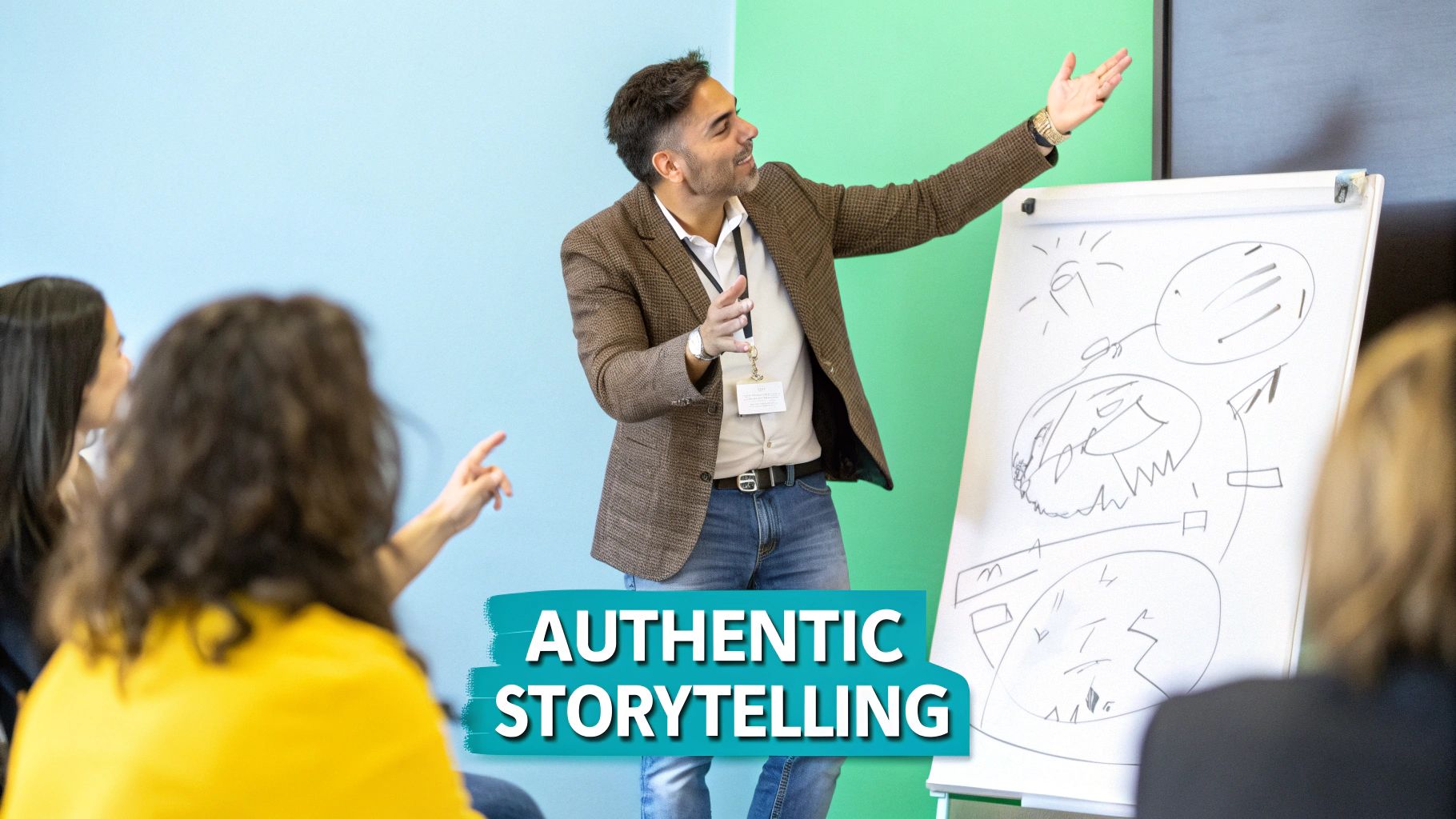
This is the skill that separates a manager who gives updates from a leader who builds a movement. Think of Steve Jobs' iconic product launches; he didn't just list features, he told a story about how a device would change your life. Similarly, Satya Nadella used the narrative of a growth mindset
to completely transform Microsoft's culture from combative to collaborative. Storytelling turns a corporate vision into a personal mission for every employee, building trust and engagement.
Why Prioritize Communication and Storytelling?
Leaders who master storytelling can articulate a compelling vision, navigate organizational change with less resistance, and provide feedback that motivates rather than demoralizes. By weaving data and logic into a narrative, they make complex strategies understandable and memorable, ensuring everyone is pulling in the same direction with genuine enthusiasm.
Actionable Training & Reinforcement
- Learning Objectives: Understand foundational story structures (e.g., Hero’s Journey), learn to craft compelling messages for different audiences, and practice using personal anecdotes and metaphors to build authenticity and connection.
- Suggested Formats: A
TED Talk
style workshop where leaders develop and deliver short, impactful presentations, a peer-coaching circle focused on refining key messages, or leveraging the best internal communication tools to share video messages. - SAI/Slack Reinforcement:
- Prompt Idea:
SAI, give me a three-act story structure I can use to frame my next team update about our quarterly goals.
- Workflow: Create a dedicated Slack channel like
#leadership-story-lab. Have SAI prompt leaders monthly to share a short story about a team win or a lesson learned. This creates a repository of powerful internal narratives and provides a safe space for practice and peer feedback.
- Prompt Idea:
7. Decision-Making and Critical Thinking
In a landscape of constant change and information overload, the ability to make sound, timely decisions is a leader’s core function. This isn't about having all the answers; it's about knowing how to find them. Critical thinking is the disciplined process of actively and skillfully conceptualizing, applying, analyzing, and evaluating information to guide belief and action. Leaders who master this skill move beyond reactive problem-solving to proactively shaping outcomes.
This training topic for leaders is vital for building organizational resilience and agility. Consider Amazon's famous two-pizza team
rule, a structural decision designed to foster autonomy and fast, decentralized decision-making. This framework empowers small teams to innovate without bureaucratic friction. Similarly, the meticulous, fact-based decision frameworks used by Warren Buffett or the analytical rigor taught in Harvard Business School case studies show how structured thinking can mitigate risk and uncover opportunities that others miss.
Why Prioritize Decision-Making and Critical Thinking?
Leaders trained in these skills can cut through the noise, identify the root cause of a problem, and evaluate potential solutions with clarity and logic. They build teams that are empowered to challenge assumptions and contribute diverse perspectives, leading to more robust and innovative solutions. This proactive approach prevents costly mistakes and positions the organization to capitalize on emerging trends.
Actionable Training & Reinforcement
- Learning Objectives: Understand common cognitive biases (e.g., confirmation bias, anchoring), apply decision-making models like the OODA Loop or a decision matrix, and practice techniques for deconstructing complex problems.
- Suggested Formats: A workshop analyzing real-world business case studies, a
premortem
session where teams imagine a project has failed and work backward to identify risks, or a Slack-based debate on a strategic business challenge. - SAI/Slack Reinforcement:
- Prompt Idea:
SAI, what are the key steps in a premortem analysis for our upcoming product launch?
- Workflow: When a significant decision is made, create a private Slack channel and use SAI to document the decision, the key assumptions, and the expected outcome. Set a reminder in three months to review the results, fostering a culture of continuous learning and accountability.
- Prompt Idea:
8. Building High-Performing Teams
A leader’s ultimate success is measured not by their individual output, but by the collective achievement of their team. This training topic for leaders moves beyond basic management to the art and science of assembling, developing, and leading a group of individuals who consistently deliver extraordinary results. It involves creating a system where clarity of purpose, mutual accountability, and deep-seated trust converge to produce an environment where the whole is truly greater than the sum of its parts.

This discipline is crucial because it’s the engine of organizational growth. Look at Google's renowned Project Aristotle,
which distilled the essence of high-performing teams down to five key dynamics, with psychological safety being the most critical. Similarly, the New Zealand All Blacks rugby team's legendary no dickheads
policy underscores the importance of character and shared responsibility over individual ego. These examples prove that building elite teams is an intentional, repeatable process, not a matter of luck.
Why Prioritize Building High-Performing Teams?
Leaders trained in this area become architects of excellence. They can diagnose team dysfunctions, foster healthy conflict that sparks innovation, and build resilient teams that thrive under pressure. The outcome is higher productivity, lower turnover, and a sustainable competitive advantage that is difficult for others to replicate.
Actionable Training & Reinforcement
- Learning Objectives: Understand the stages of team development, learn to establish psychological safety, define clear roles and responsibilities, and facilitate effective team rituals like goal-setting and retrospectives.
- Suggested Formats: A multi-day offsite focused on team chartering and trust-building exercises, a workshop on Patrick Lencioni's
The Five Dysfunctions of a Team,
or a Slack-based challenge to define and codify team norms. - SAI/Slack Reinforcement:
- Prompt Idea:
SAI, what's the best way to structure a project kickoff meeting to ensure role clarity and alignment for my team?
- Workflow: Use a recurring SAI poll in the team channel asking,
On a scale of 1-5, how psychologically safe do you feel sharing a dissenting opinion this week?
This provides a real-time pulse on team health. Leaders can also use SAI to centralize team documentation, creating an instantly searchable knowledge management system in Slack that keeps everyone aligned on goals and processes.
- Prompt Idea:
9. Resilience and Stress Management for Leaders
In an era of constant change and high-pressure demands, a leader's ability to manage stress and bounce back from adversity is no longer a soft skill; it's a core competency. Resilience is the capacity to withstand, adapt to, and recover from challenges, setbacks, and stress. Leaders who are resilient don't just survive; they model the composure and stability that their teams need to thrive, preventing burnout and creating a sustainable, high-performance culture.
This training topic for leaders is vital because a leader's stress level is contagious. Arianna Huffington famously pivoted The Huffington Post's culture to prioritize wellness after her own collapse from exhaustion, demonstrating that leader wellbeing directly impacts organizational health. Similarly, Microsoft’s emphasis on mindfulness and wellness programs for its leadership acknowledges that a calm, focused leader is a more effective and strategic leader. Resilient leadership builds a foundation of psychological safety where teams feel supported, not stressed.
Why Prioritize Resilience and Stress Management?
Leaders trained in resilience can better navigate uncertainty, make clear-headed decisions under pressure, and maintain a positive outlook that inspires their teams. By modeling healthy coping mechanisms, they give their teams permission to prioritize their own wellbeing, leading to lower absenteeism, higher engagement, and a significant reduction in team-wide burnout.
Actionable Training & Reinforcement
- Learning Objectives: Identify personal stress triggers, learn and practice mindfulness and stress-reduction techniques, develop strategies for setting healthy work-life boundaries, and build a personal resilience plan.
- Suggested Formats: A workshop on mindfulness-based stress reduction (MBSR), a webinar series featuring experts on burnout prevention, or a peer support group for leaders to share challenges and coping strategies.
- SAI/Slack Reinforcement:
- Prompt Idea:
SAI, suggest a 5-minute mindfulness exercise I can do before a difficult conversation.
- Workflow: Schedule a recurring SAI message in a private leadership channel every Friday afternoon, prompting leaders to share one way they plan to disconnect and recharge over the weekend. This normalizes and encourages the crucial practice of setting boundaries.
- Prompt Idea:
10. Ethical Leadership and Corporate Governance
Ethical leadership isn't just a compliance checkbox; it's the fundamental bedrock upon which trust, reputation, and long-term sustainability are built. This training moves beyond legal jargon to instill a deep-seated commitment to integrity, accountability, and responsible decision-making. It’s about creating a culture where doing the right thing is the only way of doing business, empowering leaders to navigate complex moral dilemmas with clarity and conviction.
This training topic for leaders is vital for safeguarding an organization's future. The classic case of Johnson & Johnson's response to the Tylenol crisis in 1982 remains a powerful example. By prioritizing public safety over short-term profits, they set a gold standard for corporate responsibility and ultimately strengthened their brand for decades. In contrast, the downfalls of companies like Enron serve as a stark reminder of how quickly an unethical culture can destroy an empire. Ethical leadership is the proactive defense against such catastrophic failures.
Why Prioritize Ethical Leadership?
Leaders who champion ethics build immense trust capital
with employees, customers, and stakeholders. They cultivate an environment where people feel safe to speak up, report concerns without fear of retaliation, and take pride in their work. This leads to higher employee morale, stronger customer loyalty, and a resilient organizational reputation that can weather any storm.
Actionable Training & Reinforcement
- Learning Objectives: Define and apply core ethical principles, understand key corporate governance frameworks, analyze complex ethical dilemmas using decision-making models, and learn to foster a culture of transparency and accountability.
- Suggested Formats: A case study workshop analyzing real-world ethical crises, a panel discussion with senior leaders on personal ethical challenges, or a microlearning series on recognizing and avoiding conflicts of interest.
- SAI/Slack Reinforcement:
- Prompt Idea:
SAI, what is our company's official policy on accepting gifts from vendors?
- Workflow: Use SAI to create a scheduled poll in a leadership channel:
This week, did you face a decision with a significant ethical component? (Yes/No - answers are anonymous)
. This normalizes the conversation and keeps ethics top-of-mind without being accusatory.
- Prompt Idea:
Comparison of 10 Leadership Training Topics
| Leadership Topic | Implementation Complexity 🔄 | Resource Requirements ⚡ | Expected Outcomes ⭐ / 📊 | Ideal Use Cases 💡 | Key Advantages ⭐ |
|---|---|---|---|---|---|
| Emotional Intelligence (EI) Leadership | Moderate–High 🔄: deep personal work and cultural shift | Moderate ⚡: 360° feedback, coaching, ongoing practice | High ⭐ / Strong 📊: improved engagement, lower conflict, higher retention | Teams needing psychological safety, people-focused development | Stronger relationships, better morale |
| Strategic Thinking & Visionary Leadership | High 🔄: intensive analysis and alignment across levels | High ⚡: market research, cross-functional time, scenario planning | High ⭐ / Long-term 📊: strategic positioning, clearer roadmaps | Market disruption, long-term growth, M&A planning | Forward-looking clarity, competitive advantage |
| Change Management & Agile Leadership | High 🔄: coordinated change cycles and stakeholder work | High ⚡: change teams, training, tools, champions | High ⭐ / Measurable 📊: faster adoption, increased agility | Organizational transformations, digital shifts | Faster pivots, higher adoption rates |
| Coaching & Mentoring Leadership | Moderate 🔄: habit formation and one-on-one cadence | Moderate ⚡: leader time, coaching training, frameworks | High ⭐ / Developmental 📊: accelerated talent growth, better retention | Succession planning, individual development | Faster skill growth, stronger leader-employee bonds |
| Diversity, Equity & Inclusion (DEI) Leadership | High 🔄: systemic policy and culture change | High ⚡: audits, training, ERGs, measurement systems | High ⭐ / Strategic 📊: broader talent pool, increased innovation | Improving equity, diverse hiring, reputation building | Increased innovation, expanded talent access |
| Communication & Storytelling Leadership | Moderate 🔄: skill practice, feedback loops | Moderate ⚡: workshops, rehearsal, presentation coaching | High ⭐ / Immediate 📊: clearer messaging, stronger buy-in | Change announcements, leadership messaging, crisis comms | Greater persuasion, improved clarity and trust |
| Decision‑Making & Critical Thinking | Moderate 🔄: structured frameworks and analysis | Moderate ⚡: data access, facilitation tools, training | High ⭐ / Reliable 📊: fewer costly errors, faster confident decisions | High-stakes choices, complex problem-solving | Better risk assessment, improved decision quality |
| Building High‑Performing Teams | High 🔄: sustained team design, trust-building | High ⚡: recruitment, training, performance systems | Very High ⭐ / Tangible 📊: significant productivity and retention gains | Scaling teams, mission-critical units | Sustained performance, scalable team models |
| Resilience & Stress Management for Leaders | Moderate 🔄: habit change plus organizational support | Moderate ⚡: wellness programs, coaching, time investments | High ⭐ / Wellbeing 📊: reduced burnout, improved decision-making | High-pressure roles, burnout prevention initiatives | Greater leader longevity, modeled healthy behavior |
| Ethical Leadership & Corporate Governance | High 🔄: policy, governance and cultural reinforcement | Moderate–High ⚡: compliance systems, training, monitoring | High ⭐ / Protective 📊: trust, reduced legal/regulatory risk | Regulated industries, reputation-sensitive orgs | Enhanced trust, long-term reputation protection |
From Topics to Transformation: Make Knowledge Flow Effortlessly
We've explored a comprehensive map of essential training topics for leaders, from the nuanced art of Emotional Intelligence to the structural demands of Ethical Leadership. Each of these ten areas represents a powerful lever for elevating your influence, driving team performance, and building a resilient, forward-thinking organization. Mastering these isn't just about personal development; it's about fundamentally reshaping your team's capacity for success.
However, the journey from learning to leading is often derailed by a single, pervasive obstacle: friction. Every minute a leader or team member spends hunting for a document, clarifying a process, or re-answering a question that's been asked a dozen times before is a minute stolen from innovation, coaching, and strategic execution. The most impactful leadership training in the world can't overcome a system where knowledge is fragmented and inaccessible.
The True Cost of Information Gaps
Think about the daily reality in your workspace. A new team member needs the latest project brief. A junior leader needs to recall the Q3 performance review guidelines. Someone asks, for the tenth time, What's our official policy on remote work stipends?
These aren't leadership failures; they are system failures. They create a constant drag on momentum, forcing your most valuable people to become human search engines instead of strategic thinkers.
The leadership principles we've discussed, such as coaching, strategic thinking, and building high-performing teams, all depend on a foundation of shared, easily accessible knowledge.
* Effective coaching is impossible when you spend half your one-on-one clarifying basic operational details.
* Strategic vision gets lost in the fog when your team can't find the data and documentation to support it.
* High-performing teams are built on autonomy, but autonomy requires team members to have the answers they need at their fingertips, without waiting for a manager's reply.
Bridging the Gap Between Training and Tangible Results
This is where the true transformation lies. The ultimate goal of any leadership development program is to create a more effective, self-sufficient, and intelligent organization. The principles are the what
; creating an environment of effortless knowledge flow is the how.
Imagine a world where you and your team never have to leave Slack to find an answer. No more switching tabs to search through convoluted wikis, cluttered cloud drives, or outdated email chains. Imagine every piece of tribal knowledge, every process document, and every critical update being captured and organized automatically, simply by having conversations in the channels where you already work.
This isn't about adding another tool to your stack; it's about eliminating the need to look anywhere else. It's about empowering your leaders to focus on leading, not on administrative archaeology. When information flows freely, the skills learned in your leadership training can finally be put into practice. Your leaders can dedicate their energy to mentoring, strategizing, and removing real roadblocks, confident that their team has the foundational knowledge it needs to execute flawlessly. You can finally stop managing information and start leveraging it to build a smarter, faster, and more aligned organization. This is how you turn a list of training topics for leaders into a legacy of tangible business results.
Ready to eliminate the information bottlenecks that hold your leaders back? SAI transforms your Slack workspace into an intelligent, self-organizing knowledge base, giving your team instant answers to every question. Add SAI to a Slack channel for free today and give your team the gift of uninterrupted work.