10 Knowledge Management Best Practice Principles for 2025
Imagine a workday where you never open another app to find information. No more digging through wikis, pinging colleagues for a password, or waiting hours for a response to a simple question. Instead, you just ask a question in Slack, and the exact answer your team is looking for appears instantly.
This isn't a futuristic dream; it's the reality modern teams are building by implementing a smarter knowledge management best practice framework. The old way of working—defined by endless document folders, siloed expertise, and constant interruptions—is a proven productivity killer. It forces your most talented people to spend their time hunting for information instead of creating value. The new way is about making knowledge flow effortlessly within the tools you already live in, like Slack, eliminating the friction between a question and its answer.
This guide moves beyond abstract theory to deliver 10 transformative, actionable principles. We won't get lost in complex technical setups. Instead, we'll focus on the profound business shift you can achieve: a workplace where your team's collective brain is available on-demand. Imagine your team asking a question in a Slack channel and getting an immediate, accurate answer, sourced from your company's scattered documents, conversations, and experts.
This is more than just efficiency; it's about unlocking your team's full potential. Get ready to eliminate the endless hunt for information and reclaim your most valuable asset: time for deep, focused work. Let's dive into the practices that make this possible.
1. Establish a Clear Knowledge Management Strategy
Jumping into knowledge management without a clear strategy is like setting sail without a map. You might find some interesting islands, but you’ll never reach your intended destination. A formal knowledge management strategy is your foundational blueprint, a documented plan that transforms random acts of information sharing into a cohesive system aligned directly with your business objectives. This isn't just about organizing files; it's about systematically capturing, distributing, and leveraging your team's collective intelligence to drive measurable growth and efficiency.
This foundational step is arguably the most critical knowledge management best practice because it provides purpose and direction for every other initiative. It forces you to answer vital questions: What knowledge is most critical to our success? Who owns it? How will we measure the impact of sharing it? By defining these parameters upfront, you ensure your efforts are focused on high-value activities that directly support core business functions, from accelerating new hire onboarding to improving customer satisfaction scores.
How to Implement This Practice
A successful strategy begins with a thorough assessment of your current state.
- Conduct a Knowledge Audit: Before you build, you need to know what you have. Identify your most valuable knowledge assets. Where does critical information live? Is it trapped in experienced employees' heads, scattered across private Slack DMs, or buried in outdated documents? Pinpoint the bottlenecks and gaps where information flow breaks down.
- Involve Key Stakeholders: Knowledge management is a team sport. Bring together leaders from different departments like sales, support, engineering, and HR. Their diverse perspectives will ensure the strategy addresses the entire organization's needs, not just one team's pain points.
- Define and Align Objectives: Your KM goals must mirror your company's goals. If your company objective is to reduce customer churn, a corresponding KM objective would be to
decrease support ticket resolution time by 20% by creating an instantly accessible knowledge base of common issues.
- Secure Executive Sponsorship: Gaining buy-in from leadership is non-negotiable. An executive sponsor provides the resources, authority, and advocacy needed to drive adoption and overcome organizational inertia.
Pro-Tip: Your strategy is a living document. Plan to review and adjust it quarterly. As your business evolves, your knowledge needs will change, and your strategy must adapt to stay relevant and effective.
2. Create a Centralized Knowledge Repository
If your strategy is the map, your centralized knowledge repository is the treasure chest. It’s a single source of truth where all valuable company information is stored, organized, and made instantly accessible. This isn't just a shared drive filled with chaotic folders; it’s a living digital hub designed to eliminate the time-wasting, soul-crushing hunt for information across different apps, email threads, and Slack channels. Imagine a world where every employee, from a day-one hire to a seasoned veteran, can find the exact answer they need, right when they need it, without asking anyone.
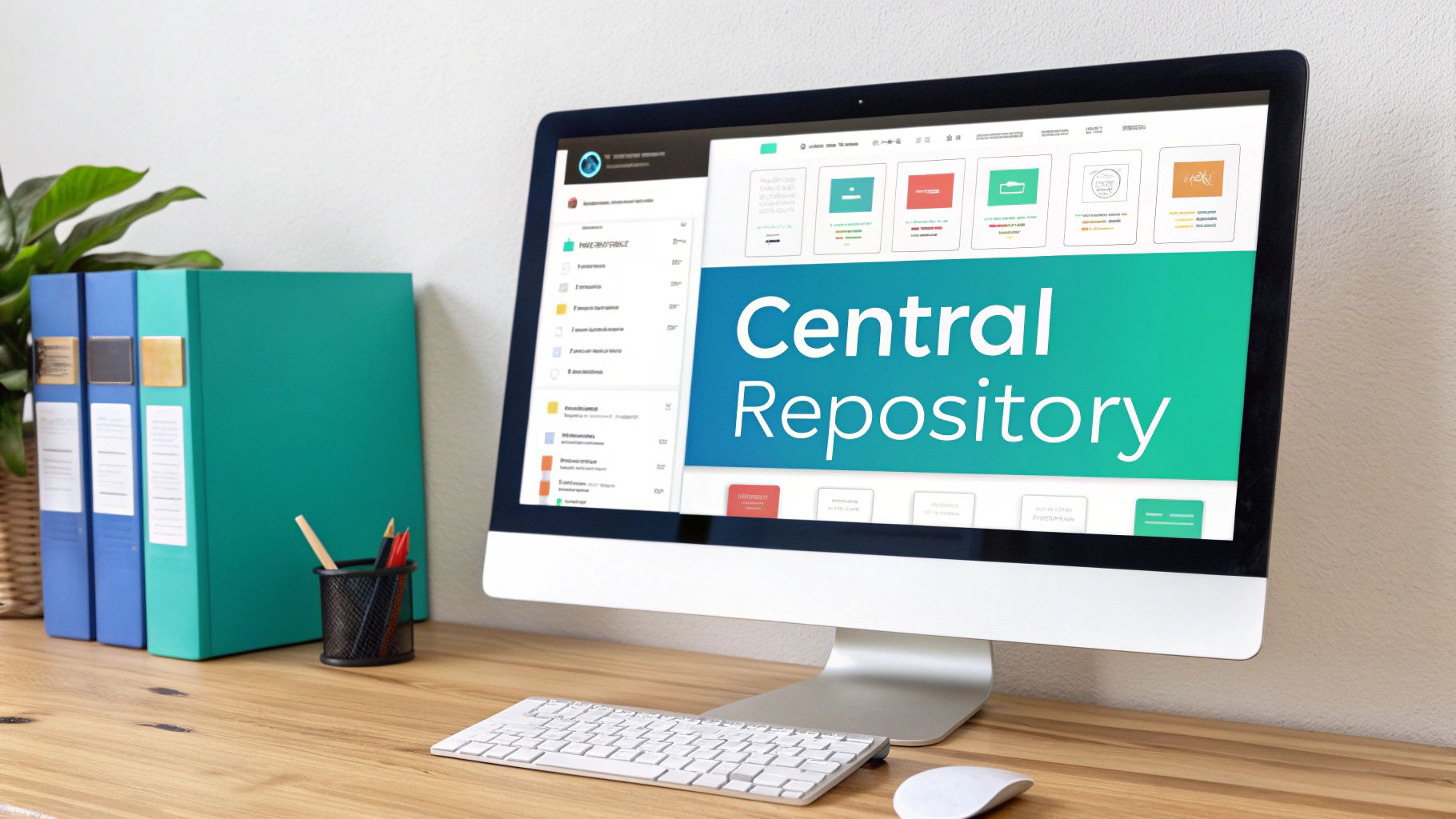
This knowledge management best practice directly attacks productivity’s greatest enemy: information silos. By consolidating documents, best practices, project histories, and institutional wisdom into one searchable platform, you empower your team with autonomy and speed. Platforms like Confluence, SharePoint, and Notion have become standard for this reason, providing a structured home for knowledge that would otherwise be lost. The goal is to make accessing information as easy as a Google search, turning your company’s collective intelligence into a tangible, competitive asset.
How to Implement This Practice
Building an effective repository requires deliberate design and ongoing curation.
- Establish Clear Architecture: Don't let your repository become a digital junk drawer. Design a logical folder structure and enforce strict naming conventions from day one. This ensures content is intuitive to find and browse.
- Assign Content Ownership: Every piece of knowledge needs a dedicated owner responsible for keeping it current and accurate. Assign departmental
librarians
or subject matter experts to maintain their respective sections. - Create Standardized Templates: Ensure consistency and quality by creating templates for common document types, such as project plans, meeting notes, or process documentation. This makes contributing new knowledge fast and uniform.
- Prioritize Searchability: The best repository is useless if no one can find anything. Invest in a platform with robust search functionality and train your team to use tags and metadata properly to improve discoverability.
Pro-Tip: Schedule quarterly
content auditsto prune outdated or irrelevant information. A clean, current repository builds trust and encourages usage. If users constantly find old information, they'll stop looking.
3. Implement Knowledge Capture and Documentation Processes
If your team's most valuable knowledge walks out the door every evening, you don't have a business asset; you have a business risk. Implementing formal knowledge capture processes transforms fragile, person-dependent information into a durable, accessible company resource. This is about systematically capturing the how-to,
the why,
and the what we learned
from daily operations, projects, and individual experts before that knowledge is lost forever.

This discipline is a core knowledge management best practice because it directly counters brain drain and knowledge silos. By creating structured methods for documentation, like NASA does with its Lessons Learned database, you ensure that insights from a single project or employee benefit the entire organization for years to come. It’s the difference between your team constantly reinventing the wheel and building on a solid foundation of collective experience to accelerate innovation and problem-solving.
How to Implement This Practice
Systematic capture turns documentation from a chore into a high-leverage habit.
- Standardize with Templates: Don't make people start from a blank page. Create simple, standardized templates for different knowledge types, such as project post-mortems, meeting notes, process guides, or expert interviews. This reduces friction and ensures consistency. For guidance, learn how to create a standardized operating procedure with this step-by-step guide.
- Integrate Capture into Workflows: Build documentation directly into your existing processes. Add a
document lessons learned
step to your project management checklist or acreate knowledge article
task after a complex support ticket is resolved. Make it part of the job, not an afterthought. - Embrace Multimedia: Not all knowledge is best captured in text. Encourage short video walkthroughs for software processes, audio recordings of client debriefs, or annotated screenshots to explain complex steps. This makes knowledge easier to create and more engaging to consume.
- Schedule Knowledge Transfer Sessions: Proactively book short, recurring meetings with subject matter experts specifically to capture their expertise. A focused 30-minute session is far more effective than hoping they’ll find time to write things down on their own.
Pro-Tip: Focus on capturing
tacitknowledge, the unspoken expertise and intuition experts have. Ask questions like,How did you know to do that?orWhat was the common mistake to avoid here?to uncover the insights that aren't written in any manual.
4. Foster a Knowledge-Sharing Culture
The most sophisticated tools and processes will fail if your team culture doesn’t support them. Fostering a knowledge-sharing culture means creating an environment where employees are actively encouraged, recognized, and empowered to share what they know. This is a deliberate shift away from information hoarding and toward collective intelligence, where collaboration and open communication are the default settings, not the exception.

This cultural foundation is a crucial knowledge management best practice because it provides the human engine for your entire system. A strong sharing culture ensures that knowledge doesn't just get stored; it gets circulated, debated, and improved upon. It's the difference between a dusty digital library and a vibrant, living ecosystem of information. When your team instinctively shares insights, a new hire can find an answer in seconds, a sales rep can pull up a critical case study instantly, and innovation happens faster because people aren't constantly reinventing the wheel.
How to Implement This Practice
Cultivating this culture requires intentional, consistent effort from leadership down.
- Lead by Example: Senior management must be the most active participants. When leaders openly ask questions, admit what they don't know, and freely share their own expertise and lessons learned, it signals that this behavior is valued and safe for everyone.
- Recognize and Reward Sharers: Acknowledge and celebrate employees who contribute valuable knowledge. This can be done through public shout-outs in company-wide Slack channels, small bonuses, or by making knowledge contribution a formal metric in performance reviews.
- Establish Knowledge-Sharing Forums: Create dedicated spaces and times for sharing. This could include
lunch and learn
sessions, departmental brown bags, tech talks, or a specific Slack channel like#knowledge-sharewhere employees can post interesting findings or ask for help. - Promote Psychological Safety: As highlighted by researcher Amy Edmondson, people won't share if they fear looking incompetent. Leaders must create an environment where asking questions is encouraged, and constructive failure is treated as a learning opportunity, not a punishable offense.
Pro-Tip: Make sharing frictionless. The harder it is to contribute, the less likely people are to do it. Integrate knowledge capture directly into existing workflows, like using a tool that learns from conversations in Slack, so sharing becomes a natural byproduct of daily work, not an extra chore.
5. Develop Communities of Practice (CoPs)
While a centralized knowledge base is essential, not all knowledge can be neatly documented. Much of an organization's most valuable expertise is tacit, nuanced, and developed through shared experience. This is where Communities of Practice (CoPs) excel, creating dedicated forums for individuals who share a common passion or professional discipline to deepen their collective knowledge and accelerate problem-solving. These groups transform informal who should I ask about this?
conversations into a structured, self-sustaining engine for innovation and learning.
This approach is a critical knowledge management best practice because it nurtures the human element of knowledge sharing. CoPs provide a psychological safe space for members to ask tough questions, experiment with new ideas, and collaboratively tackle complex challenges that no single person could solve alone. For example, a CoP for your customer support team can become the primary hub for sharing advanced troubleshooting techniques, while an engineering CoP can collectively establish and refine coding standards, drastically improving both quality and efficiency across the board.
How to Implement This Practice
Cultivating a thriving CoP is about fostering connection and shared purpose, not just creating another Slack channel.
- Start with a Clear Purpose: Identify a domain where collective intelligence is vital, like
Front-End Development
orCustomer Success Strategies.
Find a passionate champion to lead the group and define its mission. What common challenges will this group solve? - Empower Voluntary Participation: CoPs are most effective when members are intrinsically motivated to join and contribute. Don't mandate participation. Instead, create a compelling value proposition that attracts people who are eager to learn and share their expertise.
- Facilitate, Don't Dictate: The group's leader should act as a facilitator, not a manager. Their role is to spark discussions, organize events like
lunch and learns,
and recognize contributions. This empowers the community to take ownership of its own direction and growth. - Provide Dedicated Resources: Success requires investment. This could mean a dedicated Slack channel, a budget for guest speakers, or simply allocating protected time for employees to participate in CoP activities without feeling like they are falling behind on their primary duties.
Pro-Tip: Use a dedicated Slack channel for each CoP and connect an AI tool like SAI to it. SAI can monitor discussions, identify emerging best practices, and automatically capture valuable solutions, turning ephemeral conversations into a searchable, permanent knowledge asset for the entire organization.
6. Use Knowledge Management Systems and Technology
Imagine your team never having to leave Slack to get an answer. Instead of context-switching to a wiki or searching a shared drive, they just ask a question in a channel, and the right information finds them. This is the transformation promised by modern knowledge management systems (KMS). These platforms are the technological backbone that turns your strategy into a living, breathing part of your team's workflow, making knowledge instantly discoverable right where they work.
This is a critical knowledge management best practice because the right technology acts as a force multiplier for all your other efforts. It's the engine that eliminates the friction between a question and its answer. Instead of employees spending hours searching through disconnected drives, old email threads, or interrupting colleagues, a KMS provides a single source of truth. The result is a workday with fewer interruptions and more time for deep, focused work, all powered by a system that delivers information on demand.
How to Implement This Practice
Choosing and implementing a KMS requires a thoughtful, user-centric approach.
- Evaluate Needs Over Features: Don't be dazzled by a long list of features. Start by mapping your team's actual pain points and workflows. Is the biggest problem finding documents, or is it getting quick answers to questions? The best tool is the one that solves your specific problems and integrates seamlessly into your existing tech stack.
- Prioritize Integration and Accessibility: A KMS that lives on an island will be ignored. Look for platforms that integrate deeply with the tools your team uses daily, especially communication hubs like Slack. The goal is to bring knowledge to your users, not force them to go hunting for it. For a deeper dive, you can learn more about what a knowledge management system is and its core components.
- Plan a Phased Rollout: Attempting a big-bang implementation across the entire company is a recipe for failure. Start with a pilot group or a single high-impact use case, like onboarding new sales reps or supporting a specific product line. Gather feedback, demonstrate value, and build momentum before expanding.
- Invest Heavily in Training: Technology is only effective if people know how and why to use it. Go beyond a simple demo; create use-case-specific training that shows teams how the KMS will make their specific jobs easier and more efficient.
Pro-Tip: Focus on the user experience above all else. If finding information is difficult, clunky, or slow, your team will revert to old habits. The system should feel as intuitive and effortless as asking a colleague a question in Slack.
7. Conduct Regular Knowledge Audits and Assessments
Running a business without knowing what your team knows is like a library with no catalog. The information is there, but finding the right book is a frustrating game of chance. Regular knowledge audits are the systematic process of creating that catalog. They involve evaluating your company's intellectual assets to understand what knowledge you have, where it lives, what's missing, and how efficiently it flows through the organization. This isn't about micromanagement; it's about strategic inventory management for your most valuable asset: collective intelligence.
This proactive approach is a cornerstone knowledge management best practice because it prevents knowledge decay,
where critical information becomes outdated, inaccessible, or lost entirely when an expert leaves. By systematically mapping your knowledge landscape, you can identify high-value information trapped in individual Slack channels or employee inboxes and ensure it's captured and shared. This process directly translates to faster problem-solving, reduced dependency on specific individuals, and more consistent, high-quality work across the board.
How to Implement This Practice
A successful audit transforms insight into a clear action plan.
- Map Your Knowledge Sources: Begin by identifying where information resides. This includes explicit knowledge in documents, wikis, and databases, as well as tacit knowledge held by subject matter experts. Use surveys and interviews to ask teams:
What information do you need to do your job that is hard to find?
- Analyze Gaps and Bottlenecks: Compare the knowledge you have against what your teams need. Where are the critical gaps? For example, does your sales team lack updated competitive intelligence, or does your support team constantly ask engineering the same technical questions in a private channel?
- Involve Cross-Functional Teams: Don't conduct audits in a silo. Assemble a small group with representatives from different departments. A support agent's perspective on knowledge gaps will be vastly different from a developer's, and both are essential for a complete picture.
- Prioritize and Document Findings: You can't fix everything at once. Score the identified knowledge gaps based on their impact on business goals (e.g., customer satisfaction, operational efficiency). Create a clear, actionable report detailing the findings and recommending specific improvements.
Pro-Tip: Schedule your knowledge audits like any other critical business review, either annually or bi-annually. Consistent check-ins ensure your knowledge management system evolves with your organization and prevents new information silos from forming.
8. Implement Mentoring and Coaching Programs
Some of your most valuable organizational knowledge isn't written down; it's embodied in the experience, judgment, and intuition of your senior team members. Mentoring and coaching programs create dedicated pathways to transfer this tacit knowledge directly from experts to novices. This is about institutionalizing the transfer of wisdom, ensuring that years of hard-won experience don’t walk out the door when an employee leaves. It’s a proactive strategy to cultivate talent and embed deep-seated expertise across your organization.
Formalizing these relationships is a powerful knowledge management best practice because it accelerates learning and builds a culture of continuous development. Instead of leaving growth to chance conversations, you create a structured yet personal system for knowledge transfer that benefits everyone. Mentees gain practical insights and career guidance, mentors develop leadership skills, and the organization builds a more resilient and capable workforce. This human-centric approach turns individual expertise into a shared, renewable asset.
How to Implement This Practice
A successful program requires more than just pairing people up.
- Thoughtfully Match Participants: Don’t just match based on job titles. Use surveys and initial conversations to understand mentees' career goals and learning styles, then align them with mentors who have relevant experience and a genuine interest in teaching.
- Provide a Flexible Structure: Offer a framework for the relationship, such as recommended meeting frequency, goal-setting templates, and conversation starters. However, allow pairs the flexibility to adapt the structure to their specific needs and goals.
- Train Your Mentors: Mentoring is a skill. Provide training on active listening, giving constructive feedback, and effective coaching techniques. This ensures mentors are equipped to guide their mentees effectively rather than simply giving advice.
- Recognize and Reward Participation: Publicly acknowledge the contributions of mentors. Whether through performance reviews, internal awards, or a simple thank you in a company-wide Slack channel, recognizing their effort encourages continued participation and reinforces the value of knowledge sharing.
Pro-Tip: Use a dedicated Slack channel like
#mentoring-programto facilitate the program. Mentors can share resources, mentees can ask general questions, and program coordinators can post announcements and gather feedback, creating a central hub for the entire initiative.
9. Create Knowledge Retention Plans for Critical Roles
When a senior engineer retires or a top salesperson leaves, they don't just take their experience with them; they take years of undocumented institutional knowledge. Without a plan, this brain drain creates massive operational risks, slows down projects, and erodes your competitive edge. Creating knowledge retention plans for critical roles is a strategic defense against this loss, ensuring that invaluable expertise is captured and preserved long before an employee’s last day.
This proactive approach is an essential knowledge management best practice because it safeguards your organization’s most valuable asset: its specialized, hard-won expertise. Instead of scrambling during an exit interview, you systematically transfer mission-critical knowledge from individuals to the collective. This process protects institutional memory, ensures business continuity, and accelerates the ramp-up time for their successors, preventing the costly cycle of reinventing the wheel.
How to Implement This Practice
A robust retention plan is built on foresight, not last-minute panic.
- Proactively Identify Critical Roles: Don't wait for a resignation letter. Regularly map out which positions hold unique, high-impact knowledge that would be difficult or impossible to replace quickly. Think about technical wizards, client relationship gurus, or process experts.
- Schedule Structured Knowledge Capture Sessions: Well before a planned departure, facilitate a series of interviews, workshops, or
brain dump
sessions. Use these to document processes, decision-making logic, and key relationships. Focus on thewhy
behind their actions, not just thewhat.
- Establish
Knowledge Backup
or Mentorship Roles: Pair senior experts with junior team members. This creates a natural, ongoing transfer of skills and context, making the formal offboarding process a final review rather than a frantic first attempt at knowledge capture. - Use Video and Screen Recordings: For complex, hands-on procedures, have experts record themselves performing the task. A five-minute video of a senior technician troubleshooting a complex machine is infinitely more valuable than a dense, text-only manual.
Pro-Tip: Make knowledge transfer a standard part of the offboarding process for everyone, not just senior leaders. Use exit interviews to specifically ask,
What knowledge is critical for your replacement's success, and where can they find it?This normalizes the practice and uncovers hidden knowledge gems. Learn more about how to capture and preserve team expertise.
10. Measure and Communicate KM Value and ROI
If you can't measure it, you can't improve it, and you certainly can't justify it. Measuring the value and ROI of your knowledge management efforts is how you transform a nice-to-have
initiative into an indispensable business driver. This practice involves systematically tracking metrics that connect your knowledge-sharing activities directly to tangible business outcomes, such as reduced costs, increased productivity, and improved customer satisfaction. It's the language that leadership understands and the evidence that secures ongoing investment and resources.
This critical knowledge management best practice moves your efforts from anecdotal success stories to data-backed proof of impact. It answers the crucial question, Is this working?
for stakeholders and your team. By quantifying the benefits, like the time saved when an engineer finds an answer in Slack in 30 seconds instead of spending 30 minutes searching, you build a powerful business case. This proves your KM system isn't just a cost center; it's a strategic asset that fuels efficiency and accelerates growth.
How to Implement This Practice
Demonstrating value requires a blend of quantitative data and qualitative feedback.
- Establish Baseline Metrics: Before launching any new KM tool or process, measure your starting point. How long does it take to resolve a support ticket? How much time do new hires spend asking repetitive questions? This baseline is your benchmark for proving improvement.
- Balance Quantitative and Qualitative Data: Track hard numbers like ticket deflection rates, time-to-resolution, and employee onboarding time. Supplement these with qualitative insights from user surveys and interviews. Ask questions like,
How has instant access to information in Slack improved your daily workflow?
- Use Storytelling to Illustrate Impact: Numbers are powerful, but stories are memorable. Share a specific example of how a sales rep closed a deal faster because they instantly found the right case study, or how a support agent delighted a customer with a quick, accurate answer.
- Communicate Results Regularly: Don't wait for the annual review. Create a simple dashboard and share monthly or quarterly updates with executive sponsors and the wider team. Visualizing progress keeps momentum high and reinforces the value of everyone's participation.
Pro-Tip: Focus on leading indicators that predict success, not just lagging ones that report on the past. For example, tracking the adoption rate of a new knowledge tool or the number of questions answered successfully in Slack can signal future improvements in employee productivity and customer satisfaction.
10 KM Best Practices Comparison
| Practice | Implementation Complexity 🔄 | Resource Requirements ⚡ | Expected Outcomes ⭐📊 | Ideal Use Cases 💡 | Key Advantages ⭐ |
|---|---|---|---|---|---|
| Establish a Clear Knowledge Management Strategy | High 🔄🔄🔄 — governance & planning intensive | Moderate–High ⚡⚡ — leadership time, cross-functional input | Clear alignment with business goals; improved KM ROI 📊 | Organization-wide KM rollout; aligning KM to strategy | Secures executive buy-in; prioritizes resources |
| Create a Centralized Knowledge Repository | Medium–High 🔄🔄 — taxonomy & integration work | High ⚡⚡⚡ — platform costs, maintenance, content curation | Faster findability; reduced silos; consistent standards 📊 | Distributed teams; document-heavy environments | Improves access and reuse; enforces standards |
| Implement Knowledge Capture & Documentation Processes | Medium 🔄🔄 — process design and QA | Moderate ⚡⚡ — SME time, templates, tools | Preserves tacit knowledge; accelerates onboarding 📊 | High turnover teams; pre-retirement capture | Builds organizational memory; repeatable procedures |
| Foster a Knowledge-Sharing Culture | High 🔄🔄🔄 — behavior and mindset change | Moderate ⚡⚡ — incentives, forums, leadership effort | More innovation, engagement, collaboration 📊 | Creative teams; organizations needing collaboration boost | Sustainable sharing; stronger team cohesion |
| Develop Communities of Practice (CoPs) | Medium 🔄🔄 — coordination, facilitation | Low–Moderate ⚡⚡ — member time, minimal admin | Peer learning; faster problem-solving; network effects 📊 | Specialized domains; cross-functional knowledge exchange | Accelerates expertise development; fosters networks |
| Use Knowledge Management Systems & Technology | High 🔄🔄🔄 — implementation and integration | High ⚡⚡⚡ — licensing, IT, training | Scalable KM, analytics, improved discovery 📊 | Large enterprises; global, remote workforces | Automation, search, and usage analytics at scale |
| Conduct Regular Knowledge Audits & Assessments | Medium 🔄🔄 — structured evaluation work | Moderate ⚡⚡ — facilitators, interviews, analysis | Identifies gaps/risks; informs priorities and investments 📊 | KM health checks; pre-strategy or program reviews | Evidence-based prioritization; risk detection |
| Implement Mentoring & Coaching Programs | Medium 🔄🔄 — program design and matching | Moderate ⚡⚡ — mentor time, training, coordination | Tacit knowledge transfer; leadership development 📊 | Succession planning; high-potential development | Personalized transfer of expertise; retention benefits |
| Create Knowledge Retention Plans for Critical Roles | Medium 🔄🔄 — targeted capture & cross-training | Moderate ⚡⚡ — capture sessions, documentation | Reduced continuity risk; smoother role transitions 📊 | Roles with high attrition/retirements; critical experts | Mitigates knowledge loss; supports succession |
| Measure & Communicate KM Value and ROI | High 🔄🔄🔄 — requires rigorous metrics & attribution | Moderate–High ⚡⚡⚡ — analytics, reporting, surveys | Demonstrates KM impact; secures ongoing investment 📊 | Justifying KM budgets; executive reporting cycles | Provides evidence for decision-making and funding |
Your Next Conversation Could Build Your Company's Brain
The journey through the ten pillars of knowledge management best practice reveals a powerful, unifying truth: effective knowledge management isn't a separate, top-down initiative. It's a fundamental shift in how your team communicates, collaborates, and creates value. It's about transforming the daily flow of information from a temporary, transactional exchange into a permanent, strategic asset.
We've explored everything from establishing a clear strategy and fostering a knowledge-sharing culture to implementing robust technology and measuring ROI. Yet, the core challenge for most teams, especially those living in Slack, remains the same: how do you make capturing and accessing knowledge feel effortless, instantaneous, and invisible? The answer lies not in adding another tool to your stack, but in activating the knowledge already present in your daily conversations.
From Disjointed Channels to a Unified Intelligence
Imagine a workday free from the familiar friction of finding information. No more switching between tabs, searching through outdated wikis, or interrupting a colleague to ask a question you know has been answered before. The best practices outlined in this article, from creating centralized repositories to fostering communities of practice, all point toward this ideal state.
The real breakthrough happens when these principles are embedded directly into your workflow. Think about it: every question asked and answered in a Slack channel, every project decision documented, and every process clarified represents a piece of your company's collective intelligence. The problem is that this intelligence is ephemeral. It gets buried in threads, lost in crowded channels, and ultimately fades from memory.
A true knowledge management best practice for the modern era doesn’t just store information; it activates it. It learns from your team's natural interactions and delivers validated answers on demand, right where the work is happening. This transforms knowledge management from a chore into a seamless, automated background process. Your team doesn't have to change their behavior; the system simply gets smarter with every conversation.
The True Value: Reclaiming Time and Focus
The ultimate goal isn't just to build a comprehensive knowledge base. The goal is to give your team back their most valuable resource: focused time. When information is instantly accessible, the cycle of repetitive questions is broken. New hires can onboard faster, customer support can resolve issues with greater speed and accuracy, and engineering teams can spend less time searching for context and more time building.
This is the tangible impact of mastering knowledge management:
* Reduced Time-to-Answer
: Drastically cut down the minutes and hours employees spend searching for information.
* Increased Productivity: Empower teams to make faster, more informed decisions without leaving their primary communication hub.
* Enhanced Employee Experience: Eliminate the frustration of information silos and empower every team member with the knowledge they need to excel.
The most profound shift occurs when your organization's memory becomes an active participant in your work. It's not a dusty library you visit; it's an intelligent assistant that anticipates your needs and provides the right answer at the right moment. This isn’t a distant future; it’s a capability you can implement today, starting with a single Slack channel. Your next conversation doesn't have to just solve a problem for one person; it can solve it for everyone, forever.
Ready to transform your Slack conversations into a self-building, instantly searchable knowledge base? SAI embeds these knowledge management best practices directly into your workflow, learning from your team's Q&A to provide instant, trusted answers without ever leaving Slack. Stop the search and start building your company's brain today by visiting SAI.