Institutional Knowledge Definition: How to Capture and Preserve Team Expertise
What if your team could stop the endless scavenger hunt for information? Imagine a workday where no one has to dig through old emails, scroll through endless chat histories, or open ten different browser tabs just to find an answer. Instead, they just ask a question in Slack and get an instant, accurate reply. This is the transformation that happens when you master your institutional knowledge.
From Frantic Searching to Instant Answers
Let's be honest about your team's current reality. How many times a day does someone ping a colleague to ask a question they've answered a dozen times before? How much time gets vaporized digging through old Google Docs, searching forgotten channels, or just guessing how a critical process was handled last quarter? This constant, fragmented search is more than a minor annoyance; it's a silent killer of productivity and morale.
Now, picture the alternative. Imagine a day where your team never has to open another resource. Instead of interrupting their focus to hunt for information, they simply ask a question right where they're already working—inside Slack—and get the answer they need, instantly.
The real goal isn't just to store information. It's to eliminate the disruptive, time-consuming
searchthat pulls your team out of deep work and slows down momentum.
What Is the Institutional Knowledge Definition
At its heart, institutional knowledge is the sum of all the understanding, skills, and hard-won insights your organization has built over time. It's the unwritten rules of the road, the specific quirks of a long-term client, and the practical know-how that actually makes your business tick. With employee turnover on the rise, holding onto this knowledge isn't just a nice-to-have
—it's critical for survival. This insightful article about institutional knowledge digs deeper into why it's so vital for operational continuity.
This isn't about building another clunky database. It’s about creating a work environment where answers flow effortlessly. The difference is night and day:
- Before: New hires spend weeks bombarding senior staff with the same basic questions, waiting for replies and disrupting everyone's focus.
- After: New hires get instant, consistent answers inside Slack and start contributing meaningfully from day one, without derailing your experts.
- Before: A key project decision gets buried forever in a forgotten Slack thread from six months ago, forcing the team to start from scratch.
- After: That same decision is found in seconds with a simple question, giving the team crucial context to move forward with confidence.
Learning to manage this flow of information is the bedrock of any modern, efficient team. We cover the specifics of this process in our guide on what is a knowledge management system. Making this shift transforms wasted search time into focused, high-impact work, giving your team back its most valuable resource: time.
The Hidden Expertise That Actually Powers Your Business
To get a real handle on what institutional knowledge
means, you have to look at how information actually moves through your business day-to-day. It all comes down to two very different types of knowledge, but only one is the secret sauce that gives your team its edge.
First, you have explicit knowledge. This is the straightforward stuff—the official guides, process docs, and onboarding handbooks. It’s structured, easy to write down, and simple to pass along.
But then there's the really valuable stuff: tacit knowledge. This is the magic that happens between the lines. It’s the gut feeling an account manager gets about a client’s mood, the I've seen this exact bug before
fix from a senior developer, or the critical context a project manager drops in a quick Slack huddle.
Think about learning to ride a bike. You can read a manual on how to balance and pedal (explicit knowledge), but you only really learn by getting on and developing a feel for not falling over (tacit knowledge). Your business runs on the same principle.
Let's break down how these two types of knowledge show up in your team’s everyday workflow.
Tacit vs. Explicit Knowledge In Your Team
| Knowledge Type | Description | Where It Lives In a Slack-Based Team |
|---|---|---|
| Explicit Knowledge | The officialinformation. It's documented, structured, and easy to find... in theory. |
Process docs in Google Drive, onboarding checklists, Confluence pages, official company wikis. |
| Tacit Knowledge | The unwritten rulesand experience-based wisdom. It’s messy, conversational, and often lives in people's heads. |
A thread answering a unique customer question, a DM with a quick fix, a group huddle deciding on a last-minute change. |
While explicit knowledge gives your team a playbook, it's the tacit, on-the-fly wisdom that actually wins the game.
The Real Advantage Is Unwritten
If explicit knowledge is the skeleton of your operation, then tacit knowledge is the central nervous system that makes everything actually work. It’s the collected wisdom that keeps your team from repeating old mistakes and gives them the confidence to tackle tricky, one-of-a-kind problems.
In a fast-moving company, this priceless expertise is being created all day, every day in tools like Slack. Every question answered, every problem solved, and every decision debated in a channel adds to this living, breathing library of tacit knowledge.
The problem? This wisdom is incredibly fragile. Without a system to capture it, these brilliant solutions and crucial insights disappear into the digital scrollback, lost forever to anyone who wasn't part of that specific conversation. Learning how to tap into this unwritten expertise is the key to unlocking a whole new level of efficiency, turning your team’s daily chats into a permanent, searchable asset for everyone.
The True Cost of Letting Knowledge Walk Out The Door
When a great employee hands in their notice, it stings. But the empty desk they leave behind is just the beginning. The real pain is the slow, silent bleed of invaluable knowledge that walks out the door with them—a loss that hits your bottom line, grinds projects to a halt, and can seriously derail your momentum.

We've all seen this knowledge drain
in action. A critical project suddenly hits a wall because the only person who knew its messy history is gone. New hires take ages to get up to speed, peppering senior staff with questions and slowing the whole team down because the essential context just isn't written down anywhere.
The financial cost of this brain drain is staggering. In the U.S. alone, large businesses lose an estimated $47 million per year in productivity simply because they fail to share knowledge effectively. This isn't just a theoretical risk; it's the cold, hard cost of re-solving the same problems and reinventing the wheel every time someone new joins the team. You can dive deeper into how institutional knowledge loss impacts value creation to see the full picture.
The Domino Effect of Lost Wisdom
Losing that unwritten expertise sets off a chain reaction. It’s not just one problem; it’s a cascade of failures that can hamstring your company's ability to grow.
When your team's memory is erased with every departure, you're not just losing information; you're losing your ability to innovate. The focus shifts from moving forward to simply trying to catch up with where you were yesterday.
This constant erosion of your team's collective wisdom leads to some seriously painful outcomes:
- Slower Problem-Solving: That tricky bug an experienced engineer could fix in five minutes? It now takes a whole team half a day of digging through old code to figure out.
- Inconsistent Customer Experience: A new account manager, unaware of a key client's quirks and preferences, makes a rookie mistake that jeopardizes a relationship you spent years building.
- Reduced Innovation: Instead of building on past successes, your team is stuck rediscovering old lessons, spinning their wheels just to get back to square one.
Every departure chips away at your company's foundation. Without a system in place to capture and preserve this crucial knowledge, you're essentially paying to learn the same lessons over and over again, sacrificing both progress and profit in the process.
How Slack Is Both the Problem and the Solution
For any team that moves fast, Slack is the digital office. It's the central hub where decisions get made, problems are wrestled with, and those brilliant aha!
moments happen. Every single conversation adds another layer to your company’s collective know-how.
But here’s the paradox: Slack is incredible at creating this knowledge and absolutely terrible at keeping it. The firehose of information creates a massive, ever-expanding archive that, more often than not, feels like a black hole.
We’ve all been there. You know a key decision was made in a channel last month, but now you’re stuck in an endless scroll, praying you’ll stumble across that one specific thread. This kind of chaotic search kills momentum and forces people to ask questions that have already been answered perfectly.
Your team’s most valuable insights shouldn't have a shelf life. The answers shared today should become a permanent, searchable asset for the future.
Turning Chaos Into a Searchable Brain
What if that constant stream of conversation didn’t just vanish into the ether? What if, instead of becoming a graveyard for good ideas, your Slack history could become a living, intelligent brain for the whole company?
Imagine this: instead of your team manually digging through channels, they just ask SAI a question in Slack. The AI instantly understands what they need and delivers the right answer, pieced together from past conversations, documents, and threads. The search is over. The endless hunt for information is replaced by a single, simple question.
This flips Slack from a source of information overload into your single source of truth. Seeing a real AI in Slack knowledge base example makes it clear just how seamless this can be. Your team’s collective memory becomes instantly accessible, turning every past conversation into a powerful asset.
Turn Your Team's Conversations Into Your Greatest Asset
Let’s be honest: the old way of saving company knowledge is completely broken. It hinges on the idea that someone, somewhere, will stop their actual work to meticulously update a wiki or a shared drive. That rarely happens. In the chaos of daily deadlines, it's the first task to get pushed aside.
The result? Your team’s most valuable, on-the-fly insights vanish the second they're shared.
Now, imagine a different way. Instead of forcing everyone into another tool, what if an intelligent assistant worked silently in the background, right inside the app your team already lives in? With a tool like SAI, you stop asking your team to manage knowledge. You simply empower them with instant answers directly in their Slack workflow.
From Buried Threads to Instant Answers
This isn't just about indexing conversations. It's about transforming your workflow so that no one ever has to search for information again.
When a teammate has a question, they don't get a link to a 20-page document they have to waste time digging through. They just ask SAI and get the exact answer they need, pulled from a conversation that happened three months ago.
This diagram shows the all-too-common black hole
where valuable Slack conversations disappear. But it also shows how an AI-driven solution can turn that chaos into a reliable knowledge source.
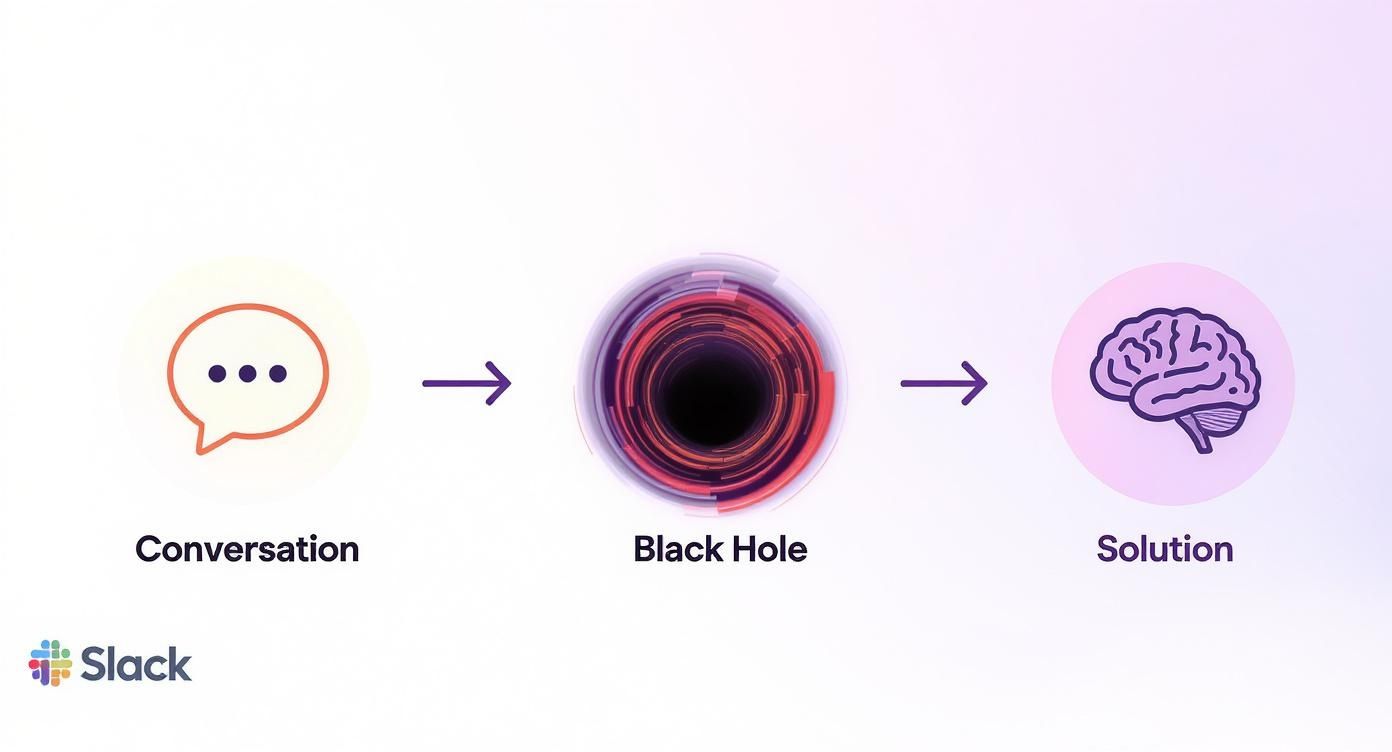
This picture perfectly illustrates a massive failure in modern workflows. Expertise is constantly being created, but it's almost never captured. This leads to endless repeated work and drains productivity. The new way of managing your institutional knowledge is to stop managing it at all. Let AI turn your team’s existing conversations into the only resource they’ll ever need.
The goal is to make your team's collective intelligence instantly available to everyone, forever. No more context switching, no more interrupting senior staff, and no more searching for answers that have already been given.
This approach transforms your daily chatter into your most powerful and dependable asset. For teams ready to make this shift, a few core principles are key. You can get a head start by reviewing our list of 10 knowledge management best practices for 2025.
By letting AI do the heavy lifting, you achieve effortless knowledge preservation. You finally break the endless cycle of asking and re-asking the same questions, freeing up your team to focus on innovation and growth. The change is profound: you stop managing documents and start empowering people with immediate, accurate answers.
Frequently Asked Questions
Let's cut through the jargon. Getting a handle on institutional knowledge is your first step toward building a more resilient, efficient team. Here are some straight answers to the questions I hear most often from business owners and team leads.
What Is Institutional Knowledge, in Simple Terms?
Imagine it as your team’s collective brainpower—all the stuff that never makes it into a formal handbook. It's the shortcuts someone figured out, the specific quirks of a top client, the hard lessons learned from a project that went sideways, and that unspoken understanding of how we *really* get things done here.
When that knowledge walks out the door, it’s like your company’s computer crashes without saving. The team is stuck relearning old lessons, repeating past mistakes, and wasting time solving problems that were already solved months ago. The simplest institutional knowledge definition is this: it's the unwritten expertise that truly makes your business run.
Is This Really Important for a Small Team?
Yes, and it’s arguably more critical. In a small company, each person holds a massive slice of the operational know-how. If one of your key players leaves, the fallout is immediate and often devastating—far more so than in a huge corporation with overlapping roles.
For a small business, losing one experienced team member isn't just a gap—it's a gaping hole in your company's memory and ability to execute.
Building good knowledge-sharing habits now creates a solid foundation to grow on. It makes bringing on new hires a breeze and ensures your entire operation isn't dangerously reliant on one or two people.
Will Using an AI Tool Just Create More Work for Us?
It's designed to do the exact opposite. A well-built AI assistant for knowledge management should blend right into your team's daily flow, working quietly in the background of tools you already live in, like Slack. This means there's zero extra effort or workflow change required.
Your team just keeps talking and collaborating as they normally would. The AI is the one doing the work—capturing, organizing, and serving up that knowledge when it's needed. Instead of adding tasks to your plate, it frees up the time everyone wastes hunting for information, bugging coworkers, and explaining the same things over and over.
How Is This Different from a Normal Wiki?
A traditional wiki is like a library that someone has to manually stock and organize. It relies on people stopping their actual work to write down what they know, and then remembering to keep it updated forever. Let's be honest—that rarely happens. They almost always become stale and untrustworthy.
An AI-powered system, on the other hand, is alive and automated. It captures knowledge straight from the source: your team's real-time conversations. It’s smart enough to find the exact answer buried deep in a Slack thread, not just in a formal document. This makes your team's most current, practical expertise instantly available to everyone.
Stop letting your team's best answers disappear into the void. With SAI, you can turn your Slack conversations into a permanent, searchable knowledge base—automatically. See how you can eliminate repetitive questions and give your team back their focus by trying SAI for free.