A 30 60 90 Template That Drives Real Results
A 30 60 90 day plan isn't just a document; it's your personal roadmap for hitting the ground running in a new role. It's how you turn those first three months of good intentions into a solid strategy, helping you make a real impact right away and build serious momentum.
Turn Your First 90 Days into a Strategic Advantage
Let's be honest: walking into a new job without a plan is like navigating without a map. You just hope for the best. A 30 60 90 day plan changes all of that. It’s your blueprint for cutting through the noise and ambiguity, allowing you to move from passive observer to active contributor from your very first week.
Think of it as taking control of your own success story. You're not just waiting for instructions; you're actively shaping your contribution. This framework swaps guesswork for a clear-headed strategy, fast-tracking your learning curve and building credibility with your new team. It’s all about aligning your daily actions with what the company actually needs, securing those crucial early wins, and proving your value from the get-go.
Charting a Course for Impact
The real magic of the 30 60 90 template is how it brings order to what can be a pretty chaotic time. Instead of drowning in a sea of new faces, systems, and acronyms, you have a specific focus for each month. The whole point is to shift gears smoothly from learning the ropes to actively driving results.
And this isn't just about looking organized for your new boss. The numbers back it up. Companies with structured onboarding plans report up to 54% greater new hire productivity and a massive 50% drop in turnover. Research from experts at Smartsheet confirms just how much business impact a solid plan can have.
This timeline gives you a great visual of how you’ll progress—from discovery and learning to refining processes and, finally, launching your own high-impact work.
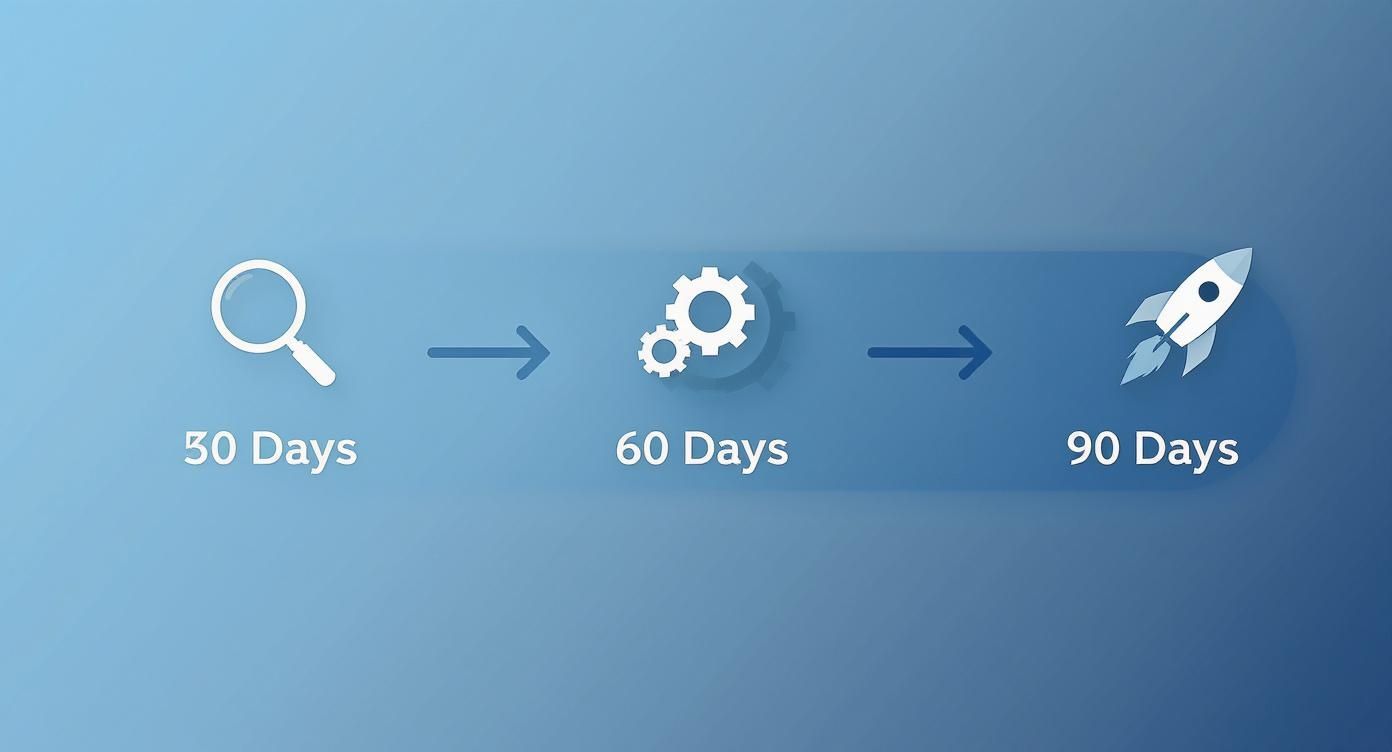
As you can see, each 30-day block builds on the last. This creates a powerful forward motion that really sets you up for long-term success.
To keep your priorities straight, here’s a quick overview of the mindset you should adopt for each phase.
Your Strategic Focus for Each 30-Day Phase
| Phase | Primary Goal | Key Activities |
|---|---|---|
| Days 1-30 | Learn & Absorb | Meet the team, understand the company culture, learn systems, and ask tons of questions. |
| Days 31-60 | Contribute & Refine | Start taking ownership of smaller tasks, identify areas for improvement, and begin contributing ideas. |
| Days 61-90 | Lead & Drive | Take initiative on projects, implement your own strategies, and start delivering measurable results. |
This table is your cheat sheet for staying on track. It guides you from being the new person who needs help to becoming the go-to person who provides it.
The Real Business Transformation
Picture this: you never have to scramble through shared drives or awkwardly interrupt a busy colleague just to find basic information. That’s the kind of clarity a well-crafted plan gives you. When you walk into your first one-on-one and present this, you're not just handing over a to-do list. You're showing your manager that you're a strategic thinker who is committed to making things happen. You're positioning yourself as a partner in your own success.
The real value of a 30 60 90 plan isn't just in the document itself, but in the proactive, aligned conversations it creates with your manager and team from day one.
By mapping out your first three months, you give yourself the confidence to make a significant impact. While this plan is a critical starting point, you can explore other employee onboarding best practices in our guide to make sure you're fully prepared. Ultimately, this framework is what helps you transition from being the new hire
to an indispensable member of the team, faster than you ever thought possible.
Mastering Your First 30 Days: The Learning Phase
Your first month on the job isn't about moving mountains; it's about learning the landscape. Think of yourself as an intelligence agent on a mission. Your goal is to actively listen and gather information, not just passively read through the employee handbook. This first phase is what sets the entire foundation for your future success.
Forget about trying to reinvent the wheel in week one. Instead, your job is to become a sponge. Your primary objective is to soak up the unwritten rules, get a gut feeling for the company's core value proposition, and figure out who the key players are that really make things happen. This isn't just about memorizing names and titles; it's about understanding the real lines of influence and communication.
Building Your Foundation of Knowledge
Those first few conversations you have are your most valuable assets. Get time on the calendar with your manager, any direct reports, and key colleagues from other departments. The real art here is asking insightful questions that get you past the surface-level stuff.
The most critical skill in your first 30 days is the ability to ask great questions and truly listen to the answers. This is where you uncover the cultural nuances and hidden expectations that aren't in any official document.
This period of deep immersion is exactly why a structured plan is so effective. In fact, research from Homebase shows that using a 30 60 90 template can boost new employee engagement by 20-25% in the first three months. That’s measured by hitting key learning milestones, like getting through your intro meetings and getting comfortable with the core tools.
Creating Your Learning Playbook
To make this process less abstract, you'll want to focus on a few key areas. These are the actions that help you turn all those initial conversations into a solid understanding of the business.
- Clarify Success Metrics: Have a frank conversation with your new boss. Ask them directly,
What does a successful first 30 days look like to you?
This one question cuts through all the guesswork and makes sure you're both on the same page from day one. - Master Essential Tools: Get a list of the critical software and platforms your team lives in every day—the CRM, the project management tool, the communication hubs. Don't just aim for basic familiarity; shoot for real proficiency.
- Map the Key Influencers: Start building a mental (or even physical) map of who you need to know. Who are the go-to subject matter experts? Who are the informal leaders people turn to for advice? Building these relationships early is a massive advantage.
As you gather all this information, you're not just learning for yourself; you're uncovering the core knowledge your team relies on. Imagine if all this crucial context wasn't trapped in people's heads. A powerful knowledge management system creates a central brain for the whole team, so everyone has instant access to the answers they need.
By the end of this phase, you won't just know what to do; you'll finally start to understand why it's done that way.
Shifting Gears: Making an Impact in Days 31-60
Alright, you’ve spent the first month soaking everything up. You’ve met the key people, you understand the rhythms of the business, and you’ve got a handle on the company culture. Now what?
The next 30 days are all about shifting from a passive observer to an active contributor. This is where the rubber meets the road. You're not expected to launch a massive, company-wide overhaul just yet. Far from it. The real goal here is to snag a few quick wins—those small but meaningful contributions that show you're not just learning, but you're ready to do.
You've got a solid foundation. Now you can start using that knowledge to spot a clunky process or an overlooked opportunity.

It’s time to take ownership, offer feedback backed by that fresh perspective of yours, and really start collaborating with your team. Your 30 60 90 template for this phase should be packed with actions that create visible results.
From Listening to Executing
Making that jump from listener to contributor is a deliberate move. Credibility isn't given; it's earned every time you follow through on a promise or offer a genuinely helpful idea. This is your moment to evolve from the new person
into a trusted member of the team—someone who's already helping to move the needle.
To make this happen, zero in on a few key areas that will really highlight the value you bring.
- Own a Small Project: See a manageable task that needs a leader? Volunteer. It's the perfect way to show initiative and prove you're reliable without the crushing pressure of a high-stakes, mission-critical project.
- Offer Smart Feedback: Those fresh eyes are your superpower. When you see something that could be done better, don't just point it out. Frame it as a constructive solution, showing you’ve done your homework and you're focused on making things better for everyone.
- Build Your Network: Start having conversations with people outside your immediate team. Grab a virtual coffee with someone from marketing or engineering. Understanding how the whole machine works together will make you a much smarter collaborator.
Finding Your Voice
As you get more involved, you’ll naturally find yourself in more meetings where the real work gets hashed out. Don't shrink into the background. Your perspective is valuable precisely because you aren’t bogged down by the way we've always done it.
The 60-day mark is where you stop asking,
So, what's the process here?and start asking,I was thinking, what if we tried this instead?That subtle shift from inquiry to suggestion is a dead giveaway that you're becoming an integrated, trusted part of the team.
By proactively hunting for those small wins and sharing your ideas, you build the trust and momentum you'll need to tackle bigger challenges down the line. This phase is all about turning knowledge into action and cementing your role as a proactive, valuable player.
Driving Impact and Ownership in Your Final 30 Days
The first 60 days were all about getting your bearings and learning the ropes. Now, you’re in the final stretch. This last month is where you really hit your stride, shifting from being a contributor to becoming a leader within your domain.
It’s your opportunity to operate with more autonomy, drive real, tangible results, and cement your reputation as a go-to person on the team. This is about moving past the assigned tasks and starting to proactively shape the future of your role.
This final phase is less about learning and more about leading. You should have the confidence to take charge of bigger projects, pitch your own ideas, and offer smart insights that help improve how the team works. Whether you're a manager or an individual contributor, this is where you prove you can take full ownership.

From Execution to Initiative
By day 61, you’ve built up enough context and credibility to stop just executing tasks and start taking the initiative. Your 30 60 90 template should now reflect goals that create a measurable impact on the business. You’re not just finishing a project anymore; you’re launching something that moves a key metric or solves a nagging problem for the team. It’s time to think bigger.
To make this transition happen, zero in on a few key actions:
- Execute a Major Initiative: Grab the reins of a complex project that ties directly into the team's or company's bigger objectives. This is your chance to show you can handle all the moving parts and deliver value on your own.
- Propose a New Idea: You’ve been observing for two months—what have you noticed? Use what you’ve learned to spot a gap or an opportunity. Put together a well-researched proposal and present it. This shows you’re thinking strategically.
- Mentor a Colleague: A fantastic way to demonstrate leadership is to share your knowledge. Offer to help a newer team member get up to speed. It multiplies your impact and reinforces what you’ve learned.
Measuring Your Progress and Setting the Stage
As you near the 90-day mark, it's absolutely critical to look back and connect your activities to actual results. Pull out your original plan and see how you stacked up. This isn't just a self-review; it's a powerful story you can share with your manager to demonstrate the value you’ve added in such a short period.
By the end of this phase, you are no longer just filling a position. You are actively shaping the success of your role, owning your outcomes, and setting a clear vision for what you will accomplish in the next quarter.
Think of this final part of your plan as a springboard. You’ve used the 30 60 90 template to build momentum, prove what you can do, and become a fully integrated, proactive member of the team. You aren’t just ready for what’s next—you’re the one defining it.
Real-World 30-60-90 Plan Examples
A blank template is a solid start, but let's be honest—it’s the real-world examples that bring the strategy to life. Theory is one thing, but seeing how a plan actually works in a specific role is what makes all the difference.
This is where we move from framework to function. We're going to break down what a high-impact 30-60-90 day plan looks for three totally different jobs: a sales rep hustling for pipeline, a new manager focused on team growth, and a product manager navigating a complex roadmap.

Think of these as a source of inspiration. Use them to build a plan that's both ambitious and genuinely achievable for your role and responsibilities.
The Sales Representative
For any sales rep, the first three months are a sprint. It's all about ramping up, building a solid pipeline, and starting to close deals. Your plan needs to be aggressive, loaded with metrics, and focused on mastering the company’s story.
First 30 Days (Learn & Prepare): The mission here is total immersion. Jump headfirst into product training, shadow at least 3 top-performing reps on their calls, and get comfortable in your CRM. By day 30, the goal is to deliver the core sales pitch without a script and have your first 10 qualified leads teed up.
Next 30 Days (Contribute & Execute): Time to put that learning into action. The focus shifts to pure activity. You should be making 50+ outbound calls a week, running 5 product demos on your own, and tweaking your approach with your manager based on real-world feedback.
Final 30 Days (Own & Accelerate): This is where you prove you can deliver. The big objective is to close that first deal and build a predictable pipeline. You should be managing a full sales cycle solo and aiming for a pipeline valued at 3x your quarterly quota.
This isn't just busy work; it has a massive impact. One survey showed that 65% of new reps with a 30-60-90 plan hit their quota in the first three months. That number drops to just 42% for those winging it. For more on this, the team at Zendesk has some great insights into how these plans fuel sales success.
The New Manager
When you step into a management role, your focus completely shifts. Your plan is less about your personal output and all about empowering your team. You're building trust, understanding the group’s rhythm, and creating an environment where people can thrive.
A manager's 90-day plan succeeds when it shifts the spotlight from
my accomplishmentstomy team's growth and achievements.It's about enabling others to do their best work.
To make this happen, you need to prioritize people and processes from day one.
First 30 Days (Listen & Align): Your primary job is to listen and learn. That means scheduling 1-on-1s with every direct report to understand their goals, frustrations, and wins. You'll also want to meet with key partners in other departments and get crystal-clear expectations from your own boss.
Next 30 Days (Coach & Improve): Now you can start making small, meaningful improvements. Maybe you introduce a more efficient meeting structure, tackle a persistent process bottleneck, or give some focused coaching to a team member. The goal is to score a small
team win
to build some early momentum.Final 30 Days (Empower & Strategize): It's time to start thinking bigger. Set clear performance goals for the upcoming quarter, delegate a major project to a high-potential team member to help them grow, and present your strategic vision for the team to leadership. This kind of planning goes hand-in-hand with a strong onboarding strategy; you can learn how to build a better employee training plan template in our guide.
The Product Manager
A new Product Manager's first 90 days are an exercise in information absorption and learning to influence without formal authority. The entire plan should be laser-focused on deeply understanding the customer, the product, and the market landscape.
First 30 Days (Customer & Product Immersion): Your objective is to become the go-to expert. That means conducting at least 5 customer interviews to hear their problems firsthand, meeting with leads from engineering, sales, and marketing, and getting a firm grasp on the current product roadmap and backlog.
Next 30 Days (Identify Opportunities): Armed with context, you can begin to make an impact. Dive into product usage data to spot a key drop-off point, write your first Product Requirements Document (PRD) for a small but valuable feature, and start forming a strong point of view on a strategic opportunity.
Final 30 Days (Drive an Initiative): Now you take the lead. This is about taking full ownership of a feature from initial planning all the way to launch. You'll also present a compelling business case for a new initiative to key stakeholders and establish the core metrics that will define success for your product area going forward.
To help you visualize how these goals build on each other, here’s a quick comparison of what the end of each 30-day phase might look like for these different roles.
Example Goals Across Different Roles
| Role | Day 30 Goal Example | Day 60 Goal Example | Day 90 Goal Example |
|---|---|---|---|
| Sales Rep | Deliver the core pitch flawlessly and source 10 qualified leads. | Independently run 5 product demos and refine call scripts. | Close first deal and build a pipeline valued at 3x quarterly quota. |
| Manager | Complete 1-on-1s with all direct reports and align on team goals. | Identify and fix one key process bottleneck for a quick team win. | Present your strategic vision for the team to leadership. |
| Product Manager | Conduct 5 customer interviews and document the current roadmap. | Analyze usage data and write a PRD for a small feature. | Take full ownership of a feature release from planning to launch. |
Seeing these side-by-side really highlights how a 30-60-90 plan is customized. It’s not about checking boxes; it’s about setting meaningful, role-specific milestones that lead to real success.
Common Questions About Your 90 Day Plan
https://www.youtube.com/embed/0S6metiSxZo
Even with a great template in hand, you’re bound to have questions as you start putting your own plan together. That’s a good thing—it means you’re thinking critically. Let's walk through a few of the most common sticking points I see.
How Detailed Should My 30 60 90 Plan Be?
This is a classic question. The best way to think about your 30 60 90 template is as a strategic roadmap, not a daily to-do list. You're aiming for clarity and direction, not a minute-by-minute script.
Stick to 3-5 major priorities for each 30-day period. Under each one, jot down a few concrete, measurable actions. For instance, instead of a vague goal like Learn about our customers,
get specific: Schedule and conduct discovery calls with **5** key customers.
Your finished plan should be one or two pages, max. It needs to be a document you can actually pull up and reference in a meeting, not a novel that gathers dust.
Should I Share My Plan With My Manager?
Yes. One hundred percent, yes. In fact, doing this in your first week is one of the biggest power moves you can make.
Bringing a drafted plan to your manager shows that you’re proactive and ready to hit the ground running. It immediately aligns you both on what success looks like and turns your future one-on-ones from simple check-ins into genuine strategy sessions.
Sharing your plan isn't about asking for permission; it's about building a partnership. It creates a shared language for what you're trying to accomplish and opens the door for meaningful feedback.
This simple act establishes you as someone who takes ownership, and that builds a massive amount of trust right from the start.
What If I Don’t Achieve Everything in My. Plan?
First, take a breath. It's completely normal—I’d even say it's expected. No plan survives contact with reality.
Your 30-60-90 day plan is a living document, not a test you pass or fail. Priorities will shift, unexpected projects will land on your desk, and you’ll uncover new information that makes some of your initial goals obsolete.
The trick is to communicate. If you see a goal is falling behind, don't hide it. Flag it early with your manager, talk through what's getting in the way, and recalibrate together. The real power of the 30 60 90 template isn't in hitting a perfect 100%; it's in the focus, alignment, and strategic conversations it drives.
Imagine a workday where you and your team never have to search for information again. No more digging through shared drives, no more interrupting colleagues for answers you know exist somewhere. Instead, you just ask SAI right in Slack and get the exact information you need, instantly. This is what it feels like to have your company’s collective brain at your fingertips. Get started with SAI today.