A Quick Guide: asynchronous communication tools to boost productivity
Let's be honest: asynchronous communication is just a fancy way of saying we're trading information without expecting someone to drop everything and reply instantly. It’s about letting people collaborate on their own terms, across different schedules and time zones.
The goal isn't just to talk differently; it's to shift the entire focus from being constantly available to being consistently productive.
Escape the Notification Trap and Get Real Work Done
Picture a workday where your to-do list actually gets shorter. Imagine your team deep in focused work, completely free from the constant stream of pings, pop-ups, and last-minute meetings that shatter concentration. This isn’t some far-off dream—it’s what happens when a team truly gets the hang of asynchronous communication.
This guide isn't just about definitions. We're going to get into the real-world results you can expect when you build an async-first culture. You'll see how moving away from a reactive, always-on
panic mode to a more deliberate and thoughtful workflow gives your team the space to do their best work, no matter where they are or what time it is.
What Always On
Is Really Costing You
That pressure to reply instantly creates a constant, low-grade hum of anxiety. Every single notification yanks your team out of their flow. And the science is clear: studies show it can take over 20 minutes to get your focus back after just one little interruption.
This endless context-switching isn't just a minor annoyance. It's actively draining your company's most important asset—your team's ability to think, create, and solve hard problems.
The change starts when you make deep, uninterrupted work the priority. Asynchronous tools give you the framework to turn that chaos into clarity. When you get it right, you’ll start seeing some incredible shifts:
- Better Work, Period: Your team finally has the breathing room to think things through, review information properly, and write well-crafted responses instead of shooting from the hip.
- More Empowered People: Trust skyrockets when you empower people to manage their own time and contribute when they're at their sharpest, not just when their light is green.
- A Saner, More Productive Culture: Cutting down the notification noise directly leads to less stress and burnout, creating a work environment people actually want to be a part of.
Think of this as your blueprint for a complete communication overhaul. We’re building a calmer, more focused, and wildly productive team where deep work is the default, not a luxury. By adopting powerful Slack productivity tools, you can amplify this focused environment even further.
This is so much more than just sending an email instead of a Slack message. It’s a deliberate choice to build a system where information flows logically, decisions are recorded for everyone to see, and every single person has the freedom they need to excel.
The Hidden Costs of Constant Workplace Interruptions
That “quick question” ping on Slack or the last-minute video call might seem harmless. But each one carries a heavy price. These small interruptions are fractures in your team's concentration, derailing productivity and slowly chipping away at their ability to produce high-quality work.
This is the true, often invisible, cost of a synchronous-first culture—a tax on your team's most valuable resource: their focus.
The damage isn't just about feeling distracted. Every time a team member is pulled away from a complex task, it takes a significant amount of time to get back into that deep-work state. When this happens over and over, all day long, the cumulative loss is staggering. Your team ends the day feeling busy but not productive, caught in a cycle of reacting to notifications rather than driving meaningful progress.
Drowning in Unplanned Meetings
This constant state of reactivity is most visible on our calendars. The numbers don't lie. Research shows a concerning 57% of meetings are unscheduled, and one in ten calls gets booked at the very last minute. With the average professional already spending about two hours a day in calls, this reactive scheduling actively sabotages any real chance for focused work. If you want to dig into the data yourself, you can explore the full research on workplace communication habits on superhuman.com.
This is where shifting our mindset becomes so powerful. Moving toward an async-first approach directly combats the chaos.
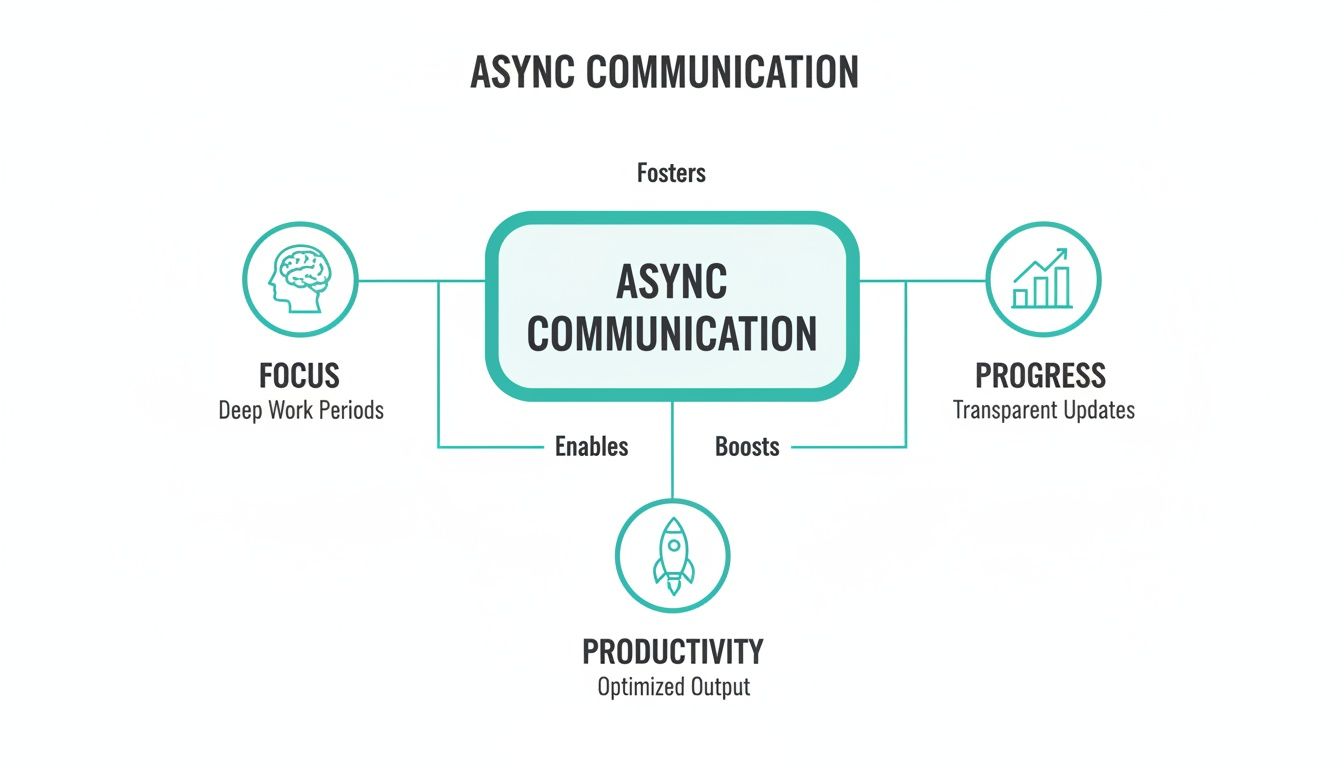
As you can see, the relationship is simple but profound: when you protect focus, you naturally unlock higher productivity and accelerate real progress.
The True Business Impact of Interruptions
A culture built on immediate responses doesn't just frustrate your team; it creates serious business bottlenecks. Important projects stall while waiting for someone in a different time zone to wake up. Knowledge gets trapped in private DMs, forcing others to interrupt the same experts with the same questions again and again.
Here’s a look at how these two very different ways of working stack up.
Synchronous vs Asynchronous Workflows
| Aspect | Synchronous (The Default) | Asynchronous (The Transformation) |
|---|---|---|
| Productivity | Low-value meetings and constant pings fragment attention. | Deep, uninterrupted work becomes the norm, boosting output. |
| Knowledge Sharing | Information is siloed in DMs and one-off calls. | Knowledge is documented publicly, creating a searchable single source of truth. |
| Team Well-being | Always onculture leads to stress and burnout. |
Flexible schedules empower autonomy and improve work-life balance. |
| Inclusivity | Favors those in specific time zones or who think fastest on their feet. | Gives everyone, regardless of location or personality, a chance to contribute thoughtfully. |
The contrast is stark. An async approach isn't just a minor tweak; it fundamentally changes how work gets done for the better.
Imagine a day where your team never has to dig through shared drives or ping multiple people to find an answer. Instead, they just ask a question in Slack and get the information they need, instantly. This is the transformation that asynchronous tools enable.
This isn't just about convenience. It’s a strategic shift away from an environment that burns people out. Asynchronous communication tools are the remedy to this crisis of constant interruption, offering a clear path to reclaim your team’s time, protect their focus, and build a more resilient, productive, and frankly, happier organization.
Building Your Asynchronous Workflow in Slack
Making the jump to an async culture isn't about buying a shiny new piece of software. It’s about consciously building new habits. The real transformation happens when you start redesigning your daily interactions to protect everyone’s focus time.
If you’re already using a platform like Slack, you have the perfect launchpad for a powerful asynchronous system without adding a bunch of new tools to the mix.
The key is to shift your perspective. Stop thinking of Slack as a constant, real-time chat room and start treating it like a well-organized library of conversations. This simple mental flip encourages a few powerful habits that can turn a stream of chaotic noise into structured, searchable clarity.
Establish Your Foundational Habits
Before you even think about adding new tools, you need to get the basics right. This is all about creating a predictable flow of information so everyone knows where to find what they need, whenever they need it.
Start with these non-negotiable practices:
- Embrace Threads Religiously: This is the big one. Every new post in a channel should be its own topic. Any replies, follow-up questions, or related chatter must stay within that thread. It's a simple discipline, but it stops conversations from crashing into each other and makes your channels instantly scannable.
- Create Clear Channel Conventions: Don't let your Slack workspace turn into a digital junk drawer. A clear naming system is your best friend (e.g.,
#proj-q3-launch,#team-marketing,#topic-social-media). When every conversation has a logical home, you kill the cross-talk and make information easy to find weeks or months later. - Use Status Updates Intelligently: A good status update is worth a dozen
you there?
pings. Get your team into the habit of signaling their availability (e.g.,Deep Work until 2 PM,
In client meetings,
Out of office
). It proactively manages expectations and cuts out the guesswork.
The goal here is bigger than just cleaner channels. It's about ending the constant, frustrating hunt for information. Imagine a day where no one has to ask, “Where was that file?” or “What did we decide on that?” because the context is exactly where it’s supposed to be.
Supercharge Your Workflow with a Knowledge AI
Once you’ve established these core habits, you're ready to bring in a tool that can truly complete your async setup. This is where an AI assistant like SAI completely changes the game. It ends the frustrating cycle of searching for information once and for all.
Imagine this: your team never has to scroll through old threads, dig through a messy Google Drive, or interrupt your go-to expert for an answer they’ve already given ten times. The endless searching stops.
Instead, they just ask SAI directly in Slack, What are our Q3 marketing goals?
and get an instant, accurate answer pulled from your team's collective wisdom.
This is the final piece of the async puzzle. It plugs the single biggest leak in your team's productivity: the repetitive question. Every answer an expert shares is captured and made available 24/7. Suddenly, your entire team has a single source of truth that never gets lost and never goes offline. You can boost team knowledge with a wiki for Slack that practically builds itself.
Choosing Tools for Deep Work, Not More Distractions
Let’s be honest. The last thing your team needs is another app to log into. The whole point of adopting asynchronous tools is to dial down the noise, stop the endless scavenger hunts for information, and give people back their most precious resource: uninterrupted time to actually think.
The wrong tool just adds another layer of notifications and one more place to search for answers. But the right one? It practically disappears into your workflow, actively protecting your team’s focus instead of demanding it.
The Core Questions to Ask Before You Choose
Before you get dazzled by feature lists, take a step back. The answers to these three questions will tell you if a tool is going to be a genuine asset or just another shiny distraction.
Does It Integrate or Isolate? A great async tool shouldn't force your team to constantly jump between apps. It has to meet them where they already are—and for most of us, that's Slack. A tool that truly integrates with your central hub prevents you from accidentally creating new information silos.
Does It Centralize or Scatter Knowledge? Imagine a world where every question your team asks in Slack is answered instantly, without anyone having to search through old threads or shared drives. That's what true centralization feels like. The alternative is a mess of scattered information, forcing people to ask the same questions over and over.
Does It Eliminate or Disguise Interruptions? Here's the real test. Does the tool actually reduce how often someone has to tap a colleague on the shoulder? Does it empower people to find answers themselves, or does it just swap a Slack ping for a different kind of notification?
Building a Cohesive Tech Stack
Your async toolkit should work together like a well-oiled machine, not a jumble of competing apps. Each piece should have a clear job. This is how you cover all your bases without creating overlap and confusion. To see how different platforms can fit together, take a look at our guide on the best internal communication tools for 2025.
The transformation is profound. Imagine your team never having to open another tab, dig through a shared drive, or ping three different people to find information. They just ask SAI in Slack and instantly get the answers they and their team are looking for.
This isn’t just a nice-to-have; it's a direct route to more autonomy and deeper, more meaningful work. As remote and hybrid models have become the norm, the demand for these solutions has exploded. The team collaboration market is on track to hit $42.20 billion by 2030, which tells you that companies are serious about investing in tech that supports focused, flexible work. You can find more on this trend over at mordorintelligence.com.
To build a powerful, non-redundant stack, think about your tools in categories based on what they do best:
- Project Management (e.g., Asana, Trello): This is your command center for tasks, deadlines, and project progress. These tools bring clarity to who is doing what by when.
- Collaborative Documentation (e.g., Notion, Confluence): This is the home for your official, long-form content—think company policies, detailed project briefs, and technical documentation.
- Instant Knowledge Access (e.g., SAI): This is the real game-changer. It’s the connective tissue that makes all your team’s scattered knowledge instantly accessible right inside Slack, answering questions on the spot so the flow of deep work is never broken.
The Future of AI-Powered Asynchronous Work
The next big jump for asynchronous communication isn’t just about finding a better tool; it’s about making the tools we already use intelligent. What if your workflow didn't just store information but could actually understand and anticipate what your team needs next? This is where AI is set to turn a good async system into a great one.
We're already moving beyond apps that just track tasks. The real game-changer is creating predictive assistants that make your whole async setup smarter. Think of an AI that can instantly summarize a sprawling, 50-message Slack thread into three key bullet points, automate your routine status updates, or find that critical document moments before you even realize you need it.
From Passive Knowledge to an Active Partner
This is where the magic really happens—when your company’s collective brainpower becomes a living, intelligent partner. Instead of a static library of documents and old messages, all that information transforms into an active asset that helps your team win.
This is the future being built right now with tools like SAI. It’s a complete overhaul of how we find and use information. Imagine never having to open another tab, dig through a messy shared drive, or ping a colleague just to ask a quick question. That constant, frustrating hunt for context finally comes to an end.
Instead of searching through multiple resources, you just ask SAI a question in Slack and get an instant, accurate answer. Every piece of knowledge your team creates becomes immediately accessible, turning passive information into a powerful strategic advantage.
But this is about more than just convenience. It’s about creating a system that learns. An intelligent assistant doesn’t just answer the questions you ask; it starts to understand the ones you haven’t thought of yet.
A Proactive Approach to Team Knowledge
Imagine an AI that not only fetches answers but actively points out knowledge gaps across your company. It might notice that the same question about your new expense policy keeps popping up and then nudge the right person on the finance team to create a definitive guide.
This kind of smart automation is changing how teams work together. In fact, integrating AI and machine learning into communication platforms is a massive growth area, projected to expand at a compound annual growth rate of 18.5% between 2024 and 2030. You can explore more insights on AI-powered team collaboration tools on thedigitalprojectmanager.com.
By turning your internal conversations into a reliable source of truth, these asynchronous communication tools don’t just make work easier—they make your entire organization smarter, faster, and more resilient.
Your Blueprint for a More Productive Workplace
Let's be honest, making a real change in how your team works can feel daunting. But this is your playbook for getting it done. The real transformation here isn't about buying new software; it's about fundamentally shifting your culture from one of constant interruptions to one of focused, intentional work.
Think of asynchronous communication not just as a remote work perk, but as a serious competitive advantage. It’s for any company that truly values high-quality output and the well-being of its people.
The path forward is actually quite simple. With a deliberate strategy, you can help your team reclaim their most valuable asset: their attention. This blueprint will help you build a more efficient, focused, and sustainable way of working, one step at a time.
Your Three-Step Action Plan
You don't need a massive, complicated rollout to see a difference. Start with these three steps to build momentum and show your team some quick wins.
Audit Your Bottlenecks: For just one week, become an observer. Watch for the moments where communication grinds to a halt. What are the questions that get asked over and over? When do people have to tap a colleague on the shoulder (virtually or physically) just to find a piece of information? This isn't about pointing fingers; it's about spotting your biggest opportunities.
Establish Clear Guidelines: Put together a simple, one-page document that clarifies when to use async tools and when a real-time meeting is actually necessary. Set clear expectations for response times and really encourage the use of threads in Slack. This small bit of structure gives your team the confidence they need to start building new habits.
Integrate a Single Source of Truth: This is where the magic happens. You need to strategically add a tool like SAI that ends the endless hunt for information for good.
Imagine this: your team never has to open another tab, dig through five different shared drives, or interrupt a colleague ever again. They just ask SAI right inside Slack and instantly get the answers they need—answers that you and your team have already provided.
When you create a single, instantly accessible source of truth, you don't just reduce interruptions—you start to eliminate them entirely. This gives your team the autonomy they need to push forward, focused and confident in their work.
Got Questions? We've Got Answers.
Pivoting to an async-first culture can feel like a big leap. It’s natural to have questions. Here are a few of the most common ones we hear from teams making the switch.
Will My Team Feel Isolated If We're Not Always Online Together?
It's a valid concern, but we've found the opposite is usually true. Async work doesn't kill connection; it makes it more deliberate and meaningful. You're trading a constant stream of low-value pings for thoughtful, well-crafted updates that actually keep people in the loop.
This shift frees up precious calendar space for the synchronous moments that truly matter—like high-energy creative sessions or team-building events where you can actually connect as people, not just colleagues.
What Happens When Something Is Genuinely Urgent?
This is where having a clear plan is crucial. A great async culture starts by defining what an emergency
really is. For those rare, truly critical situations, you create a simple break glass
protocol.
This could be a specific, high-alert Slack channel with loud notifications, or even just picking up the phone. By doing this, you protect your team's focus for 99% of their work while still having a reliable way to handle true emergencies when they pop up.
Can We Still Brainstorm and Be Creative?
Absolutely. In fact, many teams find their creative output gets even better. Async brainstorming gives people the space to actually think before they contribute. Instead of a frantic live meeting, you can use a shared document or a dedicated thread where ideas can be added over time.
This approach sidesteps the
loudest voice winsproblem of many real-time brainstorms. It gives introverts and deep thinkers a chance to shine, leading to more diverse and well-developed ideas before you ever hop on a call to finalize the plan.
Ultimately, these practices help teams move forward confidently, creating an environment that’s more focused, inclusive, and collaborative.
Ready to eliminate interruptions and give your team an instant source of truth? SAI learns from your Slack conversations to provide on-demand answers, so your team can stop searching and start doing. Add SAI to a channel for free at https://sai-bot.ai.