A Standard Operating Procedure for Training That Ends Repetitive Work
A training SOP is really just a clear, documented set of instructions that guarantees everyone gets the same high-quality information for any given task. It's about turning that chaotic, ask-as-you-go
training into a reliable, repeatable system. The result? You slash the time senior team members waste answering the same questions and help new hires actually get productive, fast.
This kind of structured approach makes sure critical knowledge doesn't just live in someone's head—it gets captured and shared uniformly across the whole organization.
Escape the Loop of Repetitive Questions
Picture this: you're finally in the zone, deep into a project, when the pings start. Where's the latest project file?
How do I process this type of invoice again?
What's the protocol for a customer refund?
Each question yanks you out of your workflow, forcing you to dig through old chats or re-explain a process for what feels like the tenth time.

This cycle of interruptions is more than just annoying. It's a massive productivity killer and a dead giveaway that your training is happening on the fly. When all the important information is stuck in the minds of a few key people, your team's entire momentum hinges on their availability. This creates bottlenecks, stalls projects, and leaves newer folks feeling unsure and unsupported.
The Real Cost of Unstructured Training
Without a standardized system, every question you answer is just a band-aid, not a cure. The knowledge shared in a direct message or a quick call vanishes into thin air, destined to be asked again. It's an invisible tax on your team's time and focus.
This is exactly why businesses are pouring money into structured learning. In 2024-2025, global corporate training spending shot up to an incredible $102.8 billion. It's a clear signal that companies recognize the power of standardized procedures for driving efficiency. They're seeing that without SOPs, training becomes a fragmented mess, creating skill gaps and wasting resources.
On the flip side, those who commit to structured methods see a serious return—a whopping 42% of companies using eLearning report direct revenue gains. You can dig deeper into the numbers in the 2025 Training Industry Report.
From Reactive Answers to Proactive Empowerment
A solid training SOP completely changes the game. It moves your team from a reactive state—constantly scrambling for or dishing out the same info—to a proactive one. Knowledge becomes an on-demand utility that anyone can access.
Think about the shift:
- Before SOPs: Your team is built on shoulder taps and DMs, which just creates a culture of dependency. Answers vary from person to person, and one simple question can throw multiple people off track.
- After SOPs: Your team has a single source of truth. They're empowered to find answers on their own, which builds confidence and frees up your senior people to tackle high-value work.
The goal isn't just to write down instructions. It's to build a system where every answer becomes a permanent, searchable asset. This frees everyone to concentrate on the work that truly drives the business forward instead of just keeping up.
This guide will walk you through creating a standard operating procedure for training that finally breaks that endless cycle of questions. We're skipping the fluff and giving you a practical framework to turn scattered team knowledge into a powerful engine for productivity and growth.
The Core Components of a Training SOP People Actually Use
Let's be honest. Most SOPs end up as digital dust bunnies, forgotten in a shared drive. They’re often dense, bureaucratic, and completely disconnected from how people actually work. But a truly effective training SOP is different. It's a living document—a practical tool that makes life easier, not harder.
Think of it this way: a great SOP is the difference between a new hire feeling lost and overwhelmed, and one who hits the ground running with confidence. It all comes down to building something people want to use. Forget rigid templates and corporate jargon. The real secret is to focus on the human on the other side of the screen.

When you get the fundamentals right, you’re not just standardizing a process. You’re building a culture of competence and empowerment, where people have the answers they need right at their fingertips.
Key Elements of a High-Impact Training SOP
To make sure your SOP doesn't just sit on a shelf, you need to bake in clarity from the very start. Every component has a job to do, from setting expectations to defining ownership. This table breaks down the non-negotiable elements that ensure your training SOP is clear, consistent, and genuinely helpful.
| Component | Purpose and Key Questions to Answer |
|---|---|
| Purpose Statement | Why does this document exist? What specific outcome will it achieve? |
| Scope | Who is this for? What specific scenarios, teams, or tasks does it cover (and not cover)? |
| Roles & Responsibilities | Who owns this process? Who performs the steps? Who keeps this SOP updated? |
| Step-by-Step Procedures | What are the exact, actionable steps to complete the task, from start to finish? |
| Success Metrics | What does donelook like? How will the user know they've completed the process correctly? |
| Templates & Checklists | Are there any supporting documents, links, or tools needed to perform the task? |
Think of these elements as your recipe for a five-star SOP. Get them right, and your team will thank you for it.
Nail Down the Purpose and Scope
Every powerful SOP begins by answering one critical question: Why does this exist? Your purpose statement is the north star. It should be a single, sharp sentence that explains the desired outcome, so anyone picking it up immediately gets the point.
For instance, a vague title like Onboarding SOP
is useless. A much better purpose is: To ensure every new client is successfully configured in our CRM and receives their welcome kit within **24 hours** of signing.
See the difference? It's specific, measurable, and focuses on the result.
Just as crucial is defining the scope. You have to be ruthless here. Clearly state what this SOP doesn't cover to prevent it from ballooning into an unreadable monster. Is this for the enterprise sales team only? Does it apply to all software tiers? Spell it out.
Assign Clear Roles and Responsibilities
An SOP without a clear owner is an orphan document, destined to become outdated and irrelevant. Ambiguity is the enemy of action. You need to explicitly define who does what.
This goes beyond just listing who performs the task. You need to assign ownership for the document itself.
- The User: The person or team actually following the instructions. Everything should be written with their level of knowledge in mind.
- The Owner: The subject matter expert who is responsible for the accuracy of this SOP. They have the final say on the process.
- The Reviewer: A manager or department head who gives the final sign-off, ensuring it aligns with bigger company goals.
By assigning these roles upfront, you create a natural system for keeping the document alive and trusted.
Write Actionable Steps and Define Success
This is where the rubber meets the road. Your instructions must be crystal clear, direct, and written in plain English. No jargon, no fluff. The best way to do this? Start every step with an action verb and write from the user’s point of view. If you're looking for a solid framework, our guide on how to write a standard operating procedure is a great place to start.
Your SOP isn't just a to-do list; it's a recipe for a successful outcome. Each step should be a clear directive, leaving zero room for guesswork.
Finally, show them what done
looks like. How will they know they've nailed it? Including clear success criteria—like The client’s status is updated to ‘Active’ in Salesforce
or A confirmation email is logged in the project channel
—transforms a simple checklist into a genuine quality control tool.
Bringing Training SOPs to Life: Onboarding and Upskilling in the Real World
It’s one thing to talk about the theory behind a standard operating procedure for training, but it’s another thing entirely to see one in action. This is where the rubber meets the road—where we turn abstract ideas into practical guides you can steal and adapt for your own business. A great SOP isn't some rigid, bureaucratic document; it's a lifeline that cuts through ambiguity and gives your team the confidence to move forward.
Let’s walk through how you can build these guides for three of the most make-or-break moments in any employee’s journey: their first week on the job, a big internal role change, and getting the whole team up to speed on new software. Each scenario needs a slightly different touch, but the mission is always the same: create a clear, repeatable path to success.
Creating a Frictionless First Week for New Hires
A new hire’s first week is everything. It sets the tone. A chaotic, disorganized onboarding experience can leave them feeling lost and questioning their decision. But a solid training SOP transforms that potential chaos into a structured, welcoming journey that builds momentum from day one.
Instead of hitting them with a firehose of information, a good SOP breaks it all down into digestible pieces. Think of it less as a checklist of paperwork and more as a curated experience.
Here’s what a stripped-down onboarding SOP might look like:
- Day 1 Goal: Get the new hire set up with all their tools and feeling like part of the team.
- Confirm their workstation, laptop, and all software licenses are active before 9 AM.
- Schedule a 30-minute team welcome meeting for introductions.
- Walk them through the essential communication tools (Slack channels, project management boards) and point out key contacts.
- Day 2 Goal: Introduce them to core company processes and their first real task.
- Review the SOPs for things like submitting expenses or requesting time off.
- Assign a small, low-risk introductory task with a crystal-clear
definition of done.
- End of Week Check-in: A quick meeting to see how they're doing, answer questions, and set clear goals for the week ahead.
An onboarding SOP is your promise to a new hire that you've thought about their success before they even walked through the door. It replaces first-day jitters with a clear roadmap and proves your company is organized and invested in its people.
Navigating an Internal Role Transition
When a team member moves into a new position internally, it can be just as daunting as starting a brand-new job. They’ve got the company knowledge, sure, but they need a clear path to master a whole new set of responsibilities. An SOP for role transitions is what stops critical knowledge from getting lost in the shuffle.
This type of SOP is all about the handover of specific duties and expectations.
Imagine a Customer Support agent moving into a Sales Development Representative (SDR) role. Their transition SOP would be laser-focused:
- Knowledge Transfer: A detailed checklist of key accounts, ongoing conversations, and specific client quirks that need to be handed over from the previous SDR or manager.
- System Training: Step-by-step instructions for the sales CRM. This is crucial—they need to know how to log calls, qualify leads, and schedule demos, which is worlds away from the support ticketing system they’re used to.
- Process Acclimation: A guide to the sales team's rhythm, like the daily stand-up, weekly pipeline review, and reporting structure. This helps them sync up with the new team fast.
By documenting these steps, you’re not just supporting the employee; you're ensuring business continuity. They don’t feel like they’ve been thrown into the deep end, and critical client information doesn’t fall through the cracks. If you're looking for more ways to frame these plans, check out our guide to building a better employee training plan template.
Mastering a New Software Tool as a Team
Rolling out new software is a classic fork-in-the-road moment. It can either unlock a ton of productivity or create a massive, company-wide headache. The deciding factor? Almost always, it's the quality of the training. A training SOP for upskilling makes sure everyone learns the tool correctly and consistently, which is the only way to get a real return on your investment.
Standardization is absolutely key here. Recent data from Training Orchestra shows just how much companies lean on SOPs for technical training: 76% for IT, 67% for management skills, and 56% for onboarding. And with 75% of job skill requirements changing recently and employees learning 70% of their skills on the job, formal SOPs are non-negotiable for making sure that learning is both consistent and effective.
Let's say your team is adopting a new project management tool. A killer SOP would include:
- The Setup Guide: A dead-simple checklist for creating an account, setting up a profile, and tweaking notifications so no one gets spammed into oblivion.
- Core Feature Walkthrough: Numbered steps with screenshots showing exactly how to create a task, assign it, set a deadline, and attach a file.
- Our Team's Rules: This is the most important part. It’s where you define your team's conventions. For example,
All client-facing tasks must use the 'Client Work' tag,
orAny 'Blocker' task must be flagged as 'Urgent' with an @mention to the project lead.
This is how you go beyond the generic tutorials the software vendor gives you. You put the tool into the context of your workflow, making sure everyone is using it the same effective way from the get-go.
How to Implement Your SOP Without Disrupting Workflow
A brilliant training SOP is completely useless if it just sits in a folder collecting digital dust. The rollout is every bit as critical as the creation. This is where you transform a document into a living, breathing part of your team’s daily rhythm—making it feel helpful, not like more administrative busywork.
The trick is to introduce it as a solution to an immediate problem. Forget a formal announcement about new process adherence.
Instead, frame it as the end of frustrating scavenger hunts for information. This is about giving your team back their most valuable resource: focused time.
Weave SOPs Directly Into Your Team's Hub
Here’s the biggest mistake I see companies make: they store their SOPs in some separate, disconnected system. If your team has to leave their primary workspace—like Slack or Microsoft Teams—to find a procedure, they just won't do it. The friction is too high.
The goal is to bring the knowledge to where the questions are already being asked.
Imagine this: a team member needs an answer. Instead of opening multiple tabs, searching through shared drives, or interrupting a colleague, they just ask the question right in Slack. Instantly, the correct answer, pulled directly from your SOP, appears. This is how you achieve a seamless workflow—no more context switching, no more wasted time. You're not adding a new step; you’re making their current process infinitely faster.
This approach transforms your communication hub into the single source of truth. Every conversation that clarifies a process gets captured and made instantly accessible, ensuring the same question is never asked twice.
Turn Communication Into a Living Knowledge Base
Think about how much valuable information flies through your team’s chats every single day. A senior team member explains a complex task, a manager clarifies a policy, or a colleague shares a clever workaround. Right now, that knowledge is ephemeral. It exists for a moment and then vanishes.
By integrating your SOPs directly into your workflow, you create a system that actually learns from these interactions. When a question is answered, that new context can be used to inform the SOP, making it smarter and more relevant over time. This creates a powerful feedback loop where daily work continuously improves your documented processes. To get a better handle on this, you can learn more about what is a knowledge management system and how it helps centralize this institutional wisdom.
This process flow shows how structured procedures can support your employees at the moments that matter most, from their first day to their next big role.
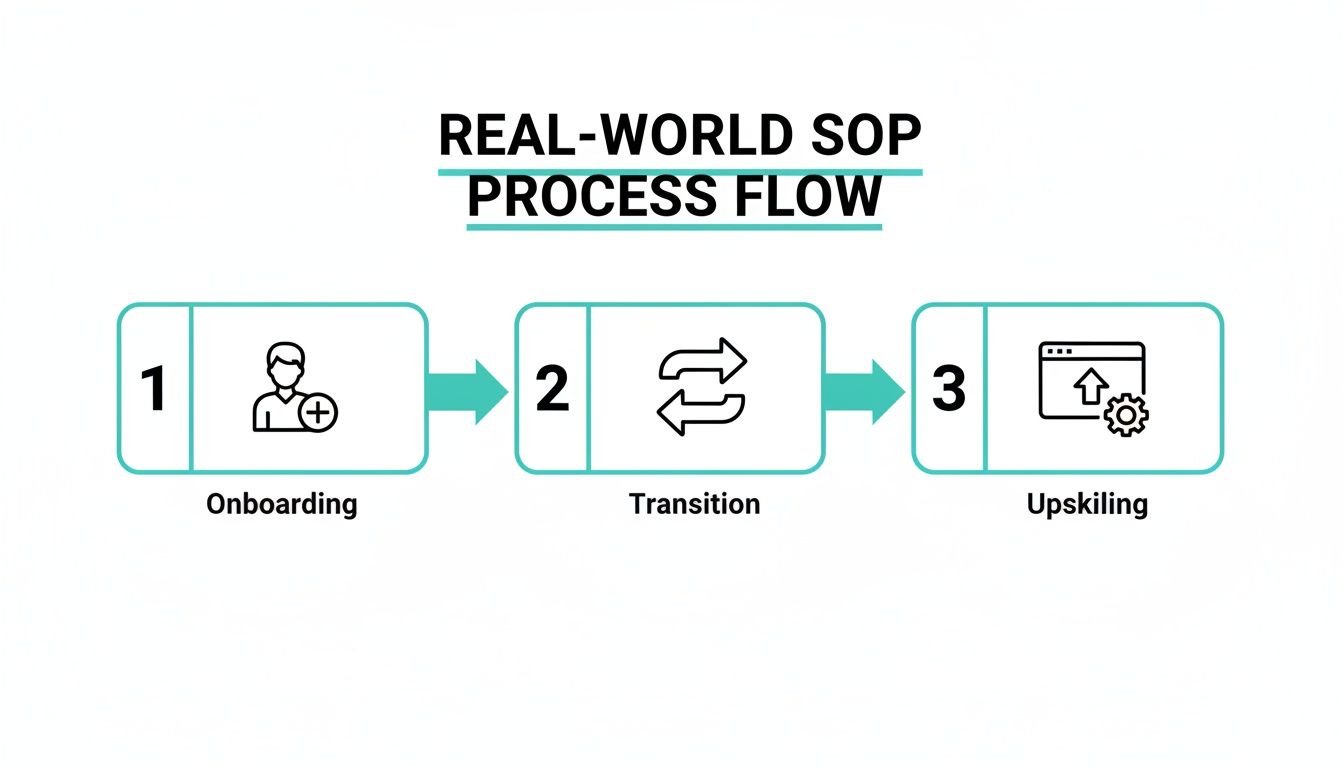
As you can see, a well-implemented SOP isn't just a document; it's a dynamic guide that supports your team through critical growth stages like onboarding, role transitions, and upskilling.
Focus on a Human-Centric Rollout
Successful implementation hinges on communicating the why
behind the SOP. Your team needs to see it as a tool for their benefit, not another mandate from management.
Here’s a practical way to roll it out that actually works:
- Start Small: Pick one common, high-pain process. Maybe it’s setting up a new client account or handling a specific type of customer ticket. Create a stellar SOP for just that one thing.
- Pilot with a Small Group: Introduce it to a few team members who feel the pain of that process the most. Let them see firsthand how it eliminates guesswork and saves them time.
- Showcase the Win: Once they love it, they become your champions. Their testimonials are far more powerful than any top-down directive.
This SOP saved me an hour this week
is the best marketing you could ever ask for.
The ultimate goal is to make your SOP the path of least resistance. When finding the right answer through the official channel is faster and easier than asking a coworker, you’ve won. Adoption becomes automatic because it's simply the smartest way to work.
By embedding your standard operating procedure for training directly into the tools your team already uses every day, you ensure it becomes a trusted resource, not another forgotten document. It’s all about delivering immediate, tangible value that your team can feel.
How to Know Your Training SOP Is Actually Working
So, you’ve put in the hours. You’ve mapped out the processes, written everything down, and rolled out a shiny new standard operating procedure for training. But here’s the million-dollar question: is it actually working?
It's easy to create a document and call it a day, but the real goal isn't just to have an SOP. It's to see a tangible, measurable shift in how your business operates. Let's get past the guesswork and talk about how you can prove your new process is making a real difference.
Connecting your procedures to real-world outcomes is how you build a rock-solid case for standardized training. This isn’t about feelings or assumptions; it’s about watching the right metrics move in the right direction and using that data to keep improving.
The Sound of Silence: Repetitive Questions Fade Away
One of the first, and most satisfying, signs of a successful SOP is a much quieter Slack channel. Think about it. When your team has a single, reliable source of truth, they stop pinging senior folks for the same basic information over and over again.
This is where the magic really happens. Your experts are no longer a human FAQ. They're freed up to focus on the complex, high-value work they were hired to do, not repeating answers they’ve given a dozen times before.
The ultimate proof of an effective SOP is when your team defaults to the documented process because it’s faster and more reliable than shoulder-tapping a colleague. It marks the shift from a culture of interruption to one of empowerment.
Track Your KPIs: The Before-and-After Snapshot
To truly prove the value of your SOP, you need to paint a clear before and after
picture. Before you launch, take a snapshot of your current performance in a few key areas. Then, circle back a month or two later and measure them again.
Here are the metrics that will tell you the real story:
- Onboarding Ramp-Up Time: How long does it really take a new hire to tackle their first major project without hand-holding? A solid training SOP should cut this time down significantly.
- Task Completion Speed: Pick a routine process and time it. A clear, step-by-step procedure removes hesitation and makes the entire workflow smoother and faster.
- Error Rate Reduction: How often do mistakes creep into a specific task? Standardized instructions are your single best defense against rework and costly slip-ups.
This isn’t just about making work easier; it has a direct financial impact. Companies that move from chaotic, ad-hoc training to structured online learning see their costs drop. But it's not just about saving money. In fact, 42% of companies that embrace structured eLearning report an increase in revenue. It's proof that clear, accessible training is a direct line to business growth. You can see more of these corporate eLearning statistics for yourself.
Tune In to the Human Feedback
Numbers are powerful, but they don't tell the whole story. The human impact of a great SOP is just as important, so pay close attention to what your people are saying.
Are your new hires sounding more confident in their first few weeks? Are team leads reporting fewer bottlenecks in their stand-ups? This kind of qualitative feedback is pure gold. It’s the confirmation that your SOP isn't just another document gathering dust—it’s a living tool that reduces stress, clarifies expectations, and makes everyone’s day-to-day work feel a whole lot less chaotic.
Still Have Questions About Training SOPs?
Jumping into the world of Standard Operating Procedures for training usually brings up a handful of common hurdles. Let's walk through the questions I hear most often from teams just getting started.
This Feels Like a Huge Project. Where Do We Even Begin?
I get it. The idea of documenting everything can feel paralyzing. My advice? Don't even try.
Instead, think small. What's the one question that derails your team's focus every single day? Maybe it’s How do I process a return?
or What's the login for the social media scheduler?
Pinpoint that single, high-frequency interruption and build your very first SOP around it. You'll solve an immediate, tangible problem, which not only provides instant value but also builds the momentum you need to tackle the next one.
How Do We Stop These Documents from Collecting Dust?
An SOP is only useful if it's accurate, and accuracy requires maintenance. The biggest mistake I see is creating documents and then forgetting them.
The secret is simple: assign ownership. Every single SOP needs a designated owner—usually the subject matter expert on that topic. Set up a recurring calendar reminder, maybe once a quarter, for them to do a quick 5-minute review. It's not a massive overhaul; it's a quick skim to ensure nothing has changed. This small, consistent habit prevents the dreaded SOP graveyard
and keeps your documentation trustworthy.
An SOP's value isn't just in the information it holds. It's in the confidence your team has that the information is correct. Regular check-ins are the foundation of that trust.
What If We Build Them and Nobody Uses Them?
This is the million-dollar question, isn't it? The answer comes down to one thing: convenience. If it's easier for an employee to tap a coworker on the shoulder (or ping them on Slack) than to find the SOP, they'll interrupt their colleague 100% of the time.
You have to make your SOPs the path of least resistance. This means putting them directly in the flow of work. Imagine your team no longer having to search through multiple folders or wikis. Imagine they could just ask a question in Slack and get an immediate, perfect answer pulled straight from your documentation. When the right information is faster to get than waiting for a person to reply, using your SOPs becomes the natural choice.
Stop letting the same questions kill your team's productivity. Imagine a workday where you never have to open another app, search through folders, or interrupt a teammate to find information. SAI plugs directly into your Slack conversations, providing instant, trusted answers the moment you ask. Get started for free at SAI-Bot.ai and transform how your team works.