Creating a Knowledgebase That Actually Gets Used
Let's be honest: creating a knowledgebase is really about building a single, reliable source of truth for your team. It's about finally getting rid of scattered information and creating one central hub where anyone can find answers in seconds, often without even leaving a tool like Slack. The end goal is simple: fewer repeat questions, faster onboarding, and more deep, focused work for everyone.
Imagine Never Hunting for Information Again

Think about your day so far. How many times have you had to stop what you were doing to dig through Google Drive, check an old email, or scan a Confluence page just to find one piece of information? Now imagine a day where you never open any of those resources. A day where you just ask a question in Slack and get the answer you and your team are looking for, instantly.
This is the simple yet profound shift that happens when you build a knowledgebase that truly works for you. The goal isn't just to store documents; it's to eliminate the endless hunt for information that fragments your team's focus and drains their day.
This guide isn’t for people who get a kick out of building complex wikis. It’s for every team lead, ops manager, or Slack admin who is just plain tired of the constant context switching and the soul-crushing cycle of repeat questions.
The True Cost of Disorganized Knowledge
The real problem isn't just the annoyance of answering the same question for the tenth time. It's the cumulative drag it puts on your team's productivity. Every single time someone has to stop, search for a document, or ping a coworker, they lose their momentum. It’s a tax on your team’s focus.
This information chaos creates a ripple effect of problems:
* Painfully Slow Onboarding: New hires feel like they're constantly bothering senior staff for basic info, which slows down their ramp-up time.
* Inconsistent Processes: Without a single source of truth, people just do things from memory or use outdated info, leading to costly mistakes.
* Expert Burnout: Your most knowledgeable people become human help desks, pulling them away from the high-value strategic work they were hired to do.
The big idea is to create a system where knowledge is captured effortlessly and shared instantly. It’s not another chore to add to your to-do list; it’s a background process that makes everyone’s day run smoother.
This isn't just a nice-to-have anymore; it's quickly becoming a business necessity. The market for AI-driven knowledge management is projected to jump from $5.23 billion in 2024 to $7.71 billion in 2025—a massive leap that shows just how urgent this problem has become. You can dig into this trend and why organizations are prioritizing it over at digitalworkplacegroup.com.
A New Approach to Creating a Knowledgebase
Forget the old way of manually building and updating a static wiki. That system is fundamentally broken because it relies on busy people taking extra time to document things. A modern knowledgebase meets your team right where they are—inside Slack. By understanding what a true knowledge management system is, you can move past just storing documents. You can dive deeper by checking out our guide on what is a knowledge management system.
The most effective systems today learn directly from your team’s conversations. When an expert answers a question once, an AI assistant captures that exchange. The next time a similar question comes up, the AI delivers that verified answer on the spot.
This simple process transforms your daily workflow by:
* Eliminating Friction: No one has to open another tab, log into a different system, or learn a new tool.
* Automating Capture: Knowledge is saved organically from real work, not from a separate, tedious documentation task.
* Providing Instant Gratification: Answers are delivered immediately, which naturally trains people to ask the system first.
It’s time to stop chasing information and start building a self-sustaining engine for your team’s collective knowledge.
Pinpoint Your Team's Biggest Time Sinks
Before you write a single word of documentation, you need to figure out what problems you’re actually trying to solve. Forget the massive, soul-crushing content audit that will inevitably fizzle out in a week. Instead, zoom in on the real pain: the constant, repetitive questions that drain your team’s energy and focus every single day.
Imagine a world where your top engineers aren’t pulled away from a critical launch to answer, “What’s the staging server password?” for the fifth time this month. Picture your newest hire finding the benefits enrollment guide on their own instead of pinging HR. This is the goal—not just to store information, but to kill the tiny, disruptive moments that absolutely wreck productivity.
You aren't trying to document everything at once. The real win is solving the most frequent and disruptive knowledge gaps first.
Spotting the Hidden Time Thieves
These recurring questions are like a hidden tax on your team's time. Each one seems small, but they add up to hours of lost focus and broken concentration. You don’t need to send out a complex survey or schedule long meetings to find them; just start paying closer attention to the daily chatter.
Look for the patterns that are already there:
- Onboarding Hurdles: What are the first five questions every single new hire asks? I'm talking about things like system access, team workflows, or where to find key project files.
- Process Clarifications: Questions like
How do I submit an expense report?
orWho needs to approve this design mock-up?
are perfect candidates for your knowledgebase. - Project-Specific Queries:
Where's the final deck for the Q4 launch?
is a classic. This is the kind of information that constantly gets buried in email threads and Slack channels.
By tackling these first, you create instant momentum. When your team sees that this new knowledgebase immediately solves a real, annoying problem, they’ll actually want to use it. This strategy delivers tangible value right from the start.
From Vague Questions to Actionable Answers
Once you've nailed down your top 5-10 repetitive questions, the next step is to frame the answers for instant clarity. A great answer doesn’t just provide information; it gets someone unstuck and back to their real work in seconds.
Think less like you’re writing an encyclopedia and more like you’re giving a quick, helpful tip to a coworker standing at your desk. The information has to be immediately usable.
For example, a terrible answer to How do I submit an expense report?
would be a link to a dense, 20-page HR policy document.
A great answer is a simple, three-step checklist with a direct link right to the expense tool. It anticipates the user’s need for speed and gives them just enough information to get the job done without overwhelming them.
This targeted approach ensures your initial work has the biggest possible impact. Instead of spending months building a comprehensive wiki that no one ever looks at, you can deliver a solution that saves your team time and frustration within the first week. A truly effective knowledgebase starts small, solves real pain, and grows from there.
Build Your Knowledgebase Inside Slack
Let’s be honest: a knowledgebase is completely useless if your team never touches it. I’ve seen countless wikis and shared drives turn into digital graveyards, and it almost always comes down to one simple thing: friction. The moment you force someone to stop what they're doing, switch tabs, and hunt for an answer in yet another tool, you’ve already lost.
Most people will just tap a coworker on the shoulder (or, more likely, ping them in a DM), which completely defeats the purpose of having a central knowledge hub in the first place.
This is exactly why building your knowledgebase directly inside Slack is a game-changer. You’re meeting your team right where they work. There’s no new app to download, no extra login to remember, and no clunky interface to learn. The barrier to entry is practically zero.
Think about it: your team’s daily conversations can become the living, breathing source of truth for your entire organization. You don’t need to kick things off with a massive, manual data entry project. It just starts happening.
The Power of Learning from Conversation
How does knowledge actually get shared on your team right now? A subject matter expert drops a perfect answer into a Slack thread, and for a glorious moment, the problem is solved. The trouble is, that brilliant answer is almost immediately buried under an avalanche of new messages, lost to the endless scroll forever.
This is where an AI assistant like SAI completely flips the script. When that expert answers a question, the AI is right there, capturing the whole exchange. It doesn't just see text; it understands the question, the context, and the verified answer that followed.
So, the next time someone asks a similar question—even if they word it differently—the AI instantly serves up that proven solution. This learn-from-conversation
model is just fundamentally better than any system that demands constant manual upkeep. It automates the single hardest part of knowledge management: getting the information into the system.
The goal isn’t to turn your team into meticulous librarians, carefully filing away information. It's to make knowledge sharing an effortless, background process that just happens as part of the daily workflow.
This approach stops your knowledgebase from becoming stale. The information stays fresh because it’s directly tied to the real-time work and conversations happening every single day. And the best part? It naturally surfaces and solves your team's most urgent information gaps without you having to guess what they are.
This simple flow shows how you can use what's already happening in your channels to pinpoint and solve your biggest time sinks, no manual audits required.
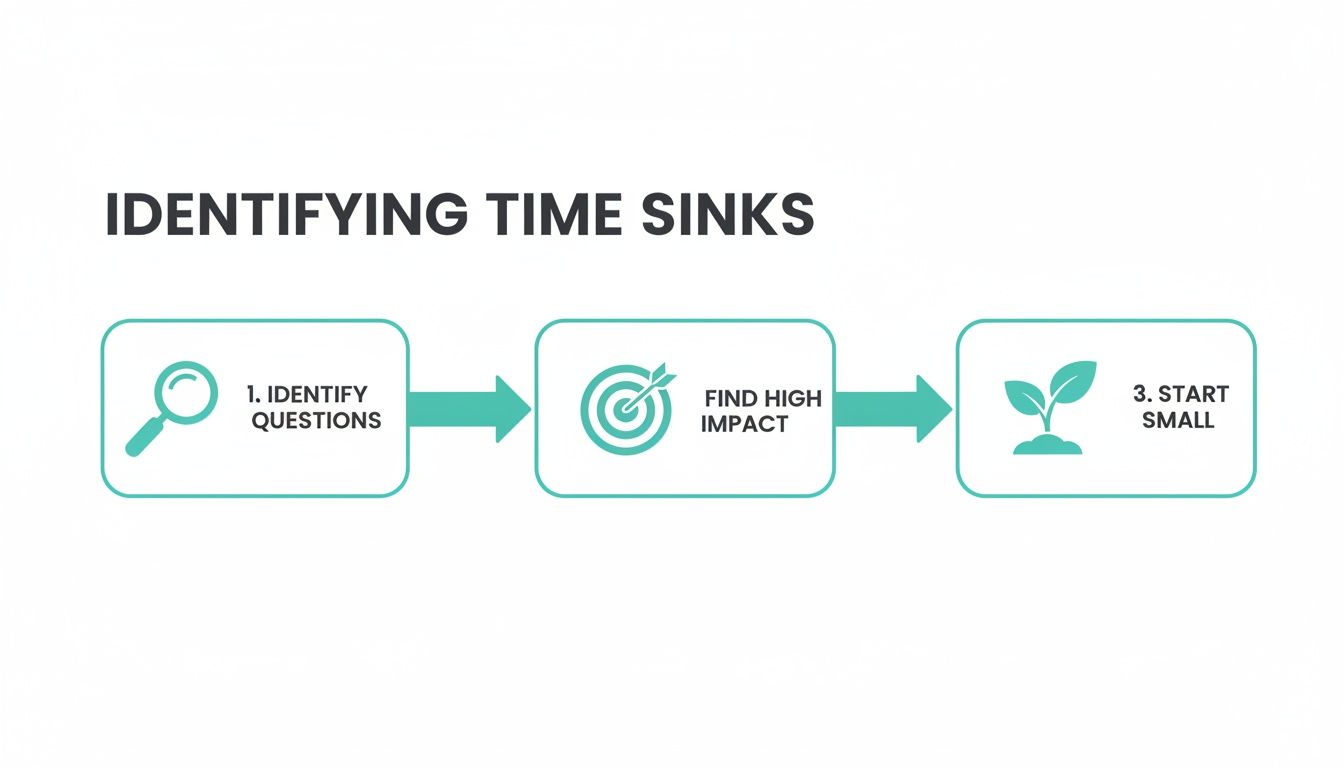
The real insight here is that by just paying attention to the questions people are already asking, you can find the high-impact knowledge gaps and start small, delivering value right away.
Why Integration Is Non-Negotiable
Forcing another standalone tool on your team is a proven recipe for failure. Research shows that the average employee already switches between 10 different apps every hour. Adding one more to the pile just creates more noise and kills any chance of adoption.
An integrated Slack knowledgebase does the opposite. Instead of pulling people out of their work, it pushes knowledge into their workflow at the exact moment they need it.
Let's break down how these two approaches really stack up.
Comparing Knowledgebase Approaches
The difference between a traditional, siloed wiki and an AI-powered system embedded in your team's communication hub is night and day. One adds to the workload, while the other reduces it.
| Feature | Traditional Wiki or Database | Integrated AI in Slack |
|---|---|---|
| Information Capture | A manual, tedious process requiring someone to write and publish an article. | Automatic capture from real-time Slack conversations and threads. |
| User Effort | High. You have to leave Slack, log in, search, and hope a relevant result exists. | Low. You just ask a question in the channel you're already working in. |
| Adoption Barrier | High. It demands a significant behavior change and learning a new tool. | Extremely low. It works inside a familiar environment your team already uses all day. |
| Content Freshness | Content quickly becomes outdated and unreliable unless actively managed. | Stays current organically as new answers from experts update old information. |
The contrast is stark, isn't it? For teams looking to centralize answers and get moving quickly, you can learn more about how a wiki for Slack can boost team knowledge and make this whole process feel seamless.
At the end of the day, the best knowledgebase is the one your team actually uses. By building it inside the tool they already have open, you eliminate the biggest roadblock to success and create a system that delivers value from the very first question answered.
Foster a Culture of Shared Knowledge
Having the right tool is a huge first step, but it’s only half the battle. A truly powerful, self-sustaining knowledgebase lives and dies by the culture you build around it.
The real goal is to change the team's default behavior. We want to shift their mindset from instinctively DMing a colleague to reflexively consulting the system first. This kind of transformation doesn’t just happen—it needs to be deliberately guided, starting from the top.
Let's play out a common scenario. A team member messages you with a question you’ve answered a dozen times. The old habit is to sigh, type out the answer again, and get back to your work.
The new way? Gently nudge them toward the public Slack channel where your AI assistant is waiting.
Try saying something like, Great question! Can you pop that into the #team-questions channel and ask SAI? I want to make sure the answer gets saved for everyone.
This one small redirect accomplishes two critical things: it gets them their answer and reinforces the new, more efficient workflow.
Championing the Change
To make this new habit stick, team leads and managers have to be the most visible users. Your actions speak volumes more than any company-wide memo ever could. When your team sees you using the system, they'll follow your lead.
Build momentum by celebrating early wins. A quick shout-out in a public channel—like, Awesome question, Sarah! SAI just learned the answer, so now the whole team has it instantly
—creates a powerful dose of positive reinforcement. It reframes knowledge sharing not as a chore, but as a collective win.
This creates a virtuous cycle:
- Questions are centralized instead of getting lost in private DMs.
- Answers are captured as the AI learns from the expert's response, instantly updating the knowledgebase.
- Knowledge is multiplied when the next person with that same question gets an immediate answer without interrupting anyone.
The objective is to make sharing knowledge an effortless background process, not another task on the to-do list. When it’s easier to ask the AI in Slack than it is to track down a person, the right behavior becomes the path of least resistance.
Overcoming the No Time
Objection
Time. It’s the single biggest hurdle to getting anyone to document anything. And it’s not just a feeling; research shows that a staggering 42% of employees feel too swamped to contribute to knowledge management. On top of that, another 38% say their company culture doesn’t even encourage it. You can dig into more knowledge management statistics that highlight why so many traditional systems just don't get adopted.
This is precisely where an automated, conversational system changes the game.
By capturing knowledge directly from the Slack conversations already happening, you completely dismantle the I don't have time for this
argument. Your team doesn't have to stop their flow, open another tab, and go do documentation.
The documentation happens as a natural byproduct of them doing their jobs.
An engineer troubleshooting an issue in a thread is simultaneously teaching the AI. A support lead clarifying a policy is, at the same time, building the knowledgebase.
Building Collective Ownership
Finally, you need to empower your team to be active participants, not just consumers. When the AI gives an answer, encourage people to verify it or suggest an improvement. This isn't about policing content; it's about collaborative gardening.
This approach creates a powerful sense of collective ownership and keeps the information from going stale. Your knowledgebase stops being a static library and becomes a living, breathing reflection of the team's combined expertise—a dynamic engine that evolves with every project and every process change.
Measure Success by What You Stop Doing

So, you've put in the work to build this amazing knowledgebase. How do you actually know if it's working? It's so tempting to get fixated on vanity metrics—page views, number of articles, search queries. But honestly, those numbers don't tell you the real story. They just measure activity, not impact.
The real sign of success isn't about what you're doing more of; it's about what you're finally able to stop doing.
A truly effective knowledgebase doesn't just give you another dashboard to monitor. It fundamentally changes how your team operates by eliminating the friction and time-sinks that used to be a normal part of the day.
Think about it. What if your most senior engineer got back an hour every day because they weren't answering the same onboarding questions over and over? Or if your support team's internal ticket queue started to shrink because people could find answers themselves? That's what real success looks like.
From Interruptions to Empowerment
The most profound change you'll see is the quiet hum of productivity that takes over when information bottlenecks disappear. It's the sound of deep, focused work happening without constant shoulder-tapping or quick question
pings on Slack. Instead of digging through old conversations, your team just asks SAI and gets an instant, accurate answer.
This shift from an interruption-driven culture to one of empowered self-service is your true return on investment.
You can actually see this change happening by looking for a few key behaviors:
- Fewer Repetitive Questions: Are those same
how do I...
questions still cluttering your main channels? Or have they vanished? - Faster Onboarding: Are new hires getting up to speed and contributing sooner, with less hand-holding from senior staff?
- Reduced Expert Burnout: Are your subject matter experts finally free to focus on strategic, high-value work instead of acting like human search engines?
Success isn't some number on a report. It's the newfound autonomy your team feels. It’s that moment a junior developer finds a complex answer on their own and gets right back to coding, without ever breaking a senior dev's focus.
This focus on smarter processes isn't just a nice-to-have. Industry analysis shows that 44% of experts name process improvement as their top goal for knowledge management. Yet, a telling 41% of organizations admit they have no idea how to measure its actual business impact. You can dig into more of these knowledge management priorities and challenges to see just how common this is.
Measuring What Truly Matters
Forget the abstract data for a minute and focus on tracking the disappearance of your biggest time-wasters. These are the concrete outcomes that leadership understands because they tie directly to the bottom line and team performance.
Sometimes the best way to start is the simplest: just ask your team. A quick poll can be more revealing than any analytics dashboard. Ask them directly, Do you feel like you can find information faster now than you could a month ago?
That human feedback is often your most powerful indicator of success.
By focusing on these practical outcomes, you can effectively measure team productivity without micromanaging and clearly demonstrate the value of all your hard work.
In the end, your goal is to create a system so seamless that people forget how chaotic things used to be. When your team can't even imagine going back to the old way of working—a day filled with endless searching and constant interruptions—that's when you'll know you've won.
Your Questions, Answered
Jumping into AI-powered knowledge management can feel like a massive undertaking, but it's probably not what you think. The goal isn't to pile on another complex system. It's about fundamentally changing how your team works—moving from a world of scattered files and constant interruptions to one where answers are instant and self-serve.
Imagine never having to dig through old DMs or shared drives again. You just ask a question in Slack and get the right answer, right now. Let's tackle the most common questions and concerns we hear from teams ready to make that a reality.
What if We Have No Existing Documents to Start With?
Honestly, that’s the perfect place to start. A blank slate is an advantage, not a roadblock, for an AI-powered approach.
The old-school method demanded a huge, upfront project to write articles and build a wiki that, let's be real, people might not even read. The modern way is to start right now, with zero prep.
Just add an AI assistant like SAI to a busy Slack channel—think #help-support or #ask-engineering—and let it listen. The knowledge base is born the moment an expert on your team answers a question. The AI instantly captures that Q&A, and that becomes your first piece of living knowledge, ready for the next person who asks.
Will This Just Create More Work for My Team?
Nope. It’s designed to do the exact opposite, and this is the most important part to understand.
Traditional knowledge bases fail because keeping them updated is a soul-crushing, manual chore for people who are already swamped. Someone has to remember to write an article, tag it correctly, and then somehow keep it from going stale.
An AI that learns from your team's conversations completely flips that script.
Your team keeps working exactly as they do today: asking and answering questions in Slack. The AI does all the heavy lifting—capturing, organizing, and resurfacing that knowledge automatically. The only
workinvolved is the initial setup. After that, the system actively reduces your team's workload by deflecting repetitive questions.
It’s a system built to take tasks off your plate, not add more to it.
How Does the Information Stay Accurate and Up-to-Date?
Accuracy comes from a real-time, built-in feedback loop that's far more effective than any manual review process. When the AI offers an answer, your team members can instantly verify it or suggest an update, right there in the Slack thread. This crowdsourced validation keeps your knowledge base evolving as fast as your team does.
Think about it: when a process changes, that old guide in a static wiki is now a ticking time bomb of bad information. With an AI system, the very next time someone asks about that process, an expert will give the new, correct answer. The AI immediately learns from that interaction, prioritizing the most recent, verified information for everyone. It stays alive, current, and trustworthy.
Can This Really Handle Our Complex, Technical Questions?
Absolutely. This isn't just for simple stuff like Where's the vacation policy?
It shines when capturing nuanced, technical knowledge precisely because it learns directly from your subject matter experts, in their own words.
When a senior developer breaks down a tricky codebase issue in a thread or a product manager outlines the logic behind a new feature, the AI captures that entire, detailed exchange. This creates a repository of expert-level knowledge that's far more practical than what you'd ever find in formal documentation.
It essentially becomes your team's collective brain, available on demand. You stop losing crucial institutional knowledge every time someone logs off for the day or, worse, leaves the company. It’s all there, captured forever, right in Slack.
Ready to stop hunting for information and give your team the gift of instant answers? SAI learns from your team’s Slack conversations to build a knowledgebase that answers repetitive questions automatically. Get started for free and see how it feels to have an expert assistant on your team, 24/7. Add SAI to Slack today.