How to Create an SOP That Transforms Your Business
Let's be honest, creating a Standard Operating Procedure (SOP) probably sounds about as exciting as watching paint dry. You're likely picturing a dusty binder filled with jargon-heavy instructions that no one ever reads. But what if we looked at it differently?
The real goal here isn't to create more paperwork. It's to build a system that gives your team the right answer, right now, solving a genuine pain point for everyone. This guide is all about ditching that old-school, tedious approach and building a world where your team never has to search for information again.
Move Beyond Busywork and Build a Smarter Team
Picture your typical Tuesday. You're deep in thought, finally making progress on that big project, when a Slack notification pops up: Hey, where do I find the latest client logos?
An hour later, it's another one: What's the process for expense reports again?
Each question seems minor, but they're silent killers of productivity. They chip away at your focus and bleed your company's most valuable resource: your team's time. This is the daily reality for so many businesses, but it absolutely doesn't have to be yours.
From Constant Interruptions to Instant Clarity
For most managers, the before
picture is painfully familiar. You've become the human Google for your team, constantly pulled away from critical work to answer questions you’ve already covered a dozen times. Meanwhile, your team members—who are trying their best—are stuck waiting for you or digging through messy shared drives and old chat histories.
This friction is more than just an annoyance; it’s a massive operational drag. In a fast-paced work environment, especially one running on a platform like Slack, these repetitive questions can devour 20-30% of a knowledge worker's day. That's not a small number. For a medium-sized company, we're talking about more than 10 hours of wasted time per employee, per week.
The idea of standardizing how we work isn't new, of course. It goes all the way back to early scientific management principles that boosted factory efficiency by as much as 300%. The factory floor is now digital, but the core lesson holds true: clarity is the engine of performance. You can explore more about these productivity insights and their historical context to see just how powerful this concept is.
The real win isn't just writing down a process. It's building a self-sufficient team that can find answers instantly, without ever leaving their workflow. The magic happens when your team stops asking you and starts asking your system.
Visualize the Transformation in Your Business
Now, let's imagine the after.
A new hire posts a question in a Slack channel about how to submit an invoice. Instead of you or a senior teammate stopping what you're doing to type out a long explanation, an answer appears instantly, pointing them directly to the step-by-step guide.
That's the difference between manual support and a system that answers for you. It’s a game-changer. Imagine a day where your team never has to open another browser tab, dig through confusing shared drives, or scroll through endless chat histories to find an answer. They just ask a question in Slack, and the information they need appears.
This simple shift delivers huge benefits:
* Reclaimed Focus: Your most skilled people are liberated from the tyranny of repetitive questions, freeing them up for the strategic work that actually pushes the business forward.
* Empowered Team Members: Employees get the information they need the second they need it. This builds autonomy, removes frustrating bottlenecks, and helps them feel more confident and capable in their roles.
* Consistent Quality: When everyone follows the same proven steps, you get consistent, high-quality output every single time. Fewer mistakes, less rework.
The True Cost of Repetitive Questions vs The ROI of SOPs
It's easy to underestimate the death by a thousand cuts
effect of disorganized knowledge. On the flip side, the gains from a well-oiled SOP system are immediate and compounding. Here’s a quick look at the two realities.
| Operational Drag (Without SOPs) | Strategic Advantage (With SOPs) |
|---|---|
| Senior team members become support bottlenecks, spending hours answering the same questions. | Experts are freed up to focus on innovation, growth, and high-value strategic projects. |
| New hires take longer to ramp up, feeling dependent and hesitant to act without constant approval. | New employees become productive faster, with the confidence to find answers and work autonomously. |
| Inconsistent processes lead to costly errors, rework, and a variable customer experience. | Standardized quality ensures every task is done right the first time, boosting reliability and brand trust. |
| Time is wasted searching for information across scattered drives, emails, and chat histories. | Answers are centralized and instant, turning wasted search time into productive work time. |
| Knowledge is siloed and walks out the door when an employee leaves, creating a constant retraining cycle. | Critical knowledge is captured and retained, creating a resilient, scalable operational foundation. |
Simply put, you're either paying the price in lost time and constant friction, or you're investing in a system that pays you back every single day in the form of a focused, efficient, and empowered team.
In the next sections, we'll get practical. I'll walk you through exactly how to create SOPs that achieve this, starting with how to pinpoint the perfect process to document first. We’ll cover how to write them so people actually want to use them and, most importantly, how to weave them into your daily workflow so they become an invisible, powerful engine for your team.
Find Your First SOP in Your Team’s Conversations
The most effective Standard Operating Procedures aren't dreamed up in a stuffy boardroom. They're not handed down from on high. The really good ones—the ones that people actually use—are discovered hiding in plain sight, scattered throughout your team’s everyday conversations.
Your team’s Slack channels are a goldmine of operational friction. Learning to spot the patterns is the first real step toward creating an SOP that delivers immediate, tangible value. Forget trying to boil the ocean by documenting every single process. That’s a fast track to burnout and a library of dusty, unused documents.
Instead, think of yourself as an operational detective. Your mission? Find the one process that’s causing the most repetitive pain.
Listen for the Echoes in Your Slack Channels
Start by just scrolling through your main team channels from the last few weeks. You're not looking for massive, complex problems. You’re looking for the small, recurring quick questions
that, let's be honest, are never actually quick.
These little questions are your clues. They signal a gap in your shared knowledge, a process that’s fuzzy around the edges, or information that’s just too hard to find.
Here are the specific patterns you should be hunting for:
* The Broken Record: Is the same question about client onboarding, file naming conventions, or how to submit an expense report popping up every few days? This is your top suspect.
* The Where's That Link?
Plea: When team members constantly have to ask for the link to the design assets folder, the marketing calendar, or the QA checklist, it’s a glaring sign that critical information isn't where it needs to be.
* The Committee Answer: You’ve seen these threads. A simple question comes in, and it takes three different people chiming in with bits and pieces of the answer to solve it. This means your process is fragmented and needs to be stitched together.
The goal isn't just to answer a question once. It's to build a system where that question never needs to be asked again. Every recurring question is an opportunity to reclaim dozens of future work hours for your entire team.
From Quick Question
to High-Impact SOP
Once you’ve spotted a few of these recurring questions, it’s time to pick your target. You're looking for that perfect low-effort, high-impact
win. The best first SOP is one that’s relatively simple to document but solves a headache that affects multiple people, multiple times a week.
Take a seemingly simple question like, How do I request a new graphic from the design team?
On the surface, it’s easy. But when you really unpack it, you realize it’s a whole workflow:
- First, you have to find the right request form.
- Then, you have to fill it out with the correct project codes and specs.
- Next, you need to know where to submit it—the right Slack channel or project management tool.
- Finally, what's the expected turnaround time? Who do you follow up with if you have questions?
That quick question
is actually a five-step process. Without a clear SOP, it creates confusion, delays, and frustration for both the person asking and the design team constantly fielding the requests. This is the perfect candidate for your first SOP. By documenting this one workflow, you eliminate a persistent bottleneck.
This is the kind of transformation we're talking about—moving from a chaotic, reactive workflow to a clear, proactive one.
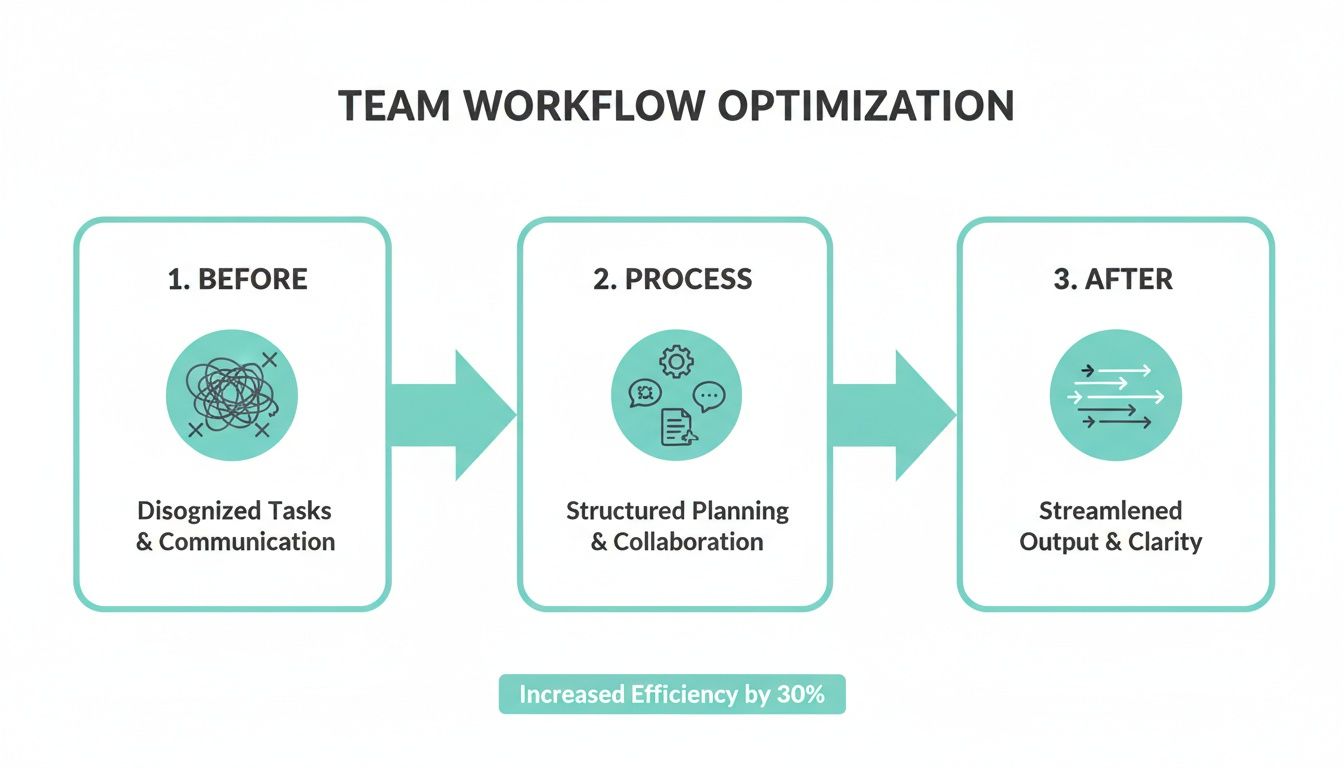
The difference is night and day. A well-defined process gets rid of the ambiguity and lets your team move forward with confidence and speed.
Now, imagine a world where your team doesn't have to stop what they're doing to ask for this information. They don’t have to search through old conversations or open a half-dozen tabs. They just ask a question naturally in Slack, and a tool like SAI instantly provides the complete, step-by-step process. This isn't just about saving a few minutes here and there; it's about creating an environment of uninterrupted focus, where your team can do their best work without the constant drag of hunting for information.
Draft an SOP Your Team Will Actually Use
Let's be honest. Most SOPs are written, filed away, and never looked at again. The biggest mistake I see people make is writing for themselves, not for their team. They pack documents with corporate jargon, assume everyone shares their background knowledge, and create something that reads more like a legal notice than a helpful guide.
And the result? It gets completely ignored. Your team is still stuck, and the same old questions keep flooding your Slack channels day after day.
A truly effective SOP is a conversation, not a command. It should be written for the person who needs it most—someone who might be new, swamped with work, or just plain stressed. Its only job is to provide clarity in an instant, not to be a monument to your extensive vocabulary.
What we're aiming for is a simple but profound shift: a workplace where no one ever has to hunt for information again. Instead of juggling browser tabs, digging through confusing folders, or interrupting a colleague, they just ask a question in Slack and get the answer they need, right when they need it. The magic happens when your team moves from searching to asking.
Start with a Crystal-Clear Purpose
Before you type a single word, you have to nail down the why.
You need to be able to state the SOP's purpose in one simple, direct sentence. If the purpose is fuzzy, the document will be too. You're not just listing steps; you're solving a specific problem for a specific person.
A weak purpose statement is something like: This SOP covers the social media posting process.
It’s technically true, but it's useless.
Now, look at a strong one: This guide shows a marketing coordinator exactly how to schedule an approved social media post in HubSpot to ensure it goes live without errors.
See the difference? It immediately clarifies the user, the tool, and the desired outcome. There's no room for confusion.
Don't bury the lead. The very first line of your SOP should tell the reader exactly what problem this document solves for them. If they can't see the value in the first five seconds, you've already lost them.
Write in Simple Language and Show Everything
This is the part where most SOPs fall flat on their face. Experts write them, and they completely forget what it feels like to be a beginner. To sidestep this trap, you have to be relentlessly clear and incredibly visual.
- Use Simple Verbs: Every step should start with a command.
Click,
Open,
Copy,
Paste.
Get rid of weak phrasing likeyou might want to consider
orit is generally recommended that.
Just tell them what to do. - One Action Per Step: This is non-negotiable. Never, ever cram multiple actions into a single step. Instead of writing,
Find the client folder and upload the final PDF,
break it down.1. Navigate to the 'Clients' folder. 2. Open the correct client sub-folder. 3. Drag the final PDF into the window.
- Show, Don't Just Tell: A screenshot is worth a thousand words, especially in an SOP. Use arrows, circles, and highlights to point out exactly where someone needs to click. For a new hire, seeing the button is infinitely more helpful than reading a long-winded description of it.
This isn't some new-age management fad; it's a principle that's been proven for decades. The idea of using clear, standardized instructions to slash errors was famously perfected by Toyota in the 1980s. Their lean manufacturing SOPs helped reduce waste by 50% in auto plants across the globe. Today, those same principles are the bedrock of how fast-moving tech companies operate, because clarity equals speed and quality.
Assign Clear Ownership and Keep It Alive
An SOP without an owner is an orphan document, and it's already on its way to becoming obsolete. You need to assign one person who is responsible for keeping it accurate and up-to-date.
Here’s the key: that person should not be a manager who is out of touch with the day-to-day work. It needs to be the person who actually performs the task.
This is a critical piece of the puzzle if you want to create an SOP that lasts. When you give ownership to the practitioner, you empower them to make updates in real-time as the process inevitably changes. This small adjustment transforms your SOP from a static, top-down order into a living, team-owned resource. For more ideas on how to structure your documents, take a look at our guide on SOP formats and templates.
Ultimately, a great SOP feels less like a rulebook and more like a dependable teammate—the one who always has the right answer, right when you need it.
Turn Your SOPs into Instant Answers

You did it. You wrestled a complex process into submission and created a brilliant SOP that’s clear, actionable, and ready to go. But what happens next is what truly matters.
If that beautifully crafted document ends up in a forgotten Google Drive folder or a dusty corner of your company wiki, you’ve only solved half the problem. A documented process is a fantastic start, but the real magic happens when that knowledge lives and breathes where your team works every single day.
The goal isn't just to have SOPs. It's to close the gap between static documentation and the dynamic, on-demand answers your team craves.
From a Buried Document to a Living Resource
Think about the all-too-common workflow. An employee has a question. They stop what they’re doing, open a new browser tab, navigate to the company drive, and start digging. Best-case scenario? They find the right document in a minute or two.
Worst case? They get frustrated, give up, and interrupt a colleague instead.
This tiny moment of friction, repeated dozens of times a day across your entire team, is a massive drain on focus and productivity. It's why the best SOP in the world is useless if it's not instantly accessible right when it's needed most.
The solution is to bring your SOPs directly into your team's central hub, like Slack. When you connect your documentation to an AI assistant like SAI, it stops being a passive file and becomes an active, intelligent resource.
Imagine this: Instead of ever having to search for a link or re-type a process again, you and your team can just ask a question in Slack. The correct answer, pulled directly from your SOP, appears instantly. That’s not just an improvement; it’s a completely different way of working.
The Power of Instant, Automated Answers
When an AI learns from your carefully crafted SOP, it can deliver accurate, context-aware responses 24/7. This isn't about replacing human expertise; it's about amplifying it. It frees your most experienced people from answering the same questions over and over, letting them focus on the complex, high-value work that truly moves the needle.
Here’s the transformation you can expect:
- Zero Search Time: Questions get answered in seconds, not minutes. The constant “context switching” that kills deep work simply vanishes.
- 24/7 Support: A new hire working late or a team member in another time zone gets the exact same quality of support as someone sitting right next to you.
- Flawless Consistency: Every single person gets the same, correct answer every single time, ensuring your processes are followed perfectly.
This shift fundamentally changes how knowledge flows through your organization. To really grasp the bigger picture, it’s helpful to explore the principles of a modern knowledge management system.
SOP Management Traditional vs AI-Assisted
The old way of managing SOPs just can't keep up. Storing them in static folders creates a barrier between the knowledge and the people who need it. An AI-assisted approach, on the other hand, tears that barrier down completely.
Look at the difference. It’s night and day.
| Feature | Traditional Method (Docs/Wiki) | AI-Assisted Method (SAI in Slack) |
|---|---|---|
| Accessibility | Requires leaving your workflow, navigating folders, and manual searching. | Instantly available within Slack; answers come to you. |
| Speed | Slow. Finding the right document and the right section takes time and effort. | Instant. Get precise, direct answers in seconds without searching. |
| Adoption | Low. If it's hard to find, people will revert to asking colleagues. | High. Effortless access encourages team-wide use and self-sufficiency. |
| Consistency | Variable. People may find outdated versions or interpret steps differently. | Guaranteed. Everyone receives the same vetted, up-to-date information. |
| Impact | Knowledge is siloed and passive, acting as a library of last resort. | Knowledge is active and integrated, becoming a real-time partner in your work. |
This isn't just about saving a few clicks here and there. It's about building a smarter, more resilient organization where your collective knowledge becomes your greatest asset—accessible to everyone, at any time, with zero effort. This is how you create SOPs that actually work.
Keep Your SOPs Alive and Effective
You’ve done the hard part. You wrestled a chaotic, recurring problem into a clear, documented solution that your team can actually follow. But let's be honest about a hard truth most companies ignore: an SOP is only valuable if it’s accurate.
Outdated information isn't just unhelpful—it's actively harmful. It destroys trust, creates confusion, and quietly pushes your team right back into the old, disruptive habits of shoulder-tapping and guessing their way through tasks.
So, the final, most crucial part of creating a great SOP is building a simple system to keep it from dying. This isn't about adding another layer of bureaucracy. It’s about making sure the effort you just invested continues to pay off, turning a one-time project into a lasting operational upgrade.
Turn Maintenance into a Team Sport
Here’s the single biggest mistake I see: treating SOP maintenance as a chore for a manager who’s too far removed from the day-to-day work to even notice when a process has changed. The real fix is to put ownership in the hands of the people who are actually doing the work.
For every SOP, assign a clear process owner.
This should be the person or team lead who lives and breathes that task. They are your front-line defense against stale instructions because they’ll be the first to spot when a step is wrong or a tool has been updated.
This simple act of assigning ownership is incredibly powerful.
- It empowers your team. You're showing you trust their expertise, which gives them a sense of pride in maintaining the
right way
to do things. - It makes updates effortless. For the owner, updating the SOP isn’t some separate, annoying task. It’s a quick edit they can make the moment they notice something’s off, keeping the document perfectly in sync with reality.
The goal is to build a culture where everyone feels responsible for the accuracy of your shared knowledge. An SOP isn't a stone tablet handed down from above; it's a living document that the team maintains together.
Set a Simple Rhythm for Reviews
Even with a dedicated owner, things can slip through the cracks. That’s why you need a simple, non-negotiable review schedule. Forget complex audit systems; a recurring calendar reminder is often all it takes.
Just set a quarterly or bi-annual calendar event for each process owner to spend 15 minutes reviewing their assigned SOP. This tiny, proactive check-in ensures that even slowly evolving processes stay current.
This kind of disciplined iteration is what separates good SOPs from great ones. In fact, research shows that 76% of high-performing teams review their core processes at least twice a year. The result? They boost compliance by a stunning 62% compared to teams that let their documents gather dust.
This isn’t a new idea. After the U.S. military standardized its procedures in 1947, it saw a 70% reduction in training accidents—a powerful testament to maintaining clear, living documentation. You can discover more insights about how these historical precedents shape today's business strategies on collegeessayguy.com.
Let Your Workflow Tell You What’s Broken
In the past, the only way you knew an SOP was outdated was when something broke. A missed deadline, a customer complaint, an invoice sent to the wrong place. But what if your workflow itself could signal that a process was becoming stale before it caused a problem?
This is where integrating your knowledge directly into your team's central hub, like Slack, becomes a game-changer.
When an AI assistant like SAI answers questions based on your SOPs, it’s not just providing information—it's also gathering intelligence. Imagine SAI answers a question about your invoicing process, but then two team members follow up with clarifications in the thread. That conversation is a flare. It’s a signal that the documented process might be missing a key step or has become unclear.
This transforms maintenance from a manual, reactive chore into a proactive, data-informed process, ensuring your knowledge base evolves right alongside your business. Dive deeper into this concept by exploring our guide on the strategy of knowledge management to end the endless search for information.
Common SOP Questions Answered
Even with a great plan, diving into the world of SOPs can feel a bit like staring at a blank page. A lot of practical questions pop up, and it's easy to get stuck on the what ifs
and how tos
before you even start. Let's tackle some of the most common hurdles I've seen teams face, so you can move forward with confidence.
The real goal here isn't just to document processes. It's about fundamentally changing how your team works day-to-day. Think about it: a world where no one has to open another browser tab to hunt for an answer, dig through old chat threads, or interrupt a colleague to ask a question they know has been answered before. That's where we're headed.
How Many SOPs Do We Actually Need to Create?
It’s tempting to think you need to document every single task from day one, but that’s a surefire recipe for burnout. The truth? You don't need dozens of SOPs to make a massive impact.
You just need one.
Seriously. Start with your single biggest, most repetitive pain point. What’s the one question that pops up in Slack so often it makes you groan? Maybe it’s, How do I request a client asset?
or What's the process for getting an invoice paid?
That's your first target.
Apply the 80/20 rule here: focus on the 20% of questions that are eating up 80% of your team's time. By creating a single, high-impact SOP for that one recurring issue, you'll deliver immediate, visible value. It’s far better to have three excellent, widely-used SOPs that solve real problems than 30 that are gathering dust in a folder somewhere.
What Is the Difference Between an SOP and a Knowledge Base?
This is a great question, and the distinction is simpler than you might think. I like to use an analogy.
An SOP is a recipe. A knowledge base is the entire cookbook.
An SOP gives you the precise, step-by-step instructions for completing one specific, recurring task—like baking a cake. A knowledge base, on the other hand, is the broader library of information that holds all your recipes.
It contains your SOPs, sure, but it also includes company policies, FAQs, product information, and general best practices.
A truly effective system uses both in perfect harmony. The SOP (the recipe) lives inside your knowledge base (the cookbook). But the real magic happens when you have an assistant who can instantly pull the right recipe from the cookbook the moment someone asks, How do I do this?
right where they’re working, like in Slack.
How Do We Get the Team to Actually Follow the SOPs?
This is the million-dollar question, isn't it? You can write the most brilliant SOP in the world, but if nobody uses it, it’s just wasted effort. Getting people on board isn’t about luck; it’s about intentionally designing a process that people want to use.
From my experience, it all comes down to three things:
- Involvement: Don't create SOPs in a vacuum. Bring the team members who actually do the work into the creation process. When they help build it, they feel a sense of ownership. They're far more likely to use it and even champion it to others.
- Ease of Access: This is the most critical piece of the puzzle. If your team has to leave their workflow to find an SOP, they won't do it. Period. The information must be available where they already are, like Slack. The path of least resistance has to lead directly to the right answer.
- Leadership Buy-In: Leaders have to walk the walk. When a manager gets asked a question covered in an SOP, their immediate response should be to point directly to that SOP. This simple, consistent act reinforces it as the single source of truth and trains the entire team to look there first.
How Can We Keep SOPs from Becoming Instantly Outdated?
An SOP that's out of date is worse than no SOP at all. It erodes trust and quietly encourages people to slip back into their old, inefficient habits. The secret to keeping your SOPs alive is to treat them as living, breathing documents—not static files you set and forget.
First, assign a clear owner
to every SOP. This should ideally be the person who is closest to that process day-to-day. Their job is simple: keep it accurate.
Second, set a non-negotiable, recurring calendar reminder for that owner to review and update it quarterly. This doesn't have to be a huge task; often, it’s just a quick 15-minute check to make sure everything is still correct.
Finally—and this is key—empower the entire team to be your eyes and ears. Create a simple way for anyone to flag when a step is unclear, a link is broken, or a process has changed. A dedicated Slack channel works perfectly for this. This collaborative approach turns maintenance from a solo chore into a collective responsibility, ensuring your knowledge base evolves right along with your business.
Ready to stop being your company's human search engine and start building a truly self-sufficient team? With SAI, you can turn every answer you give into a permanent part of your team's knowledge, instantly accessible right within Slack.