Strategy of Knowledge Management: End the Endless Search for Information
A solid knowledge management strategy is your plan to officially end the endless, frustrating search for information. Imagine a workday where you never open another tab to hunt for a document, dig through old shared drives, or interrupt a colleague. Instead, you simply ask a question right in Slack and get the exact answer you need, instantly. This is about fundamentally changing how your team works, turning scattered conversations and siloed documents into a single source of truth.
The Hidden Cost of Just Looking for Something
We’ve all been there. A critical question pops up, and the hunt begins. First, you open a new tab and start digging through the company wiki. Nothing. Then you try a shared drive. Still no luck. You vaguely remember a Slack conversation about it from a few months back, so now you're scrolling endlessly, hoping to stumble upon that one key message.
This daily ritual feels normal, but it's a silent killer of productivity.
This isn’t just a documentation problem; it’s an access problem. The information you need probably exists somewhere, but it's buried, fragmented, and totally disconnected from your team's actual workflow. Every minute spent searching is a minute stolen from meaningful, focused work.

From Constant Interruptions to Instant Clarity
This constant searching creates a ripple effect of inefficiency. When you can't find what you need on your own, what’s the next logical step? Interrupting a colleague, pulling them away from their tasks to answer a question that’s probably been asked a dozen times before. It’s a vicious cycle of repetitive questions and context-switching that drains everyone's energy and slams the brakes on momentum.
Now, picture a different reality. Instead of opening ten tabs or shoulder-tapping a coworker, your team simply asks a question in Slack and gets an immediate, accurate answer from an AI assistant like SAI. No digging. No waiting. No guessing.
This is the core promise of a modern knowledge management strategy: shifting from a culture of searching to a culture of instant answers.
We're moving past the old way of doing things, where finding information was a job in itself. The table below paints a clear picture of this shift.
The Daily Reality of Old vs. New Knowledge Strategies
| Traditional Search (The Daily Grind) | Instant Answers (The Modern Flow) |
|---|---|
| Toggling between multiple apps and tabs | Asking a question in one place (like Slack) |
| Interrupting teammates for answers | Getting instant, AI-powered responses |
| Wasting time with keyword guessing games | Receiving direct answers, not just links |
| Relying on outdated or conflicting documents | Accessing a verified, up-to-date source of truth |
| Feeling blocked and frustrated | Moving forward with confidence and clarity |
This isn't just about convenience; it's a massive competitive advantage. That's why the US knowledge management market is projected to skyrocket from $82.3 billion to an astounding $394.8 billion by 2034. This explosive growth signals a clear trend: businesses are investing heavily in strategies that cut out the operational drag and deliver immediate value.
A powerful knowledge management strategy gets to the root of this inefficiency. It transforms your team's workflow from a constant scavenger hunt into a seamless flow of execution. To dive deeper into this transformation, check out our guide on knowledge management platforms for instant answers.
Why Your Wiki Has Turned Into a Digital Graveyard
So, your company has a wiki. And a few shared drives. And a bunch of documents pinned in different Slack channels. Why, then, does finding a simple answer feel like an impossible treasure hunt? If that hits a little too close to home, you're not alone. You’ve stumbled upon the exact reason most knowledge management efforts fall flat.
Welcome to the 'documentation delusion'—the misguided belief that just writing something down makes it useful. It doesn't. The real issue isn't a lack of information; it's the soul-crushing effort it takes to find it when you need it.
This friction is the invisible culprit turning your well-intentioned wiki into a digital graveyard. It’s that place everyone knows exists, but nobody dares to visit because it’s a world away from where work actually gets done.
The Library Across Town
Picture your current knowledge base as a library clear across town. To get an answer, you have to completely stop what you're doing, drive through traffic, hunt for parking, and then wander the aisles, hoping the right book is even there. It's a clunky, frustrating process that shatters your focus.
Now, imagine having an expert librarian sitting right beside you, ready to hand you the exact page you need the second you ask. That's the difference between a traditional wiki and an AI assistant like SAI that lives inside Slack. One is a destination you have to travel to; the other is a service that comes to you, delivering answers right in your workflow. This is the core of a truly effective strategy of knowledge management.
When information is hard to access, people take the path of least resistance every single time: they interrupt a colleague. This doesn't just waste one person's time—it wastes two and kills momentum for both.
The Sneaky Costs of a Disconnected System
This friction isn't just a minor headache. It comes with real, measurable costs that silently chip away at your company's resources and morale. When your knowledge is locked away from your main communication hub, you’ve basically rolled out the red carpet for inefficiency.
Most teams feel these pains but never connect them back to their static, dusty wiki. Recognizing these symptoms is the first step toward fixing the root problem.
- Lost Productivity from Endless Searching: Every minute an employee spends digging through outdated folders is a minute they aren't solving real problems. This constant context-switching is a productivity killer, forcing people to mentally reboot after every dead-end search.
- Widespread Employee Frustration: Nothing crushes motivation faster than being stuck on a task because you can't find a simple answer. This constant struggle leads to disengagement and burnout, making employees feel like the company's own systems are working against them.
- Conflicting and Inconsistent Answers: When the
official
source is a pain to use, people create their own shortcuts. This spawns shadow knowledge bases—private notes, old DMs—which leads to conflicting advice and inconsistent work across the team. - The Agonizing 'Knowledge Drain': When a seasoned team member leaves, their expertise often walks right out the door with them. If their knowledge was only ever shared in conversations, the rest of the team is left to relearn painful lessons, repeat old mistakes, and slow everyone down.
These issues are precisely why it's not enough to just have a knowledge base. You have to build a knowledge base that actually gets used by weaving it directly into the fabric of your team's day-to-day work. Your team deserves a system that gets rid of friction, not one that creates it.
The Three Pillars of Instant Knowledge Access
A real strategy of knowledge management isn't about buying yet another tool or building a bigger, better wiki that no one will use. It’s about a fundamental shift in mindset—one that brings answers directly to your team, right where they work, and kills the friction that grinds productivity to a halt.
This modern approach is built on three core pillars that work together to create a self-building, instantly accessible source of truth.
Picture a workday where you never have to open another tab, dig through old shared drives, or ping a colleague for an answer you know someone has. Instead, you just ask a question in Slack and get what you need, instantly. That’s the goal, and it all starts here.
Effortless Knowledge Capture
The first pillar is effortless capture. Imagine a world where your company's knowledge base builds itself. That's the transformation. Traditional methods fail because they ask your busiest experts to stop their work, open a separate tool, and write down something they just explained. It's a chore, and it rarely happens.
A modern strategy flips this on its head. Instead of asking people to document, knowledge is captured from the place it's already being shared: your team's conversations in Slack. When an expert answers a question, that valuable exchange is instantly saved and made available to everyone, without anyone lifting a finger. An AI assistant like SAI works in the background, turning every expert answer into a permanent, reusable asset for the entire company.
This diagram shows the simple but powerful shift from the old, manual methods to the new, instant reality.
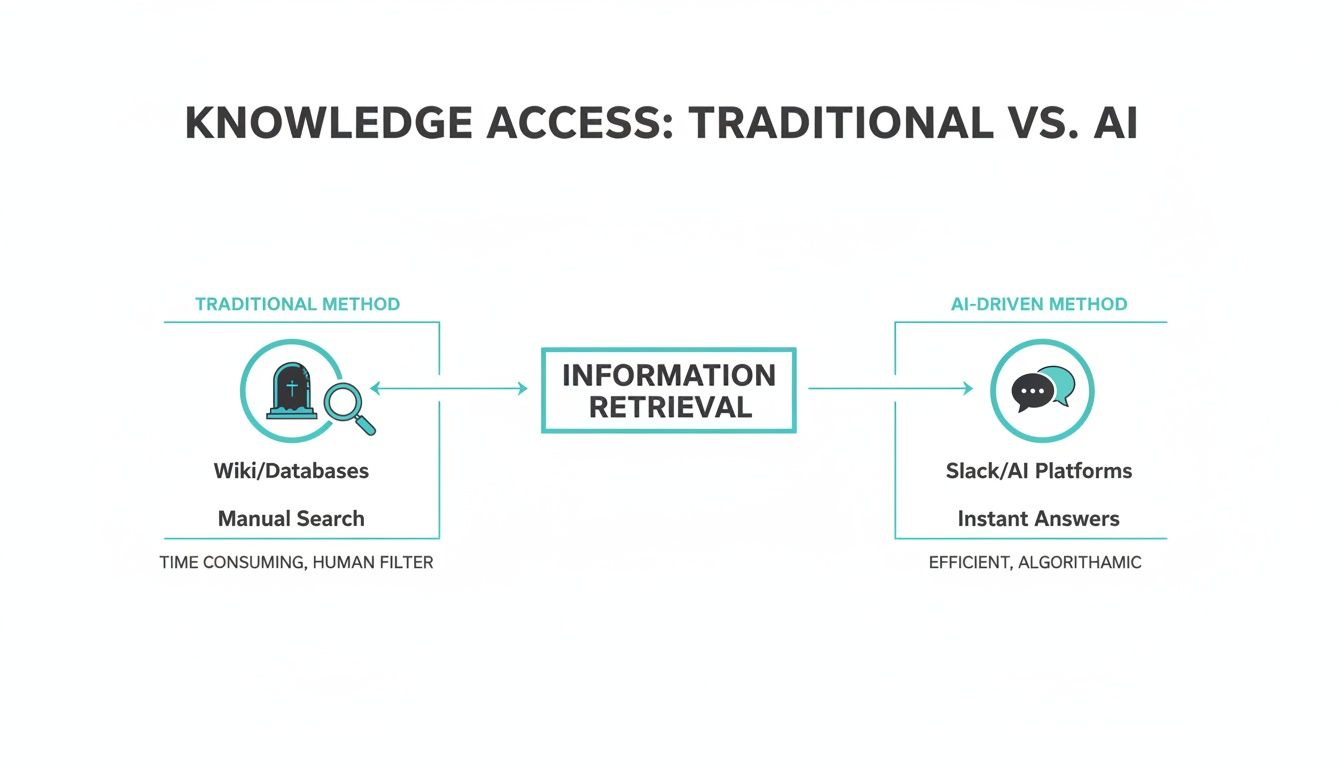
You can see the high-friction journey of traditional wikis on one side, contrasted with the direct, AI-powered path to instant answers right inside Slack.
Instant Knowledge Retrieval
The second pillar is instant retrieval. Captured knowledge is useless if finding it is still a pain. This is where your strategy moves knowledge from being a destination you have to visit to a service that comes to you.
Imagine asking a question in plain English and getting a direct answer, not a list of links to sift through. This is the end of keyword guessing games. A modern system understands what you're asking and provides the information you need, right in your workflow.
The goal is to make getting information as simple as asking a question. When the answer arrives in seconds, directly in your workflow, you eliminate context switching and keep your team focused on what matters.
This is the ultimate payoff for your team. Zero time spent searching means more time spent doing. Questions are no longer roadblocks; they're just quick checkpoints on the way to getting things done.
Continuous Improvement
The final pillar is continuous improvement. A static knowledge base is a dying knowledge base. Information changes, processes evolve, and new questions pop up every single day. Your knowledge management strategy has to be a living system that gets smarter with every interaction.
This is all about creating a built-in feedback loop. When the system surfaces an answer, team members can quickly verify its accuracy or suggest a better one. Every new question and every verified answer sharpens the system's understanding, ensuring the knowledge base doesn't just grow—it actually improves. This iterative process prevents knowledge from going stale and builds real confidence in the answers it provides.
This forward-thinking approach is fueling massive growth, with the global knowledge management software market projected to surge from USD 22.9 billion to USD 81.9 billion by 2035. This boom is driven by the shift to digital workplaces where sharing knowledge efficiently is no longer optional. For Slack-first teams, it highlights just how critical a strategy of knowledge management is for turning conversations into a reliable, ever-improving brain for the company. You can discover more insights about this growing market and see why the timing couldn't be better.
How to Build Your Answer Engine in Slack
The theory behind a modern knowledge management strategy is great, but its real magic lies in the day-one impact. This isn't some six-month migration project or a convoluted software rollout. It’s about making one small, smart change right where your team already lives—Slack—and seeing the results almost instantly.
You don’t need to boil the ocean here. The path to instant answers starts with solving just one painful, recurring problem. Forget trying to document everything. Instead, focus on automating the answers that will give your team the most time back, starting today.

Step 1: Pinpoint Your Biggest Knowledge Bottleneck
Before you touch any tools, you need to find the single biggest source of repetitive questions in your workspace. Where does that endless loop of Where do I find...
or Who knows about...
grind things to a halt? Just think about the Slack channels that feel like a broken record.
This is your ground zero—your high-impact zone. By zeroing in on this one area first, you practically guarantee a quick, visible win that builds momentum for everyone else.
Common bottlenecks usually hang out in channels like these:
* A busy support channel: Agents are constantly typing out the same answers to questions about features, pricing, or basic troubleshooting.
* An HR or ops channel: It’s a constant stream of questions about company policies, benefits, expense reports, or office logistics.
* A new hire onboarding channel: Every new employee asks the exact same set of questions during their first few weeks.
* A technical or engineering channel: Junior devs repeatedly ping senior team members for setup instructions or best practices.
Just pick one. The goal is to solve a real, tangible problem, and fast.
Step 2: Let the AI Learn from Your Team
Once you’ve picked your channel, the next step is deceptively simple: you add an AI tool like SAI directly to it. That’s it. There’s no manual setup, no uploading documents, and no forcing your team to learn yet another piece of software.
This is a fundamental shift from old-school knowledge management. Instead of demanding people change their habits, the technology adapts to how they already work.
The system immediately starts learning from the existing conversation history in that channel. Every question that has ever been asked and answered by your experts becomes its initial knowledge base. The value is created instantly.
This process transforms years of scattered, conversational know-how into a structured, searchable brain for your team—all without a single minute of manual data entry. You can get a closer look at how this works in this AI in Slack knowledge base example that delivers instant answers.
Step 3: Ask Your First Question and See the Magic
This is the moment of truth. With the AI listening in your chosen channel, you get to see the transformation happen in real time. Go ahead, ask one of those common, repetitive questions you identified earlier.
Instead of waiting for a busy colleague to stop what they're doing and reply, you get an immediate, accurate answer synthesized from all those past conversations.
Imagine the collective sigh of relief. The endless interruption loop is finally broken. The senior engineer isn't pulled away to explain the dev environment setup for the tenth time. The HR manager doesn't have to copy and paste the link to the benefits portal again. Everyone gets to stay focused on what they were hired to do.
Step 4: Champion the Change as a Time-Saver
With a clear, visible win in one channel, it's time to share the good news. The key is to frame this not as another tool
but as a way to give everyone their most valuable resource back: time.
When you introduce this to other teams, don't talk about features. Talk about the results.
-
We've cut out **70% of repetitive questions** in the support channel, freeing up our agents to tackle the tough customer issues.
-
New hires are finding what they need in minutes, not days.
-
Our senior team can finally focus on innovation instead of being a human FAQ.
The best knowledge management strategy doesn't feel like a top-down mandate. It feels like a helping hand. It starts small, delivers undeniable value from day one, and grows organically as other teams see just how much friction it removes from their daily grind.
Measure the True Impact on Your Business
How do you really know if your knowledge management strategy is working? For too long, we’ve been fooled by vanity metrics. Think number of articles created
or documents uploaded.
These numbers might look good on a slide deck, but they tell you absolutely nothing about the impact on your team’s daily grind.
A modern strategy needs modern metrics. It's not about counting things anymore; it's about measuring the fundamental shift in how your business runs. The real goal is to prove its worth with hard data that shows your team is faster, smarter, and more focused than ever before.
This is a complete pivot from tracking busywork to tracking business outcomes. Instead of asking, How much did we document?
you start asking, How much time did we save?
Moving Beyond Vanity Metrics
You'll see true success in the flow of work, not on a sterile dashboard. It's about the quality and speed of your team's output, not the sheer quantity of documentation sitting in a folder somewhere. When knowledge is right there in Slack, you can finally start tracking metrics that tie directly to your bottom line.
A huge part of a modern strategy is consolidating all those scattered tools to unlock real business gains. It's not uncommon to see information chaos; research shows 36% of organizations are juggling three or more knowledge management tools, which just creates more silos.
But when you unify everything, the wins are measurable. 39% of companies who adopt a unified strategy report better business execution, leading to faster decisions and quicker time-to-market. Another 35% see direct improvements in customer support, employee satisfaction, and collaboration. You can dig into the full research on these knowledge management findings to see just how powerful centralization can be.
This is how you finally prove the ROI of your efforts with clear, undeniable data. An AI assistant like SAI is built to surface these exact insights, helping you build a business case that leadership simply can't ignore.
Metrics That Actually Matter
Let's get practical and focus on the outcomes that prove your strategy is delivering real, tangible value. These are the numbers that tell a story of less friction and more productivity.
- Reduced Time-to-Answer: This is the big one. Are people getting help in seconds, not hours or days? Track the time it takes from the moment a question is asked to the moment a correct answer is delivered. A sharp drop here means less waiting, less context switching, and way more momentum.
- Fewer Repetitive Questions: Is your support team or senior staff finally free from answering the same questions over and over again? Keep an eye on the volume of repeat questions in key channels. A successful strategy will show this number plummeting as the AI steps in to handle common queries.
- Faster New Hire Onboarding: How long does it take for a new person to become self-sufficient? Instead of weeks of hand-holding, a powerful knowledge base lets them find their own answers. This metric shows you're shrinking the learning curve and getting new team members making an impact much faster.
These metrics aren't just about efficiency. They point to a healthier, more empowered work culture where everyone has what they need to succeed without creating bottlenecks for others.
Metrics That Matter Old vs. New KM Strategies
The table below really highlights the shift in thinking. It contrasts the old, hollow way of measuring success with the new, impact-focused approach.
| Outdated Metric (The Old Way) | Impactful Metric (The New Way) |
|---|---|
| Number of articles in the wiki | Reduction in time spent searching for answers |
| Page views on the knowledge base | Decrease in repetitive questions asked |
| Number of documents shared | Faster onboarding time for new hires |
Likeson a wiki page |
Higher employee satisfaction scores |
Adopting this perspective changes the entire conversation. Your knowledge management strategy stops being a cost center and becomes a clear driver of business value. You're no longer just managing documents; you're actively removing the friction that holds your team back—and now you have the numbers to prove it.
Frequently Asked Questions
Pivoting to a modern knowledge management strategy can feel like a big leap, especially when your team’s muscle memory involves spelunking through old wikis and shared drives. It’s completely normal to have questions about how this kind of seamless, AI-driven approach actually plays out day-to-day.
Let’s tackle some of the most common questions we hear from teams who are tired of searching and ready to start finding.
Will This AI Replace Our Existing Company Wiki?
Not at all. A better way to think about it is as a smart, fast new layer that sits on top of your existing resources. A tool like SAI is built to grab all the valuable, on-the-fly knowledge that almost never makes it into a formal wiki—we’re talking about the quick questions, the expert tips, and the problem-solving that happens in the middle of a busy Slack thread.
It becomes the team’s first port of call, answering the vast majority of questions right where the work is happening. Your wiki can continue to be the home for deep, structured documentation, while the AI handles the immediate, everyday stuff. The real goal here is to give everyone the fastest possible path to an answer.
How Much Setup or Training Does This Take to Get Started?
This is where the magic really happens. The setup is next to nothing. You just invite an AI assistant into a busy Slack channel, and it starts learning from your team's conversations right away.
There’s no manual data entry, no complex configurations, and zero formal training needed for your team. They just keep working and asking questions like they always have. The system adapts to your team, not the other way around.
How Do We Make Sure the Answers Are Always Accurate?
Accuracy is baked right in through a constant feedback loop. The best knowledge management systems aren't static archives; they're living, breathing things that evolve alongside your team.
When someone asks a question, the AI surfaces an answer based on what it's learned from past conversations. Your own team members can then instantly verify, correct, or add to that answer in the natural flow of work. This community-driven validation keeps the knowledge base fresh and reliable.
Even better, when an expert drops a new, more accurate answer into a Slack channel, the system learns from it and prioritizes that information for future questions. This process actively fights the knowledge decay
that makes old wikis so untrustworthy over time.
Ready to stop the endless search and give your team the gift of instant answers? SAI learns from your Slack conversations to build a knowledge base automatically. Add it to one channel for free and see the difference today at https://sai-bot.ai.