How to Reduce Operational Costs Your Practical Playbook
If you want to get serious about cutting operational costs, you have to look past the obvious line items on your P&L statement. The real money drains aren't always the software licenses or office rent; they're the silent killers of productivity hiding in plain sight. I'm talking about the constant interruptions and the time your best people waste re-explaining the same things over and over.
A real cost-cutting playbook starts right there—by diagnosing the invisible waste.
Pinpoint Your True Operational Costs

It’s easy to focus on cutting a software subscription here or reducing a budget there. But those are just the tip of the iceberg. The financial bleed is happening in the tiny, compounding moments of inefficiency that add up every single day.
Think about one of your developers, deep in a complex coding task. A quick Slack message pops up asking for a link to a spec doc. The question takes ten seconds to answer, but it completely shatters their concentration. It's not an exaggeration—studies show it can take over 23 minutes to get back into that state of deep focus.
That lost time is a massive, un-budgeted operational cost.
The High Price of Daily Interruptions
These little disruptions are more than just annoying; they're a direct hit to your bottom line. They create what I call knowledge friction
—the constant, low-level struggle to find basic information. This friction slows down projects, burns out your team, and forces your most valuable people into roles they were never hired for.
Picture a new marketing hire trying to figure out your campaign launch process. They spend half a day digging through a messy Google Drive, pinging colleagues, and dropping questions in a public Slack channel. Each one of those questions interrupts a senior team member, pulling them away from high-impact work to become a glorified human search engine.
This exact scenario is playing out in every department, every single day. The cost isn't just the few minutes spent answering the question. It's the opportunity cost of what your most skilled—and most expensive—people could have been doing instead.
Moving Beyond Spreadsheets To Find Real Waste
To find these hidden costs, you have to stop looking at spreadsheets and start looking at how your team actually works. Where are the bottlenecks? What questions pop up again and again?
To help you get started, I’ve put together a quick table to diagnose the most common—and often overlooked—sources of operational waste.
| Identifying Your Top Operational Cost Drivers |
|---|
| Cost Driver |
| Repetitive Questions |
| Knowledge Silos |
| Constant Context Switching |
| Manual Data Entry |
| Inefficient Meetings |
Recognizing these patterns is the first step. You're not just finding problems; you're uncovering opportunities to build a smarter, more efficient system.
This isn't about blaming people. It's about fixing broken processes that force good people into bad habits. The goal is to make your team's collective knowledge durable and instantly accessible. When a question is answered once, it should be captured and reusable for everyone, forever.
By mapping these daily inefficiencies, you get a crystal-clear picture of your true operational burdens. This detailed diagnosis is the essential foundation for any meaningful change.
It also gives you a healthier way to think about performance. By focusing on removing these blockers, you'll naturally learn how to measure team productivity without micromanaging, because you're enabling output instead of tracking busywork. Once you’ve pinpointed where the real waste is, you can finally build a strategic plan to eliminate it for good.
Secure Quick Wins by Streamlining Daily Work

Once you've figured out where the money is really going, don't jump straight into a massive, complex overhaul. The best place to start is with the low-hanging fruit—those small, repetitive tasks that quietly eat up countless hours every single month. These are your quick wins, the kind that build momentum and show your team an immediate, positive impact.
Forget about a six-month software implementation for a second. Instead, picture your finance team getting a full day back every week because they no longer have to manually chase down and approve expense reports. This isn't some futuristic dream; it’s what happens when you get serious about streamlining daily work.
These small victories are crucial. They directly attack the operational friction your team feels every single day, and when people see their daily headaches disappear, they become your biggest champions for the larger changes to come.
Target the Silent Time Killers First
The biggest opportunities for quick wins are almost always hiding in plain sight. You’ll find them in the manual data entry, the convoluted approval chains, and the inefficient communication habits that have become just how we do things around here.
Take the common project kickoff, for example. A project manager might burn hours creating a new plan from scratch, hunting down the right people for sign-off, and manually plugging tasks into a project management tool. This kind of repetitive, manual slog is a perfect target.
You can completely transform this process with standardized templates and some simple automation. The goal is to stop forcing people to reinvent the wheel for routine work. Here are a few high-impact areas to look at first:
- Standardized Project Templates: Create pre-built plans for common projects with task lists, timelines, and stakeholders already mapped out. This move alone slashes meeting prep time and ensures nothing gets missed.
- Automated Approval Workflows: Use simple tools you probably already have—like Slack or your project management platform—to automate requests and approvals. No more bottlenecks.
- Centralized Documentation: Instead of letting key info get lost on individual hard drives, create a single, accessible home for all essential documents and procedures.
These aren't expensive changes. They are smart shifts in process that unlock immediate efficiency and prove you’re serious about cutting costs in a way that actually helps your team.
The most powerful quick wins come from eliminating tasks that nobody wants to do in the first place. By automating tedious work, you free up your team’s brainpower for the creative, strategic thinking you hired them for.
From Manual Effort to Smart Systems
Let me give you a real-world example. A mid-sized marketing agency I worked with realized their content approval process was a total mess. An article would get passed around in a never-ending email chain, feedback would get lost, and nobody knew which version was the latest. It was a classic operational bottleneck.
Their solution was simple but incredibly effective. They set up a clear, three-step approval workflow directly within their content management system. This one change instantly clarified who needed to review what and by when, cutting their average approval time by 50%.
That’s a quick win. It didn't require a new software subscription or months of training—just a smarter process.
Along the same lines, developing clear documentation is a powerful way to kill recurring questions. If your team is constantly explaining the same things over and over, you’ll find that building a library of how-to guides for standard operating procedures can save dozens of hours each month.
By tackling these smaller, visible inefficiencies first, you get two things done. You immediately lower your costs by cutting down on wasted time. And just as importantly, you start building a culture where everyone is on the lookout for smarter ways to work—a foundation you'll need before moving on to bigger, more systemic changes.
Wipe Out Costly Interruptions by Putting AI in Slack

Alright, we’ve talked about streamlining workflows, and that’s a solid start. But it only gets you so far. Now, it’s time to go after the biggest hidden cost in almost every company: the constant, soul-crushing search for information.
Imagine a workday where your team never has to dig through another Confluence space, hunt for a Google Doc, or ping a colleague just to find a simple answer. It's not a fantasy. It’s the transformation you see when your company's main communication hub becomes its single source of truth.
The operational cost of this knowledge friction
is massive. Every time someone asks, Where's the latest sales deck?
or Who approves PTO requests?
it sets off a domino effect of wasted time and broken focus for multiple people.
What Instant Answers Actually Look Like
This is where integrating an AI assistant like SAI directly into Slack changes everything. And no, this isn't about adding another tool to the pile. It's about making the one tool your team already lives in exponentially smarter.
Forget hunting across ten different platforms. Imagine your team just asking a question in a Slack channel. SAI instantly finds the right answer from your company's documents, wikis, and even past conversations, delivering a clear, reliable response in seconds.
The impact is immediate. A new hire can ask about the Wi-Fi password or onboarding docs without ever interrupting their manager. A sales rep can pull up the latest pricing on the fly without derailing an engineer.
This is a monster strategy to reduce operational costs. You're giving every single person on your team what they need most to stay productive: immediate access to the right information, right when they need it.
The Real ROI of Killing Knowledge Friction
The return on investment here is direct and incredibly easy to measure. Just think of the hours your most valuable—and highest-paid—employees get back every single day.
When your senior engineers and managers are no longer a walking help desk, they can finally focus on the high-value, strategic work you hired them to do.
Slashing these repetitive questions isn't just a nice idea; the numbers back it up. A McKinsey report on the state of AI found that 33% of businesses are already using generative AI specifically to cut costs. In areas like supply chain, a massive 41% of companies saw costs drop between 10% and 19% after bringing in AI.
When you get rid of this knowledge friction,
you build a more efficient and autonomous team. The benefits go way beyond just time savings:
- Faster Onboarding: New hires get up to speed in days, not weeks, because they have a 24/7 expert to answer all their basic questions.
- Smarter Decisions: Teams make better, faster calls when they have instant access to accurate data and company policies.
- Less Burnout: You eliminate a huge source of frustration for everyone—both the people asking the questions and the experts who are constantly being interrupted.
This isn’t just about efficiency; it's about creating a saner, more productive work environment.
A New Way to Work
The real shift here is cultural. When information is easy for everyone to find, you break down knowledge silos and stop relying on a few key people. Your team's collective intelligence becomes a permanent, searchable asset—not a fragile resource that walks out the door at 5 PM.
Imagine this: your team never opens another resource. No more searching through multiple places. They just ask SAI in Slack and get the answers they and their team are looking for. This is the future of work, and it's how you build a truly low-friction, scalable operation.
This fundamentally changes how your team gets things done. Project handoffs are smoother. Cross-functional work gets faster because everyone can find the context they need without scheduling another meeting.
You're no longer just answering one-off questions; you're building an intelligent knowledge base that gets smarter with every interaction. For a great look at how this works in the real world, check out this guide on using an AI in Slack knowledge base example that delivers instant answers.
Moving from a reactive ask and wait
culture to a proactive ask and know
model is one of the most powerful moves you can make to cut operational costs for good. It's about giving your team the tools to be their best by removing the single biggest thing holding them back: the hunt for information.
Reshape Your Team for Maximum Efficiency
Once you’ve automated the repetitive workflows and plugged knowledge gaps with AI, you’ve hit an inflection point. It's time to stop seeing your team structure as a fixed cost. Instead, start treating it like the dynamic, powerful asset it is. This isn't about layoffs. It's about a strategic realignment—matching your best talent to your most important business goals.
When the constant noise of manual tasks and repetitive questions finally fades, you get a crystal-clear view of who excels at what. You can elevate your people from being reactive problem-solvers to becoming proactive value-creators. This shift does more than just boost output; it has a huge impact on job satisfaction and retention, which helps you tackle one of the biggest hidden operational costs there is: employee turnover.
From Reactive Support to Proactive Success
Think about your customer support team. A week ago, they were probably drowning in a sea of simple, repetitive questions—password resets, shipping updates, you name it. Now that an AI assistant handles a massive chunk of those queries instantly, what does their day look like?
Suddenly, they have breathing room. They have the space to completely transform their roles. Instead of just putting out fires all day, they can focus on activities that build genuine, long-term customer loyalty and actively reduce churn. This is how a department goes from being a cost center to a profit driver.
Here’s what that transformation looks like in the real world:
- Proactive Client Outreach: Your team can now spot customers who are struggling or at risk of leaving by looking at usage data. They can then reach out with solutions before a problem even arises.
- Strategic Onboarding: They can dedicate serious time to high-value new clients, making sure their first experience is stellar. That initial white-glove treatment pays dividends in customer lifetime value.
- Building a Knowledge Hub: With fewer interruptions, the team can create top-notch tutorials, webinars, and help-desk articles. This not only empowers customers but also reduces future ticket volume.
This isn't just theory. Imagine your support team in Slack finally able to take a breath as AI handles 70% of queries instantly. This mirrors the kind of wins Walmart saw when they put AI to work, driving down costs across the entire business. They achieved a 1.5% reduction in supplier deal costs, 20% lower unit costs through supply chain optimization, and a massive 40% drop in their live agent workload. You can dig into how other companies are getting these kinds of results in these case studies from Coherent Solutions.
Aligning Skills with High-Value Work
And this isn't just about customer support. This principle applies to every single role in your company.
Your senior developers, no longer serving as a human search engine for junior colleagues, can finally get those deep, uninterrupted blocks of focus time they need for real innovation. Your marketing managers can stop fielding endless questions about campaign status and instead spend their time analyzing performance data to make your ad spend work harder.
The goal here is to create an environment where every single person is working at the top of their intelligence and skill set. That's the ultimate form of operational efficiency—and it's a powerful driver of employee engagement.
When you strip away the frustrating, low-value work that causes burnout, you build a more resilient, motivated team. People want to feel like their work actually matters. By automating the drudgery, you’re not just making them more efficient; you’re making their jobs more meaningful. This strategic move is absolutely essential if you’re serious about wanting to reduce operational costs for good, because a happy, engaged team is one that sticks around, saving you a fortune in recruiting and training.
Your 90-Day Plan to Lower Operational Costs
All the strategies we've discussed are powerful on their own. But let's be honest, real, lasting change only happens when you put them into action with a deliberate plan. This is where ideas turn into numbers on a P&L statement.
A scattered, let's try this
approach just won't cut it. To truly reduce operational costs, you need a focused, phased rollout. One that builds momentum and proves its worth every step of the way. This 90-day plan is your roadmap to do exactly that, designed to make a real dent in your expenses within a single business quarter.
We'll break this down into three 30-day sprints. Each has a clear focus, specific actions, and hard metrics so you can move from diagnosis to optimization in a structured, manageable way. This isn’t just about plugging in a new tool; it's about fundamentally rewiring how your team finds information and gets things done.
Phase 1: Diagnose and Discover (Days 1-30)
Your first month is all about gathering intelligence. You have to move beyond gut feelings and assumptions to pinpoint exactly where operational friction is burning cash. The goal here is to build an undeniable business case backed by cold, hard data.
This means you need to become an observer. Watch how your team works, especially in Slack. Look for the patterns of inefficiency we talked about earlier. Who's always asking questions? And more importantly, who is always answering them? I guarantee you'll find that a few key experts are shouldering that burden, creating a massive knowledge bottleneck for everyone else.
To make this real, start a simple audit. Your mission is to identify and quantify the cost of repetitive questions.
- Find the Hotspots: Pinpoint 2-3 of your busiest Slack channels where the same questions pop up over and over again. Think
#it-support,#hr-questions, or a chaotic project channel. - Track the Questions: For just two weeks, log every recurring question you see. A simple spreadsheet will do. Note the question, who asked, and who answered.
- Talk to Your Experts: Sit down with the people who are constantly answering these questions. Ask them point-blank:
How much time do you spend on this every day?
Then ask them what high-value work gets pushed aside because of it.
By the end of this phase, you won't just feel like there's a problem—you'll have a documented list of the top 10-15 questions that are draining hours of productivity from your team every single week. This data is the ammunition you need for everything that follows.
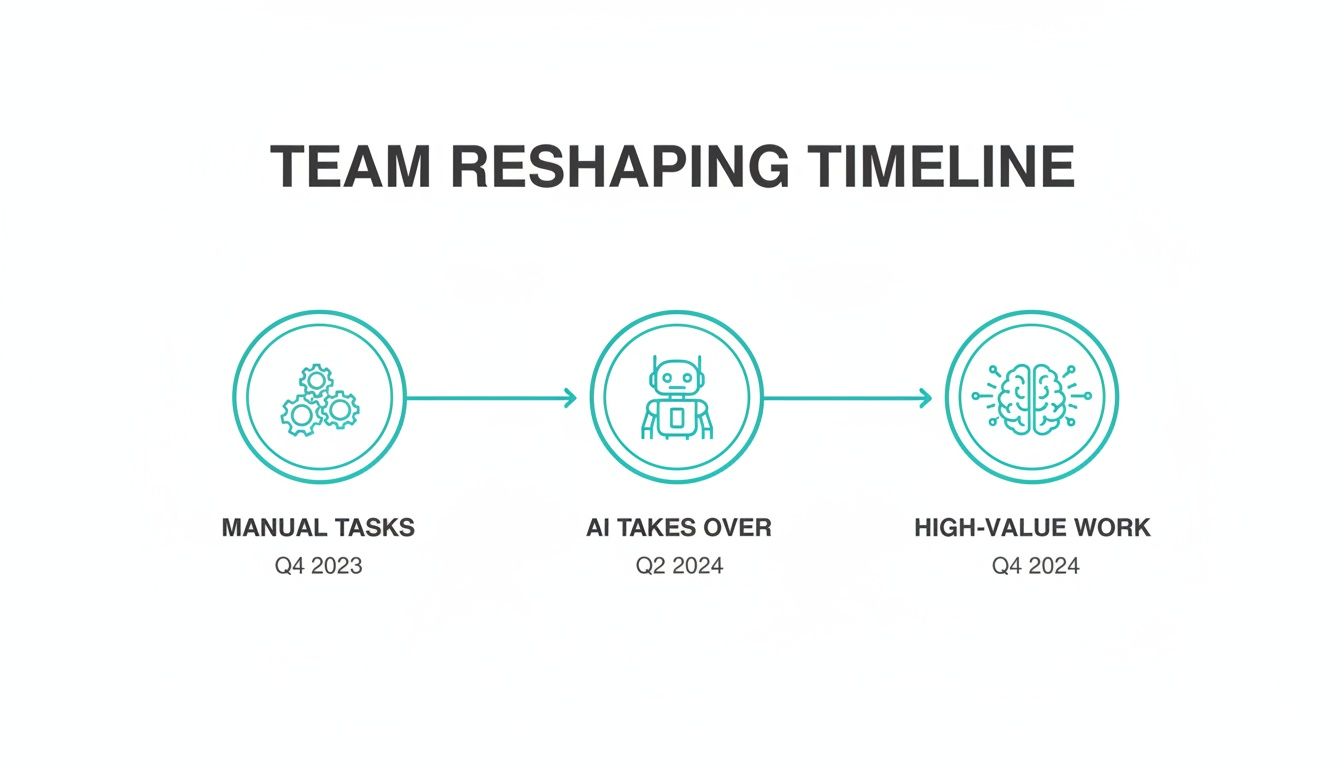
This timeline shows exactly what we're aiming for: a clear shift where smart automation handles the grunt work, freeing up your talented people to focus on innovation and complex problem-solving.
Phase 2: Implement and Empower (Days 31-60)
Alright, you've got your data. Now it's go-time. This month is all about launching a small, focused pilot program to prove the concept and score a quick, undeniable win. This is how you build excitement and make the case for a company-wide rollout.
This is where you bring in an AI assistant like SAI. But don't just dump it into your entire workspace and hope for the best. Pick one of the high-traffic channels you identified in Phase 1—the one with the most painful, repetitive questions and a clear expert
who is feeling the burn. This targeted strike minimizes disruption and makes measuring the impact incredibly easy.
Your mission is to solve a specific problem for a specific group of people.
- Pick Your Pilot Team: Choose the team or channel that stands to gain the most, right away. An IT helpdesk or a customer support team are almost always perfect candidates.
- Deploy SAI to the Channel: Add the AI assistant to that single Slack channel. Because SAI learns from your existing conversations and documents, there's no complex, drawn-out setup. It starts providing value almost immediately.
- Train Your Expert: The key to adoption is making your resident expert the hero. Show them how to verify SAI's answers with a simple click. Every time they confirm an answer is correct, the AI gets smarter and more reliable. Their job description shifts from being a human search engine to being a knowledge curator.
This is where the magic happens. You're not just deflecting questions; you're building a living, intelligent knowledge base that works 24/7. The expert gets their time back, and the rest of the team gets instant, accurate answers without interrupting anyone.
Phase 3: Measure and Optimize (Days 61-90)
The final month is all about proving it worked and planning your next move. You've launched the solution, and now you need to quantify the results to demonstrate a clear return on investment. This is how you get the budget and buy-in to expand this across the entire organization.
Go back to the same metrics you tracked in Phase 1. The before and after
picture should be dramatic. The flood of repetitive questions in your pilot channel should have slowed to a trickle, and the time-to-answer for common issues should be almost zero.
Here's how you nail down the value and build your case for scaling up.
- Measure Question Reduction: Compare the number of repetitive questions in the pilot channel from Phase 1 to now. You should see a massive drop—we often see this number exceed 70%.
- Calculate Time and Money Saved: Check back in with your pilot team's expert. Quantify how many hours they've reclaimed each week. You can translate this directly into salary cost savings and, more importantly, increased capacity for strategic work.
- Survey the Team: Ask the pilot group about their experience. Are they finding info faster? Do they feel less frustrated and more productive? This kind of positive feedback is powerful social proof.
Below is a simple table that lays out this entire process.
90-Day Cost Reduction Rollout Plan
| Phase (Timeline) | Key Actions | Success Metrics |
|---|---|---|
| Phase 1: Diagnose (1-30) | Identify high-traffic channels in Slack. Track repetitive questions for 2 weeks. Interview key experts on time spent. | A documented list of the top 10-15 recurring questions and an estimate of hours lost per week. |
| Phase 2: Implement (31-60) | Select one pilot channel. Deploy SAI. Train the channel's expertto verify answers and build the knowledge base. |
SAI is active in the channel. The expert is confidently verifying answers. Early positive feedback from the team. |
| Phase 3: Measure (61-90) | Re-measure question volume. Calculate expert time saved. Survey the pilot team for satisfaction and productivity gains. | >70% reduction in repetitive questions. Quantified hours/cost saved. A strong business case for expansion. |
By the end of these 90 days, you'll have a clear, data-backed success story that shows exactly how to reduce operational costs. You've gone from diagnosing a hidden problem to implementing a targeted fix and measuring its direct financial and productivity impact. This is your playbook for building a leaner, smarter, and more efficient organization.
Common Questions Answered
Starting a big cost-saving push can feel like a heavy lift. It's totally normal for questions and a bit of uncertainty to pop up, both for you and your team. Let's tackle the most common ones I hear from managers right out of the gate.
How Do I Get My Team On Board (Without Them Thinking Layoffs Are Coming)?
This is, without a doubt, the most important conversation you'll have. You have to get out in front of it, and be direct.
The key is to frame this whole effort around eliminating the frustrating, soul-crushing work, not eliminating people. Talk about getting rid of the tedious tasks and constant shoulder-taps that prevent them from doing the interesting, high-impact stuff they were actually hired for.
But talking isn't enough—you have to prove it. Your first move should be to target a process that everyone on the team collectively despises. Maybe it's a ridiculous expense reporting workflow or a manual report that takes hours to pull together. Once they physically feel that pain point disappear, the lightbulb goes on. They'll see this is about making their work life better, not just slashing budgets.
Your message needs to be crystal clear:
We're investing in you. We're getting better tools and systems to make your jobs less frustrating and more rewarding.This reframes the entire conversation from fear to opportunity.
Is Another AI Tool Just Going to Create More Work?
It's a fair question. No one wants another complicated piece of software to learn, another login to forget, or another system to manage. The last thing you need is a solution
that adds to the team's workload.
That's why the type of tool matters so much. A good AI assistant, like SAI, is designed to be invisible. It lives right where your team already collaborates—inside Slack.
There’s no new app to download or separate website to log into. It simply learns from the conversations and documents you already have. The only real task
is for your subject matter experts to occasionally click a button to verify an answer is correct, which then instantly makes the AI smarter for the entire company. It’s a tiny bit of effort that pays off massively by turning a one-off answer into a permanent knowledge asset.
How Fast Will We Actually See a Return on This?
When you’re tackling knowledge friction and repetitive questions, the payback is fast. I’m not talking about waiting a full quarter to see the needle move; you’ll feel the impact almost immediately, and it just keeps growing.
Here’s a realistic timeline:
- In the first week: Your pilot team will notice a real drop in repeat questions. Your senior people will get a surprising amount of focus time back right away.
- In the first month: Any new hires on that team will get up to speed much faster because they can find answers themselves instead of constantly interrupting colleagues.
- In the first quarter: That time you've saved starts showing up in tangible ways—projects move quicker, and your team has more capacity for the work that actually grows the business.
The true ROI isn't just about the hours you get back. It's about increasing the speed and agility of your entire operation. When information is instantly accessible, every single thing you do becomes faster and cheaper. This is how you reduce operational costs in a way that actually accelerates your growth.
Ready to stop the endless searching and give your team the instant answers they need? See how SAI can turn your Slack workspace into a powerhouse of knowledge and help you cut operational costs for good. Add it to a channel for free today.