How to write standard operating procedure: A practical guide
Writing a great standard operating procedure is about more than just listing steps. It starts with nailing down the purpose and scope, then picking the brains of your in-house experts to gather the real-world details. From there, it's all about structuring the document for pure clarity and writing the instructions in simple, actionable language.
The whole point is to create a guide that anyone on your team can pick up and use to get a task done right—every single time. That consistency is the secret sauce for scaling your operations without everything falling apart.
Escape the Endless Loop of Repetitive Questions

It’s Tuesday morning. You're finally in the zone, deep into a critical project, and then… ping. A Slack notification. It’s the new hire, asking for the fifth time this week how to access the client reporting dashboard. You let out a sigh, your concentration shatters, and you find yourself typing out the same instructions you’ve already shared a dozen times.
This isn’t just a minor annoyance; it's a silent productivity killer. Each little interruption forces a context switch, and studies show it can take over 23 minutes to get back into a state of deep focus after a distraction. When your team is constantly tapping you on the shoulder for the same information, that lost time snowballs into hours of wasted potential.
The True Cost of Undocumented Knowledge
The damage goes way beyond just lost minutes. When crucial processes live only inside the heads of a few key people, your entire operation is running on borrowed time. This tribal knowledge
creates massive bottlenecks and risks that actively hold back your growth.
Without clear, accessible procedures, you're inviting a whole host of problems:
* Constant Interruptions: Your senior people turn into human search engines, pulled away from high-value work to answer the same old questions about logins, workflows, and policies.
* Inconsistent Outcomes: Tasks get done differently depending on who’s doing them. This leads to unpredictable quality, confused clients, and frustrating rework.
* Delayed Projects: A simple step can become a major roadblock. A project might grind to a halt just because the one person who knows how to generate a specific report is on vacation.
* Painful Onboarding: New hires feel lost and unproductive. They spend their first few weeks hunting down basic info instead of actually contributing.
This kind of chaotic environment breeds a culture of dependence and frustration. Nobody can act autonomously because they don't have the information they need to move forward with confidence.
The Shift to Instant, On-Demand Answers
Now, imagine a different reality. Imagine a day where you never have to search through old documents, ping multiple people, or hunt for an answer in a dozen different places ever again. A new project manager needs to know the client onboarding steps. Instead of digging through a chaotic shared drive or bugging someone in a public channel, they have a single, reliable source for the answer.
Even better, they simply ask an AI assistant like SAI right inside Slack and get an immediate, accurate answer drawn from your team's collective knowledge.
This is the power that well-written SOPs unlock. They aren't just dusty documents collecting cobwebs; they are the fuel for your team's independence and efficiency. When you learn how to write a standard operating procedure that actually works, you’re not just creating a document—you're building a system where answers find your team, right where they work.
By documenting your processes, you create a workplace where focus is protected, and answers are immediate. You shift from a culture of interruption to one of instant resolution, empowering your team to solve problems on their own.
This new way of working frees everyone up to focus on what really matters. Senior staff can finally dedicate their time to big-picture strategy, trusting that the day-to-day tasks are being handled correctly. Meanwhile, junior team members feel empowered and capable from day one. To see this in action, check out our guide on ending repetitive Slack questions for good.
Ultimately, mastering SOPs is your ticket to reclaiming focus, building a more autonomous team, and scaling your business without all the growing pains.
Laying the Groundwork for a Winning SOP
Before you even write a single word, you need a game plan. Let's be honest: a beautifully detailed SOP for the wrong process is just as useless as having no SOP at all. The goal isn't just to document for the sake of it; it's to solve a real, recurring business problem that's actively draining your team's time and energy.
Think about your day-to-day operations. Where do things constantly grind to a halt? What are the questions that keep popping up in Slack, derailing your most focused people? Those pain points are goldmines. Your first SOPs should come from there. Don't start with some massive, company-wide initiative. Instead, hunt for the small, repetitive tasks that cause the most friction.
Identify the Most Painful Processes
Your first mission is to find the processes that are practically begging for documentation. These are often the tasks that seem second nature to your veterans but become black holes of confusion for everyone else. When you document these first, you get an immediate win—fewer interruptions, more consistent results, and a happier team.
Start by looking for these tell-tale signs:
* High-Frequency Questions: Think about what new hires always ask. Which logins or report-generation steps are constant sources of DMs and shoulder taps?
* Tasks with High Error Rates: Where do mistakes happen most often? The process for submitting client invoices or configuring a new software tool might be a prime candidate.
* Processes Reliant on One Person: If Dave from accounting is the only person who knows how to run payroll correctly, that’s a huge risk. Documenting that process removes a critical bottleneck and protects your business.
This isn't about boiling the ocean. It's about putting out the biggest fires first. By targeting these high-impact areas, you build momentum and prove the value of good documentation right out of the gate.
Define a Clear and Realistic Scope
Once you've picked your process, the next critical step is defining its scope. This is exactly where so many teams go wrong. They try to create a single, monstrous document that covers every possible exception and edge case. The result? An intimidating wall of text that nobody ever reads.
Your SOP needs a clear beginning and a clear end. Trying to document everything at once is a recipe for a document that will never get finished—or used.
For example, forget writing an SOP called “Client Management.” It’s too big. Instead, break it down into something like, “How to Onboard a New Enterprise Client.” This smaller scope is manageable to write, far easier to follow, and infinitely more useful for the person actually doing the work. A tight scope keeps your instructions direct, relevant, and actionable.
Know Your Audience Inside and Out
Finally, who is this document actually for? You absolutely have to know your audience. The way you’d write an SOP for a brand-new intern is completely different from how you’d write one for a senior engineer. Your audience dictates everything: the language you use, the level of detail you provide, and the format you choose.
Think about these two scenarios:
* For a new hire: You’ll need to spell out every acronym, avoid jargon like the plague, and probably include screenshots for every single step. Your goal is to leave zero room for guessing.
* For a seasoned expert: You can likely skip the basics. The SOP might just be a high-level checklist—a quick reference to make sure no critical steps are missed during a complex but familiar task.
Getting this foundation right is non-negotiable. It ensures the final document isn’t just another piece of corporate red tape, but a powerful tool your team can actually use. It also means any AI assistant, like SAI, that reads it will be able to give your team accurate answers and help them perform tasks flawlessly.
How to Structure an SOP for Maximum Clarity
A great SOP isn't just about what you write down—it’s about how you organize it. Think of the structure as the skeleton holding your process together. Get it right, and you have a document people actually use. Get it wrong, and it’ll just collect dust in a shared drive.
We’ve all been there, wrestling with confusing instructions. The frustration usually isn't because the information is wrong, but because it’s a jumbled mess. Your team feels the same way. A smart structure makes the whole process feel intuitive, helping everyone from a nervous new hire to an AI assistant like SAI grasp the procedure in seconds.
The Anatomy of a Powerful SOP
The best SOPs, no matter what process they’re for, all share a few foundational elements. These aren't just bureaucratic fluff; each piece plays a critical role in bringing clarity and stopping confusion before it starts. If you're figuring out how to write a standard operating procedure, mastering this anatomy is your first move.
These essential components are your building blocks. Let's break down what a user-friendly SOP needs and why each part is so important for your team.
Key Components of a User-Friendly SOP
| Component | Purpose | Why It Matters for Your Team |
|---|---|---|
| Descriptive Title | To clearly identify the process at a glance. | A specific title like How to Process a Client Refund for a SaaS Subscriptionis searchable and instantly tells someone if they’ve found the right document. Refund SOPdoesn't. |
| Clear Purpose Statement | To explain the whybehind the procedure in one or two sentences. |
This gives the team context. Knowing the goal helps them make better decisions if something unexpected comes up. It’s the difference between blindly following steps and understanding the mission. |
| Scope & Responsibilities | To define the start and end points of the process and who owns each part. | This eliminates the dreaded I thought you were doing thatconversation. It draws clear lines in the sand, preventing tasks from falling through the cracks and making accountability a non-issue. |
| Glossary of Terms | To define any jargon, acronyms, or tool-specific language upfront. | Never assume everyone speaks the same internal language. Defining terms like P2 ticketor push to stagingensures no one gets lost in translation, especially new team members. |
| The Procedure Itself | To provide the detailed, step-by-step instructions. | This is the core of your SOP. It's the actionable part of the guide that turns intent into consistent execution. We'll get into how to nail this part next. |
Putting these pieces together turns your SOP from a simple checklist into a comprehensive, self-contained guide.
The real magic of a well-structured SOP is that it anticipates your team's questions. By providing context, defining terms, and clarifying roles upfront, you remove all the mental roadblocks that stop people from even trying to use it.
Writing Steps People Will Actually Follow
This is where the rubber meets the road. Your instructions have to be simple, direct, and impossible to misread. The easiest way to get there is to embrace a few writing principles that put the user first.
First, always use an active voice and simple language. Instead of writing, The invoice should be submitted by the project manager,
just say, The project manager submits the invoice.
It’s direct and assigns a clear action.
Second, break everything down visually. Use short paragraphs. Use numbered lists for steps that have to happen in order and bullet points for everything else. Visuals are your secret weapon here. A well-placed screenshot or a quick screen recording can explain a tricky step way better than a wall of text ever could. If you want to go deeper on this, check out our guide on the ultimate SOP document format for business clarity.
This isn't just a stylistic choice; it's proven to work. The EPA's comprehensive guidance on SOPs shows that concise, step-by-step formats in an active voice slash procedural errors. Why? Because they specify exact details, like quality checks, which ensures 100% traceability during audits.
When you structure your SOP for clarity, you’re turning a static document into a living, breathing tool that empowers your team and builds a foundation for consistent, high-quality work.
A Practical Guide to Writing Your SOP
This is where the rubber meets the road. It’s the moment your team's operational know-how gets pulled out of people's heads and turned into a real, actionable asset for the entire company. Let’s be clear: writing an SOP isn't about crafting a literary masterpiece. It's about translating expertise into simple, direct instructions that kill the guesswork and empower your team to get things done right.
The writing process itself should reflect that goal. Forget the old-school image of a manager locked in an office, hammering out rules from on high. A truly great SOP comes from teamwork, capturing the messy, on-the-ground reality from the very people who live that process every single day. That collaborative spirit is the secret sauce—it’s what turns a document that could be followed into one that the team actually wants to use.
This flowchart boils the structure down to its three essential parts.
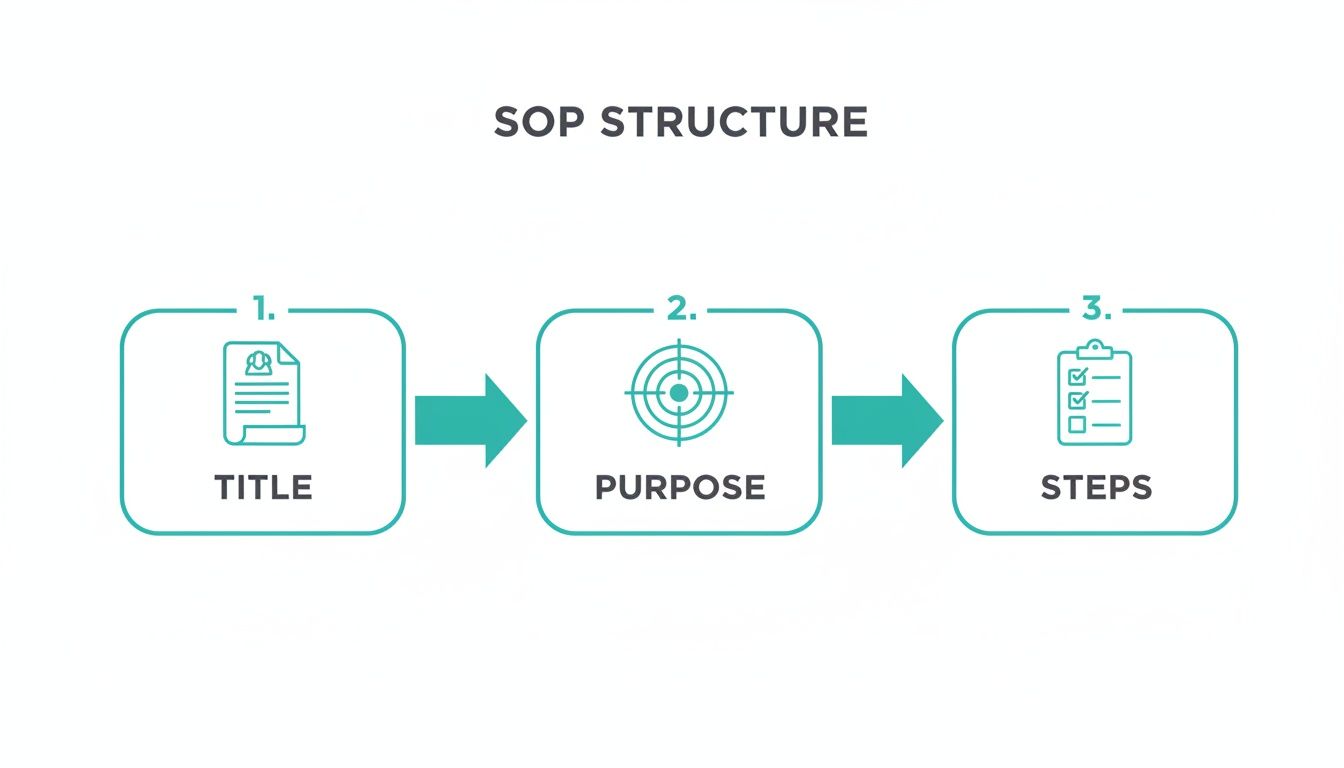
As you can see, a clear title, a sharp purpose, and truly actionable steps are the pillars that make an SOP work.
Start by Talking to Your In-House Experts
Before you type a single word, you need to listen. The most critical process knowledge isn't in a manual—it's locked away with your subject matter experts (SMEs). These are the folks doing the task day in and day out. They know the shortcuts, the common snags, and all the unwritten rules that separate a job done from a job done well.
Pulling them in from the get-go is a non-negotiable, and it wins you two huge advantages:
- You Get It Right: They provide the nitty-gritty details that make the SOP practical, preventing you from documenting some idealized workflow that doesn't actually work in the real world.
- You Get Instant Buy-In: When people help build the process, they own it. They’re far more likely to champion a procedure they had a hand in creating.
Book a quick session to just watch them work. Ask them to narrate what they're doing and, crucially, why they're doing it that way. This is how you capture the context that turns a sterile checklist into a genuinely helpful guide.
Break It Down Into Bite-Sized Steps
Once you've gathered those expert insights, your job is to distill that complex knowledge into a simple, numbered sequence. The aim here is to make the process impossible to screw up. Think of it like a recipe from a good cookbook—each instruction is a single, clear action.
Resist the urge to lump multiple tasks into one step. Instead of writing, Log into the CRM, find the client, and update their info,
you break it down like this:
- Step 1: Open your browser and go to the company CRM.
- Step 2: Enter your username and password to log in.
- Step 3: Use the main search bar to find the client's record by name.
- Step 4: Click the
Edit
button and update the necessary contact fields.
This might feel like over-explaining, but that's exactly what makes an SOP foolproof. It leaves no room for ambiguity, ensuring even a brand-new hire can follow along without getting stuck. Always use simple language and an active voice to keep your instructions direct and easy to scan.
Nail Down Your Review and Approval Process
An SOP draft is just a theory. Before it becomes the official standard, it absolutely must be tested and validated by the people who will actually use it. A half-baked review process can torpedo all your hard work and lead to an inaccurate document that just erodes trust.
Keep your review workflow simple and sharp:
- The
Can You Do It?
Test: Hand the draft to another team member and have them try to complete the task using only your written steps. Did they get stuck? Was anything confusing? This real-world pressure test is the single best way to find the gaps. - The SME's Final Nod: The original expert who helped you should give the final document their seal of approval, confirming it perfectly captures the best way to do the work.
- The Official Sign-Off: Finally, a manager or team lead should give the final approval, officially blessing the SOP as the company standard.
This cycle of writing, testing, and refining does more than just ensure accuracy. It transforms what could be seen as a top-down directive into a team-wide agreement on the best way forward. It builds a culture of shared ownership.
Once it's approved, your SOP is ready for prime time. It becomes the single source of truth that helps your team—and even helpful AI assistants like SAI—get things done right, every single time.
Bringing Your SOPs to Life and Keeping Them Relevant
An SOP sitting in a forgotten folder is just a document. It’s useless. But an SOP that’s woven into your team's daily rhythm? That’s a genuine competitive advantage. This is where the real work begins—taking that guide you’ve carefully crafted and turning it into a cornerstone of your team’s efficiency.
The old way of doing things, like emailing a PDF and just hoping for the best, is a surefire recipe for failure. It just doesn't work anymore. We all live and work in real-time collaboration tools, and your SOPs need to be right there with you.
Imagine this: a new hire needs to process a refund. Instead of nervously tapping a coworker on the shoulder or getting lost in a labyrinth of shared drives, they just ask a tool like SAI directly in Slack: How do I process a refund for a new customer?
And boom—the correct, up-to-date procedure appears instantly, right where they're already working. This isn't just a minor convenience; it's a fundamental shift that ends the endless hunt for information.

It’s this kind of seamless integration that actually gets people to use the resources you build, creating a true single source of truth that everyone trusts.
Cultivating the SOP-First Mindset
Just sending out the SOP isn’t enough. The real mountain to climb is training your team to check the knowledge base first. This is a cultural shift, and it has to start at the top.
Your training sessions shouldn't be a lecture. Nobody wants that. Make it a hands-on workshop where team members actually walk through the new process, using the SOP as their guide. This practical application builds muscle memory and, more importantly, confidence.
After that, you have to model the behavior you want to see. When a team member asks a question in Slack that’s clearly answered in an SOP, resist the urge to just type out the answer. Instead, gently redirect them. Share the link to the procedure or show them how to ask SAI. This simple act reinforces the idea that the knowledge base is the team's primary source of truth, empowering them to find answers on their own next time.
The goal isn't just to teach a process; it's to build a culture of self-sufficiency. When your team trusts the knowledge base, they stop relying on interruptions and start solving problems on their own.
And this isn't just a nice idea—it's backed by data. A landmark 2020 study found that teams using detailed SOPs saw a staggering 40% increase in reproducibility and a 30% decrease in procedural mistakes. For your business, that means fewer errors and smoother, more predictable operations. If you're curious, you can discover more about these findings on SOP effectiveness.
Keeping Your Knowledge Base Alive
An SOP is not a set it and forget it
project. Business needs change, software gets updated, and your team will inevitably find better ways of doing things. An outdated, inaccurate SOP is often worse than having no SOP at all because it kills trust and can lead to costly mistakes.
You need a simple, sustainable system for keeping your documentation fresh. Think of your knowledge base as a living thing that needs to grow with your business, not a digital graveyard of forgotten files. In fact, the process for maintaining your SOPs is just as important as the one for writing them. We cover this in more detail in our guide on how to build a knowledge base that actually gets used.
To get started, put a straightforward review and versioning system in place:
- Schedule Regular Reviews: Assign an
owner
to every SOP. Then, set a recurring calendar reminder for them—maybe quarterly or every six months—to give it a quick review and make sure it's still accurate. - Embrace Feedback: Create a dead-simple way for anyone on the team to suggest an improvement or flag something that's out of date. This makes everyone a stakeholder in the quality of your documentation.
- Manage Versions Clearly: When you update an SOP, use a basic versioning system (like v1.1, v1.2) and add a quick note explaining what changed. This transparency shows the team the information is current and trustworthy.
By taking these final steps, you guarantee that all the hard work you put into writing your SOPs will pay off for years, creating a more resilient and efficient team.
Got Questions About SOPs? We've Got Answers.
Even with the best intentions, diving into SOP creation brings up a lot of questions. Let's tackle some of the most common hurdles I see teams face when they start turning their operational chaos into a well-oiled machine.
How Many SOPs Do We Really Need?
This is the classic how long is a piece of string?
dilemma. The truth is, the right number isn't a number at all—it's about impact. Forget setting a goal to create 50 SOPs. Instead, focus on solving the 5 most painful bottlenecks holding your business back right now.
Start where the friction is highest. What are the repetitive questions that constantly pop up in your Slack channels? Which simple tasks seem to go off the rails time and again, pulling senior team members away from high-value work? Document those first. You'll know you have enough SOPs when your team feels empowered and self-sufficient, not when you check off an arbitrary number on a list.
What if Our Processes Are Constantly Changing?
I hear this a lot, especially from fast-moving startups. But here’s the thing: a dynamic environment is actually the single best argument for having solid SOPs. An SOP isn't meant to be a rulebook carved in stone; think of it as a living document.
Imagine this: Your team isn't digging through old emails or scattered Slack threads, trying to piece together the current process. Instead, there's a single, trusted source of truth. When a process changes, you update one document, and everyone—including an AI assistant like SAI—is immediately on the same page. This agility is what prevents the costly mistakes that happen when people are working off old information.
Your SOPs should be a living system that evolves with your business, ensuring everyone is always working from the most current playbook.
How Do We Get People to Actually Use Them?
Ah, the million-dollar question. The answer comes down to two things: integration and culture. An SOP is only useful if it's easier to consult than it is to tap a coworker on the shoulder (or ping them on Slack). This means your documentation can't be buried in a dusty, forgotten folder on some shared drive.
You have to bring the knowledge to where your team already works. Weaving your SOPs directly into a tool like Slack is an absolute game-changer. When someone can ask a question and get an instant, accurate answer pulled from an SOP without ever leaving their workflow, you’ve won. You've made the right way the easy way.
Here’s the simple reality of getting your team on board:
- Make it effortless: The path of least resistance has to lead directly to the SOP, not a colleague's DMs.
- Lead by example: When a question comes up, leaders and managers should consistently point people to the relevant SOP. This builds the habit.
- Prove the value: Once people see that using SOPs genuinely makes their own jobs easier and faster, adoption will happen naturally.
Ultimately, great SOPs do more than just outline tasks. They create a culture of self-sufficiency and protect your team's most valuable resource: their focused time. By building a system where answers are instant and accessible, you empower everyone to do their best work, free from the constant drag of repetitive questions.
Stop being the human search engine for your team. SAI learns from your Slack conversations to provide instant, accurate answers, turning every question into a permanent part of your knowledge base. Start for free and reclaim your focus with SAI.