Master Strategic Knowledge Management in Slack
Let’s be honest, “knowledge management” can sound a bit stuffy and academic. But what we're really talking about is transforming your team's collective brainpower into your greatest competitive advantage. This isn't about creating more folders or another wiki nobody uses. It’s about ending the daily grind of repetitive questions and constant interruptions so your team can actually get work done.
Imagine a Workday With Zero Repetitive Questions
Think about your team's day-to-day. How many times does someone get pulled away from deep work to answer a question they've answered a dozen times before? Where's the latest project deck?
What's our expense policy again?
Who do I talk to about getting a new license?
Each interruption shatters focus and creates tiny, frustrating delays that add up.
This is the all-too-familiar reality of unmanaged knowledge. Expertise gets trapped in one person's head, and answers exist only as long as it takes to type them in a Slack channel before they disappear forever.
Now, imagine a completely different way of working. A teammate has a question, and instead of pinging a colleague, searching through old files, or opening another app, they just ask SAI in Slack and get an instant, accurate answer. No waiting. No interruptions. No digging through old threads. This isn't a fantasy; it’s the result of a deliberate, strategic approach to how your team’s knowledge flows.

From Information Chaos to Instant Clarity
This is where strategic knowledge management comes in. Forget the jargon—it's a practical game plan for turning your company's scattered information into a reliable, on-demand asset. It moves knowledge out of private DMs and siloed documents into a single source of truth that works for you 24/7.
The benefits aren't just theoretical; they’re immediate and incredibly powerful. You'll see a real shift by:
- Eliminating Information Bottlenecks: Answers are always there, even if your go-to expert is in a meeting, on vacation, or asleep on the other side of the world.
- Reclaiming Valuable Hours: All the time spent asking and re-answering the same old questions gets funneled back into the productive, high-impact work that actually moves the needle.
- Empowering Team Autonomy: New hires and seasoned pros alike can find what they need to make smart decisions and move forward without needing constant hand-holding.
The real goal here is to create a self-service culture. Every question answered becomes a permanent part of your organization's collective intelligence, making the entire team smarter, faster, and more aligned.
Breaking the cycle of repeat questions builds a more resilient and focused team. Ready to see how it's done? Check out our step-by-step guide to ending repetitive Slack questions. It's the first step in moving from a state of constant interruption to one of seamless productivity.
What Strategic Knowledge Management Actually Means
Let’s cut through the jargon. Strategic knowledge management isn’t some stuffy academic concept or just another piece of software to learn. It's the real, operational difference between a team that’s constantly chasing down answers and one that compounds its collective intelligence with every conversation.
Think of your team’s expertise as a river. Without a strategy, every brilliant idea, hard-won answer, and critical decision just flows downstream and disappears forever. A strategic approach is like building a reservoir; it captures that flow so you can tap into it whenever you need it.
It’s about ending the scavenger hunt. Imagine a workday where you never open another resource. No more opening ten different tabs, digging through ancient project folders, or pinging three different people to find one simple answer. The whole rhythm of the workday changes. Instead of searching, you just ask.
The Three Pillars of Modern Knowledge Strategy
The modern approach isn't about creating more work—it’s about eliminating it. It’s a system designed to make your team’s know-how permanent and instantly available by focusing on three pillars that work in harmony:
- Passive Knowledge Capture: This is where the magic happens. Your team's daily Slack conversations, questions, and expert answers are automatically saved and understood. No forms to fill out, no wikis to update. It learns from the work you’re already doing.
- AI-Powered Organization: Behind the scenes, AI is busy categorizing and connecting all this captured knowledge. It gets the context, linking related ideas without anyone having to manually tag a thing or create a single folder.
- Instant On-Demand Delivery: The moment a question comes up, the right, verified answer is delivered instantly, right where the conversation is happening. This means new hires get up to speed faster, support teams give consistent answers, and your whole operation can scale without descending into communication chaos.
This isn't just a nice-to-have—it's a massive profitability engine. The global knowledge management market is exploding, projected to grow from US$885.6 billion to US$2.5 trillion by 2030. That incredible growth points to a simple business truth: companies that get a handle on their collective expertise are the ones winning. You can see the booming market for knowledge management solutions on marketresearch.com for yourself.
From Reactive Answers to a Proactive Asset
Ultimately, strategic knowledge management flips the script. Your team's expertise—their most valuable asset—stops being temporary and siloed. It becomes a permanent, searchable resource that works for you 24/7. It finally puts an end to the soul-crushing cycle of repetitive questions that drain productivity and morale.
This shift means every answer given becomes a long-term asset for the entire company. You answer a question once, and the system ensures no one ever has to ask a colleague for that same information again.
This fundamentally changes how teams work together. It protects your senior experts from being a bottleneck for routine questions, freeing them up to focus on the work that truly matters. You can get a deeper understanding by exploring what a knowledge management system is and how it works. This is how you stop the brain drain and start building a smarter, more efficient organization from the inside out.
The Hidden Costs of Unmanaged Team Knowledge
The real price of poor knowledge management never shows up on a balance sheet. It’s a silent tax on your team’s momentum, morale, and budget. It’s the daily friction that grinds everything to a halt. We tend to focus on the time wasted searching for answers, but the true damage runs much deeper, stalling projects and creating a current of frustration that pulls everyone under.
Think about it. Your top salesperson quotes an old price from a buried Slack message because they couldn't find the latest deck. Or a developer spends an entire afternoon wrestling with a bug that another engineer fixed six months ago, but the solution is lost in a forgotten channel. These aren't just minor hiccups. They're expensive, repetitive failures that happen every single day when there's no strategy in place.
For a new hire, the feeling is even worse. They sit around for hours, waiting for someone to answer a simple setup question, feeling unproductive and like they're bothering everyone. This is the painful reality when knowledge is trapped, temporary, and depends entirely on one person's availability. It’s a workflow built on interruptions.

The Domino Effect of Information Gaps
When your team is flying blind without a strategic knowledge management plan, the problems multiply. It’s not just one person’s wasted time; it’s a domino effect that ripples across the entire organization.
- Decision Paralysis: Projects get stuck in limbo because stakeholders are all working from different, outdated information. Without a single source of truth, no one feels confident enough to make a call, leading to blown deadlines and missed opportunities.
- Inconsistent Customer Experience: When your support agents can't find reliable answers fast, customers get mixed messages. This chips away at their trust and tarnishes your brand's reputation, one frustrating interaction at a time.
- The High Cost of Brain Drain: When a seasoned expert walks out the door, their knowledge walks out with them. The cost isn't just in recruiting a replacement; it's in the months of lost context and the painstaking effort of re-solving problems that were already figured out.
These hidden costs aren't just operational headaches—they directly kneecap your bottom line and your ability to compete. And the market is catching on. The global knowledge management market hit a massive USD 32.94 billion in 2023 and is projected to soar to USD 163.69 billion by 2032. This explosive growth sends a clear message: managing knowledge isn't a luxury anymore; it's essential for survival. You can dig into more details about this market's rapid expansion on zionmarketresearch.com.
Inaction vs. Automation A Clear Choice
Doing nothing is still a choice—and a very expensive one. That daily tax of inefficiency adds up fast, creating a culture of frustration where just finding the right information feels like half the job.
So, what's the alternative? It's not about forcing your team to use yet another tool or manually update a wiki they'll forget about next week. It's about letting them just ask SAI in Slack and get instant answers, pulled directly from your team's collective brain.
The change is huge: you go from a culture of searching and waiting to a culture of asking and doing. Every answer SAI delivers makes the team’s shared knowledge stronger, helping everyone become more autonomous, efficient, and focused.
The choice becomes pretty clear when you see the costs and benefits side-by-side. The following table breaks down the daily pain of doing nothing versus the immediate wins you get with an automated approach.
The True Cost of Knowledge Gaps vs. The Gains from Automation
| Business Pain Point | The Hidden Cost (Without a Strategy) | The Transformation (With Automated Knowledge Management) |
|---|---|---|
| Onboarding New Hires | New team members wait hours for answers, feeling unproductive and isolated. Seniors are constantly interrupted with repetitive questions. | New hires find answers instantly in Slack, becoming productive on day one. Seniors stay focused on high-impact work. |
| Answering Customer Queries | Support agents scramble for answers, leading to slow response times and inconsistent customer service. | Agents get accurate, consistent answers in seconds, leading to faster resolutions and happier customers. |
| Project Decision-Making | Teams work with outdated information, causing rework, delayed decisions, and missed deadlines. | Everyone has access to the latest project specs, decisions, and context, ensuring projects move forward with confidence. |
| Expert Availability | Key information is locked in one person's head. When they're busy or on vacation, everything grinds to a halt. | Expertise is captured and shared automatically. The whole team can access critical knowledge 24/7, with or without the expert. |
| Employee Turnover | When a veteran employee leaves, their knowledge walks out the door, forcing the team to start from scratch. | Valuable knowledge is retained within the system, ensuring continuity and making it easier to ramp up new team members. |
This isn't just about saving a few minutes here and there. It’s about building a smarter, more resilient, and more powerful way to operate.
How AI Puts Knowledge Sharing on Autopilot in Slack
So, the strategy makes sense on paper, but how does it actually play out in a busy workday? This is where we move from theory to reality. Modern strategic knowledge management isn't about giving your team another tedious task. It's about embedding an intelligent partner right into your workflow—one that does the heavy lifting for you, quietly and automatically.
Imagine a world where you and your team never have to leave Slack to find an answer again. An AI assistant is always listening in your channels. It’s not intrusive. It doesn't add to the noise. It simply observes and learns from the natural rhythm of conversation as your experts answer questions. It grasps the context—not just isolated keywords—and locks in the correct answer permanently.
The next time that same question pops up, even if it's phrased a little differently, the AI is ready. It instantly delivers the verified answer, right there in the channel. Forget manual setup or building a wiki from scratch. Your team gets what they need without ever having to leave Slack.
Finally, an End to the Manual Knowledge Base
Let's be honest, the old way of managing knowledge was a real drag. It meant someone had to manually write up documents, meticulously tag articles, and constantly prod people to update a separate system that nobody really wanted to use anyway. That model is fundamentally broken because it treats knowledge sharing as an extra chore on an already packed to-do list.
AI completely flips the script. Instead of you feeding information into a system, the system learns directly from your team's natural workflow.
- Zero Manual Setup: The AI gets to work the moment you add it to a channel, learning from your existing Slack history. It starts delivering value in minutes, not months.
- Context Over Keywords: It's smart enough to understand what people actually mean. A new hire asking,
how do I get my laptop?
gets the same helpful answer as a senior team member asking,what's the IT procurement process?
- Always On, Always Learning: It works around the clock, capturing valuable insights from every conversation. This ensures answers are available instantly, even when your subject matter experts are sound asleep.
This kind of intelligent automation is what closes the gap between having a knowledge strategy and actually executing it. A 2023 global survey revealed that professionals are now prioritizing tech that supports context-driven knowledge management, a trend that accelerated after massive knowledge loss during the Great Resignation. This is precisely the problem that AI solves by turning fleeting conversations into permanent, strategic assets. You can find more details on the state of knowledge management in 2023 on kmglobalnetwork.org.
A Day in the Life with Automated Answers
Let’s make this concrete. Imagine your #customer-support channel. A new agent asks, What's our refund policy for annual subscriptions?
Instead of your team lead having to stop what they're doing to type out the same response for the tenth time, SAI instantly serves up the correct, up-to-date policy.
The change is profound. The agent gets the help they need immediately, the team lead stays focused on high-value work, and a critical piece of knowledge is automatically captured for the next person who needs it.
This is about more than just saving a few minutes here and there. It's about building a smarter, more self-sufficient organization. Every answer the AI delivers reinforces your team's collective brainpower. It protects your most valuable asset—your people's expertise—and puts it at everyone's fingertips, on demand.
The result? A workplace with fewer shoulder taps, faster problem-solving, and a team that can finally focus on work that matters, not on endless scavenger hunts for information. To see exactly how this works, take a look at our guide on how an AI in Slack can serve as a knowledge base example that delivers instant answers. It’s the next logical step toward building a truly knowledgeable team.
Your Simple Roadmap to an Automated Knowledge Base
Putting a strategic knowledge management plan into action can feel like a monster project. But it doesn't have to be. Forget the months-long rollouts and the need for a dedicated project manager. The best way to get started is to start small, prove your value right away, and grow from there—all without derailing your team's existing workflow.
The entire philosophy is built on one simple principle: meet your team where they already work. For most of us, that's Slack. The goal isn't to force people to hunt for information in yet another new tool; it's to bring the answers directly to them. This roadmap is all about making a real, tangible impact from day one.
Start with a Single Source of Pain
Before you do anything else, find the single biggest source of repetitive questions in your workspace. Where’s the most friction? Pinpointing this initial target is the most important step because it guarantees you’re solving a genuine problem that people feel every day.
You might find it in:
- A specific support channel: Something like
#support-requestsor#it-help, where the same questions about setup, access, or common bugs pop up constantly. - An HR or Ops channel: Think
#hr-questionsor#ops-updates, which often get flooded with inquiries about company policies, benefits, or procedures. - A busy project channel: A place where new folks are always asking for context, links to key documents, or updates on decisions made weeks ago.
Once you’ve found this channel, your first move is simple: add an AI assistant like SAI to it. That’s it. No complicated setup, no manual data entry. You’ve just planted the seed for a new way of working.
This approach is designed for simplicity and immediate impact. By focusing on one high-pain area, you create a testing ground to demonstrate clear value before asking for a wider organizational commitment.
From here, the heavy lifting of building your knowledge base happens on its own. The AI gets to work observing conversations, remembering key information, and preparing to answer questions all by itself.
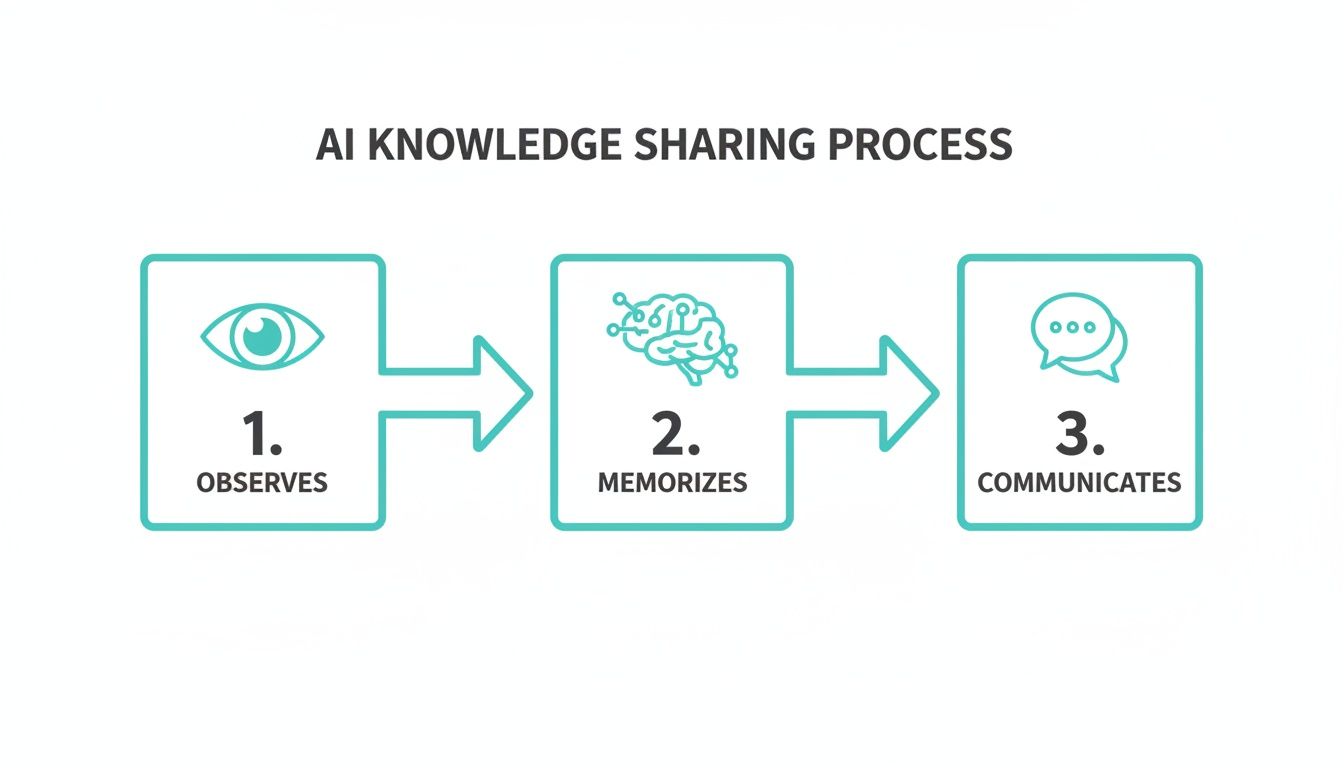
This simple, three-step cycle is the engine of your new knowledge strategy. It turns everyday conversations into a permanent, searchable asset without anyone lifting a finger.
Watch the Magic Happen in Hours
This isn't a check back in a quarter
kind of strategy. Because the AI learns from your existing Slack history, it starts working almost immediately. Within hours of joining a channel, it begins to understand the common questions and the correct answers your team experts have already provided.
The first time it intercepts a repetitive question and answers it correctly is a game-changing moment. Suddenly, your team lead doesn't have to stop what they're doing. The person asking gets an instant response. And everyone else in the channel sees a new, more efficient way of working in action.
You're no longer just talking about the idea of knowledge management; you're showing them what it looks like. That first success is your most powerful tool for getting buy-in.
Expand Organically Based on Success
Once you've proven the value in that first channel, expanding becomes a natural next step, driven by demand rather than some top-down mandate. Other team leads will see the reduction in interruptions and want the same for their channels.
Your roadmap for growth couldn't be simpler:
- Prove the Concept: Let the AI do its thing in your initial target channel. Just track the number of questions it answers automatically.
- Showcase the Wins: Share the results. Highlight the time saved and the noise reduction for your subject matter experts. A quick message like,
**SAI answered 25 support questions on its own this week, saving our team lead about 3 hours**,
is incredibly powerful. - Expand to the Next Pain Point: Work with another team lead to identify their most repetitive channel and add the AI there. Then just repeat the process, building momentum with each success story.
This organic approach ensures your knowledge management system grows because it’s genuinely helping people, not because it’s a corporate initiative. You're improving how your business operates one channel at a time, building a powerful, self-maintaining knowledge base that your team will actually want to use because it makes their lives easier.
Measuring the Success of Your New Strategy
So, how do you actually know if your new approach to knowledge management is paying off? It’s not about counting documents in a forgotten folder or tracking how many people viewed a wiki page last month. The real proof is in the way your team’s workday changes for the better.
You’ll know it’s working when the daily scavenger hunt for information finally stops. Think about it: no more juggling a dozen different apps, digging through old project files, or sending a flurry of Slack messages just to find one simple answer. The new reality is simple: instead of searching everywhere, your team just asks SAI and gets what they need, right in Slack.
This move away from information chaos is the entire point, and it’s something you can tangibly measure. You aren't just adopting a new tool; you're reclaiming your team's most precious asset—their time and focus. The proof isn't buried in some abstract report; it's in the daily, noticeable difference in how work gets done.
Key Metrics That Tell the Real Story
To make a strong case for this investment, you need to track the numbers that truly matter. We're not talking about vanity metrics here. These are the figures that draw a straight line from automated answers to better team performance and less friction in your operations.
Here’s what to focus on:
- Fewer Repetitive Questions: Keep an eye on your busiest Slack channels, like
#it-supportor#hr-questions. A drop in the same old questions popping up again and again is a clear sign that SAI is deflecting interruptions from your experts. - Faster Time-to-Answer: How long does it usually take for someone to get an answer to a common question? With an automated system, the answer arrives instantly. This metric is gold because it proves you're killing off those costly delays and information bottlenecks.
- Quicker New Hire Onboarding: Measure how fast new team members get up to speed. When they can find information on their own without constantly tapping a teammate on the shoulder, their time to become productive shrinks dramatically.
The most convincing data point you'll ever have is the sound of silence. A quieter support channel doesn't mean people have fewer problems—it means they're solving them on their own. That's a massive win for everyone's productivity.
The Human Wins You Can't Ignore
Beyond the hard data, the feedback you get from your team is often the most powerful evidence you have. Your strategic knowledge management is a success when you start hearing people talk about feeling less interrupted and more in control of their own work.
Listen for comments like:
-
I haven't been pulled away to answer that same policy question all week.
-
It's just so much easier to find what I need without bugging anyone.
-
My onboarding was way smoother because I could get answers right away.
This is the human side of your ROI. A team that feels empowered and focused is a team that delivers better work, faster. They're less frustrated and can finally dedicate their brainpower to solving new challenges instead of rehashing old ones. That shift—from a culture of constant interruption to one of confident autonomy—is the true sign of a strategy that works.
Common Questions About Knowledge Management in Slack
Bringing any new strategy into your team's workflow is going to spark a few questions. That’s perfectly normal. When we're talking about something as critical as your team's collective knowledge—especially in a lightning-fast environment like Slack—it's smart to be skeptical. You're looking for a real-world impact, not just another piece of software to manage.
Let's be clear: the objective here isn't to build some clunky, technical knowledge base that nobody ever looks at. It's about creating a workday where you never have to tab over to another resource, hunt through different apps, or dig through a graveyard of old channels ever again. You just ask SAI in Slack and get the right answer, right away.
Will My Team Have to Learn a New Tool?
Nope. Not at all. The entire point of modern strategic knowledge management is to seamlessly fit into your team's existing habits. It meets them right where they’re already working: inside Slack. A good AI solution works quietly in the background, which means there’s no new interface to master or complex workflow to adopt.
Your team keeps asking questions exactly like they do now. The only thing that changes is who answers. Instead of pinging a teammate and waiting around, they get an instant, verified answer from the AI. It's designed to be completely frictionless, making their current process better, not forcing them into a new one.
How Long Does It Take to See Results?
This isn’t one of those maybe in six months
kinds of projects. You can get an AI assistant set up in a single Slack channel in less than a minute. Because it learns directly from the conversations your team is already having, it starts adding value almost immediately.
You'll see a real impact the very first time someone asks a question that's been answered before, and the AI steps in to handle it automatically. Traditional knowledge bases often require months of painstaking manual work before they're even remotely useful. This approach starts paying for itself on day one.
Is Our Team's Conversational Data Secure?
Security is everything. Any enterprise-grade AI tool built for Slack has to be designed with rock-solid security protocols. It should operate completely within the secure walls of your workspace and be built to follow strict data handling policies. All the knowledge it captures is owned by you, and only you.
Your data should only ever be used to provide answers back to your team. It should never, ever be shared externally. When you're looking at different options, make sure they are completely transparent about their security practices and meet modern compliance standards. Your data is your most valuable asset—protect it.
This approach turns your everyday conversations from fleeting moments into a powerful, secure, and instantly accessible resource for everyone.
Ready to stop searching and start knowing? With SAI, you can turn your team’s collective expertise into an on-demand resource that works 24/7. Add it to a single Slack channel for free and see how it ends repetitive questions for good. Get started with SAI today.