Master Your Knowledge Management and Strategy
Picture your workday, but without the chaos. No more frantic digging through shared drives, scrolling endlessly through chat channels, or bugging a coworker and waiting... and waiting. A smart knowledge management and strategy isn't just a nice-to-have; it's what pulls your team out of the constant search cycle and into a state of clear, focused action.
Stop Searching and Start Solving

Think about it. Instead of opening five different tabs just to track down a single stat, you ask a simple question right inside Slack. Rather than interrupting a senior developer for the tenth time about a specific process, the answer you need appears instantly. This isn't some far-off dream—it's the direct result of a strategy that weaves knowledge right into the fabric of your team's daily work.
The real problem for most companies isn't a lack of information. It's the sheer effort required to find it when you need it. A well-known McKinsey study found that employees spend nearly 20% of their time just looking for internal information. That’s a full day every single week, gone. This guide is all about getting that day back.
The True Cost of Disconnected Knowledge
Every minute someone spends searching for an answer is a minute they're not helping a customer, closing a deal, or improving your product. This isn't just a small annoyance; it's a massive drag on productivity, innovation, and even team morale. The constant context-switching kills focus and is a fast track to burnout.
The ripple effects are felt everywhere:
* Onboarding crawls. New hires are left stranded, struggling to find basic info and constantly leaning on others, which slows everyone down.
* Decisions get delayed. When data is all over the place, making a confident, timely call is next to impossible. Opportunities slip away.
* Expertise gets wasted. Your most experienced people become human search engines, pulled away from high-value work to answer the same questions over and over.
The real goal isn't just to create more documents. It's to build a system where the right knowledge finds you at the exact moment you need it, with zero friction.
The difference between a company that struggles with information overload and one that thrives on collective intelligence is stark. It's a fundamental shift in how work gets done.
The Shift From Scattered Information to Centralized Intelligence
| Daily Challenge | The Old Way (The Pain Point) | The New Way (The Strategic Gain) |
|---|---|---|
| Finding a sales process | Scouring old emails and pinging three different people. | Asking SAI in Slack, What are the steps for a new enterprise deal?and getting an instant checklist. |
| Onboarding a new hire | A messy shared folder and a week of shoulder-tapping. | A single, trusted source inside Slack that answers 90% of their initial questions. |
| Solving a support ticket | Searching a clunky, outdated wiki for a similar issue. | Getting an AI-suggested answer from SAI, right within the support channel. |
| Making a data-backed decision | Trying to locate the latest Q3 report across multiple drives. | Instantly pulling the key metrics and summary by asking SAI a simple question. |
This isn't just about saving time; it's about making your entire operation smarter and more agile.
A New Way of Working
A modern knowledge management and strategy completely flips the script. It transitions your company from a culture of searching to a culture of solving. It’s about building a single source of truth that actually works for you, not against you.
Imagine a workday where your team never has to open another resource or search in multiple places for information again. They just ask a question in Slack and get the answer they need from SAI, instantly. The expertise your team already shares every day becomes an organized, accessible asset that helps everyone. To see what this looks like, you can explore platforms built around the end of search and deliver instant answers.
This approach empowers your team to reclaim those lost hours, make smarter decisions, and stay focused on the work that actually moves the needle.
Why Knowledge Management Is Your New Competitive Edge
Let's cut through the jargon. Knowledge management isn't about building a stuffy digital library that no one ever visits. It's about creating a living, breathing system where your team's collective brainpower is captured, shared, and put to work—effortlessly.
Think of it as your company’s external brain. It’s always on, instantly accessible, and constantly getting smarter with every project and conversation. This isn't just a nice-to-have; it's a strategic necessity. The cost of 'lost knowledge' is staggering. Every time a new hire asks the same onboarding question, an expert gets pulled from deep work, or a project stalls because someone can't find that one crucial file, your business bleeds momentum and money.
A smart knowledge management and strategy flips this liability into your greatest asset. It takes all that valuable tribal knowledge
—currently trapped in scattered emails, DMs, and individual hard drives—and turns it into a shared resource that helps everyone work smarter.
From Hidden Answers to Accessible Intelligence
The old way of working forces your team into a frustrating game of hide-and-seek with information. They dig through tangled shared drives, scroll endlessly through Slack channels, and ping colleagues, hoping for a quick answer. This constant search-and-wait cycle doesn't just eat up time; it shatters focus and creates bottlenecks that grind your entire operation to a halt.
Now, imagine a different reality. A place where your team is solving, not searching.
- A junior marketer needs the latest brand guidelines. Instead of shouting into a public channel and waiting, they ask SAI in Slack and get the correct file instantly.
- A support agent hits a tough customer issue. They find the fix in seconds, pulling up insights from a similar problem that a different agent solved weeks ago.
- A sales rep is prepping for a big client call. They pull the most compelling case studies and talking points right from their workflow, without missing a beat.
This isn't magic. It’s the direct result of a strategy built to make knowledge flow frictionlessly to the exact moment it's needed.
The goal is to create an environment where the answer finds you before you even have to ask. It's about building an intelligent system that anticipates what your team needs and delivers clarity on demand.
The Unmistakable Business Impact
When your team can tap into the company’s collective intelligence instantly, the benefits ripple across the entire organization. You’re not just saving a few minutes here and there; you're fundamentally rewiring how work gets done. The result? Measurable improvements where it counts.
This isn't just a niche idea anymore—it's a movement. The global knowledge management market is projected to skyrocket to USD 4,168.52 billion by 2035, growing at a compound annual growth rate of 18.12%. This explosive growth is driven by a simple truth: 62% of enterprises now view knowledge-sharing platforms as a strategic must-have for sharper decision-making and seamless information flow. You can dig deeper into the stats on the booming knowledge management market on Business Research Insights.
By investing in a knowledge management and strategy, you're making a direct investment in your bottom line, your team's sanity, and a more resilient, agile organization ready to outmaneuver the competition.
Build Your Strategy Without the Headache
Let's be honest. The idea of creating a formal knowledge management and strategy probably sounds like a massive, resource-draining project. But what if the best approach wasn’t some top-down, multi-month initiative? What if it started by simply solving the most annoying problems your team faces every single day?
The secret to a strategy that actually works is to start where your team already is—inside their existing workflows. Forget the grand plans for a new, monolithic system that requires weeks of training. A successful strategy begins by identifying your most immediate and painful knowledge gaps.
What questions get asked over and over in your team’s Slack channel? Where do new hires get stuck? What critical information is trapped in one person’s head? Answering these questions is the foundation of a strategy built for immediate impact.
Start With the Real-World Problems
The goal is to build a system that feels completely natural, almost invisible. It shouldn’t feel like another task on someone’s to-do list. Instead, it should be the path of least resistance to getting an answer. Imagine a new reality for your team, one where they never have to think about where to look for information again.
This isn't about forcing people to document every little thing they do. It's about choosing a method that captures knowledge as a natural byproduct of their work. Think of a system that learns directly from the Q&A happening in your Slack conversations, automatically turning those solutions into a searchable, reliable knowledge base—without anyone lifting an extra finger.
When your strategy focuses on making life easier from day one, your team won't just adopt it—they’ll champion it. For a deeper look into the components of such a system, you can explore what makes a knowledge management system truly effective.
A Practical Step-by-Step Approach
Building this kind of strategy is more straightforward than you think. It’s all about focused, iterative improvements, not a giant leap. By breaking it down, you can start delivering real value almost immediately.
Identify the Pain: Just start by listening. Create a simple list of the top 10-15 questions that constantly interrupt your experts and slow down projects. These are your first targets.
Locate the Experts: For each of those questions, who is the go-to person? Pinpoint these key knowledge holders. They're the ones feeling the pain of repetitive interruptions the most, and they have the most to gain.
Define Critical Knowledge: Not all information is created equal. Focus first on the knowledge that unblocks a process, helps close a deal, or solves a common customer issue. Prioritize what's most critical for business operations.
Integrate, Don't Interrupt: Choose tools and processes that fit seamlessly into how your team already works. If your team lives in Slack, your knowledge solution should live there too. Make it effortless.
The most powerful knowledge management strategy is one that removes friction, not adds it. The right approach makes finding information easier than tapping a coworker on the shoulder—that's the real key to getting everyone on board.
This process transforms how your organization uses its collective intelligence. This flow shows how you can turn scattered insights into a real competitive advantage by capturing, sharing, and growing your team's knowledge.
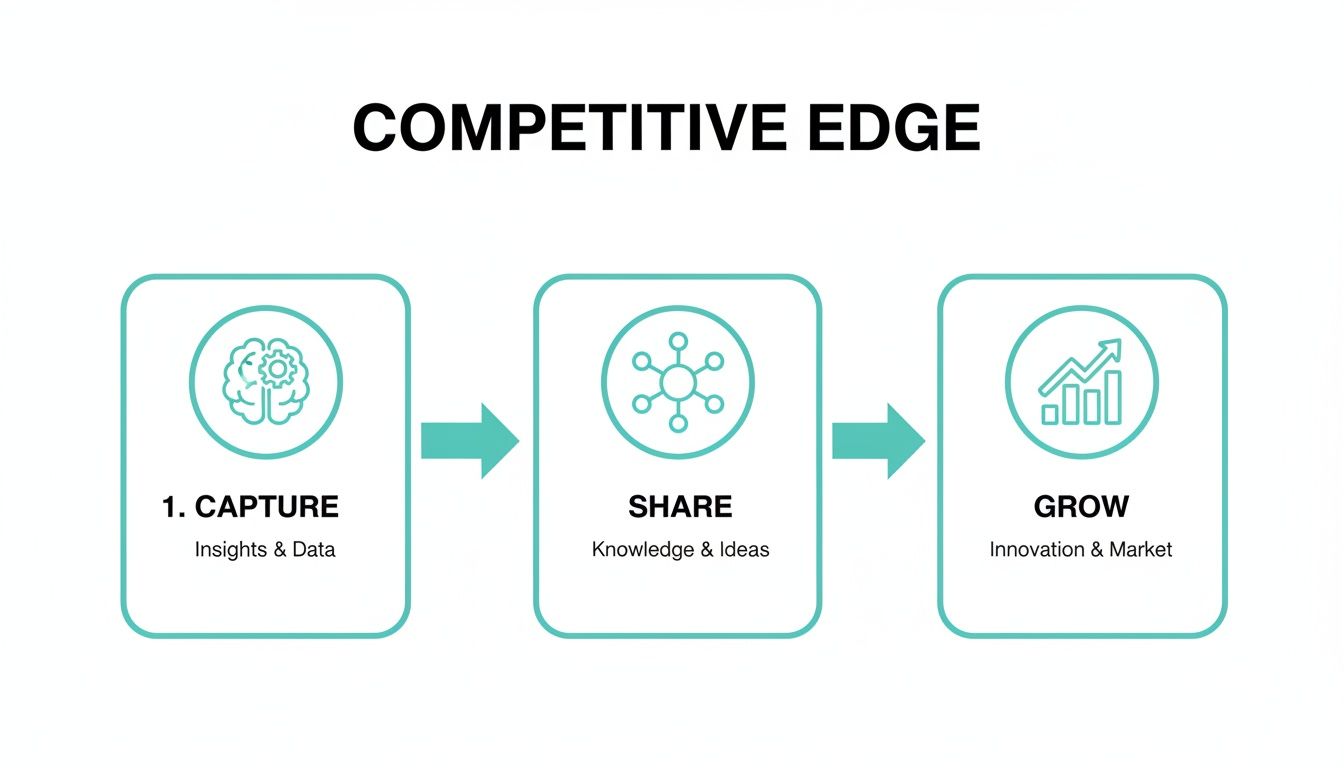
This simple cycle shows that a successful strategy is all about continuous motion: it captures valuable insights, makes them easy to share, and then uses that shared knowledge to fuel growth. By focusing on this flow, you create a self-sustaining system where your team gets smarter and more efficient over time.
The Three Pillars of an Effective Framework
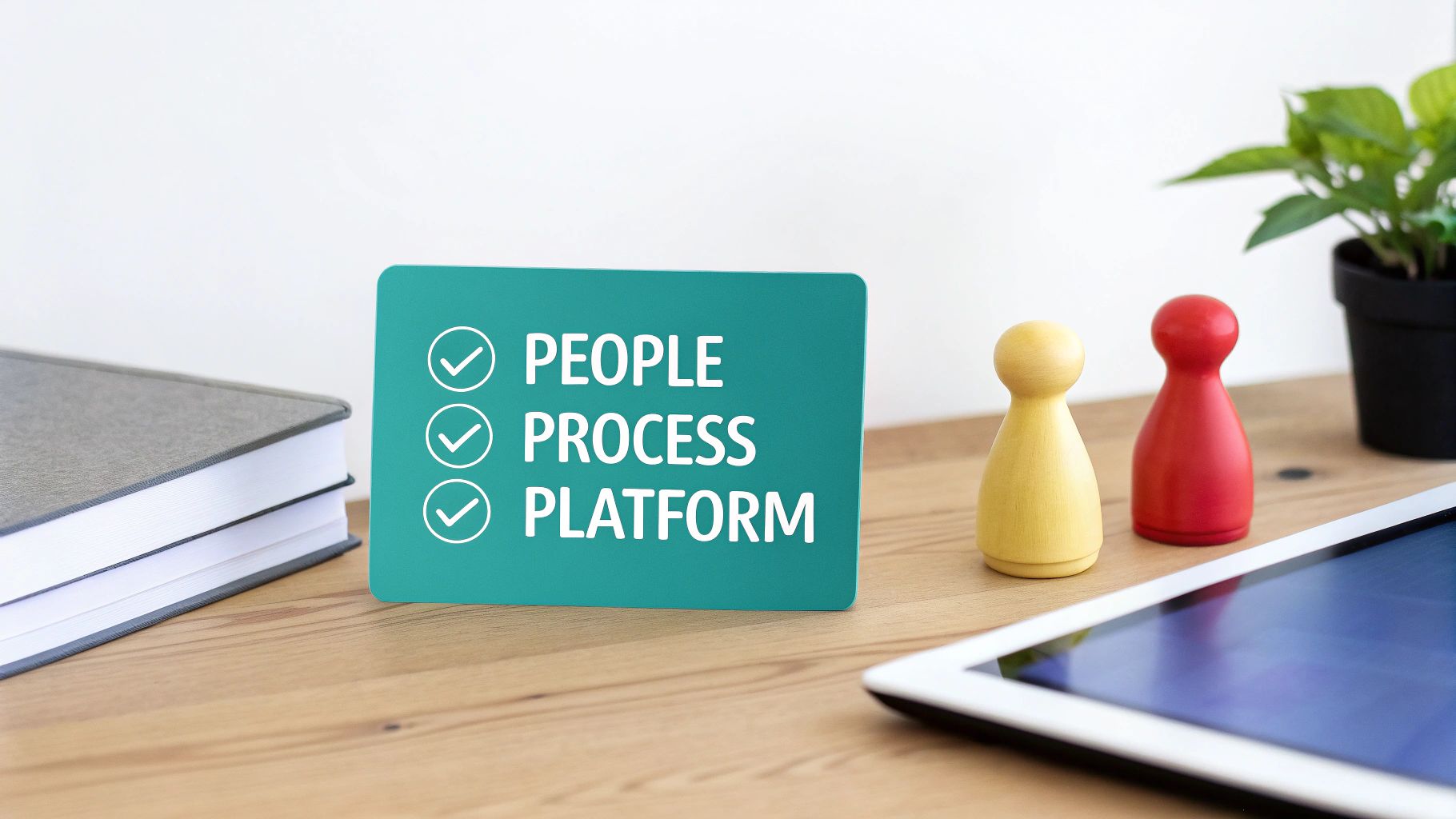
A powerful knowledge management strategy isn't about buying expensive software or writing a hundred-page rulebook. It’s much simpler than that. From what I’ve seen, the most successful programs are built on just three core pillars: People, Process, and Platform.
When these three work in harmony, you create a system that practically runs itself. But if one is out of sync, the entire structure can crumble, no matter how good your intentions are.
Imagine your team no longer having to dig through shared drives, outdated wikis, or endless chat histories. What if they could just ask a question in Slack and get an instant, accurate answer? That’s not a pipe dream. It’s the direct result of aligning these three pillars to make finding information completely effortless.
Pillar 1: People and Culture
Let’s be honest: the most sophisticated tool on the planet is just a paperweight if nobody uses it. This is why people are your true foundation. Your goal is to build a culture where sharing knowledge isn’t a chore—it’s just how things get done.
It's about shifting the entire team’s mindset from hoarding expertise to sharing it openly. This cultural change starts to take root when:
- Asking questions is encouraged. Curiosity becomes a sign of engagement, not a lack of knowledge.
- Sharing answers is rewarded. Experts get recognized for making their knowledge accessible to everyone, not for being the only person with the answer.
- Leadership walks the talk. When managers and executives actively use the system to ask and answer questions, everyone else follows suit.
A healthy knowledge culture changes the core question from
Who knows this?toWhere can I find this?It’s a subtle shift, but it empowers everyone to solve problems on their own.
Pillar 2: Simple and Lightweight Processes
When most people hear the word process,
they think of rigid rules and bureaucracy. That’s the exact opposite of what you want here. The best KM processes are so lightweight they feel invisible.
The goal is to define simple, repeatable ways for knowledge to be captured, verified, and updated without creating extra work for anyone.
Forget nagging your team to spend hours writing articles for a company wiki they’ll never look at again. A modern process should be built around their existing habits. For instance, a tool like SAI can automatically capture valuable Q&A happening right inside Slack, turning everyday conversations into a permanent, searchable knowledge base. No manual entry needed.
The real key is to make sharing knowledge easier than not sharing it. For a deeper dive into creating these kinds of effortless systems, check out our guide on the 10 best practices for knowledge management.
Pillar 3: The Right Platform
Finally, the platform is the technology that brings your people and processes together. This isn't just a folder or a database; it’s the engine that makes knowledge flow. And there’s one golden rule here: meet your team where they already work.
If your company lives and breathes in Slack, trying to force them into a separate platform is a guaranteed recipe for failure. The right platform should feel like a natural extension of their daily conversations, not another tool to learn. It needs to be faster and easier than just asking a coworker for the tenth time.
There’s a reason the knowledge management software market is projected to explode from USD 13.70 billion in 2025 to USD 32.15 billion by 2030. A staggering 62.66% of this market is dominated by cloud-based tools that integrate seamlessly into existing workflows, according to market analysis from Mordor Intelligence. The demand for frictionless solutions is clear.
When you get these three pillars right, you’re not just building a system. You’re cultivating a smarter, faster, and more resilient organization where the right answer is always just one question away.
Measure the Real Impact of Your Knowledge Strategy
So, how do you know if your knowledge management strategy is actually making a difference? You could count system logins or track how many articles get published, but those are just vanity metrics. The real proof isn't buried in a spreadsheet; it’s in the day-to-day transformation of how your team gets work done.
True success is a total shift in how people find answers. It’s the difference between a new hire spending their first week tapping shoulders and a new hire finding everything they need on their own. It’s your senior expert getting a full afternoon of deep, uninterrupted work because they aren’t fielding the same questions over and over again.
From Frustrating Searches to Instant Answers
Picture a workday without any information scavenger hunts. No more frantic digging through shared drives, pinging coworkers for a document, or just waiting for someone to get back to you. The ultimate win is a workplace where your team trusts that the right answer is always one question away—right inside Slack.
Instead of your team wasting nearly 20% of their time just looking for internal information, they're getting those hours back. The best way to show your strategy is working is to tell that story, backed by numbers that reflect actual business outcomes.
The goal isn't just to build a knowledge base. It's to create an environment where repetitive questions disappear, experts are free to innovate, and every team member feels empowered to solve problems on their own.
Key Metrics That Tell the Real Story
To build a compelling business case and show a tangible ROI, you need to focus on outcomes, not just activity. These key performance indicators (KPIs) paint a much clearer picture of how your knowledge strategy is directly improving efficiency and productivity.
Time to First Answer: How quickly can an employee find what they need without having to ask another person? A shrinking
Time to First Answer
proves your knowledge base is becoming the go-to source of truth. It's fast and it's reliable.Ticket and Question Deflection Rate: This is the gold standard for measuring how many interruptions you're eliminating. Track the drop in repetitive questions asked in public channels or sent directly to your experts. Every question deflected is a win for the person who got an instant answer and the expert who wasn't pulled from their work.
New Hire Onboarding Speed: How long does it really take for a new team member to start contributing meaningfully? A solid knowledge strategy shortens this runway dramatically. When new hires can find their own answers, they get up to speed faster and feel more confident from day one.
Building Your Business Case
When you track these kinds of metrics, you can tell a much more powerful story. Instead of just saying, We created 50 new articles,
you can say, **We cut repetitive questions in our main support channel by 40%**, which gave our senior engineers back five hours a week to focus on the new product release.
This is how you prove that your KM strategy isn't just another IT project—it's a fundamental driver of business growth. By focusing on the tangible improvements in your team's daily grind, you show everyone how a seamless flow of knowledge is your company’s most valuable asset.
Common Knowledge Management Pitfalls to Avoid
Launching a new knowledge management initiative is always exciting. But the truth is, many of them fail. It's rarely because the core idea is wrong; it's usually because of a few common, and totally avoidable, missteps.
The biggest trap? Thinking of KM as a one-and-done project. You're not just building a static library of documents that will gather dust. The goal is to nurture a living, breathing system that genuinely makes your team's day-to-day work easier.
Another classic mistake is picking a tool that’s a pain to use. If your team has to jump out of their workflow, log into some clunky platform, and manually document every little insight, they just won't do it. Your shiny new system will quickly turn into a digital graveyard, and you'll be right back at square one.
Ignoring the Human Element
Here’s a hard truth: the best technology in the world can't fix a culture of information hoarding. A successful knowledge management and strategy is built on a foundation of trust, where people feel safe and encouraged to share what they know.
Without genuine buy-in from leadership and a clear answer to the what's in it for me?
question, your team will see this as just another box-ticking exercise. This cultural piece is everything. You're trying to shift the entire mindset from my knowledge is my power
to our collective intelligence is our greatest asset.
A knowledge management system should feel invisible. It should work for your team, not the other way around. The moment it feels like extra work, you’ve lost the battle for adoption.
Focusing on Documentation Over Conversation
So many old-school approaches fail because they ask people to stop what they're doing to write things down. But think about where the most valuable knowledge actually lives. It’s not in perfectly polished articles; it's in the quick, informal conversations happening all day long, especially in tools like Slack.
Instead of forcing a rigid documentation process on everyone, a much smarter approach is to capture knowledge directly from those interactions. Imagine if every question asked and answered in a Slack channel automatically became a searchable, intelligent resource. That's how you eliminate the friction.
This move toward automated, integrated systems is what’s fueling the massive growth in this space. The entire knowledge management market is expected to rocket from USD 42.8 billion in 2024 to USD 143.3 billion by 2032. A huge chunk of that growth is coming from services that help companies weave these systems into their existing workflows, avoiding the very pitfalls we're talking about. You can dig into more stats about the booming knowledge management market on Verified Market Research.
By understanding these traps—treating it like a project, picking the wrong tools, and ignoring the culture—you can build a strategy that’s resilient, user-friendly, and set up for long-term success.
Frequently Asked Questions
Putting a new knowledge management strategy into practice always raises a few good questions. Let's tackle some of the most common ones so you can move forward with confidence and know what kind of real-world impact to expect for your team.
How Do We Get Our Team to Actually Use It?
Here's the secret: the right way to find information has to be easier and faster than the old way of just asking a coworker. If your team practically lives in Slack, your knowledge solution needs to be right there with them. Adoption becomes a non-issue when getting an answer is as simple as asking a question in a channel they already have open all day.
Think about your newest team member. Instead of tapping a senior colleague on the shoulder (virtually or otherwise) and waiting for a reply, they just ask SAI in Slack and get an instant, accurate answer. That single positive experience is powerful. It creates a ripple effect. All you have to do is celebrate those small wins and find a few champions who can show everyone else how much easier their day just got.
The best systems don't need a big
adoption campaign.They feel invisible. They weave so seamlessly into how you already work that using them is the most natural thing to do.
What Is the Difference Between a Tool and a Strategy?
A knowledge base is just a tool—think of it as a digital filing cabinet where you store documents. A true knowledge management strategy, on the other hand, is the entire living, breathing system that makes that tool valuable. It’s the culture of sharing, the simple processes that keep information up-to-date, and the smart platform that puts it all at your team's fingertips.
A tool without a strategy inevitably becomes a digital graveyard—an archive of outdated information nobody trusts. A real strategy ensures your knowledge base is a dynamic, reliable source of truth that helps your team solve problems faster, every single day.
How Long Does It Take to See Real Results?
Forget everything you've heard about waiting months or even quarters to see a return. When you use a modern approach that plugs directly into your team's daily conversations, you can see a real impact almost immediately.
Start by tackling the top 10-15 most frequently asked questions—the ones that constantly pull your experts away from their work. You can literally measure a drop in repetitive questions and see problems getting solved faster within the first couple of weeks. The trick is to start small and score those quick, noticeable wins. Just imagine a world where no one ever has to ask for the WiFi password, the latest brand guidelines, or that one crucial sales deck ever again. That’s an immediate win.
Ready to stop searching and start solving? With SAI, you can transform your team's scattered Slack conversations into a single source of truth that delivers instant answers, right when you need them. End the constant interruptions and empower your team to find information right where they already work. Add SAI to Slack for free and see the transformation for yourself.