Meaning of Playbook: Your Guide to a More Productive Team
Ever wonder what a playbook
really is? It's not just another binder collecting dust on a shelf. Think of it as your team’s collective brain—a living, breathing guide that captures the best way to handle just about any situation you can imagine.
In the past, a playbook might have been a static manual. Today, it’s a dynamic blueprint for success, turning scattered know-how into instantly accessible answers.
More Than a Document, It's an Advantage

Picture a day where the same old questions just... stop. No more frantic searches through old Slack threads for that one crucial link. No more tapping a coworker on the shoulder for a process they’ve already explained five times.
That's the real power a playbook brings to the table. It’s an active system that captures your most valuable asset—your team's shared intelligence—and puts it to work right where you need it most.
From Static Manual to Smart System
The whole concept of a playbook has grown up. It's no longer just for sports; it's a core strategic tool for modern businesses, especially as they get to grips with AI.
Consider this: by 2025, an estimated 75% of business leaders will be using generative AI tools. We're already seeing the impact—customer support agents using AI resolve 13.8% more issues per hour, and programmers are shipping 126% more projects. This isn't just about new tech; it's about a new way of working.
A well-crafted playbook, especially one supercharged with AI, does a few critical things:
- It kills friction. Instant clarity means your team can act decisively instead of waiting around for answers.
- It stops the context-switching. People stay focused on meaningful work, not on hunting for information.
- It empowers the whole team. Everyone gets the same high-quality information, which builds consistency and confidence across the board.
The goal is to create a single source of truth that works for you, not one you have to work to maintain. This approach turns documentation from a chore into a competitive advantage.
Ultimately, a playbook is about automating how your team shares knowledge. It's about building a smarter, more resilient organization where information flows freely, allowing everyone to do their best work. To see how this fits into the bigger picture, you might want to read our guide on what a knowledge management system is.
Why Every Team Needs a Playbook to End Repetitive Work

Let’s talk about the real cost of repetitive questions. It’s not just the seconds spent typing out an answer. It's the constant, momentum-killing interruptions that yank your most valuable people right out of their flow.
Every Slack ping asking, “Hey, where’s the latest sales deck?” or “What’s our refund policy again?” grinds progress to a halt. Your seasoned experts end up playing the role of a human search engine instead of driving the business forward.
This is the state of chaos so many teams are stuck in. Vital information gets shared in a busy channel, answered, and then disappears into the digital ether, only to be asked again tomorrow. It's a cycle that burns out your best people and creates a drag on everyone else.
From Disruption to Harmony
Think of a talented team working without a playbook like an orchestra trying to perform without a conductor. Every musician might be a virtuoso, but without a shared score and clear direction, you just get a lot of noise.
The playbook is the conductor. It ensures everyone knows their part, when to come in, and how their contribution fits into the bigger picture. It transforms individual efforts into a symphony of productivity.
This is the after
state a playbook delivers. It brings a sense of calm and order to the daily flood of communication. Instead of a relentless barrage of repeat questions, you have a single, reliable source of truth that empowers everyone to find their own answers.
Imagine a world where you never have to dig through old conversations or tab over to another app to find what you need. You just ask your question in Slack, and the right answer, pulled from your team’s collective knowledge, appears instantly. This isn't some far-off dream; it's what a modern playbook makes possible.
The Tangible Business Transformation
This shift from chaos to clarity does more than just save a few minutes here and there. It fundamentally changes how your business operates. The real power of a playbook is measured in the results it drives—less friction, more focus.
When answers are instantaneous and accessible, the entire team gets a serious performance boost.
- Faster Onboarding: New hires can get up to speed in days, not weeks. They have a clear roadmap to your processes, tools, and essential company knowledge right at their fingertips.
- Consistent Execution: Everyone follows the same proven steps, which means you get quality and reliability in everything you do, from closing a deal to handling a support ticket.
- More Time for What Matters: Your senior people are liberated from the grind of answering basic questions, freeing them up to focus on the strategic work that actually grows the business.
A playbook isn't just about writing things down; it's about making work work better. For a closer look, check out our step-by-step guide to ending repetitive Slack questions and see how to get started. By bringing your knowledge together, you create a calmer, more focused, and wildly more productive environment for everyone.
Diving Into the Different Types of Business Playbooks
Let's get one thing straight: a playbook isn't some dusty, one-size-fits-all company manual. A truly effective playbook is a living, breathing guide built to solve a very specific business problem. Its real power comes from its focus.
Instead of trying to boil the entire ocean, think about the biggest points of friction in your company. What’s slowing down your sales reps? Where are your support agents getting stuck? Answering those questions is the first step to figuring out which playbook will give you the biggest win, right out of the gate.
Playbooks for Your Customer-Facing Teams
Your customer-facing teams are the voice of your company. Consistency here isn't just a nice-to-have; it's everything. A great playbook takes the guesswork out of customer interactions, turning tribal knowledge and best practices into a reliable system everyone can follow.
Sales Playbook: Think of this as the definitive guide for your entire revenue team. It maps out everything—from the best prospecting emails and discovery call questions to handling common objections and nailing the follow-up. The result? Reps stop winging it and start executing a proven strategy, which means shorter sales cycles and more people hitting their numbers.
Customer Support Playbook: Picture this: every single support agent has instant access to the perfect answers for common questions, clear steps for escalating tricky issues, and your exact policy on refunds. That’s what this playbook does. It slashes ticket resolution times and ensures every customer gets the same fantastic experience, which is a game-changer for satisfaction and loyalty.
We're not trying to turn people into robots reading from a script. The goal is to arm your entire team with the hard-won wisdom of your top performers. It’s about making excellence the new standard.
Playbooks for Your Internal Operations
Just as crucial are the playbooks that keep your internal engine humming. These are the guides that cut down on administrative drag and stop the endless back-and-forth that kills productivity.
HR Onboarding Playbook: We’ve all seen it. A new hire starts and immediately feels lost, pinging their manager with a million questions about payroll, benefits, and which software to use. An onboarding playbook gives them a clear, step-by-step roadmap for their first few weeks, empowering them to get up to speed and contribute much, much faster.
IT Troubleshooting Playbook: This is a lifesaver. It’s a simple guide for all those common tech headaches—VPN access, password resets, software permissions. It lets employees solve small problems themselves, freeing up your IT team to focus on the big-picture projects that really matter, not another password reset ticket.
Project Management Playbook: This playbook brings order to chaos by standardizing how projects get kicked off, managed, and completed. It defines who does what, sets clear communication rules, and establishes key milestones. The outcome is simple: projects run smoother, stay on track, and stick to the budget.
To really see how these playbooks work in practice, let's break them down by the problems they solve and the value they deliver.
Essential Playbook Types for High-Growth Teams
This table breaks down common playbook types by function, outlining the key problem each one solves and the tangible business outcome it delivers.
| Playbook Type | Problem It Solves | Business Transformation |
|---|---|---|
| Sales | Inconsistent sales process, long ramp-up times for new reps, and missed quotas. | Faster sales cycles and predictable revenue growth. |
| Customer Support | Slow ticket resolution, inconsistent customer experiences, and high agent turnover. | Higher customer satisfaction (CSAT) and improved retention. |
| HR Onboarding | New hires feel disconnected and take months to become fully productive. | Reduced time-to-productivity for new employees. |
| IT Troubleshooting | IT team is buried in repetitive, low-level support tickets. | Increased IT efficiency and focus on high-impact projects. |
| Project Management | Projects miss deadlines, go over budget, and lack clear ownership. | Improved project delivery and resource allocation. |
Each of these playbooks zeroes in on a distinct, high-friction area of the business. By creating a dedicated resource for each one, you start turning messy, reactive workflows into a repeatable system that’s built for growth.
How to Build a Playbook Your Team Will Actually Use
Let's be honest. The best playbook isn't some dusty 50-page document that no one ever reads. The best playbook is the one your team uses every single day, almost without thinking, because it just works. It solves their problems and makes their jobs easier.
So, forget the old way of trying to document everything from scratch. That path leads to burnout and creates a static manual that's outdated the second you hit publish.
A much better approach is to build your playbook organically, starting right where the real work happens: your busiest Slack channels.
Start Where the Questions Are
Your team is already telling you what they need, every single day. The first step is to simply listen. Go through your key channels and pinpoint the top 5-10 questions that come up over and over again.
These are your building blocks. They represent the biggest points of friction in your team's day and, therefore, the most valuable knowledge to capture first.
-
Where's the latest sales deck?
-
What's our process for handling refunds again?
-
Who has to sign off on this social media post?
-
How do I get access to the analytics dashboard?
Each of these is a perfect seed for your first playbook entries. By solving these immediate pain points, you prove the playbook's worth from day one and get instant buy-in.
Focus on Outcomes, Not Jargon
Once you have your list of questions, write down the answers with a ruthless focus on clarity. Don't get bogged down in long, technical explanations. Your goal is to provide a short, direct answer that helps someone get something done.
Your goal isn't to create a comprehensive encyclopedia; it's to provide the fastest path from question to action. Keep sentences short. Use bullet points. Bold key takeaways. Make it impossible to misunderstand.
For growing businesses, this is more than just good practice—it's a competitive advantage. A recent survey from Clutch found that 44% of SMB decision-makers see AI delivering the biggest business impact this year. On top of that, 58% are focusing on improving customer experience and operational efficiency. A living, breathing playbook that automates away repetitive questions directly fuels that efficiency.
Assign Clear Ownership
A playbook without an owner is a playbook doomed to become obsolete. To keep it a living, trusted resource, you absolutely must assign clear ownership for different areas of knowledge.
The sales lead owns the sales plays. The support manager owns the customer service procedures. The marketing lead owns the brand guidelines. This distributed model ensures the content isn't just accurate on day one, but is constantly updated by the experts who live and breathe it every day.
This is how you turn your playbook into a true single source of truth everyone can rely on. If you're looking for more guidance on this, our guide on how to build a knowledge base that actually gets used is a great next step.
From Manual Lookups to Automated Answers in Slack
Let's be honest, the true power of a playbook isn't in the document itself. It’s in the moment you realize you don't have to go looking for it. That's the real game-changer—transforming a static guide into a living, breathing knowledge system right inside the tools your team already uses every day.
Imagine this: no more frantic searches through shared drives. No more digging through old Slack channels or opening a dozen browser tabs to find that one specific process doc. All that friction just… disappears. Instead, your team gets the right answer, right away.
Your Team’s Collective Memory on Demand
Imagine never having to leave your workflow to find an answer again. Instead of opening another resource or searching through multiple places, you simply ask a question in Slack, and the correct information from your team's collective brain appears instantly. Tools like SAI make this possible by learning from every conversation and automatically capturing your team’s know-how.
All that brilliant, practical knowledge that usually gets buried in noisy channels is captured and made available 24/7. The entire focus shifts from the chore of finding information to the simple act of getting work done.
This isn't some far-off concept. It's happening right now, solving the age-old problems of knowledge getting lost or going stale. You're no longer just managing documents; you're giving your people instant, reliable answers.
Think of it as a simple, continuous loop: you spot common questions, document the best answers, and then share that knowledge effortlessly.
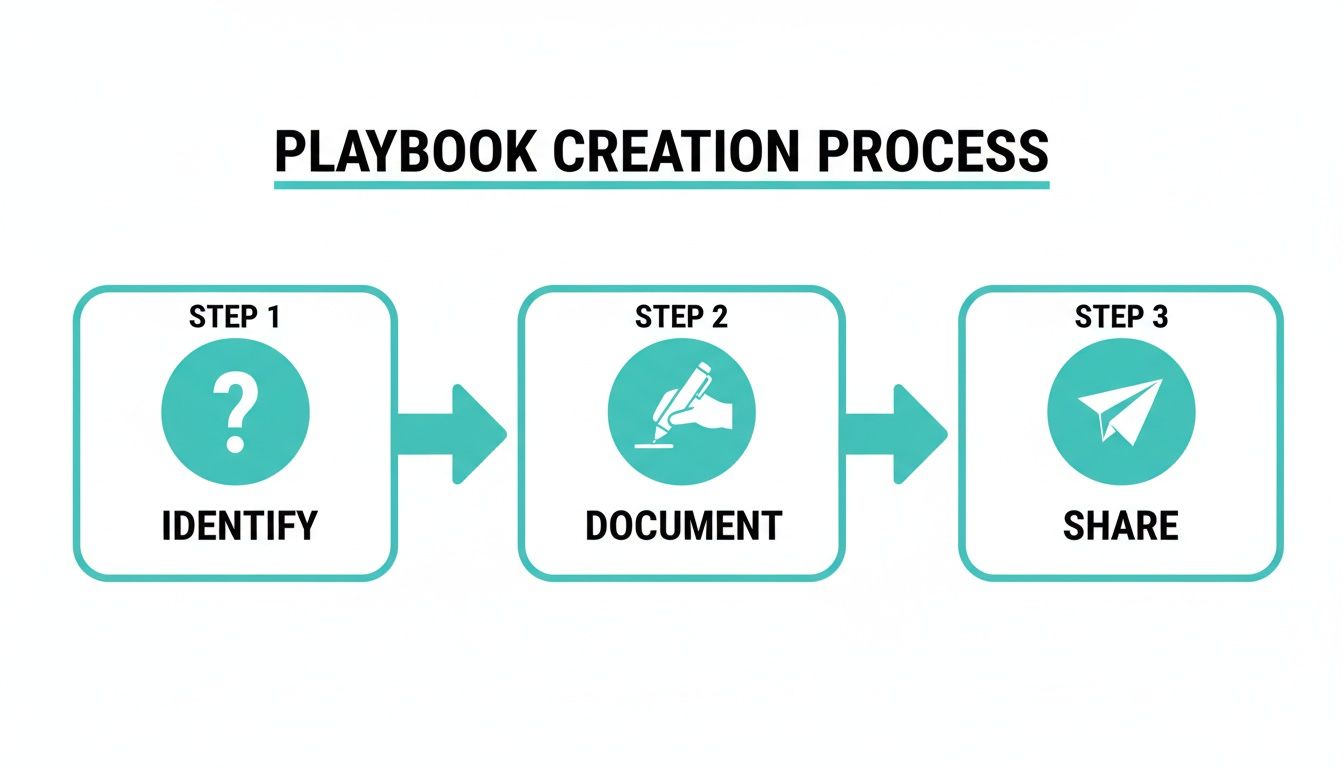
The elegance is in its simplicity. A great playbook system just keeps cycling through identifying needs, documenting solutions, and sharing them with zero friction.
The End of Let Me Find That for You
We've all been there. A junior team member pings you for a link. Someone from another department has a question about a process. Each interruption seems small, but they pull your experts away from the work that actually moves the needle. An automated playbook completely flips that script.
Instead of bugging a person, a team member just asks their question in Slack. Instantly, the AI serves up the correct answer and even points to the source, so everyone knows the information is legit and current. This is about more than just saving time; it's about building a team that feels more autonomous and empowered.
This shift delivers some pretty incredible benefits that totally redefine what a playbook is for:
- Less Searching, More Doing: The hours spent hunting for info can finally be used for productive, revenue-generating work.
- Less Waiting, More Progress: Projects don't get stuck waiting for someone to reply. Instant answers keep the momentum going.
- Less Repetition, More Innovation: Your experts are finally free from answering the same five questions over and over, letting them focus on solving new, bigger challenges.
This evolution is what gives the modern meaning of playbook its punch. It stops being a noun—a thing you have to read—and becomes a verb—an action that delivers immediate clarity. It takes your team's most valuable asset, their collective knowledge, and turns it from a scattered liability into a strategic advantage you can use on demand. The goal is simple: create a workplace where the right answer always finds you.
Measuring the ROI of Your Automated Playbook
So, you’ve built out an incredible automated playbook. How do you actually prove it's delivering real value? The answer isn't just a vague feeling of better efficiency.
It’s in the cold, hard data that shows a clear business impact on how your team operates every single day.
Imagine your busiest Slack channel suddenly becoming quieter and more focused. That's one of the first signs your playbook is working. An AI-powered system gives you the ability to quantify this shift by tracking exactly how many repetitive questions are answered automatically, saving countless hours across the entire organization.
From Vague Metrics to Tangible Wins
The true return on investment becomes crystal clear when you start measuring the right things. Instead of simply feeling more productive, you can point to specific improvements that directly boost your bottom line.
A successful automated playbook delivers measurable results in several key areas:
- Faster Onboarding: Keep an eye on how quickly new hires get answers to their initial questions without having to pull senior team members away from their work. This drastically shortens their time-to-productivity.
- Fewer Escalations: Monitor the number of issues that get kicked up the chain to managers or specialized teams. When a playbook provides clear, first-line answers, you'll see this number plummet.
- Decreased Resolution Times: For any support team, this is the holy grail. An automated playbook serves up instant, consistent answers, which directly lowers the average time it takes to resolve a customer ticket.
An automated playbook delivers a clear and compelling return on investment by systematically cutting operational costs and eliminating the bottlenecks caused by a lack of accessible knowledge.
Moving from Experimentation to Execution
The modern meaning of playbook is all about moving from chaotic experimentation to disciplined execution, especially when AI is involved. While plenty of organizations are still just piloting AI, the high-performers are already redesigning their core workflows around it.
A playbook provides the perfect structure to move from simply trying out new tools to achieving scalable ROI. In fact, recent research shows that 72% of leaders are already tracking business ROI from their AI initiatives. You can learn more about the current state of AI adoption and see how other companies are measuring their success.
This is where an automated playbook truly shines—delivering exactly where it matters most by reducing friction and lowering costs.
Frequently Asked Questions About Business Playbooks
Plenty of teams get the idea of a playbook but get stuck when it comes to actually building one. Let's walk through the common questions that come up and see how a playbook can genuinely change how your team works.
What Is the Most Important Part of Creating a Playbook?
The absolute most critical step is to start with real-world pain. Don't fall into the trap of trying to document every single process you have. That’s a recipe for a project that never gets finished.
Instead, zero in on the top 5-10 repetitive questions that constantly interrupt your experts. Solve those first. By tackling the most persistent and annoying problems, you deliver immediate value and build momentum. A playbook’s success isn't about how thick the binder is; it's about how often it's used to make someone's day easier.
How Do I Keep a Playbook from Becoming Outdated?
This is the classic playbook problem. The secret is to treat it like a living system, not a static document destined to collect dust on a digital shelf. One way is to assign a clear owner for each section or process, making them responsible for updates.
But there's a much better way. Use a tool that learns directly from your team's everyday conversations. For example, an AI assistant in Slack can automatically capture new answers and solutions as they're shared. This means your playbook stays current without anyone having to do constant manual updates.
This approach flips playbook maintenance from a tedious, never-ending chore into a seamless, automated background process. Your single source of truth actually stays true, all by itself.
My Team Is Small—Do We Really Need a Playbook?
Yes, and you might need it more than you think. Small teams often see the biggest benefits. When you only have a few people, the loss of just one team member can create a massive knowledge gap. A playbook acts as your team's memory, capturing that critical expertise and making you far more resilient.
It also helps you build fantastic habits early on, creating a foundation of consistency that scales with you as you grow. Think about it: your small team can operate with the precision and efficiency of a much larger one, all because no one has to hunt for an answer or wait around for a reply ever again.
Stop the endless searching and repetitive questions. With SAI, your team's collective knowledge becomes an on-demand resource right inside Slack. Get started for free and see the transformation for yourself at https://sai-bot.ai.