Strategy for Knowledge Management: Build a Self-Learning Slack Knowledge Base
A modern strategy for knowledge management isn't about building another dusty, forgotten wiki. It’s a living, breathing plan to centralize your team's collective brainpower and make it instantly available right where you work—inside Slack. The goal is to move beyond static documents and create a system that learns and answers questions on its own, cutting out the wasted hours we all spend just trying to find things.
Move from Constant Searching to Instant Answers
Picture your workday for a moment. What if you never had to dig through a six-month-old Slack thread for that one crucial link? What if you didn't have to interrupt your senior engineer—for the fifth time this week—with the same question? Imagine no more waiting on an answer that's holding up your entire project.
This isn't a pipe dream. It's what a well-executed knowledge management strategy actually delivers. It’s about shifting your team's entire workflow from a frantic, disorganized scramble for information into a smooth, simple conversation with a single source of truth. Best of all, you never have to leave Slack.

The Shift to Effortless Knowledge Flow
Let’s be honest: nobody wants to deal with a complex setup or spend their days manually documenting every little thing. The best strategies meet your team right where they are, in the tools they use every single day. By integrating an AI tool like SAI directly into Slack, you can build a knowledge base automatically from the conversations you’re already having.
This approach turns everyday questions and answers into a permanent, searchable asset. Every Slack conversation becomes a building block for a smarter, more self-sufficient team. It’s about getting back your focus and letting people do their best work, not just look for information they need to start their work. For a deeper dive, check out our guide on what a knowledge management system is and how it all comes together.
This shift from manual effort to automated intelligence is a dramatic change in how teams operate.
From Knowledge Chaos to Instant Clarity
| Challenge | The Old Way (The Daily Grind) | The New Strategy (The Effortless Flow) |
|---|---|---|
| Finding Answers | Scouring old Slack channels, DMs, and various drives. | Asking a question in any Slack channel and getting an instant, verified answer. |
| Asking for Help | Interrupting colleagues and waiting for them to reply. | The AI bot finds the answer from past conversations, freeing up experts. |
| New Hire Onboarding | A flood of repetitive questions for the whole team. | New hires can ask the AI bot basic questions and get up to speed independently. |
| Capturing Knowledge | Important info gets lost in the noise of daily chat. | Every question and answer automatically trains the knowledge base. |
The difference is night and day. One path is a constant, low-grade frustration, and the other is a seamless flow of information that empowers everyone.
Embracing a Cloud-First Approach
This whole transformation is backed by a massive industry trend. The global knowledge management software market is huge—valued at around USD 773.6 billion—and it's overwhelmingly driven by cloud-based tools. In fact, these solutions command a dominant 62.18% market share for a reason.
Businesses are voting with their budgets, choosing cloud platforms for their scalability, ease of use, and AI capabilities. This segment is projected to grow at an incredible 19.68% CAGR through 2031, leaving older, on-premise systems in the dust. You can learn more about these knowledge management software market trends.
The real power of a modern knowledge management strategy isn't just about finding information faster. It's about creating an environment where every single person on your team feels confident they can get the answer they need, the moment they need it, allowing them to move forward with absolute clarity.
The new reality is beautifully simple: instead of searching, you just ask. Whether it’s in a public channel or a DM, getting team knowledge becomes as natural as having a conversation. This is how you finally break the cycle of repeat questions and build a truly productive, self-reliant team.
Find Your Team's Biggest Knowledge Gaps
Before you can build a system that works, you have to understand the daily friction your team is already dealing with. A smart strategy doesn't start with picking a new tool; it starts by mapping out the pain points. We're trying to get from a world of endless DMs and channel-hopping to one where you can just ask a question in Slack and get an instant, correct answer.
To do that, you need to become a detective, and the crime scene is your company's Slack workspace. You're looking for the clues that show you exactly where productivity goes to die.
Become a Slack Channel Detective
Believe it or not, your team's Slack channels are a goldmine of information about what’s broken. Instead of guessing what people need help with, you can literally watch it happen in real-time. The trick is to look for the patterns that scream for a better way of doing things.
Start by lurking in your busiest help-oriented channels—think #it-support, #ask-hr, or #dev-help. You're hunting for the greatest hits,
those questions that pop up again and again, week after week.
- Spot the Repeats: Are new engineers constantly asking how to get access to the staging environment? Is the Wi-Fi password a weekly topic?
- Track the Timestamps: How long does it actually take for an expert to see the question and respond? What happens if someone asks at 8 PM on a Friday? Crickets, usually.
- Identify the Experts: Who are the handful of people constantly getting pinged to answer the same things over and over, pulling them away from their actual jobs?
Every time you see a repeated question, that’s a clear sign of a knowledge gap that's draining your team's time and focus. It's not just a hunch; studies show that knowledge workers waste nearly 20% of their time just looking for internal information. Finding these repeat questions gives you a list of high-impact problems to solve first.
The goal here isn’t to document every single question ever asked. You're looking for the 20% of questions that are causing 80% of the interruptions. Fixing those first will give you the biggest, most noticeable win right out of the gate.
Uncover Hidden Bottlenecks and Tribal Knowledge
Okay, so the obvious repeat questions are easy to spot. But the real damage often comes from the sneakier problems: information bottlenecks and all that tribal knowledge
locked away in a few key people's heads.
Project-specific channels and processes like new hire onboarding are fantastic places to hunt for these.
Signs of Knowledge Bottlenecks:
* Project Delays: You see a project grind to a halt because everyone is waiting on one specific person for a password, an approval, or a piece of critical information.
* Vague Hand-offs: A task gets passed from one person to another with missing context, forcing the next person to waste time hunting down the details that should have been there from the start.
* Onboarding Overload: Your senior team members spend their first week with a new hire answering a firehose of basic questions about company policies, tool access, and standard procedures.
This is where tribal knowledge becomes a massive liability. What happens when that one expert goes on vacation, gets sick, or eventually leaves? All their unique knowledge walks right out the door with them. A solid knowledge management system is your insurance policy against that brain drain.
By doing this informal audit, you’re not just making a list of problems. You're building a rock-solid business case. You're creating a map that shows exactly where an AI assistant could step in to provide 24/7 answers, give your experts their time back, and help your whole team become more resilient and self-sufficient. This is the foundation for everything that comes next.
Create a Frictionless Knowledge Capture Workflow
Let's be honest. Traditional knowledge bases are where good intentions go to die. They’re built on a fantasy—the idea that busy people will happily stop what they’re doing, switch apps, and meticulously document a solution they just came up with. It just doesn’t happen.
A winning knowledge management strategy doesn't dump another task on your team. It makes capturing knowledge an invisible, automatic byproduct of their daily work.
Imagine if every time your go-to engineer explains a deployment process in Slack, or a support lead helps a new hire with a tricky customer question, that wisdom was saved. Instantly. Automatically. This flips the old, broken model on its head. Instead of asking your experts to do the work twice—first solving the problem, then documenting it—you just let them solve it. An AI assistant like SAI works quietly in the background, learning from the Q&A already flowing through your channels. No extra effort required.
From One-Off Answers to an Eternal Resource
Think about the last time you answered a question in a DM. That little nugget of wisdom became a disposable asset, almost immediately lost to the scrollback. The next person with the same question? They're going to interrupt you or someone else all over again. This is a massive, hidden time sink.
An intelligent workflow changes everything. That single answer, given just once in Slack, is transformed into a durable, reusable piece of knowledge. The AI gets the context and serves up that same solution the next time a similar question is asked. It’s a capture once, answer forever
model.
The real magic here is that the system gets smarter with every conversation. It’s not a static document; it’s a living resource that grows with your team, ensuring the information is always current without anyone lifting a finger to
updateit.
Real-World Scenarios in Action
This isn't just theory; it's a practical shift that changes how teams operate day-to-day. The goal is to make capturing knowledge so seamless that your team doesn't even notice it's happening.
- For Customer Support: An escalation hits the
#support-escalationschannel. A senior agent types out a detailed, step-by-step fix. Instead of being asked to copy-paste it into a wiki, the AI just absorbs it. Two days later, a junior agent faces a similar problem, asks SAI, and gets that same expert-verified solution without bugging anyone. - For Engineering: A new dev is stuck setting up their local environment and asks for help in
#dev-help. An experienced engineer drops in a code snippet and a few key commands. Boom. It’s saved automatically. Weeks later, the next new hire asks about the setup and gets the answer instantly, code and all. - For HR and Ops: An employee asks about the new remote work stipend in
#ask-hr. The HR manager clarifies the eligibility rules. That answer is now the source of truth, ready for the dozen other people who will ask that exact same question over the next month.
The process below shows how you can quickly spot the patterns and identify the key experts whose knowledge is most critical to capture.
This kind of quick audit helps you zero in on the conversations that will deliver the biggest bang for your buck. It’s a core part of building a self-sustaining system—like a powerful wiki for Slack that actually builds itself.
The End of the Information Scavenger Hunt
So what does this feel like for your team? It means they can finally stop searching and start doing.
Picture your day without having to hunt through three different cloud drives, scroll through endless Slack channels, or ping a colleague and hope they see your message. Instead, you just ask. You ask SAI in Slack, and you get the answer. That's it.
This shift brings a sense of calm and confidence to the whole company. Your team feels empowered, knowing answers are a keystroke away. And your experts? They’re finally freed from the tyranny of answering the same questions over and over again.
Launch an AI Knowledge Hub That People Actually Use
Alright, this is where the rubber meets the road. All that planning and strategizing comes to a head as we bring your AI-powered knowledge hub to life right inside Slack.
Forget about drawn-out implementation plans or waiting on IT tickets. The goal here is to move fast and deliver immediate, tangible value to your team. We’re talking about creating a world where no one has to open another browser tab, hunt through a labyrinthine Google Drive, or shoulder-tap a colleague just to find a simple link.
Instead, they just ask. Right in Slack. The shift is subtle but massive: moving from a culture of searching to a culture of getting instant answers right where the work happens.
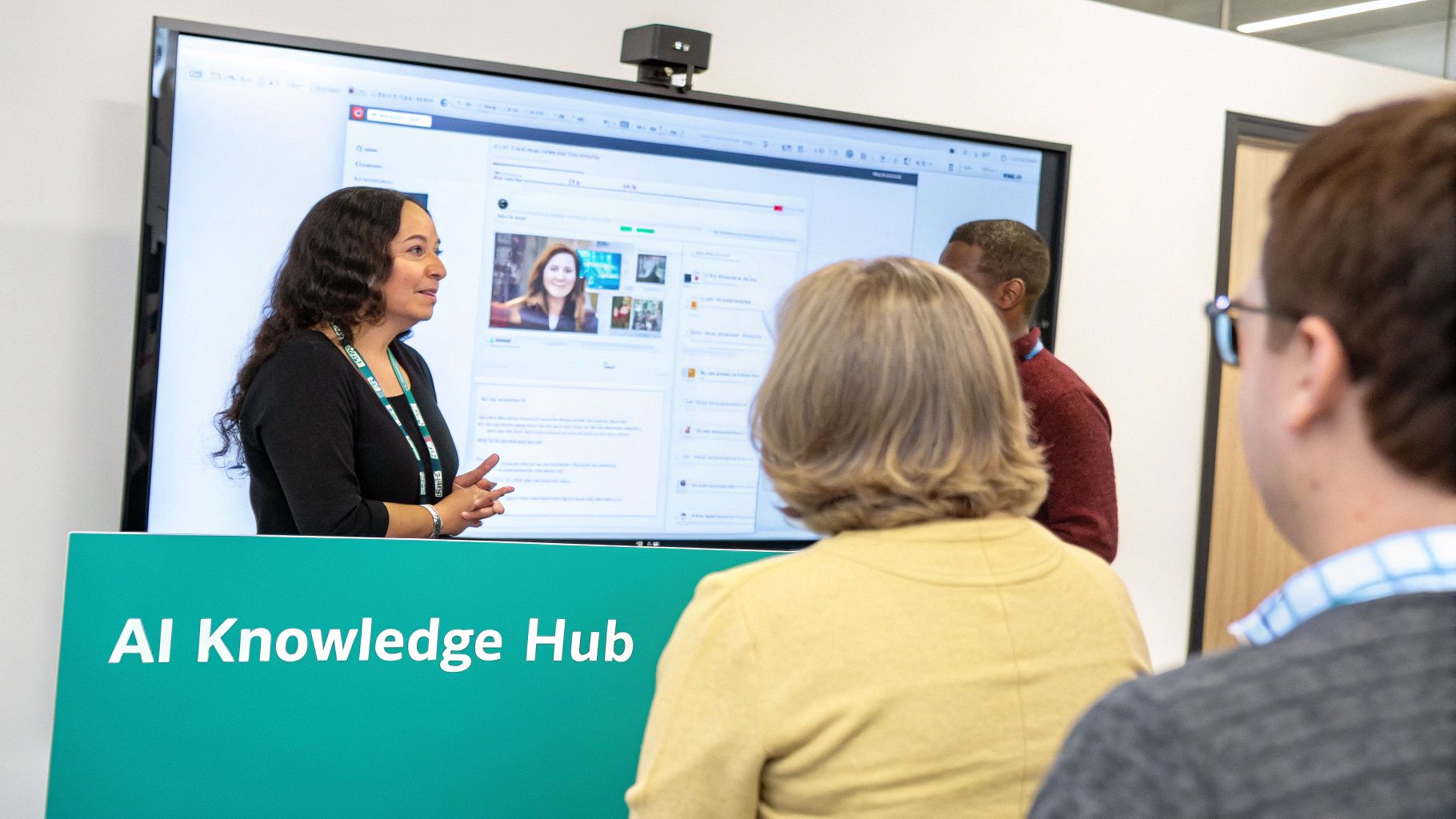
The image above really captures the essence of what we're doing—making knowledge a central, accessible part of the conversation. When you pull information out of dusty, isolated wikis and put it into a conversational interface like Slack, you demolish the barriers that keep people from finding what they need.
Start Small, Prove Value, and Get People Talking
Look, the secret to a successful launch isn't some grand, company-wide announcement followed by mandatory training. That’s how you get eye-rolls and resistance.
The real key is to start small, prove the concept, and let the results generate their own buzz. Pick one, just one, high-traffic channel where the same questions pop up constantly and the pain of finding answers is felt by everyone.
A few prime candidates come to mind:
* #it-support: Perfect for all those repeat questions about software access, VPN woes, and laptop policies.
* #hr-questions: An absolute goldmine for handling endless queries on company holidays, benefits enrollment, and expense reports.
* #dev-help: Imagine freeing up your senior engineers from answering the same onboarding and environment setup questions over and over again.
By zeroing in on a single channel, you create a controlled experiment. You can show off some quick wins without a massive upfront effort. An AI assistant like SAI gets to work on day one, learning directly from the conversations already happening and turning them into an intelligent, searchable resource on the fly.
Tackle Your Tool Sprawl Head-On
This targeted approach is a direct assault on the tool fragmentation that plagues so many companies. It’s a real problem. Research shows that a staggering 36% of companies are juggling three or more separate knowledge management tools, and 31% admit they don't even have clear visibility into their own systems.
By pulling answers into one place—a Slack channel—you start building that single source of truth everyone talks about but few actually achieve. And the payoff is huge. Organizations that get this right see massive improvements, with 39% reporting better decision-making and 35% boosting customer support with faster resolutions. If you want to dig into the numbers, check out these knowledge management trends and statistics.
Getting Your Team On Board (Without a Fight)
When you introduce this to your pilot team, keep it simple. Frame it as what it is: an experiment to save everyone time and cut down on interruptions.
Here’s a simple message you can steal and adapt:
Hey team, we’re trying something new in `#it-support` to help everyone get answers faster. I've added an AI assistant, SAI, to the channel. Before you ping a person, give SAI a try first. It learns from our conversations, so every question you ask actually makes it smarter for the next person.
Set clear expectations from the get-go. The AI won't be perfect on day one, but it learns incredibly fast. Encourage people to be curious and just ask it questions.
The aha!
moment is what you're after. It's that instant when a junior team member gets a perfect, detailed answer from the AI, solving their problem without derailing a senior colleague's focus. That one experience is often all it takes to turn a skeptic into your biggest advocate. This is exactly the kind of result you can see in this example of an AI knowledge base in Slack.
This isn't about forcing adoption; it's about demonstrating undeniable value. When people see for themselves that they can get what they need in seconds, not minutes or hours, they won't need to be convinced. They'll just start using it. And that's how you turn a strategy on a document into a living, breathing part of your company's culture.
Make It Stick: Driving Adoption and Measuring Real Impact
Let's be honest: the fanciest knowledge management system is just shelfware if your team doesn't actually use it. This is where the rubber meets the road. Your real goal isn't just to implement a tool; it's to change behavior. You want to create a new instinct—one where people automatically ask your AI assistant in Slack instead of shoulder-tapping a colleague or opening a dozen browser tabs.
This kind of shift doesn't happen by accident. You have to actively nurture it.
It starts with making the new way of working feel natural and rewarding. Leadership can't just announce the change and walk away; they need to be the first ones using the tool and singing its praises. When you see those early wins—like someone finding a critical answer from the AI in seconds and saving an hour of digging—shout it from the rooftops in a team channel. Nothing sells a new process better than seeing a teammate get real value from it.
Stop Counting Articles and Start Measuring What Matters
It's so easy to fall into the trap of tracking vanity metrics.
A dashboard showing 1,000 knowledge articles might look impressive, but it tells you absolutely nothing about whether you're solving real business problems. You're not building a digital library to collect dust; you're building an engine to make your team faster and smarter.
So, toss out the content counts and focus on metrics that truly move the needle:
- Faster Answers: How long does it take for someone to get the information they need? This is your ground zero for productivity.
- Fewer Interruptions: Are your senior experts getting pulled into the same questions over and over? Track the drop in those repetitive pings and watch their focus time return.
- Quicker Onboarding: Are new hires getting up to speed in days instead of weeks? Measure how quickly they can solve problems on their own without needing hand-holding.
These aren't just feel-good numbers; they represent cold, hard ROI. They prove that your knowledge strategy is freeing people from the drudgery of information hunting so they can do their best work.
The real sign of a winning knowledge management strategy isn't a massive, bustling knowledge base. It's a quieter, more focused Slack workspace where people are getting more done with fewer interruptions.
Weave It Into Your Culture
Driving this kind of change is a cultural mission. The most successful companies are the ones that integrate knowledge sharing directly into the collaboration tools their teams already live in. They avoid common roadblocks like a vague strategy or, worse, a culture where people hoard information.
The data backs this up: 35% of firms report a direct boost in employee productivity and collaboration after putting a formal KM strategy in place. These market leaders aren't just buying tech; they're investing in AI-ready platforms that seamlessly fit into how their teams already operate. If you want to dig deeper into the data, you can explore more findings on the knowledge management market.
This all points to one simple truth: technology is rarely the biggest hurdle. The real challenge is changing habits. Your job is to make the new habit so ridiculously easy and obviously better that it becomes the default.
Let Your AI Assistant Prove the ROI for You
Manually tracking all these impact metrics sounds like a full-time job, right? This is where an AI assistant like SAI becomes your secret weapon. It doesn't just answer questions; it gives you the data to prove its own value.
Dashboards can instantly show you which questions are asked most often, how many interruptions were deflected from your experts, and which pieces of knowledge are providing the most bang for their buck.
This built-in measurement is a game-changer. It lets you walk into any stakeholder meeting and show, with data, exactly how your strategy for knowledge management is making the organization more efficient. You're not just organizing information—you're turning it into a competitive advantage.
Got Questions About Your Knowledge Management Strategy? You're Not Alone.
Whenever a team decides to get serious about knowledge management, the same questions always pop up. It makes sense. You’re talking about changing the fundamental way your team finds and shares information, moving from a messy, frustrating hunt to a world of instant answers.
Let's walk through the big concerns that come up time and time again when teams decide to tackle this inside Slack.
Our Knowledge Is Scattered Everywhere. Where Do We Even Begin?
This is hands-down the number one question I hear. It feels overwhelming, and the old way of thinking—the big, scary migration project—is a total non-starter. Trying to round up every document and file before you even begin is a surefire way to kill your project before it has a chance.
Forget that approach. Don't try to boil the ocean.
Instead, zoom in on the pain. Where does the information chaos hurt the most? Pinpoint that one, high-traffic Slack channel where all the questions converge. For you, it might be #customer-support-issues, #ask-engineering, or #it-help. That’s your ground zero.
Start right there. By plugging an AI tool into that single channel, you immediately start solving the most disruptive, frequently asked questions. The AI learns directly from the Q&A happening in real-time, building its knowledge from the conversations that actually matter today. You don't have to move a single file.
Once your team gets that first wow
moment of an instant, perfect answer, you’ll have all the momentum you need to expand strategically.
The goal isn’t to organize the messy past; it’s to make the future effortless. Start with the conversations happening right now, and let the knowledge base build itself from what your team truly needs.
How Do We Stop Our Knowledge Base From Becoming Outdated?
Ah, the stale wiki problem. We've all seen it. A knowledge base is created with the best intentions, but it relies on the fantasy that busy people will stop what they're doing to perform manual updates. They won't. And soon enough, no one trusts the information anymore.
A modern strategy for knowledge management flips this dynamic on its head by making your knowledge live.
When you have an AI assistant working inside Slack, your knowledge base is constantly refreshed with every new conversation. It’s a dynamic, self-healing system. Think about it: when a process changes, someone is bound to ask about the new way of doing things. The second an expert drops the updated answer in a channel, that conversation becomes the new source of truth.
Suddenly, maintenance isn't a dreaded task on a to-do list. It’s just a natural byproduct of your team’s daily work, ensuring the answers people get are always the right ones. This is how you finally break the cycle of content decay.
Will AI Replace The Need For Human Experts On Our Team?
Not a chance. In fact, it does the opposite—it liberates them. An AI assistant is a force multiplier for your subject matter experts. It shields them from the relentless barrage of repetitive questions, freeing them up to focus on the complex, high-value work they were actually hired to do.
Your best engineer shouldn't be spending half their day explaining how to connect to the VPN. Your HR lead shouldn't have to answer the same question about the holiday schedule ten times a week.
With an AI assistant in place, your experts only have to answer a common question once. The AI learns it and then handles that question every single time it comes up again, effectively scaling that person’s expertise across the company, 24/7. This protects their time and mental energy for real innovation, deep problem-solving, and mentoring the next generation of experts.
The goal is not to replace your experts, but to make their knowledge instantly and endlessly available to everyone who needs it.
Stop the endless searching and give your team the gift of instant answers. With SAI, you can turn your Slack conversations into a self-learning knowledge base that frees up your experts and empowers your entire team. Add it to a channel for free today and see the transformation for yourself. Get started with SAI.