The Ultimate Guide to Internal Help Desk Software
What if your workday was finally free of the constant pings and the mental whiplash of context switching? With an internal help desk built for Slack, that's exactly what you get. Imagine your team never having to open another resource, search through messy shared drives, or interrupt a colleague ever again. Just asking a question in Slack and getting the answer, instantly.
Picture Seamless Productivity

Right now, your team is probably wasting precious minutes hunting for information scattered across outdated guides and different platforms. That time spent searching absolutely kills deep work and causes projects to drag. The result is a constant, low-level friction that you can feel across the entire company.
Think about the real cost:
- Wasting time searching multiple systems just drains energy and morale.
- Interrupting colleagues for every little question shatters everyone's concentration.
- Losing your train of thought after each context switch is a massive productivity sink.
Now, imagine swapping all that chaos for a simple interaction in Slack. No more juggling a dozen browser tabs or digging through wikis. Just type a question, get an answer, and get back to what you were doing.
The Before and After Is Striking
The old way is a mess of manual work—shoulder taps, direct messages, and delayed responses that bring everything to a halt. After bringing in a tool like an internal help desk, you'll see questions get resolved in seconds, restoring focus and momentum to your team.
We reclaimed **10 hours** per week simply by centralizing answers in Slack.
It's a straightforward equation: as context switching goes down, deep, focused work goes up. Your teams start hitting their milestones faster, and the collective stress level drops. This isn't just theory; it's the daily reality for teams using SAI.
Here’s a classic example: a new hire needs the VPN setup instructions. Before, they'd have to email IT, wait hours for a reply, and probably end up bugging a coworker. With SAI, they just ask in the #help-it channel and get the exact steps right away.
- No new support ticket needs to be created.
- The answer is delivered instantly.
- No follow-up pings are necessary.
Better yet, this entire exchange becomes part of your company's collective brain. Every question asked and answered in Slack makes your internal knowledge stronger and more reliable, ensuring information stays consistent without anyone lifting a finger. This frees up your subject matter experts from having to explain the same thing over and over again.
Over time, this living source of truth breaks down the usual knowledge silos between departments. Everyone stays aligned on the latest policies, and important updates get out to the whole company instantly.
- HR policies are at everyone's fingertips.
- IT procedures are available on demand.
- Project guidelines are just a quick Slack message away.
SAI essentially becomes your company's single source of truth, effortlessly organizing your Q&A history and making sure nothing gets lost. Your team no longer has to suffer through outdated manuals or buried documents.
Real-World Relief for Every Team
The impact is felt everywhere. Marketing teams launch campaigns smoother when brand assets and guidelines are a simple search away. Engineering teams resolve incidents faster when they can pull up configuration details in a snap. And HR spends far less time clarifying basic questions about benefits or PTO.
Our support queue dropped by **80%** after we added SAI.
Want to see how it works in more detail? Check out our step-by-step guide to ending repetitive Slack questions.
Making the switch from chaos to clarity isn't just a small improvement. It’s about giving your team back hours of their day, cutting down on needless interruptions, and letting them focus on the work that actually matters. That’s a workday worth fighting for.
What Exactly Is Internal Help Desk Software?
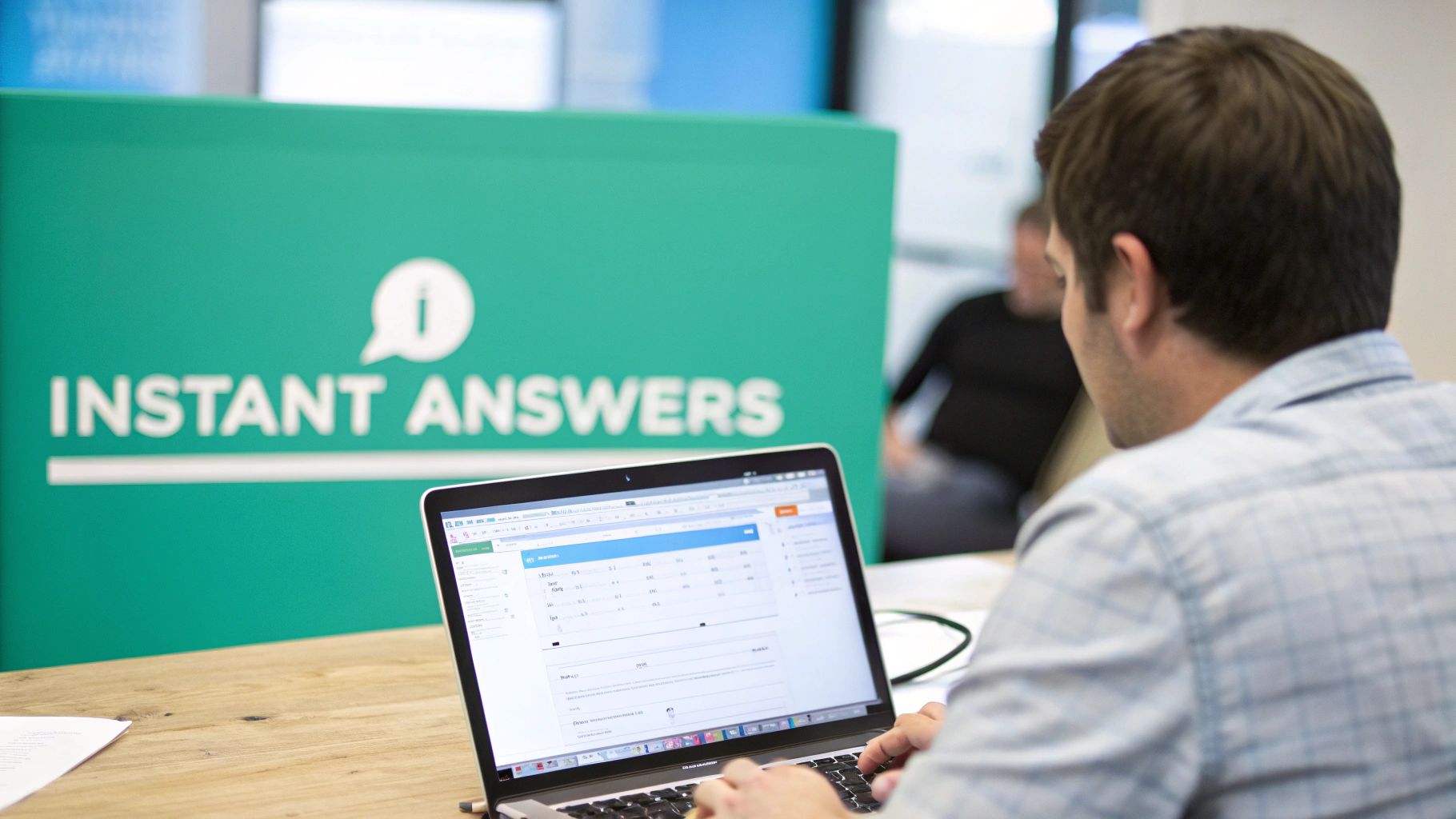
Let's clear up what we mean by internal help desk software. If you're picturing a stuffy, complicated IT ticketing system, think again. A better way to imagine it is as your company’s collective brain—all that crucial internal knowledge, neatly organized and instantly accessible to everyone on the team.
This is the system that finally ends the frustrating scavenger hunt for information. It’s designed to provide immediate answers to all those everyday questions that constantly pop up. It stops the endless digging through shared drives, sifting through outdated wikis, or pinging a coworker for the third time about the guest Wi-Fi password or the PTO request process.
Your Company's Always-On Expert
Think of it as having a resident expert on staff 24/7, one who knows exactly where every single piece of company information lives. A new hire needs to figure out how to set up their benefits? Instead of asking three different people and getting two different answers, they just ask the system and get the correct procedure right away.
The core idea is simple: transform your internal support from a time-sucking, manual chore into a smooth, self-service experience. It’s a strategic move to eliminate the operational drag that quietly slows your entire company down.
This shift does more than just save time; it builds a culture of self-sufficiency. People feel empowered when they can find what they need on their own. And your actual experts—the IT, HR, and Ops teams—are freed from the soul-crushing task of answering the same five questions all day long. The result is a sharper, more productive, and more focused team.
The Transformation Beyond the Tech
The real magic of a modern internal help desk software isn't just what it does, but how it does it. This isn't about forcing everyone to learn yet another clunky portal they'll forget the password to. The best tools meet your team right where they’re already working, like inside Slack.
Picture this quick, painless workflow:
- A question pops up. A team member needs to know the process for submitting an expense report.
- They ask in a Slack channel. No new app to open, no portal to log into, no formal ticket to create.
- An instant answer arrives. The correct, up-to-date process is delivered right there in the conversation.
This is fundamentally different from old-school support models. The focus shifts from managing a queue of tickets to simply delivering answers. It's not just a little faster; it’s a completely different way of thinking about internal support. It respects your team’s time and workflow, letting them get what they need and get right back to their real work.
The whole goal is to make getting help completely frictionless. If you want to go deeper on this, check out our guide to help desk automation software.
Ultimately, thinking of this as just another tool
misses the bigger picture. It's a direct investment in your team's daily productivity, speeding up everything from new hire onboarding to day-to-day operations. When knowledge is just a question away, you unlock your entire team’s potential.
The Hidden Costs of Disorganized Internal Support
We’ve all seen it: the quick question
that pops up in a Slack channel. It seems harmless enough, but that little interruption is a productivity assassin in disguise. A single five-minute distraction doesn't just cost five minutes—research shows it can torch a full twenty minutes of focused work as your team member scrambles to get back in the zone.
This isn't a minor annoyance. It's a silent, constant drain on your business's resources. When your internal support is a chaotic mix of DMs and shoulder taps, every day bleeds productivity. It's your top developer losing an hour of deep coding because they had to explain where to find an API key for the third time this week. It's the new hire spending their first three days feeling lost, trying to stitch together a coherent picture from outdated wikis and scattered Google Docs.
The Financial Drain of Context Switching
Every time an employee has to slam the brakes on what they're doing—either to ask a question or to answer one—they pay a cognitive tax.
This constant context switching is one of the biggest hidden expenses in modern companies. It murders deep work, pushes back deadlines, and is a fast track to employee burnout.
Think about your most senior engineer, the one you rely on for the toughest problems. If they're fielding just four repetitive questions a day, you've just lost over an hour of their most valuable, high-impact work. Now, multiply that loss across your entire team, day after day. The financial hit is staggering. It’s truly death by a thousand paper cuts.
The real cost of disorganized support isn't measured in minutes, but in lost momentum and missed opportunities. It's the silent killer of project deadlines and innovation.
This widespread inefficiency is exactly why so many companies turn to external solutions for help. The help desk outsourcing market is on a rocket ship, projected to grow from nearly USD 10 billion in 2024 to a massive USD 18.3 billion by 2033. And while it’s true that 50% of organizations now outsource at least some of their help desk functions, a smart-thinking group is realizing they can achieve the same—or better—results by adopting smarter tools internally. If you're curious about these industry shifts, you can discover more insights about IT support trends on Auxis.com.
Quantifying the Impact on Your Business
The costs here go way beyond lost time. A messy internal support system directly hammers key business metrics you can actually measure.
- Slower Employee Onboarding: A confusing start means new hires take far longer to become productive. This drives up their ramp-up cost and delays the moment they start adding real value.
- Increased Expert Burnout: Your senior people become accidental support agents, stuck on a hamster wheel of repeating the same information instead of driving the business forward. This breeds frustration and, ultimately, turnover.
- Inconsistent Information: When knowledge lives in people’s heads or is scattered across ten different places, you get conflicting answers. This leads to mistakes, rework, and a total breakdown in operational consistency.
By not centralizing and automating how your team gets answers, you're essentially paying a premium for inefficiency. This is where a more structured approach becomes a no-brainer. A solid internal help desk software isn't just about fielding questions; it's a strategic move to reclaim lost time and protect your team's focus. The heart of any great system is a well-oiled knowledge base. If you want to dive deeper into this, you can learn more about what a knowledge management system is in our detailed article.
Calculating the return on investment (ROI) here is surprisingly simple. Start by estimating how many hours your experts lose each week to repetitive questions. Translate that time into salary cost, and you'll quickly build an undeniable business case for change—one that boosts your bottom line by unlocking your team’s true potential.
Comparing Slack-Native Tools and Traditional Ticketing
When you’re looking for the right internal help desk software, you'll quickly find yourself at a crossroads. One path leads to traditional, external ticketing portals, and the other keeps your team right where they’re already working—inside Slack. The difference isn't just about a feature list; it's a fundamental clash of philosophies on how work should actually get done.
Traditional systems treat support like a formal, separate chore. An employee has a question, so they have to stop what they’re doing, open a new browser tab, log into a portal, and meticulously fill out a form to create a ticket. Then they're tossed into a queue, waiting for an email notification that someone has finally seen their request.
This old-school workflow is absolutely riddled with friction. It yanks people out of their main workspace, shatters their focus, and bakes in delays at every single step. It turns asking a simple question into a bureaucratic hassle, making people think twice before they even bother asking for help.
The Old Way: A Legacy of Friction
Let's play this out. Your marketing specialist needs a high-res logo for a big presentation, and fast. With a traditional system, this quick need balloons into a multi-step ordeal. They have to leave Slack, navigate to the help desk portal, and submit a formal ticket to the creative team. Now, they wait. And wait.
This legacy model was built for an older, slower way of working, where communication was more structured and far less immediate. In today's world, it feels clunky and totally out of sync with the fast-paced, conversational flow of modern teams. The constant context-switching it forces on people is a well-known productivity killer.
The New Way: Seamless Answers in Slack
Now, let's rewind and picture that same scenario, but this time with a Slack-native tool like SAI. The marketing specialist stays right in their Slack channel and just asks, @SAI, where can I find the latest company logos?
Within seconds, the AI assistant replies with a direct link to the correct folder in their shared drive.
Problem solved. There was no portal to log into, no ticket to create, and no queue to get stuck in. The whole thing took less than ten seconds and happened right where the work was already happening. This is the heart of the transformation: support becomes an invisible, frictionless part of the daily conversation, not a separate task to be managed.
The real goal isn't just to answer questions faster. It's to completely eliminate the idea of a
support ticketfor most internal requests, replacing it with instant, on-demand, self-serve answers.
This approach respects your team’s most precious resource: their time and focus. By meeting them where they are, you demolish the barriers that discourage them from finding information, which leads to better decisions, fewer mistakes, and a whole lot less frustration.
This visual breaks down the very real business costs of a high-friction support model. It’s not just about annoyance; it’s about the financial hit from constant interruptions and wasted time.
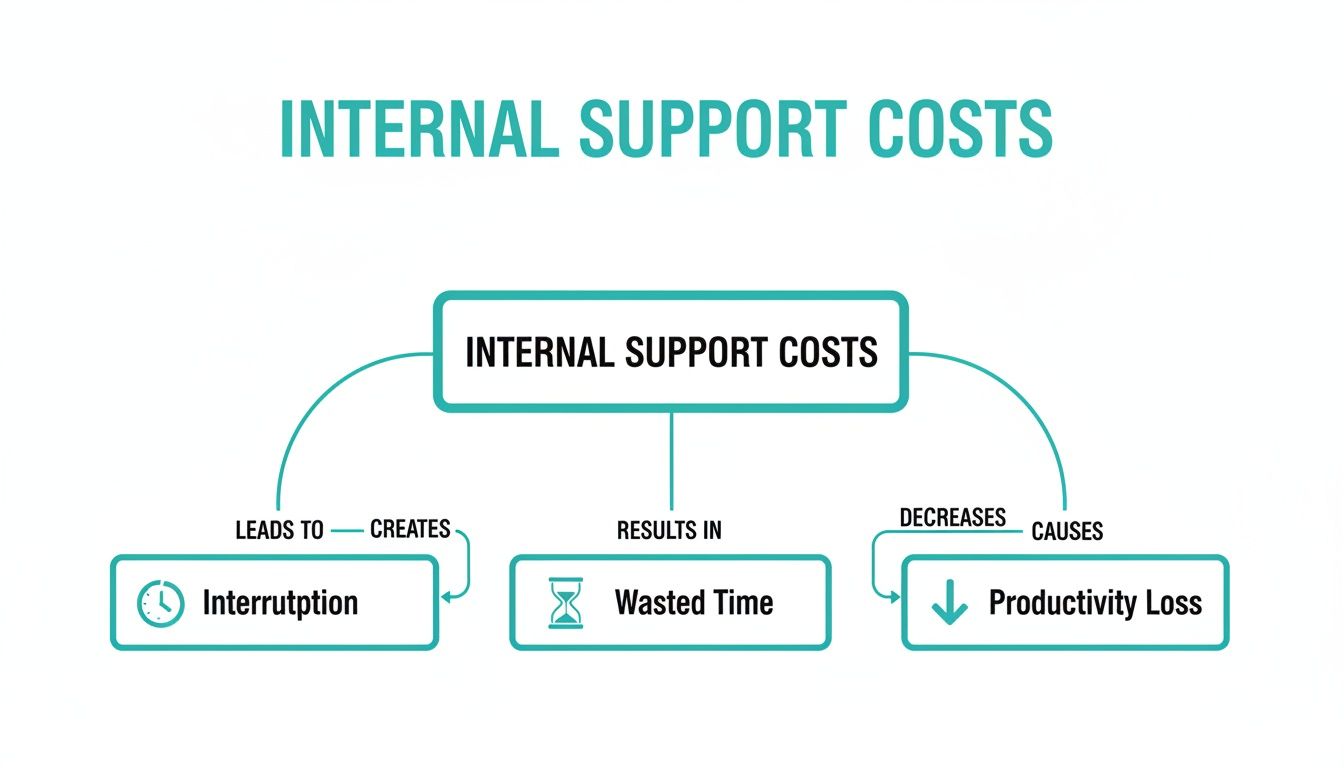
Each of these pain points—interruption, wasted time, and productivity loss—is a tangible drain on company resources. A seamless, Slack-native solution is specifically designed to plug these leaks.
Slack-Native AI vs. Traditional Ticketing Systems
The choice between a modern, conversational tool and a legacy portal really comes down to the kind of experience you want to create for your team and the business impact you're trying to achieve. Let's put them side-by-side.
| Aspect | Slack-Native AI (like SAI) | Traditional Ticketing System |
|---|---|---|
| User Experience | Instant answers inside Slack. No new tabs, no logins, no forms. Just ask. | Requires leaving your workflow, logging into a separate portal, and filling out a form. |
| Time to Resolution | Seconds for most common questions. AI provides immediate, known answers. | Hours or even days. Depends on agent availability and queue length. |
| Employee Adoption | Effortless. It fits into a tool and behavior your team already uses daily. | A struggle. It forces a new, clunky process and requires change management. |
| Knowledge Capture | Automatic. The AI learns from questions and answers happening organically in Slack. | Manual and tedious. Requires someone to formally write and update knowledge base articles. |
| Impact on Focus | Keeps employees in their flow stateby eliminating context switching. |
A major productivity killer. Constantly pulls people away from their core tasks. |
| Accessibility | Democratizes knowledge. Anyone can ask for anything, anytime, right in Slack. | Silos information behind a portal. Access is often gated and less immediate. |
As the table shows, the modern, Slack-native approach isn’t just an incremental improvement—it’s a complete rethinking of how internal support should work. It prioritizes speed, efficiency, and the employee experience above all else.
This shift toward more integrated, user-friendly solutions is reflected across the industry. The global help desk software market, valued at USD 1.75 billion in 2026, is on track to hit USD 4.17 billion by 2035. A huge driver of this is the dominance of cloud-based solutions, which now make up 62% of the market thanks to their scalability and easy integrations. If you want to dive deeper into the market's direction, you can read the full research about help desk software growth.
Ultimately, the decision boils down to a simple question: Do you want your team to spend their time navigating systems, or do you want them spending it on the actual work they were hired to do? Choosing a Slack-native approach isn't just a modern convenience; it’s a strategic move to build a more focused, efficient, and empowered company.
How AI is Rewriting the Rules for Internal Support
Let's be honest, the future of internal support isn't about writing more documentation that no one reads. It’s about getting fast, accurate answers to your team, right where they’re already working. And that's exactly where AI is completely changing the game for internal help desk software.
Think about it. What if you never had to open another browser tab to hunt down a piece of information again? No more sifting through a confusing company wiki, getting lost in a chaotic shared drive, or pinging the same expert with the same question for the third time this week. You just ask your question in Slack and get an instant answer.
That’s the reality AI delivers. It’s not some clunky new system you have to manage. It's a smart layer that works quietly in the background, turning your team’s everyday conversations into a trustworthy source of truth.
Moving From Manual Drudgery to Automated Intelligence
Building a knowledge base the old-fashioned way was a total grind. It meant someone had to block off huge chunks of time to write, format, and publish articles, only for them to become outdated almost immediately. Modern AI assistants completely flip that model on its head.
Imagine if your company's knowledge could build itself. With a tool like SAI, you just add it to Slack, and it starts learning from the questions and answers already happening. There's no setup required. From the moment it joins a channel, it starts creating a smart, self-improving knowledge base from your team's conversations.
The magic is that your team builds a powerful, reusable company asset just by talking to each other. Every question they ask and answer makes the system smarter without any extra effort.
This approach starts delivering value from day one. There's no long waiting period or complicated configuration. The AI is ready to provide answers 24/7, learning and getting better with every single interaction. It's a huge shift from a system that needs constant feeding to one that maintains itself.
The demand for this kind of smart, cloud-based support is exploding. The IT helpdesk software market is on track to hit USD 13.9 billion in 2025 and is projected to soar to an incredible USD 24.8 billion by 2033. This massive growth is driven by businesses in every sector—from IT and education to retail—realizing they need more efficient ways to operate. You can discover more insights about this rapid market expansion on htfmarketinsights.com.
What Your New Workflow Could Look Like
Let’s get practical. What does this actually look like for your team on a typical Tuesday? It's a world where crucial knowledge isn't stuck in one person's head or buried in a folder no one can find.
- No More Repetitive Interruptions: Your go-to experts are freed up from being human search engines. They can finally focus on the strategic work that really matters.
- Onboarding in Hyperdrive: New hires can ask anything they need in Slack and get immediate, consistent answers, drastically cutting down the time it takes for them to become productive.
- One Source of Truth: Everyone gets the same, correct answer every single time. This eliminates the confusion and mistakes that come from conflicting or outdated information.
- True After-Hours Support: Team members in different time zones are no longer blocked waiting for someone to come online. The AI is always on, ready to help.
This isn't about replacing your experts; it's about amplifying their impact. By offloading all the repetitive, low-level questions, the AI gives your most valuable people the time and space to solve the complex problems that move your business forward. Your entire Slack workspace becomes a living, breathing answer engine that works for everyone.
Turn Your Slack Workspace Into an Answer Engine
What if your team could get the answers they need without ever leaving Slack? Imagine a world with no more frantic searches through clunky company wikis, no more digging through messy shared drives, and no more pinging the same expert for the third time this week. That's the real promise of a modern workplace: transforming your company's Slack into a powerful, self-service answer engine.
Making this happen isn't about launching some massive, disruptive project. It all starts with a simple shift in thinking. Let's move away from the old-school idea that knowledge has to be painstakingly documented and instead embrace a system where it's captured automatically, right where conversations are already happening.
The Power of Zero-Effort Knowledge
The best internal help desk software is the one your team doesn't even realize they're building. Take a tool like SAI, for example. It doesn't demand a complicated setup or ask anyone to change their habits. You just add it to a channel, and it gets to work.
It quietly observes the questions and answers already flowing through your workspace, learning from every single interaction. This creates a smart, self-improving knowledge base that requires zero initial setup and starts delivering value from day one. It’s a support model that practically runs itself.
The goal is simple: make getting help as easy as asking a question. By embedding an AI assistant directly into Slack, you remove all the friction that slows your team down and kills their focus.
This approach finally solves the biggest problem with knowledge management: nobody has the time for it. Instead of burdening your team with creating and maintaining yet another database, you give them a tool that builds one for them, just by having normal conversations.
Reclaim Your Team’s Most Valuable Asset
The payoff here is immediate and easy to see. When answers are instant and right at their fingertips, your team reclaims countless hours of focused work that used to be lost to context switching and information hunting.
But this is about more than just efficiency—it's about empowerment. Every employee, from the newest hire to the most seasoned veteran, gets instant access to the collective wisdom of the entire organization. This builds a support system that truly scales, fosters self-sufficiency, and lets your experts focus on the high-impact work they were hired to do.
The result is a workplace where:
- Productivity soars because deep work is protected from constant interruptions.
- Onboarding accelerates as new team members can find what they need on their own.
- Knowledge silos disappear, creating a more aligned and collaborative culture.
A Slack-native AI assistant like SAI is the simplest first step you can take to solve this incredibly common—and costly—business problem. It’s time to stop just managing questions and start building an answer engine.
Frequently Asked Questions
Will My Team Actually Use This?
Let's be honest: getting people to use a new tool is usually a nightmare. But the beauty of a great internal help desk is that it doesn't feel like a new tool at all. Especially one that lives right inside Slack.
Instead of forcing everyone to learn a new system or remember yet another login, a tool like SAI meets them where they’re already working. They just ask questions in the same channels they use every day. There’s no new habit to build, which makes adoption practically a non-issue. It just works, and soon enough, they’ll wonder how they ever got by without it.
How Much Time Does It Take to Set Up?
If you’re picturing a massive IT project with weeks of configuration and data migration, you can breathe a sigh of relief. A modern AI assistant requires literally zero setup. You just invite it into a Slack channel, and it immediately gets to work learning from the questions and answers already flowing.
You don't have to write a single knowledge base article or import a clunky database. The system builds its own brain by observing how your team naturally communicates, meaning it starts adding value from day one.
Imagine a support system that gets smarter with every single question your team asks and answers, all without you lifting a finger. That's the power of a zero-setup, AI-driven approach.
Is My Company's Information Secure?
Security isn't an afterthought; it's the foundation. Any reputable internal help desk solution is built with enterprise-grade security from the ground up. We're talking about data encryption both in transit and at rest, plus strict access controls to ensure only the right people see sensitive information. The whole point is to give you peace of mind, protecting your company’s internal knowledge while making it instantly accessible to those who need it.
How Do I Measure the ROI?
Calculating the return on your investment is simpler than you might think. The biggest and most immediate win is the sharp drop in repetitive questions bogging down your experts. You can see this clearly by tracking how many questions the AI deflects versus how many still need a human touch.
But that's just the start. Here are a few other ways to measure success:
- Faster Onboarding: Check in with new hires. Are they finding answers and getting up to speed faster than before?
- Increased Productivity: Your senior team members are your most valuable resource. Look at the time they're getting back now that they aren't answering the same basic questions over and over.
- Improved Employee Satisfaction: A happy team is a productive team. When people aren't stuck waiting for answers, frustration plummets and morale goes up.
When you add up all the time saved and the productivity unlocked, building the business case for the tool becomes a slam dunk.
Ready to turn your Slack workspace from a constant source of interruptions into a powerhouse of instant answers? Add SAI to a channel for free and see just how easy internal support can be. Get started with SAI today.