What Is a Knowledge Management System? A Guide to Never Searching for Information Again
Imagine your workday without the constant hunt for information. No more digging through endless folders, pinging three different people, or scrolling through weeks of chat history. Instead, you just ask a question in Slack, and the right answer appears, instantly. This isn't a futuristic concept; it's the reality of a modern knowledge management system (KMS).
At its core, a KMS is a platform that centralizes your company’s collective intelligence—from critical project documents and HR policies to buried customer insights. But a truly modern KMS goes a step further. It doesn’t just store information; it brings the answers directly into the tools your team already uses every single day.
Your Company’s Brain, Right Inside Slack
Picture this: your workday starts, and you never have to open another tab to find something. The latest sales deck? The updated brand guidelines? The answer to that tricky customer question? You don't search for it. You simply ask, right in Slack, and get an immediate, accurate answer. That's the real power of a modern KMS.
It’s not about adding another tool to your tech stack. It’s about making the entire frustrating process of searching for information obsolete. Think of it as your company’s collective brain, always online and ready to help, transforming the tedious task of finding things into the simple act of knowing.
The End of Information Chaos
How much of your team's day is lost to the digital scavenger hunt? All that scattered knowledge creates a constant drag on productivity. It slows down decisions, stalls projects, and leads to people constantly reinventing the wheel simply because they can’t find the original. A KMS is designed to end that chaos by connecting all your scattered information hubs into one intelligent source.
This infographic breaks down the three essential jobs of an effective KMS: centralizing knowledge, integrating with your workflow, and delivering immediate answers.
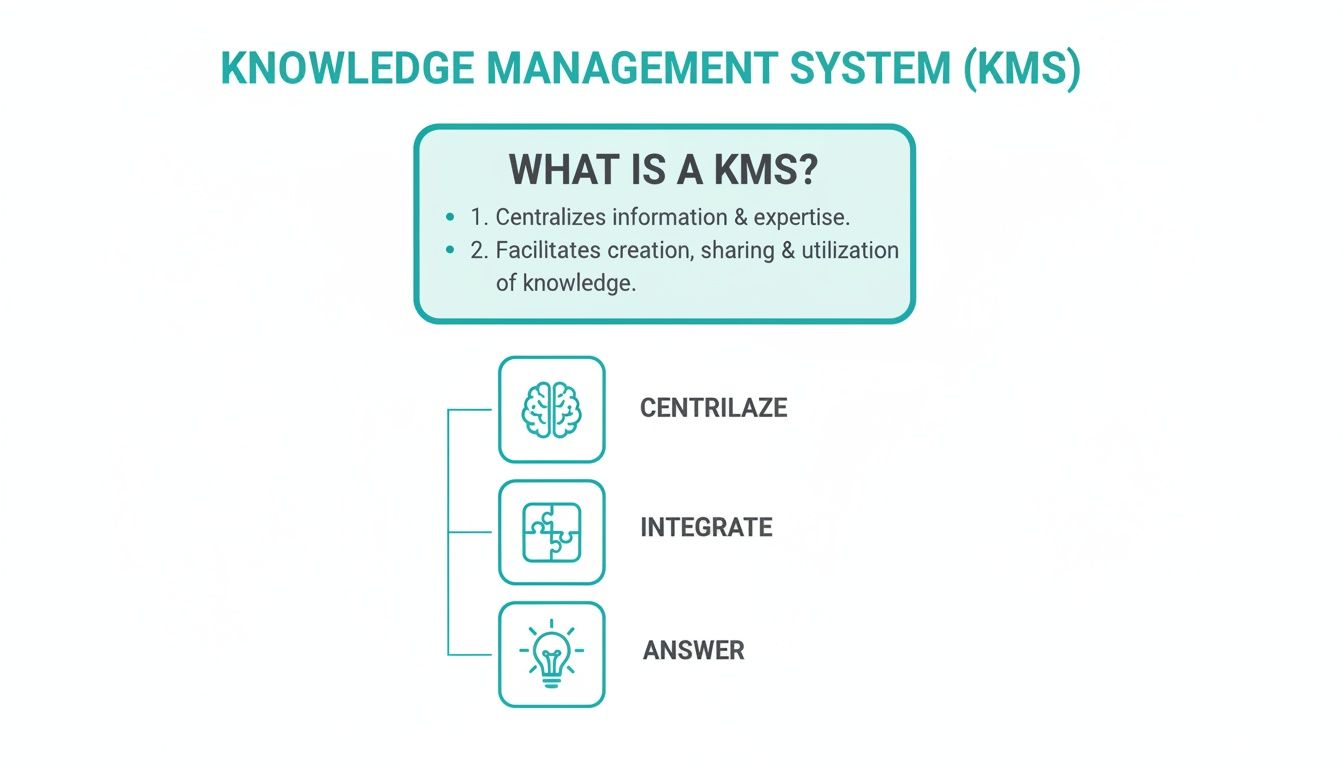
This simple process transforms a mess of siloed data into an intelligent, always-on resource that meets you where you work.
The need for these systems isn't new. Back in 2000, 80% of Fortune 500 firms were already trying to use early KMS versions to stop knowledge from walking out the door when employees left. The problem today has flipped. It’s not a lack of information but a tidal wave of it, with 80% of support agents saying that easy access to data from other departments would be a complete game-changer for them.
You can learn more about this journey in our comprehensive guide to modern knowledge management.
A modern KMS is less about building a library and more about having an expert on call 24/7. It brings your team’s collective brain directly into your workflow, allowing you to ask a question in a tool like Slack and get an immediate, accurate answer.
A Day in the Life Before and After a Modern KMS
The best way to grasp the impact of a KMS is to see the difference it makes in your daily routine. This table contrasts the all-too-common frustrating way of working with the effortless flow a modern system enables.
| Task | Without a KMS (The Frustrating Way) | With a Modern KMS (The Effortless Way) |
|---|---|---|
| Onboarding a New Hire | You send a dozen links to different drives and wikis. They spend the first week pinging teammates with basic questions. | The new hire asks SAI in Slack, What's our vacation policy?and gets an instant answer with a link to the official doc. |
| Finding a Project Update | You search your email, then Slack, then the project folder. You finally ask the project manager, interrupting their focus. | You ask in a shared channel, @SAI what's the latest on the Q3 launch?and get a summary with links to the key documents. |
| Answering a Customer Query | A support agent puts a customer on hold to find an answer. They ask in a public channel, and two people give conflicting information. | The agent asks SAI the customer's question directly in Slack and gets the verified, up-to-date answer in seconds. |
| Prepping for a Sales Call | You spend an hour hunting down the latest case study, pricing sheet, and competitor analysis, hoping they're current. | You ask SAI, Show me the latest materials for a prospect in the finance industry,and it surfaces everything you need. |
Ultimately, it’s about freeing your team from the mundane work of information retrieval. By bringing all your knowledge together and making it instantly accessible, a KMS empowers everyone to focus on what actually moves the needle: creative problem-solving, strategic thinking, and doing their best work.
How a Modern KMS Actually Changes Your Day-to-Day
Let’s get real for a minute. Forget the high-level definitions and think about the daily grind. Picture the constant, low-grade friction that slows everyone down—the endless searching, the shoulder taps, the same questions being asked over and over in Slack. A modern KMS isn't about adding another tool to the pile; it’s about making that chaos disappear.

It’s the difference between hunting for information and having it delivered right when you need it. This shift completely changes how work gets done, freeing up a staggering amount of mental energy and time that used to be lost to simple grunt work.
From Information Hunter to Strategic Thinker
Without a solid system in place, your team spends a huge chunk of its day playing detective. It’s not just a hunch—research shows that employees burn about 20% of their workday just looking for internal information. That’s an entire day each week, down the drain. This isn't just inefficient; it’s a morale killer that stops momentum dead in its tracks.
A modern KMS, especially one that plugs right into your workflow like SAI for Slack, completely flips this script. Instead of breaking your concentration to go digging through five different apps, you just ask a question right where you’re already working.
The real magic of a modern KMS is that it kills context-switching. Your team stops being information hunters and starts being strategic thinkers, finally free to focus on creative problem-solving and doing their best work.
Think about these scenarios that play out in every office, every single day:
- For Sales Teams: Your top rep is minutes from a huge client call. Instead of a frantic search for the latest pricing sheet buried in a messy shared drive, they just ask SAI in Slack,
What's our current enterprise pricing?
They get an immediate, verified answer. Boom. - For New Hires: A designer joins the team and needs brand assets. Rather than pinging three different people and waiting for replies, they can just ask,
Where can I find our logo files?
and instantly get a direct link to the right folder. They’re contributing in minutes, not days. - For Support Agents: A customer asks a tricky technical question. The agent doesn't have to put them on hold. They ask SAI, which pulls the exact troubleshooting step from an old support ticket. The issue is solved on the first try.
This is the power of a true what is knowledge management system solution—it’s not just a database, it's an on-demand expert that lives where your team works.
Giving Your Team Their Most Valuable Resource Back
The real cost of bad knowledge management isn't just wasted hours; it's lost opportunity. Every minute someone spends searching is a minute they’re not spending on innovation, collaboration, or making a customer happy. It’s the mental drain from constantly jumping between tasks that silently chips away at your team's ability to do deep, meaningful work.
By giving them a single, reliable place for answers right in the flow of conversation, you hand back their most precious resource: uninterrupted focus. People can finally stay in the zone, build momentum on big projects, and apply their best thinking where it actually counts. Your company's collective brain becomes your greatest asset, not a frustrating puzzle.
Exploring Different Types of Knowledge Management Systems
When you hear “knowledge management system,” your mind probably jumps to a clunky, outdated company wiki. You know the one—a digital graveyard of information that’s a pain to update and even harder to search. While those traditional systems still exist, the new wave of what a KMS can be is a world away, built for how modern teams actually get work done.

Think of it as the difference between a librarian who makes you perfectly file every single book and a brilliant expert who has already read everything and gives you the exact answer you need, right when you ask.
The Old Guard of Knowledge Management
Traditional systems like document repositories (imagine sprawling shared drives) and corporate intranets were the first crack at solving the knowledge problem. They basically act as digital filing cabinets, forcing you to manually organize, tag, and then hunt for information. You have to know what you're looking for and have a good guess at where it might be filed.
This approach just doesn't hold up in a fast-moving company. Information gets outdated, files are misnamed, and your team ends up wasting more time searching than working. It's a static, manual process that puts all the organizational heavy lifting on your people.
The New Wave: AI-Native Systems
Today’s most effective knowledge management systems are AI-native and designed to disappear right into your workflow. Instead of forcing you into a separate platform, they live where your team already collaborates—inside tools like Slack. The best part? You don't have to build anything.
Imagine this: you never have to open another tab, dig through another drive, or interrupt a colleague again. You just ask a question in Slack, and the answer appears. That’s the entire experience.
These intelligent systems connect to the tools you already use—Google Drive, Confluence, and even past conversations—and learn automatically. They understand the context of your questions and deliver precise answers, not just a list of links you have to sift through. It’s a fundamental shift from finding documents to getting answers. For a deeper look, check out some powerful knowledge base examples that help build a self-running business.
This modern approach directly solves the information fragmentation that plagues most companies. Right now, 54% of firms report juggling five or more different tools just to manage their knowledge, which creates utter chaos. The market for unified, AI-driven solutions is surging—from USD 5.23 billion in 2024 to an expected USD 7.66 billion in 2025—precisely because they eliminate the need to search. You can read more about the explosive growth of the KMS market.
Ultimately, the best what is knowledge management system solution is the one your team doesn’t even have to think about. It just works silently in the background, transforming your team’s scattered conversations and documents into a collective brain that's always on, always learning, and always ready to help.
Measuring the Real-World Business Impact of Instant Answers
So, how does finding information faster actually translate to your bottom line? The return on investment here isn't some vague, feel-good promise. It’s tangible, it’s significant, and it can fundamentally change how your business operates. A good KMS delivers concrete financial and operational gains that you can see and measure every single day.
Imagine your new hires becoming productive team members in a matter of days, not weeks. That's the real impact of instant answers. Instead of constantly tapping senior staff on the shoulder for basic information, they can get up to speed on their own, drastically cutting down both onboarding time and costs.
From Cost Center to Competitive Advantage
Think about your customer support team. When they're armed with immediate, accurate information, they can solve issues on the first call. That turns frustrated customers into loyal fans. For your sales reps, it’s about having the perfect case study or pricing detail ready at the exact moment it can help close a deal. This isn't just another software purchase; it's an investment in efficiency, employee morale, and a genuine competitive edge.
The real value of a KMS is that it safeguards your most valuable, irreplaceable asset: your institutional knowledge. When an expert leaves, their expertise doesn't walk out the door with them.
Using technology to boost efficiency isn't a new idea, of course, but the market growth tells a powerful story. The global KMS software market was valued at USD 22.9 billion in 2025 and is projected to skyrocket to USD 81.9 billion by 2035. That's a staggering 257.9% total growth, driven by more and more businesses recognizing its immense impact. You can see more details on this explosive market expansion at Future Market Insights.
The Power of a Single Question
The true measure of a KMS is its ability to smooth out daily workflows. It’s about getting rid of the friction of searching across a dozen different platforms—no more opening countless browser tabs or digging through ancient shared drives. The ideal experience is simple: your team can just ask a question right in Slack and get the answer they need, instantly.
This shift has a direct and powerful impact on productivity and focus. Here’s where the numbers get really compelling:
- Accelerated Onboarding: Slash the time it takes for new employees to become fully productive, saving thousands in training costs and lost output.
- Higher Customer Satisfaction: Faster, more accurate support resolutions lead directly to better CSAT scores and keep customers coming back.
- Increased Sales Velocity: Sales teams with instant access to knowledge can respond to leads faster and more effectively, shortening the entire sales cycle.
This kind of operational lift happens when systems plug directly into the tools your team already lives in. For a closer look at how this works in practice, check out our guide on using AI in Slack to build a knowledge base that delivers instant answers. It's not just about managing knowledge; it's about unleashing its full potential to drive your business forward.
How to Implement a KMS Without the Headache
The mere thought of launching a new company-wide system can be enough to give anyone a headache. You’re probably picturing complex data migrations, endless training sessions, and months of disruption. It’s a familiar story: dedicated teams working overtime just to get a new tool off the ground.
But what if a modern KMS could be up and running in about five minutes, with zero effort from you?
The new standard is a ‘zero-configuration’ approach. This means you can forget the massive, drawn-out implementation project. Instead of spending months building a knowledge base, you can start getting answers immediately.
Meet Your Team Where They Already Work
This massive shift is built on a simple but powerful idea: the technology should adapt to how your team works, not the other way around. Instead of forcing everyone to learn yet another new platform, the best systems plug right into the tools your team already lives in every single day, like Slack.
This is a game-changer. With a tool like SAI for Slack, you don’t need a project manager or a months-long rollout plan. You just add the tool to your workspace, connect your existing apps like Google Drive or Confluence, and it starts learning from your existing information immediately.
That’s right—no manual data entry, no painstaking tagging, and no building a database from scratch.
The entire experience is designed to be invisible. Imagine never again having to open another browser tab, dig through a shared drive, or interrupt a colleague. You just ask a question in Slack, and the answer appears.
This effortless setup is what makes a modern KMS so incredibly effective. The value isn't something you have to wait months to see; it shows up on day one.
From Overload to Instant Answers in Minutes
The transformation happens almost instantly. Within minutes of setting it up, your team can go from drowning in information to getting instant, organized answers. The constant friction of searching for things just melts away, replaced by a smooth, conversational flow of information.
- No lengthy onboarding: Your team members don’t need training because they're not learning a new tool. They just keep working exactly as they always have.
- No data migration projects: The system intelligently learns from your existing documents and conversations right where they already are.
- No change in behavior: Getting an answer is as simple as asking a question in a channel they already have open all day long.
This approach completely dismantles the biggest barrier to adopting new software: employee resistance. When the tool feels less like a clunky new system and more like an incredibly helpful colleague who just showed up, adoption becomes natural. It's effortless. Your team sees the benefits immediately, turning a dreaded implementation process into a welcome upgrade to their daily workflow.
Common Questions About Knowledge Management Systems
When you're thinking about bringing a modern KMS on board, a few practical questions always pop up. It’s easy to get sidetracked by feature lists and tech specs, but what really matters is how it will change the way your team actually works. Let's dig into the questions we hear all the time and get to the real business impact.

How Is This Different From a Shared Drive?
Think of a shared drive like Google Drive as a digital filing cabinet. It’s great for storing things, but that’s about it. You’re still forced to be an information hunter, needing to know exactly what file to look for and where it might be buried. You end up wasting your day sifting through endless search results, just hoping you stumble upon the right document.
An AI-powered KMS is a different beast entirely. It’s an intelligence layer that sits on top of all your data. You stop searching for files and start asking questions in plain English.
Imagine this: Instead of cracking open ten different documents, you just ask in Slack,
What was our Q3 revenue?The system instantly pulls the specific number from the correct report and gives it to you. It understands context, saving you from ever having to eyeball a dozen search results again.
Will My Team Actually Use Another New Tool?
This is the make-or-break question. Adoption is the biggest hurdle for any new software, and rightly so. Traditional tools often fail because they force your team to completely change their behavior and learn yet another platform. That friction creates resistance from day one.
Modern systems are built to sidestep this problem entirely by meeting your team where they already work. A KMS that integrates directly into a platform like Slack becomes an invisible, seamless part of the daily workflow. There’s no new app to open, no extra login to remember.
When getting an answer is as simple as asking a question in a channel that’s already open on their screen, adoption becomes effortless. The best KMS is the one that feels less like a tool and more like an incredibly helpful colleague who just joined the team.
Is This Only for Large Companies?
Not anymore. For years, only large enterprises could afford the expensive, complex systems needed to organize their knowledge. That put this kind of power way out of reach for smaller teams. But modern, cloud-based solutions have completely changed the game, making these capabilities accessible and affordable for businesses of any size.
In fact, startups and small businesses often gain the biggest advantage by building a solid knowledge foundation from the very beginning. It stops bad habits from taking root and ensures that as you scale, your institutional knowledge grows with you, not against you. The goal is the same for a team of ten as it is for a team of ten thousand: stop wasting precious time hunting for information and start focusing on growth.
Ready to stop searching and start knowing? SAI learns from your Slack conversations to provide instant answers to your team’s repetitive questions, with zero setup required. Add SAI to Slack for free and transform your team’s workflow today.