What Is Knowledge Transfer and Why Is It Your Untapped Superpower?
Let's ditch the textbook definitions for a moment. At its core, knowledge transfer is the simple act of getting critical information out of one person's head and into the hands of someone else who needs it.
Imagine your team having a shared brain—a central, accessible pool of expertise that anyone can tap into, instantly. It’s about turning that one go-to
person's invaluable experience into a durable company asset that everyone can use, just by asking a question.
Escape the Daily Scramble for Information
Sound familiar? A critical question pops up, and the frantic search begins. You dig through old project folders, scroll endlessly through chat histories, or—the most common culprit—interrupt a senior team member, hoping they have a minute.
This daily scramble is more than just a minor annoyance; it's a silent killer of productivity. Every minute someone spends hunting for an answer is a minute they're not spending on high-value work. Every interruption pulls a colleague out of deep focus, and every delay brings your own progress to a screeching halt. This is the hidden tax of poor knowledge flow, and your team pays it every single day.

A New Reality Where Answers Find You
Now, imagine never having to do that again. Imagine a workday where you don't open a single new tab to search for an answer. The same critical question comes up, but this time, you just ask SAI in Slack. Instantly, you get an accurate answer drawn from your team's collective intelligence. No more context switching. No more interrupting anyone. The information you and your team need is delivered right where you're already working.
This is the promise of effective knowledge transfer. It’s not about building yet another wiki that no one updates or scheduling more meetings. It's about creating a living, breathing system where your team's expertise is captured and shared as a natural part of the workday.
The goal is to make your company's collective knowledge as easy to access as asking a question. When you nail this, you eliminate the friction that slows teams down and build a more self-sufficient, resilient culture.
This goes way beyond just sharing documents. As you'll see when you learn more about what a knowledge management system is, it’s about turning those quick, in-the-moment conversations into reliable, searchable resources. It ensures the brilliant insight shared in a quick chat isn't lost to the digital ether.
Ultimately, getting knowledge transfer right means fundamentally changing how your team interacts with information. It’s a shift from a culture of searching and waiting to a culture of asking and knowing. That simple change unlocks a faster, smarter, and far more focused way of working.
Unlock Your Competitive Advantage Through Knowledge Transfer
Let’s be honest—poor knowledge transfer is more than just an annoyance. It's a silent killer of productivity and a constant drain on your company's bottom line. Think about all the hidden costs bleeding out of your business every single day.
You see it in the constant shoulder-tapping for answers, the project delays while someone is waiting on a response,
and the painful, slow process of rebuilding expertise after a key team member leaves.
These little moments of friction add up, creating a massive financial leak. When your support team has to reinvent the wheel for every customer ticket or your new hires take weeks just to get up to speed, you’re not just losing time—you're losing money and momentum. A smart knowledge transfer strategy is how you plug those leaks for good.
It’s about turning a reactive, inefficient scramble into a powerful engine for growth and stability.
From Hidden Costs to Tangible Gains
Imagine your customer support team resolving tickets 40% faster because every solution your company has ever created is right at their fingertips. Picture a new hire making real contributions on day three, not week three, because they can find answers to their own questions without bugging a senior teammate.
That's the real, tangible result of getting knowledge transfer right. It’s about building a more resilient, self-sufficient team where information flows freely instead of getting stuck.
When knowledge is trapped in silos or locked away in individual minds, your business is essentially operating with one hand tied behind its back. Freeing that knowledge creates an immediate competitive advantage by boosting operational speed and consistency across the entire company.
This approach transforms your team's collective experience—what many call institutional knowledge—into your most valuable asset. To really grasp its potential, it helps to see how this crucial element builds a foundation for long-term success. Dive deeper into this concept in our guide on what institutional knowledge is and why it matters.
The Proven Link Between Knowledge Flow and Growth
The connection between sharing knowledge and scaling a business isn't just a nice idea; it's backed by real-world results.
A 2023 analysis of Ireland's knowledge transfer ecosystem, for example, revealed its staggering economic impact. Companies that actively shared research and innovation saw 1.3 times more domestic sales, 2.5 times higher turnover, and an incredible 4.7 times greater exports. You can read the full breakdown of these findings on UCC.ie. These numbers prove that moving knowledge efficiently leads directly to bottom-line growth.
The same principle holds true inside your own organization. When you stop losing expertise every time someone logs off for the day and start capturing it instead, you build a compounding asset. Your team gets smarter, faster, and far more capable of driving the kind of innovation that puts you way ahead of the competition.
Why Traditional Knowledge Transfer Methods Are Failing Your Team
For years, we've relied on the same old playbook for sharing knowledge. Think of the classic company wiki, the structured mentorship program, or the all-hands training session. These methods were born from good intentions, but they were built for a different, slower-paced world of work.
In today's environment, where teams live and breathe in platforms like Slack, these old-school approaches just don't cut it. They force you to leave your workflow, search multiple places, and hope the information is still relevant. It's a fundamental mismatch—how knowledge is stored versus how people actually need to find it: right now, and right where they're working.
The Trouble with Static, Set-and-Forget
Knowledge
The biggest weakness of traditional knowledge transfer is that it treats information like a museum piece—something to be documented once and admired forever. Take the company wiki. A dedicated team member might spend days creating the perfect guide to a process, only for a software update or a new client policy to make it obsolete a week later.
This trap creates a massive, soul-crushing maintenance burden. Keeping everything up-to-date becomes a full-time job that nobody has time for. Before long, your team learns to distrust the official
sources and reverts to the most reliable method they know: shoulder-tapping a coworker.
The moment a process document is published, it begins to decay. In a dynamic work environment, static knowledge bases quickly become digital graveyards of outdated information, forcing teams to rely on ad-hoc, interruptive methods to get accurate answers.
Getting this right isn't just a matter of convenience; it directly fuels growth. Effective knowledge transfer turns siloed information into tangible business results.
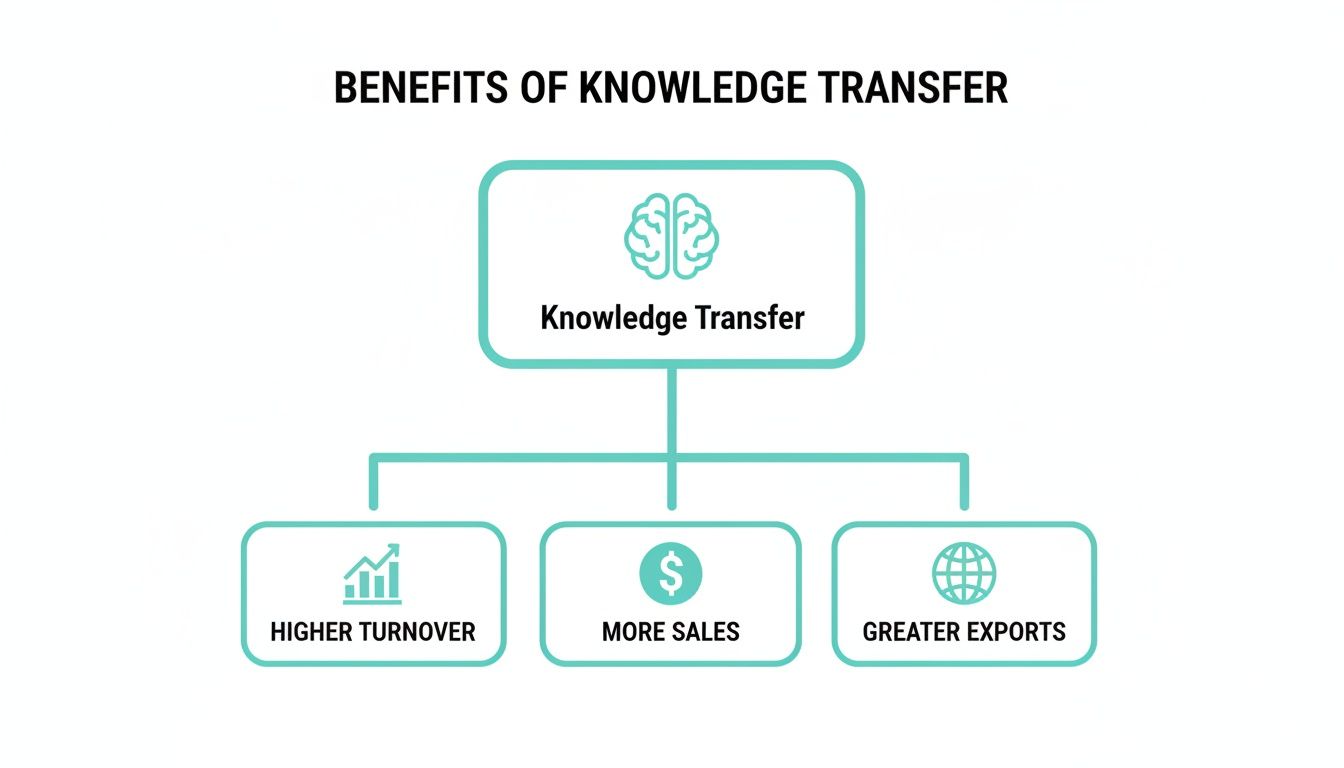
As you can see, a well-oiled knowledge-sharing system is directly connected to better sales, stronger retention, and even expanded market reach.
When Good Intentions Don't Scale
Other tried-and-true methods hit their own walls. Mentorship is fantastic for deep, one-on-one learning, but it's impossible to scale across a growing company. Your top experts end up becoming full-time help desks, answering the same basic questions instead of driving the business forward.
Formal training sessions have a similar problem: the knowledge isn't there when you need it. That critical tip from Tuesday's workshop is a distant memory by Thursday afternoon when the actual problem pops up. These methods fail because they pull people out of their work instead of embedding answers into it.
This over-reliance on person-to-person sharing creates pockets of tribal knowledge, where vital information lives only in the heads of a few key people. You can learn more about how to capture tribal knowledge in our detailed guide. The problem is clear: the old ways demand too much manual work, create too many delays, and simply can't keep pace with modern teams.
Let's look at a direct comparison of how these methods stack up against a more modern, AI-assisted approach.
Comparing Knowledge Transfer Methods
| Method | Effort to Implement | Accessibility | Scalability | Maintenance Burden |
|---|---|---|---|---|
| Documentation (Wikis) | High | Low (search is often poor) | Medium | Very High |
| Mentorship/Shadowing | Medium | Low (depends on expert availability) | Very Low | Low |
| Formal Training | High | Low (one-time event) | Low | High |
| AI-Assisted Capture | Low | High (on-demand in workflow) | Very High | Very Low |
The path forward requires a system that doesn't just store information but actively captures and shares it as a natural part of your team's everyday conversations.
A Global Lesson in Sharing Knowledge
To really see what happens when knowledge flows freely, let's step outside the office for a moment and look at the world economy. For decades, economists have been fascinated by how ideas and new tech move from one country to another. The results are stunning: when nations share research and development (R&D), it acts like a rising tide that lifts all boats, creating a massive economic boost for everyone.
This isn't just a minor bump in the numbers. Foreign knowledge has been a powerhouse for productivity in major economies. In fact, research shows that R&D flowing in from other countries can boost a company's productivity about three times more than its own homegrown efforts. You can dig deeper into these international knowledge spillovers
by exploring the research on nber.org.
Now, bring that idea back to your own company. Think of each team, department, or even individual expert as its own little country, holding its own valuable natural resources
—in this case, knowledge. When that expertise gets locked behind internal borders,
stuck in siloed inboxes or private DMs, it suffocates the very growth and innovation you're trying to foster.
Tear Down Your Internal Borders
Just like trade barriers can cripple a national economy, your company's internal knowledge barriers are slowing you down, guaranteed. Every time someone has to go through customs
—by pinging a colleague and breaking their focus or waiting hours for a simple answer—you lose momentum. That friction is a direct tax on your team's productivity.
So, what if you applied that global lesson to your own workflow? What if the sales team in London could instantly tap into the latest product insights from the team in New York without a single meeting on the calendar? What if a new developer could access ten years of a senior engineer's wisdom without ever having to interrupt their flow?
When you treat your internal expertise like a globally traded asset, freely accessible to everyone, you create an outsized lift in productivity. Breaking down these silos isn't just a process improvement; it's a fundamental economic strategy for your business.
For teams that live in Slack, this is exactly the problem an AI assistant like SAI is built to solve. It quietly captures team-specific knowledge from public channels—no tedious manual setup required. This turns fleeting conversations into a permanent, searchable knowledge base, giving you the same kind of efficiency boost seen in those international R&D spillovers.
By dissolving these internal borders, you stop forcing your people to operate like isolated nations and start building a truly interconnected economic powerhouse. This simple shift turns effective knowledge transfer from a nice-to-have into your single greatest competitive advantage.
The Future of Work Is Asking One Simple Question
The old way of finding information at work is broken. The endless digging through outdated wikis, the shoulder-tap that interrupts your team’s top expert, the long wait for an answer that grinds your progress to a halt—this is the reality for too many teams.
The future of effective knowledge transfer isn't about building another massive information graveyard or scheduling yet another training session. It’s about a fundamental change in how we get information, making it as easy as asking a single question right inside Slack.

Imagine this: today is the last day you will ever have to search for an answer in multiple places. It’s 10 PM, you’re trying to wrap up a critical task, and you’ve hit a roadblock. Instead of giving up or sending a message into the void, you just ask SAI. Instantly, you get a clear, accurate answer pulled directly from your team's collective brainpower. Your question is answered, your task is done, and nobody was interrupted.
This isn’t some far-off fantasy. It's the real, tangible result of a modern, AI-powered approach to sharing knowledge.
A Single Source of Truth That Builds Itself
Here's where the transformation truly happens: this intelligent system builds itself. Every question asked and answered in your team’s public channels feeds into a living, breathing knowledge base that maintains itself. No manual updates. No content calendars. No extra work for anyone.
That brilliant solution a senior engineer shared last month? It's captured. The onboarding tip your team lead posted yesterday? It's ready and waiting. That quick workflow clarification from a chat two weeks ago? It’s there to be found the very next time someone needs it.
This creates a flywheel effect that just keeps getting better:
* Fewer Interruptions: Your experts are finally free to focus on deep, meaningful work, knowing common questions are being handled automatically.
* Faster Resolutions: Team members get unstuck in minutes, not hours, which dramatically speeds up project timelines.
* Total Confidence: Everyone can work with the assurance that they have instant access to the most current and correct information, right where they're already working.
The real change is moving from a system where knowledge has to be actively hunted down to one where it is passively and automatically delivered the moment it’s needed. This simple shift removes the friction that kills both productivity and morale.
The Inevitable Rise of Intelligent Knowledge Systems
This evolution isn’t just a fleeting trend; it’s a massive market shift driven by a deep need for smarter ways to collaborate. The global knowledge management market ballooned to $655.8 billion in 2023 and is on track to hit an incredible $2.1 trillion by 2030, with AI integration being the primary driver.
Modern teams are already voting with their budgets: 36% are putting more resources into collaboration apps like Slack, while 38% are using AI for things like content recommendations. You can dive deeper into these trends and the role of AI in knowledge transfer on nsf.gov.
For teams that live and breathe in Slack, an AI assistant like SAI brings this future to life today. It turns your existing conversations into a reliable, intelligent resource without forcing you to change a single thing about how you work.
This is what effortless knowledge transfer looks like. It’s not another tool to manage; it's an invisible layer of intelligence that makes your entire team smarter, faster, and more self-sufficient. And it all starts by just asking a question.
Still Have Questions About Knowledge Transfer?
When you start thinking about moving beyond the daily scramble for information, a few practical questions always seem to pop up. Let's tackle some of the most common ones teams have when they're ready to get serious about sharing knowledge.
What's the Single Biggest Mistake Companies Make?
Hands down, the biggest mistake is treating knowledge transfer like a chore. It’s seen as this separate, manual task—something you do after the real work is done. Companies sink a ton of time and money into building these elaborate wikis or shared drives, and what happens? They become digital ghost towns, filled with information that was outdated the second it was published.
This whole event-based
approach just doesn't work because it relies on people who are already swamped to stop what they're doing and write everything down. It completely ignores where the most valuable insights actually live: in the day-to-day chatter, the quick Slack threads, and the collaborative problem-solving that keeps your business moving.
The secret is to capture knowledge right at the source, in the place where it’s actually created. This is why tools that learn directly from platforms like Slack are so effective—they do the work for you, making sure your shared knowledge is a living reflection of how your team really operates.
How Can I Actually Measure the ROI of This?
You don't need a complicated spreadsheet or a degree in data science to see the return here. It’s about measuring the time you get back when people aren't waiting around for answers. Think in terms of real, tangible improvements that hit your team's productivity and, ultimately, your bottom line.
Here are a few simple things you can track:
- Time-to-Answer: How long does it take to resolve a common question? When that drops from a few hours to a few seconds, you're looking at a massive productivity boost.
- New Hire Ramp-Up Time: Clock how long it takes for a new person to start contributing meaningfully. When they can find answers on their own, they get up to speed faster with far less hand-holding from senior staff.
- First-Contact Resolution Rate: This is a huge one for any support team. If agents can access the right information instantly, they solve more customer issues on the very first try.
- Fewer
Déjà Vu
Questions: Just watch the public channels. You'll see a sharp drop in the same questions being asked over and over again. This frees up your experts to focus on the tough stuff, not repeat themselves all day.
An AI-powered tool makes this incredibly easy by showing you exactly how many questions it deflects. Every single one of those is a saved interruption, and those minutes add up to hundreds of hours saved across the company.
Is This Really Necessary for a Small Team?
Yes, 100%. In fact, small teams probably need a solid knowledge transfer plan more than anyone. Think about it: in a small group, crucial information is often locked away in the head of just one or two key people. What happens if that person goes on vacation, gets sick, or decides to leave? The whole operation can screech to a halt.
This creates risky knowledge silos
that only get harder to break down as you grow. By putting a simple, automated system in place early, you prevent that dependency from ever taking root in your culture.
Starting with a tool that quietly learns from a single Slack channel builds a resilient, shared brain for your team from day one—without adding any busywork. You're not just solving a problem for today; you're building a foundation of collective intelligence that will pay off for years to come.
Ready to stop the endless searching and start getting instant answers? With SAI, you can transform your team's Slack conversations into a self-updating knowledge base that works 24/7. Add SAI to a channel for free and see how effortless knowledge transfer can be. Get started with SAI today.