What Is Tribal Knowledge And How Can You Capture It
Ever heard the term tribal knowledge? It’s all that unwritten gold—the insider expertise, the clever shortcuts, and the gut-feel solutions that live inside the heads of your most seasoned employees. It’s the real story of how things get done around here,
a story you’ll never find in an official training manual.
The Hidden Knowledge That Runs Your Business
Picture this: your top sales rep, Sarah, puts in her two weeks' notice. A wave of panic hits, but it’s not just about losing a great seller. The real crisis is everything that’s about to walk out the door with her.
We’re talking about her intuitive grasp of your most complex client accounts, the exact turn of phrase she uses to get a yes,
and that undocumented workaround for the buggy CRM feature that everyone else struggles with.
That’s the silent threat of tribal knowledge. It's the lifeblood of your company—the collective wisdom that keeps your teams moving fast and solving problems on the fly. You won't find it in a handbook. It lives in hallway chats, quick Slack messages, and the instincts of your go-to people.
Your Most Valuable and Fragile Asset
This undocumented expertise is your company's most valuable asset, but it's also your most fragile. It’s the crucial gap between the official process on paper and the actual process that delivers results. When it vanishes, simple tasks suddenly become huge roadblocks.
Think about it. These scenarios are probably playing out in your own business right now:
* The Go-To Expert: A junior developer is wrestling with a legacy codebase. The documentation is useless, so what do they do? They ping the one senior engineer who just knows
how it works, creating a frustrating bottleneck for everyone.
* The Unwritten Rule: The marketing team launches a campaign that completely misses the mark. The reason? The one person who understood the critical audience nuances and timing that made past campaigns successful is on vacation.
* The Critical Shortcut: An operations manager wastes a full day trying to fix a recurring logistics error—a problem a former employee had already solved with a simple, unrecorded tweak.
Each of these moments exposes a serious business vulnerability. When crucial knowledge is tied to individuals instead of being a shared company resource, you're always one resignation away from a crisis. Losing just one key person can derail projects, demoralize new hires, and force your team to repeat costly mistakes.
This dependence on individual memory creates a fragile operational model. Your company's ability to innovate, scale, and even function consistently is entirely dependent on keeping specific people in their seats.
Beyond a Simple Definition
So, what is tribal knowledge, really? It's more than just a collection of facts. It’s the rich operational context and intuitive understanding that makes your business actually work. It’s the institutional memory that stops your team from reinventing the wheel every single quarter.
The problem isn't that this knowledge exists—it's that it stays trapped. Getting it out of people's heads isn't just a nice-to-have
administrative chore. It's a core strategy for building a resilient, efficient, and scalable organization. Protecting this asset is fundamental to your company's survival and growth, ensuring your team's collective intelligence becomes a permanent advantage, not a temporary one.
The High Cost Of Letting Expertise Walk Away
When a seasoned employee puts in their notice, they take far more than their laptop and office keys. They walk out the door with an invisible library of unwritten rules, clever shortcuts, and gut-instinct solutions that a job description could never capture. This is the moment tribal knowledge stops being a theoretical concept and becomes a very real, very expensive problem.
The loss of a key team member sets off a chain reaction of hidden costs that ripple straight to your bottom line. It's a slow leak of resources that often goes untracked but shows up in stalled projects, lagging productivity, and a palpable sense of team frustration.
This is the valuable, unwritten know-how that's most at risk when people leave.
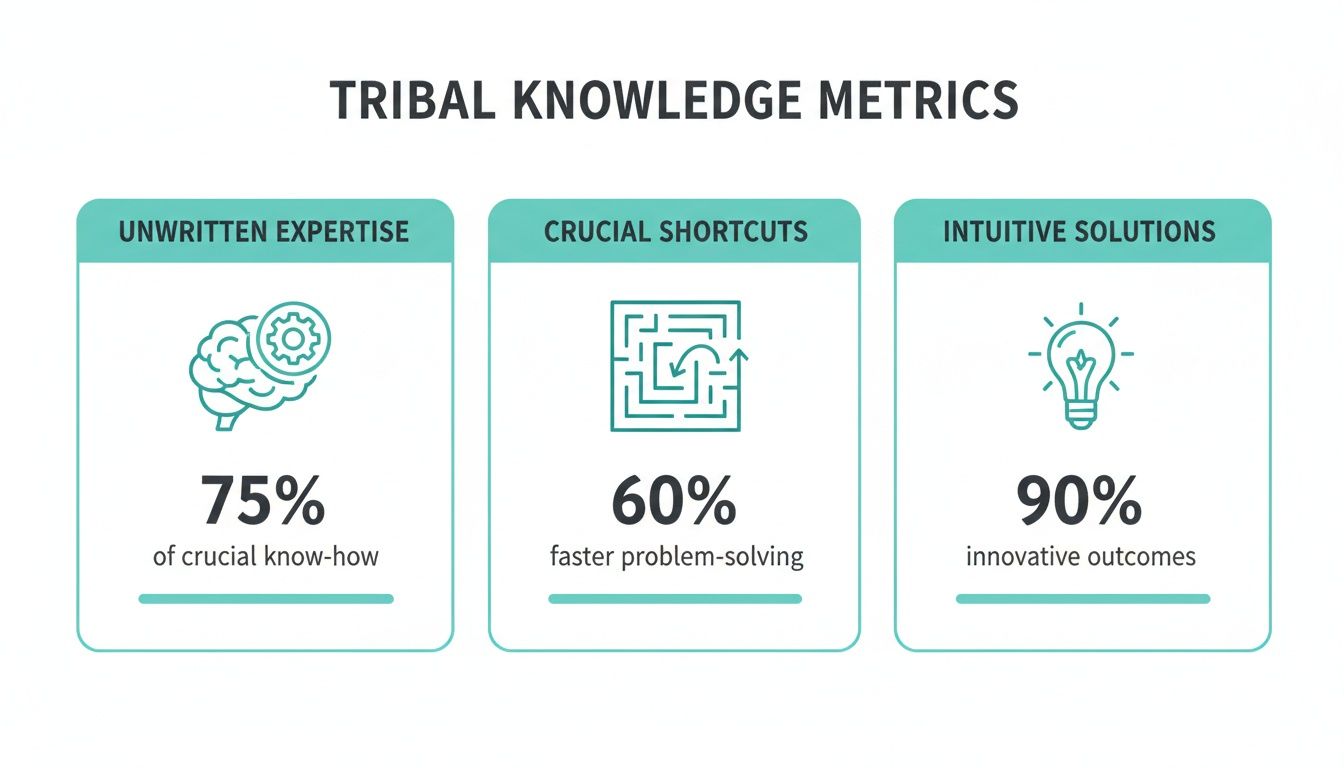
As you can see, it's not just about one person's skills. It’s the entire ecosystem of workarounds and deep understanding that keeps your team moving fast and efficiently.
The Financial Drain Of Lost Knowledge
Every time an experienced team member leaves, the clock resets. The processes they perfected, the client quirks they knew by heart, and the tricky problems they could solve in minutes are suddenly gone. This knowledge gap quickly translates into real financial losses.
First off, onboarding becomes painfully slow and expensive. New hires are left to fend for themselves, stumbling through trial and error for months just to reach the baseline productivity of the person they replaced. They spend their days hunting for answers that used to be a simple question away, constantly pulling other senior employees off high-value work.
Then, you start seeing the same costly mistakes happen over and over again. Remember that obscure bug a veteran engineer squashed last year? Without any record of the fix, a new developer might waste 40 hours trying to solve the exact same problem from scratch. That hard-won negotiation tactic that works with a particular client? A new account manager learns it the hard way, potentially souring a critical business relationship.
Finally, innovation grinds to a halt. When your team is constantly reinventing the wheel and putting out the same old fires, there’s no time or mental space left for creative, forward-thinking work. You can't build for the future when your foundation is constantly crumbling.
To dig deeper into this, check out our guide on how to preserve institutional knowledge and team expertise.
When unwritten knowledge isn't captured, the costs—both financial and operational—add up quickly across the business.
The Hidden Costs Of Tribal Knowledge Loss
| Area of Impact | Description of Cost | Business Consequence |
|---|---|---|
| Employee Onboarding | New hires take significantly longer to become fully productive, requiring more hand-holding and support. | Increased training costs, delayed project timelines, and lower initial ROI on new hires. |
| Productivity | Teams waste hours searching for information, recreating solutions, and waiting on experts for simple answers. | Slower output, missed deadlines, and a constant drag on overall team efficiency. |
| Operational Risk | Key processes depend on one or two people. If they leave or are unavailable, work comes to a standstill. | Creates single points of failure, making the business vulnerable to disruption and downtime. |
| Innovation | Teams are too busy solving old problems to focus on new ideas, improvements, or strategic initiatives. | Stagnation, loss of competitive edge, and a reactive rather than proactive business culture. |
| Customer Experience | Inconsistent service and answers because only a few employees know the rightway to handle specific issues. |
Erodes customer trust, leads to frustration, and increases the likelihood of customer churn. |
Ultimately, failing to capture this knowledge doesn't just hurt your current operations; it actively holds back your company's growth and resilience.
The Human Cost Of Knowledge Silos
Beyond the dollars and cents, letting expertise walk out the door creates a culture of frustration and dependency. When critical information is locked away in the minds of a few key people, it creates bottlenecks that slow everyone else down.
Tribal knowledge is the undocumented expertise held by your most experienced employees. Its vulnerability is staggering. In 2021, the private industry’s annual employee turnover rate hit 52.4%, meaning over half the workforce—and their knowledge—could be turning over each year. You can learn more about this trend in this ProProfs KB article.
This endless hunt for information is exhausting. It directly leads to:
- Employee Burnout: Your remaining experts get buried under an avalanche of repetitive questions, leaving them with no time for their own work. They become single points of failure, and the pressure eventually takes its toll.
- Decreased Morale: Junior and mid-level employees feel disempowered. They can't move projects forward without constant supervision, which kills their confidence and makes them feel like they aren't trusted.
- Inconsistent Customer Experience: When only one person knows the
right
way to handle a specific client issue, the quality of your service becomes a lottery. Customers get different answers from different people, which erodes trust and makes your company look disorganized.
This cycle of dependency isn't a minor inconvenience—it's a major operational risk. It makes your business fragile, inefficient, and a much less satisfying place to work. Capturing what is tribal knowledge isn't just about protecting your bottom line. It’s about building a stronger, more resilient organization where everyone has what they need to succeed.
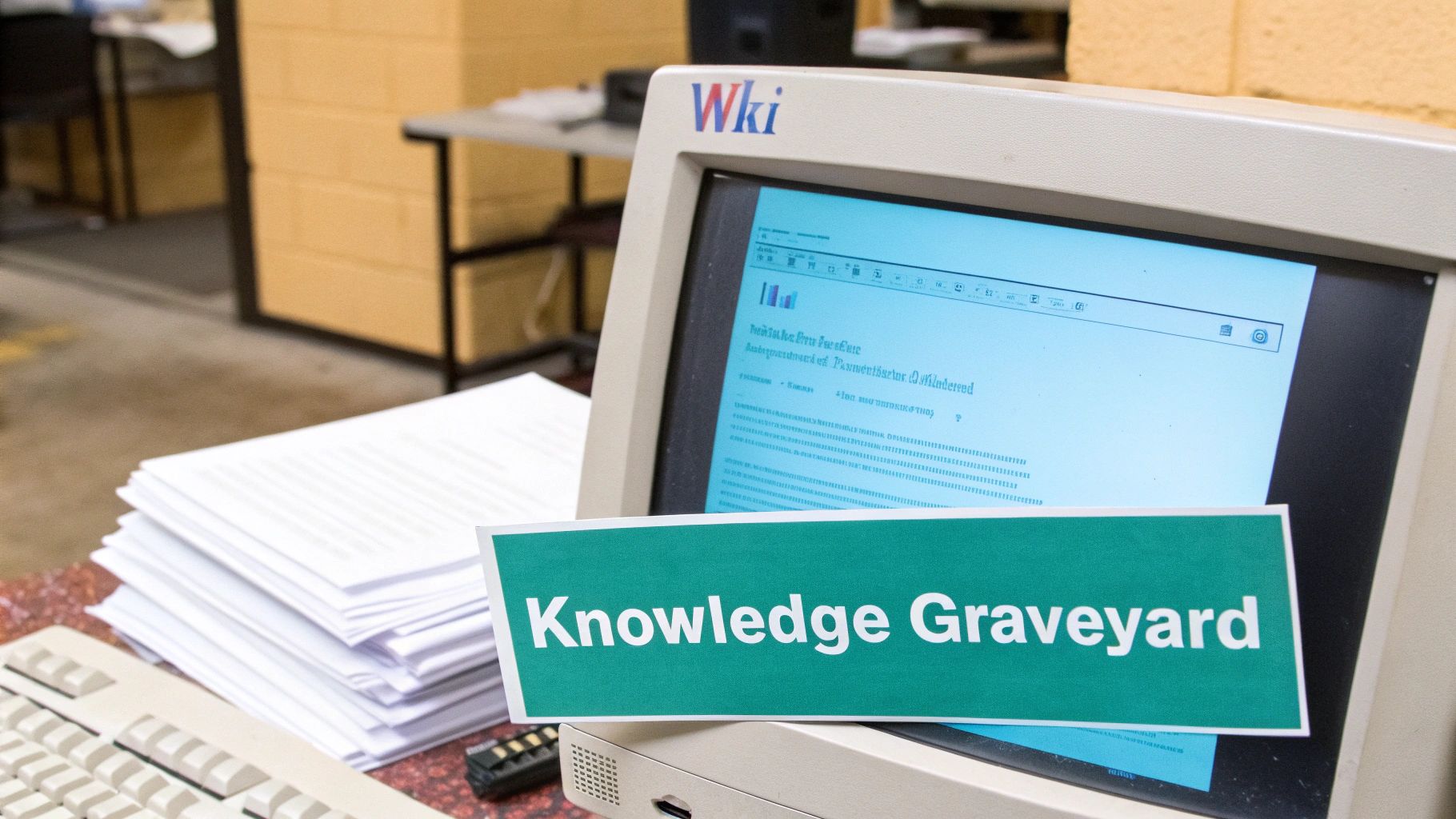
Why Your Wiki Is a Knowledge Graveyard
Most companies think they've got tribal knowledge handled. They'll point to their corporate wiki—a Confluence space or a maze of shared drives—and assume the job is done. But then, the same questions keep popping up in Slack, and critical projects grind to a halt when that one key person is on vacation. Sound familiar?
The hard truth is that these systems often become places where knowledge goes to die. They’re not living, breathing resources; they're digital archives. Over time, they turn into cluttered graveyards filled with outdated documents, half-finished guides, and conflicting information that nobody trusts or bothers to use.
This isn’t your team’s fault. It’s not about laziness or a lack of organization. The problem is that traditional knowledge management is fundamentally broken. It’s built on the absurd idea that your busiest experts have the time to stop their high-value work, switch contexts, and meticulously document every little thing they do.
The Friction of Documentation
The real enemy here is friction. Think about your top engineer or your go-to sales lead. They’re valuable because they solve complex problems, not because they’re great at writing about them. Asking them to pause, open a separate tool, and write a detailed how-to guide is a massive interruption. It breaks their flow and slows everyone down.
Because of this friction, one of two things usually happens:
- Knowledge is never captured. The expert solves the problem, answers a question in a DM, and moves on. The solution vanishes into thin air, forcing the next person with the same issue to start from scratch.
- Knowledge is captured poorly. Under pressure, the expert throws together a quick document. It might explain the
what,
but it almost always misses the crucialwhy.
This surface-level info often creates more confusion than it clears up.
Your wiki is like a library with no cataloging system. The books might technically be on the shelves, but finding the right one when you need it is a frustrating, time-consuming ordeal that most people will abandon.
This creates a vicious cycle of dependency. Instead of digging through a dusty wiki they don't trust, team members find it much easier to just ping the expert directly. This saves them a few minutes but costs your most valuable employees hours of their time, forcing them to answer the same questions over and over.
The Problem With Search and Discovery
Even when good information does make it into the wiki, finding it is another battle altogether. Most of these systems rely on exact keyword searches. You have to know the official jargon just to have a shot.
This leads to a painfully familiar user experience:
- You search for
customer refund process,
but the official document is titledClient Reimbursement Protocol v3.
No luck. - You find three different articles on the same topic, each with conflicting advice and no clue which one is current.
- You finally find what looks like the right guide, only to realize it was written two years ago and is completely obsolete.
These dead ends erode trust. After a few failed attempts, your team gives up. They stop seeing the wiki as a reliable source and go back to the path of least resistance: interrupting their colleagues. A better approach is to understand how a modern wiki for Slack can help centralize answers right where your team is already working.
The goal isn't just to store information; it's to make it instantly accessible at the moment of need. Traditional systems fail because they add steps, create barriers, and operate outside the natural flow of work. To truly solve the tribal knowledge problem, you need a solution that captures expertise seamlessly—without ever asking your team to stop what they’re doing.
How Tribal Knowledge Shows Up In Your Daily Work
Tribal knowledge isn’t some abstract theory you’d find in a business textbook. It’s the invisible script your team follows every single day, quietly guiding how work really gets done in every corner of your company.
Once you know what you’re looking for, you’ll start seeing this hidden expertise everywhere. It’s the sum of all the unwritten rules, the clever workarounds, and the hard-won wisdom that helps your people navigate their jobs. It’s the crucial difference between following the manual and knowing the actual way to get things done right.
The Sales Team Knows The Client
Picture a sales team on the verge of landing a huge account. The official company playbook is full of standard scripts for handling objections.
But the veteran on the team knows this particular client can't stand a canned pitch. Tribal knowledge is the subtle, unwritten insight: knowing to ditch the slide deck, open with a personal story about a similar project, and subtly address the CFO’s budget fears in the first five minutes. That instinct, honed over years, is what gets the deal signed—and you won't find it in any training document.
Marketing Knows The Audience
Or think about your marketing team putting together an email campaign for a very specific customer segment. Sure, the analytics can point them toward a few good subject lines, but data can't replicate human intuition.
The team’s tribal knowledge is that gut feeling about which headline will genuinely connect. It's the almost subconscious understanding that this group responds far better to a curious question than a hard-sell CTA. That kind of insight is what keeps a campaign from flopping, protecting your sender score and your relationship with your audience.
This unwritten expertise is the secret sauce behind high-performing teams. It's the practical, battle-tested wisdom that turns standard processes into exceptional results.
Without it, new hires are just following the official script, often left wondering why they aren't getting the same results. They’re completely missing the context that only comes from experience shared person-to-person.
Operations Knows The Machines
Nowhere is this more obvious—or more critical—than in operations or on a factory floor. In manufacturing, tribal knowledge is often the collection of unwritten tricks for running equipment, perfected over decades but almost never written down. With Baby Boomers retiring at a rate of 10,000 per day, this undocumented expertise is literally walking out the door, leaving a massive skills gap in its wake. You can find more details about the manufacturing knowledge gap at Dozuki.com.
This isn't just about the standard operating procedures. It’s the machine operator who knows that one specific press needs a gentle tap on the side to prevent a jam that would otherwise shut down the line for hours. It's the logistics manager who knows an unofficial shortcut in the ERP system to rush a critical shipment.
These small, undocumented actions have a huge impact, directly affecting productivity, uptime, and the bottom line. When that knowledge vanishes, the whole operation becomes less efficient and more vulnerable overnight. Spotting these everyday examples is the first step to realizing just how much of your company's success is stored only in your people's heads.
Imagine A Day Without Hunting For Information
Let's paint a picture of a transformed workday. It’s Tuesday morning, and a junior team member hits a wall on a major project. In your company today, this probably means they spend the next 45 minutes lost in a messy shared drive, searching a wiki full of outdated articles, or interrupting a senior colleague.
Now, imagine a different reality. Instead of all that, they just ask a question in Slack. And that’s it.
Seconds later, they have a perfect, step-by-step answer. It's not some generic reply—it's the exact, nuanced solution your top expert gave for the same problem three months ago, complete with all the essential context. The project keeps moving. Your expert is never pulled away from their work. And your junior employee feels capable, not stuck. This is the future of work when you stop just storing information and start making it instantly accessible.

From Constant Interruptions To Seamless Flow
The old way of working creates a day defined by friction. It’s a never-ending cycle of searching, waiting, and interrupting. Every question becomes a productivity tax, not just for the person asking, but for the expert who has to halt their own high-value work to answer it. This constant context-switching absolutely crushes focus.
But what if that friction just vanished? Imagine a workday where your team operates in a state of flow because the answers they need are always a simple query away, right inside the tool they already use. Imagine never having to open another tab to hunt for information again. This is the difference between a reactive, frustrating work environment and a proactive, high-performance one.
The goal is to create a single source of truth that builds itself. A system where every question asked and answered in Slack strengthens the collective intelligence of the entire company, turning everyday conversations into a permanent, searchable asset.
Empowering Your Team With Autonomy
When information is a pain to find, it breeds a culture of dependency. People become hesitant to take initiative, worried they'll make a mistake because they don't have the full picture.
Now, picture the complete opposite. A new hire confidently tackles a complex task on their second day because they can instantly access the wisdom of your most seasoned team members. A support agent in a different time zone solves a tricky customer issue overnight without ever having to wake up a senior engineer. This is what happens when you make expertise available to everyone, on demand. You give every single person on your team the autonomy to solve problems and make decisions with confidence.
A New Reality For Work
This transformation isn't about installing yet another complicated piece of software. It’s about fundamentally changing how your team finds and shares information, making work simpler and faster. It’s about moving away from static, dusty repositories and toward a dynamic, living knowledge base that grows and adapts with your business.
This is the central idea behind a modern knowledge management system that works where your team does. It's a smarter way to operate, focused on:
- Zero Searching: Getting accurate answers in seconds by just asking.
- No More Interruptions: Freeing up your senior talent from repetitive questions so they can focus on innovation.
- Total Empowerment: Giving everyone the information they need to do their best work on their own.
This new reality means less time spent searching and more time spent doing. It’s a workplace where the answer to what is tribal knowledge is no longer a vulnerability but a shared, accessible, and powerful asset that drives your business forward.
Turn Team Conversations Into Your Knowledge Base
This is where the chronic problem of tribal knowledge finally gets a real-world solution. We've all seen the old methods fail. Asking your best people to stop what they're doing to write down everything they know just creates friction and never gets done. But what if you could capture their expertise without them ever changing their workflow?
Imagine a system that learns from the conversations already happening every single day in a tool like Slack. This approach doesn't just improve on the old model; it completely inverts it. Instead of forcing people to document, the knowledge is simply preserved as it's shared.
A Self-Building Source Of Truth
Imagine your team's knowledge base building itself, automatically. When someone asks a question in a Slack channel and an expert provides a great answer, that entire exchange is instantly captured and becomes a permanent, searchable asset for the whole company.
This isn't just about saving snippets of text. It's about preserving the entire context—the initial question, the back-and-forth that clarified the problem, and the final, proven solution. You get the whole story, which is infinitely more valuable than a sterile wiki article written in a vacuum.
This transforms everyday communication from a temporary exchange into a lasting intellectual asset. Every resolved issue and shared tip automatically strengthens your company's collective intelligence, building a powerful knowledge base with zero extra effort from your team.
Think about the compounding effect here. A problem solved once in a public channel is a problem solved for good. A question answered for one person becomes an instant answer for everyone else who has it later. The efficiency gains start to stack up fast.
Life Without The Documentation Chore
This approach gives you a clear path from a state of constant risk to one of genuine resilience. The best part? It completely removes the burden of manual documentation from your experts, freeing them up to focus on the high-value work they were actually hired to do.
No more bugging your senior engineers to write another how-to
guide. No more asking your top sales reps to document their best closing techniques after a frantic quarter. The knowledge is captured organically, right in the moment when it’s most accurate and relevant.
This seamless process means your knowledge base is always:
- Current and Relevant: It reflects the real problems and solutions your team is dealing with right now, not six months ago.
- Rich with Context: You get the
why
behind thewhat,
which makes the information far more useful and easier to apply. - Effortless to Maintain: The system grows and refines itself automatically as your team works.
Your Team’s Brain In Slack
Ultimately, this is about turning your team's primary communication hub into its central brain. Slack stops being a place where valuable information goes to die, lost forever in the endless scroll. It becomes the living, breathing source of truth that powers your entire organization.
The shift is simple but profound. You stop losing valuable tribal knowledge every time a conversation scrolls away or an employee walks out the door. Instead, you build a smarter, more resilient organization where expertise is a shared asset, accessible to anyone, anytime, right where they already work.
Common Questions About Tribal Knowledge
Diving into the world of tribal knowledge often brings up a few common questions. Let's tackle some of the big ones so you can get a better handle on this hidden, yet vital, company asset.
How Do I Even Begin to Find Our Tribal Knowledge?
The first step is simpler than you might think: just watch and listen. Who on your team is constantly getting pulled aside or pinged on Slack for answers? These are your resident experts, and they're sitting on a goldmine of undocumented know-how.
A great way to cut right to the chase is to ask managers a pointed question: If your most experienced person quit tomorrow, what crucial information would walk out the door with them?
The answers will immediately show you where your biggest knowledge risks are hiding.
Is All of This Tribal Knowledge
Actually Good for the Business?
Honestly, no. Sometimes, that unwritten wisdom is just an inefficient or outdated process that survives simply because it's the way we've always done things.
The good news is that the process of uncovering this knowledge gives you the perfect chance to review it all. You can ditch the bad habits, formalize the brilliant workarounds, and turn those informal shortcuts into streamlined best practices for everyone.
How Can We Get People to Actually Share What They Know?
Building a culture that celebrates sharing is important, but let's be realistic—your top experts are busy. The best way to get them to share is to make it so easy they don't even notice they're doing it.
The real secret is to remove the friction. Instead of asking people to stop their work to write documentation, you use tools that capture knowledge as it's shared naturally in everyday conversations.
When you capture insights directly from the collaboration already happening in Slack, sharing becomes a seamless part of the workflow, not another chore on your expert's to-do list.
Stop letting your team's best answers disappear into the scroll. With SAI, you can turn your Slack conversations into a self-building knowledge base, automatically. Reduce interruptions and empower your team with instant, reliable answers. Add SAI to Slack for free.