Your Next Communication Plan Template That Just Works
Think of a communication plan template as more than just a document—it's your strategic map. It's the framework that dictates what you say, who you need to reach, and how you deliver the message. This is how you move your team from scattered, reactive updates to deliberate, purposeful communication.
Move Beyond Chaos to Clear Communication
Picture a day where you don't have to dig through forgotten Slack channels, sift through endless email threads, or click through multiple project boards just to find one simple update. This isn't about creating another rigid process that gets ignored. It’s about getting your team’s focus back and putting an end to the constant, draining hunt for information.
The magic happens when your communication shifts from chaotic, knee-jerk messages to a reliable system of strategic updates. When information flows predictably, the background noise of uncertainty finally fades, making space for real, deep work.
End the Endless Search for Information
When was the last time you needed a critical piece of information right now? You probably opened a dozen tabs, scrolled endlessly through Slack, and maybe even pinged a colleague, interrupting their flow. Every one of those searches is a small hit to productivity. Multiplied across an entire team, it adds up to hours of lost time and focus every single week.
A well-designed communication plan acts as your single source of truth. It carves out clear pathways for essential updates, so finding what you need becomes second nature.
Your team stops asking,
Where can I find...?and starts knowing exactly where to look. This simple change eliminates duplicate questions and ensures everyone—from leadership to new hires—is perfectly aligned on goals, timelines, and responsibilities.
The Business Impact of Clarity
The shift from chaos to clarity isn't just a nice-to-have; it delivers a measurable impact on the bottom line. With remote and hybrid work being the new standard, the need for intentional communication has never been greater.
A recent report from Axios HQ found that 68% of organizations that invested more in their communication strategy saw better alignment with business goals. Yet, the same report revealed a massive disconnect: only 12–16% of employees rated their leadership's communications as 'very effective.' A solid plan is built to close that exact gap, turning top-down announcements into information that people actually understand and act on. You can read the full report on communication strategy to dig deeper.
To see what this looks like in practice, here's a quick before-and-after snapshot of how a plan changes things on the ground.
| Challenge Area | Without a Plan (The Old Way) | With a Plan (The New Way) |
|---|---|---|
| Information Access | I'll just ask someone.Constant interruptions and shoulder taps. |
Self-service. Team members know exactly where to find project updates. |
| Project Updates | Inconsistent updates sent through random Slack DMs and email chains. | Scheduled, predictable updates in a designated channel or document. |
| Team Alignment | Different team members working off outdated or conflicting information. | A single source of truth ensures everyone is on the same page. |
| Decision-Making | Decisions are delayed while waiting for critical context or approvals. | Key information is readily available, empowering faster, better decisions. |
| Employee Onboarding | New hires feel lost, bombarding teammates with basic questions. | A clear plan gives new hires a roadmap to get up to speed quickly. |
The difference is stark. Moving to a structured plan isn't just about being more organized—it's about fundamentally changing how your team operates for the better.
Communication as a Competitive Advantage
Ultimately, this is your first step toward building a more efficient, less stressful work environment. When communication is intentional, it stops being a daily chore and becomes a powerful competitive advantage.
Projects move faster, bottlenecks disappear, and your team can operate with the confidence that comes from knowing they have the information they need, right when they need it. This clarity empowers people to make better decisions, innovate more freely, and focus their energy on work that truly matters.
Build Your Core Communication Framework

Before you can start assigning channels or setting deadlines, you need to lay the groundwork. Your core framework is the bedrock of your entire plan—the simple, unshakeable logic behind every message your team sends.
This isn't about getting bogged down in a complex spreadsheet just yet. It’s about nailing down the why before you even think about the what. If you can answer three fundamental questions right here, you’ll sidestep most communication breakdowns before they even have a chance to start.
Define Your Communication Objectives
First things first: what are you actually trying to accomplish? An objective isn't just to inform the team.
That's a starting point, not a destination. A real, powerful objective is specific, measurable, and tied directly to a business outcome.
Let's say you're rolling out new internal software. The goal isn't just to announce it; it's to get people to actually use it.
- Weak Objective:
Inform employees about the new CRM.
- Strong Objective:
Ensure **75% of the sales team** logs into and uses the new CRM for at least one core task within the first week of launch.
See the difference? That clarity turns a simple FYI into a strategic tool. You’re no longer just sending an update; you're launching a mini-campaign designed to change behavior and boost performance. This approach also helps centralize crucial information, a key principle you can learn more about by understanding what a knowledge management system is and how it supports your long-term goals.
Identify Your Key Audiences
Okay, who really needs to hear this? One of the biggest mistakes I see is blasting every message to all employees.
All that does is create noise and train people to tune you out.
Think about a major product launch. Your audiences are completely different, and each one needs a unique conversation.
- Your Sales Team: They need the nitty-gritty—value props, pricing, and how to shut down competitors. They need to sell it with confidence from day one.
- Your Customer Support Team: They need a cheat sheet of FAQs, troubleshooting guides, and a script for handling the inevitable
how does this work?
questions. - Your Existing Customers: They need to know what’s in it for them. How does this launch make their lives better? Does anything change about their current service?
When you segment your audience, you can tailor the message. It becomes instantly more relevant, and when people feel like you're speaking directly to them, they actually listen.
By focusing on specific audiences, you stop contributing to the information overload. Instead, you deliver precision-targeted updates that respect everyone's time and attention.
Craft Your Core Messages
Finally, what’s the one thing each audience absolutely must walk away with? Your core messages need to be simple, consistent, and impossible to misunderstand. This is your chance to distill everything down to its essential truth.
Let's use an internal policy update, like a new remote work policy, as an example. Your core messages might look something like this:
- For All Employees:
Starting October 1st, we're officially moving to a new hybrid work model to give you more flexibility while keeping our teams connected.
- For Managers:
You'll get specialized training and resources next week to help you lead your teams effectively in this new hybrid setup.
These messages are clean and direct. There's no room for rumor or confusion, which ensures everyone is operating from the same playbook. That consistency is what makes a communication plan truly effective.
Define Clear Roles and Communication Channels

Look, a beautifully crafted message is totally useless if it never reaches the right person. Worse yet, what if it’s delivered by the wrong one? A communication plan template is just a document until you attach real names and actual channels to it. This is the step where you finally kill the confusion that grinds projects to a halt.
Think about a critical project update. Who’s responsible for sending it? Who needs to give it the green light first? If the answer is a vague the project team,
you’re just asking for dropped balls and frustrating bottlenecks. Real clarity comes from assigning specific, unambiguous roles.
Assigning Clear Ownership
To make your plan something people actually use, you have to define who is accountable for each type of communication. This is how you stop messages from getting stuck in approval limbo or being forgotten entirely. I always start by identifying two key roles for any major communication flow.
- Designated Point of Contact (DPoC): This is the one person on the hook for drafting and sending a specific message. If it’s a weekly project update, the DPoC is the one whose job it is to get it done every single week, on time. No excuses.
- Key Approvers: These are the one or two stakeholders who must give the final thumbs-up before a message goes out. Seriously, limit this to the absolute minimum. You're trying to prevent a simple announcement from turning into a week-long committee meeting.
With these roles clearly spelled out, you replace ambiguity with accountability. When Sarah knows she’s the DPoC for all client-facing updates and that only David needs to approve them, the whole process just works.
The goal is to build a system so clear that nobody ever has to ask,
Who's handling this?orIs this approved yet?The answers should already be baked right into the plan.
Mapping Roles to the Right Channels
Defining the who
is half the battle. The other half is choosing where the communication actually happens. Your team already lives and breathes in specific tools, and for many of us, that tool is Slack. A great communication plan meets people where they already are instead of forcing them into yet another system.
This means strategically mapping your different types of communication to designated Slack channels. This isn’t about creating more channels for the sake of it; it's about giving each one a distinct and obvious purpose.
-
#announcements-project-alpha: Perfect for major, one-way updates that everyone needs to see. I recommend keeping it read-only for most members so important news doesn’t get buried in conversation. -
#qa-project-alpha: A dedicated spot for questions and clarifications. This keeps the main announcement channel clean and organically creates a searchable FAQ for the project. -
#alerts-urgent: For critical, time-sensitive information only—think system outages or an immediate deadline change. Use@channelsparingly, but use it effectively here.
This structured approach transforms Slack from a source of constant distraction into a predictable, organized hub for information. To really get the most out of your internal platforms, you should explore our guide on the best internal communication tools for 2025.
Here’s a simple matrix you can adapt to bring this to life. It’s a game-changer for getting everyone on the same page.
Sample Role and Channel Assignment Matrix
| Message Type | Audience | Primary Channel (e.g., Slack) | Owner/DPoC | Frequency |
|---|---|---|---|---|
| Weekly Project Status | Core Project Team & Leadership | #updates-project-alpha |
Project Manager | Weekly (Fridays) |
| Client-Facing Update | External Client Stakeholders | Account Manager | Bi-weekly (Tuesdays) | |
| Urgent System Alert | All Employees | #alerts-urgent |
IT Lead | As Needed |
| New Feature Launch | Marketing, Sales, and CS Teams | #launch-announcements |
Product Marketing Manager | Per Launch |
| Daily Standup Notes | Engineering Team | #dev-team-alpha |
Scrum Master | Daily |
Having a clear chart like this removes all guesswork. Everyone knows where to look for specific information and who is responsible for posting it.
This level of clarity really pays off. Research from Smartsheet shows that companies using templates like this reported a 40% increase in how fast information gets out and a 35% reduction in redundant communication. You can read more about these communication plan findings and see for yourself how they impact project success.
Alright, let's get down to what separates a communication plan that gets ignored from one that actually drives results: timelines and real-world impact.
A great plan isn't just a single, flashy announcement. It's a living, breathing campaign that guides your team from the starting gun all the way to the finish line. If you don't have a clear timeline and a solid way to measure what’s working, even the most brilliant messages will just become more noise in the daily chaos. You'll be left wondering if anyone even saw them, let alone acted on them.
Think about it this way: what if you could prove your communication efforts directly boosted the business? Imagine shipping a new feature and seeing a 30% drop in related support tickets. Why? Because the rollout communication was so dialed-in that everyone knew exactly what to do. That’s not a soft metric—that’s a tangible win.
From Milestones to Momentum
First things first, you need to anchor your communication schedule to the project’s key milestones. Stop sending updates whenever you feel like it. Instead, create a cadence, a rhythm that your team can anticipate and rely on. This simple shift transforms your plan from another distraction into a trusted source of truth.
For most projects I've run, the timeline naturally breaks down into a few key moments:
- Project Kickoff: This is your big launch. Announce the goals, who's doing what, and get everyone fired up.
- Mid-Point Check-ins: Keep the momentum going. Share progress against your goals and, more importantly, tackle any roadblocks head-on.
- Pre-Launch Huddle: The final huddle before the big play. Make sure every stakeholder is aligned and ready to go.
- Launch Day: The official
it's live!
moment, with clear instructions on what happens next. - Post-Mortem & Learnings: A candid look back at what worked, what didn't, and how you can do it better next time.
When you map your communication to these phases, you're not just throwing facts at people. You’re building a narrative—telling the story of the project's journey. It’s what keeps everyone bought in and pulling in the same direction.
Your goal is to make communication so timely and relevant that team members stop hunting for information. The right update should arrive right when they need it, almost as if you anticipated their question before they even had to ask.
Measure What Matters Most
Now for the part that most people skip: tracking what actually matters. To see if your plan is truly working, you have to look at Key Performance Indicators (KPIs) that connect to real business outcomes. Forget vanity metrics like open rates or view counts. We're looking for proof of a change in behavior or a direct bump in efficiency.
For example, let's say you just announced a new internal policy. Don't just track who opened the email. Instead, measure the adoption rate of the new process within the first month. That’s a real metric. Or after a big all-hands meeting, a jump in the scores on a targeted employee engagement survey shows your message didn't just land—it resonated.
These are the numbers that prove your work has value. They turn your communication plan from a box-checking exercise into a strategic lever that gets real results and helps you sharpen your approach for the next project.
How to Handle Crisis and Escalation
https://www.youtube.com/embed/TjB9tsdDFuk
No matter how airtight your plans are, things go wrong. A key system crashes at 4:55 PM on a Friday. A seemingly small product bug blows up on social media over the weekend. In moments like these, panic is your worst enemy.
This is where a solid communication plan really proves its worth. It gives your team a clear, pre-approved playbook for when things get chaotic, turning a potential disaster into a managed, coordinated response. This isn't just about putting out fires—it's about proving you're reliable when the pressure is on.
When you've already defined who does what and when, you skip the frantic what now?
phase. Your team can move straight into decisive, confident action instead of being paralyzed by anxiety.
Create Your Escalation Playbook
The heart of any good crisis strategy is a crystal-clear escalation path. Think of it as your team’s emergency decision tree, showing them exactly how to react when the stakes are high. You’re not just writing rules; you’re building a system that keeps people from making bad calls under duress.
Your playbook needs to answer a few crucial questions right off the bat:
- Who gets the first alert? Define the primary contact for different incidents. Is it a technical issue or a customer service firestorm? The first call might be different.
- What’s the protocol? Designate a specific Slack channel for urgent alerts and create a pre-approved message format to ensure nothing gets lost in translation.
- When do we bring in the big guns? Set clear triggers for looping in leadership or cross-functional teams.
This level of preparation is absolutely vital for staying in control. In fact, research from Textmagic highlights that 80% of communications professionals see templates as essential for maintaining consistency. The same study found that teams using them see a 25% improvement in how well their messages are remembered—a massive advantage when every word counts.
By mapping this out, you're essentially creating a standard operating procedure for emergencies. If you want to get really granular on this, we've covered how to write a standard operating procedure in our quick guide.
A well-defined escalation path means your team spends zero time debating the process and 100% of their energy on solving the actual problem. It’s the ultimate safety net for your operations.
The decision-making process doesn't stop once the alert goes out. It's a continuous loop of action, measurement, and feedback, which helps you get better every time.
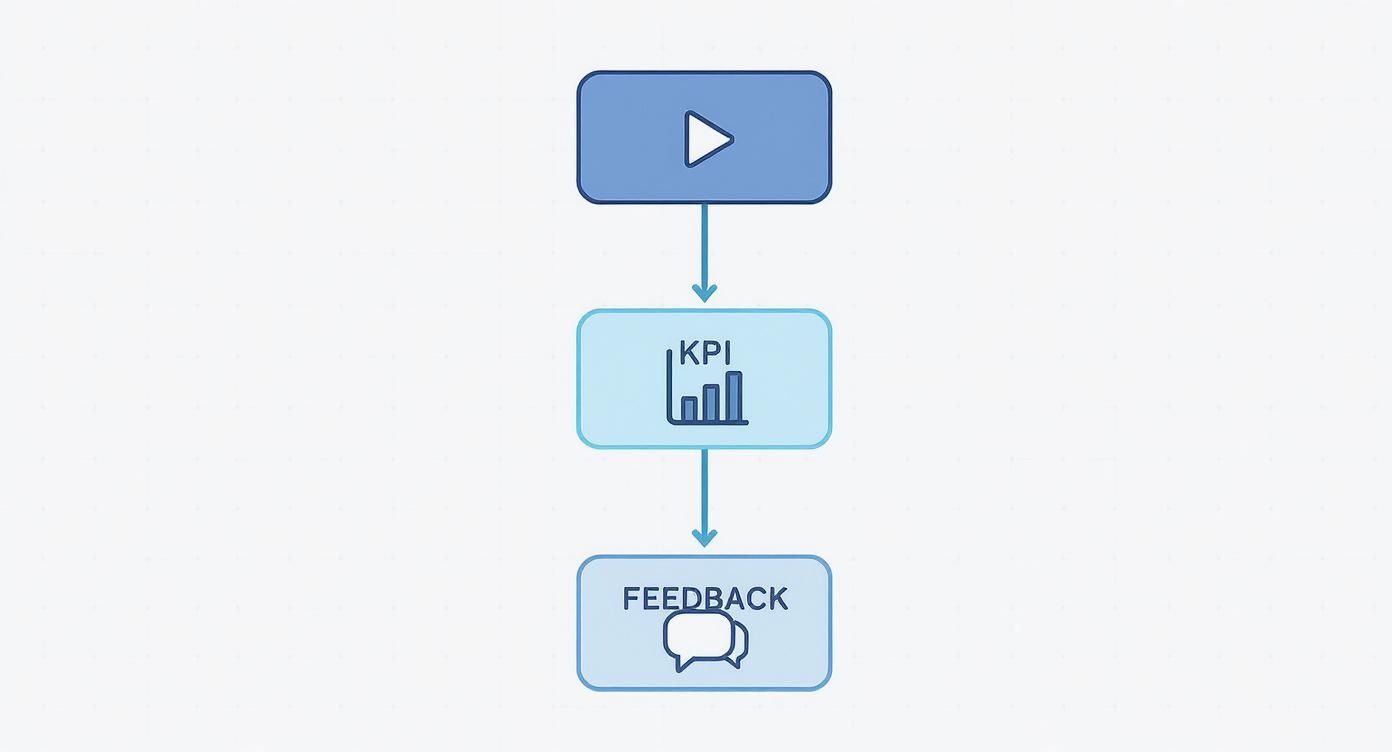
This simple flow reminds us that an effective crisis response is a cycle. You act, you measure the impact, and you gather feedback to refine your communication strategy for the next time—because there’s always a next time.
Still Have Questions? Let’s Clear Things Up
Even with the perfect template in hand, putting a new communication plan into action can feel a bit daunting. Questions always come up. Based on my experience helping teams get this right, here are the answers to the most common hurdles you'll face.
How Often Should We Update Our Communication Plan?
Your communication plan isn't a one-and-done document; it's a living guide. It needs to breathe and change right along with your team and projects.
A good rhythm is to revisit it quarterly or at major project milestones—think kick-offs or the start of a new phase. This keeps it from gathering dust. You should also give it a quick check whenever something big changes, like a shift in project scope, a new key stakeholder coming on board, or a re-org. The whole point is for it to be a useful tool, not a relic.
What’s the Biggest Mistake Teams Make?
Hands down, the biggest mistake is over-engineering the plan. It's so tempting to create a massive, 20-page document that covers every conceivable scenario. The problem? No one will ever read it. An effective plan needs to be simple, scannable, and something a busy team member can glance at and understand in 30 seconds.
Focus on clarity, not comprehensiveness. A simple one-pager that everyone actually uses is infinitely more valuable than a detailed strategy that gets ignored. Nail down your most critical communication flows first, then add more detail later if you really need it.
How Do We Get the Team to Actually Use the New Plan?
This is the million-dollar question, isn't it? The secret is ownership. Don’t just build the plan and drop it on the team. That never works. You'll get real buy-in when you involve them in creating it.
Run a quick workshop. Ask everyone what their biggest communication headaches are right now. Brainstorm solutions together. When people have a hand in building the system, they're far more invested in making it work. Also, be sure to frame it around what’s in it for them: fewer random pings, clearer expectations, and more focused work time. And finally, leaders have to walk the walk. If you want the team to use the plan, you have to use it consistently yourself.
Is a Template Even Useful for Remote Teams?
Absolutely. In fact, for remote or hybrid teams, a solid communication plan template isn't just useful—it's essential. You can't just lean over a desk to ask a quick question, so that informal knowledge sharing is gone. Intentional, structured communication has to fill that void.
A plan creates predictable pathways for information, which helps bridge the physical distance. By clearly defining that Slack is for urgent questions and email is for formal stakeholder updates, you cut through the noise and make sure everyone has the information they need to do their jobs, no matter what time zone they're in.
Imagine a day where you never have to search for information again. No more digging through drives, old emails, or forgotten project docs. With SAI, you can stop the endless hunt. Just ask your question in Slack, and get the answer you and your team are looking for, instantly. Add SAI to a Slack channel for free.